Should You Include References on a Resume?
References don’t go on a resume, not even “References available upon request.” Here’s what to do instead and how to prepare a strong reference sheet.


AUTHOR
Borislav Stojkov
Principal Resume Writer
Borislav Stojkov is a Principal Resume Writer at Toptal Resume. His professional track record includes personally reviewing and rewriting more than 2,000 resumes for professionals across industries. In his direct work with clients and the development of AI-based resume-writing services, he focuses on ATS-optimized structure, modern template design, and recruiter-aligned writing and formatting standards.
You shouldn't include references on your resume, and "References available upon request" is outdated and wastes valuable space. There are situations in the hiring process when a reference sheet should be submitted with your resume, and this article will teach you how to create it.
Why References Don't Belong on a Resume
There are three main reasons why you shouldn't include references on a resume:
- Resume space is limited: Every line on a resume should earn its place and should serve a purpose of demonstrating your job fit. In the early application stage, recruiters don't need to see your references.
- It's a privacy issue: Sharing a referee's contact details when you submit your resume for dozens of applications isn't only a formatting matter, but a privacy concern as well.
- "References available on request" says nothing: Everyone has references available on request, so saying it adds nothing to making your case.
A resume is supposed to be tailored for each job application, and every line in it should represent evidence of your qualifications. If you need help with polishing yours for your next application, Toptal Resume's AI resume builder guides you through the entire process with personalized suggestions and rewrites based on your experience and target role.
Exceptions to the Rule: When References Do Go on the Resume
The table below provides concise guidance on resume references, with exceptions to the rules depending on your specific case.
| Situation | Answer | Rule |
|---|---|---|
| Standard applications for most industry jobs | No | References aren’t needed, and you can prepare a separate reference sheet |
| The job posting explicitly requires including references on the resume | Yes | Follow the instructions from the job posting, as they always override the general rule |
| Writing "References available upon request" | No, in every case | The phrase is universally considered outdated and wastes valuable space |
| CV for academic and research positions | Often expected | Referees are commonly named on a CV (see the CV section below) |
| Federal or government applications | Same rule as the private sector | References are typically not included on the federal resume and are provided separately when requested |
| The application form has a dedicated references field | Yes, fill it in | The rule applies to the resume document, but the required fields in an application form have to be filled in |
Even federal resumes for government positions, which are often perceived as more detailed, follow the same rules as those in the private sector. References belong to a later stage in the selection process, but according to federal resume guidelines, you can optionally include the names of your supervisors as references in the job entries of the work experience section on your resume.
How to Write a Reference Sheet
The table below provides detailed guidance on how to write references in the resume references document and how to format them properly.
| Element | What to Include | Rule |
|---|---|---|
| Document header | Same contact block as in your resume | Ideally, you should match the font, size, and layout so the two documents read as one set |
| Title line | "References" or "Professional References" | One line below the header, no decorative styling |
| Referee name | Full name | Bold or the same style as a job title on the resume |
| Job title | Their current title | Use their current title, not the title they held when you worked together |
| Company | Current employer | If they have moved since you worked together, note this in the relationship line (see below) |
| Phone | Direct line or mobile | Ask which they prefer (a switchboard number isn’t useful) |
| Preferably, their work email | A personal address is fine, but never share an address without permission | |
| Relationship line | One sentence explaining how you worked together, in what capacity, and for how long | This is the field most reference sheets omit, and it makes the reference sheet useful, not just a contact list |
| Number of referees | 3 to 5 is the standard | Three is the minimum for a full picture, while more than five can be overwhelming |
| Order | By relevance to the target role | Start with the most relevant one, as recruiters are more likely to call the first name on the list |
| File format | File name format: Firstname-Lastname-References.pdf | |
| Permission | Confirmed with every referee before sending | Never send a reference sheet without asking the referees |
The important aspect of a reference page for a resume isn't just the content details, but also their relevance for your target job and your relationship with the referee.
How Many References Should You List?
When making a professional reference list, 3 to 5 referees are considered standard for the following reasons:
- 3 to 5 references are the standard that avoids both the impression of incompleteness and overwhelming the reader
- Why not fewer: Listing one or two references can raise unnecessary questions about your network, and doesn't offer a rounded view
- Why not more: More than 5 reads like a filler and can create unnecessary work for recruiters
One practical rule: Always think about relevance and quality, instead of quantity. One strong reference from your manager is more effective than three references from peripheral colleagues.
Who to Ask and Who Not to Ask for a Reference
Before considering how to write professional references to submit for a job application, you should think about who the right person is to ask. Below is quick guidance to help you decide.
Strongest references (ranked by relevance):
- Direct manager. Their opinion is the strongest evidence of your work, and it should be your first choice whenever possible.
- Senior colleague. This is a strong option when a direct manager is unavailable or a strong addition to their reference. Same team or a cross-functional colleague.
- Client or external stakeholder. This kind of credibility is particularly valuable for client-facing or consulting roles.
- Professor or academic supervisor. An appropriate choice for early-career/entry-level jobs or academic roles.
- Volunteering supervisor. This is a valid option for entry-level candidates or those whose most relevant experience comes from volunteer work (e.g., career-changers).
References to avoid:
- Family members or personal friends. They aren't evidence that confirms your professional performance.
- Peripheral colleagues. If a colleague that you barely know can't speak specifically to your work, their reference means nothing.
- Anyone you haven't spoken to recently. A referee who doesn't even remember working with you can't help you make your case.
How to Ask for a Reference and Prepare Your Referee
When asking someone for a reference, you should be short, avoid pressuring them, and always provide some context. To help you achieve that, below are two sample messages that you can use for the initial ask and to give them a heads-up before a recruiter's call.
Initial request:
"Hi [Name],
I'm actively searching for a job, and I'm applying for [describe the type of role(s) you've been applying for]. I'd be very grateful if you'd like to serve as a reference for me. More specifically, someone who can speak to [describe one or two relevant things related to that job they can confirm]. Would you be comfortable with that?
Let me know if you'd like me to share more details about the positions I'm targeting."
Before the call:
"Hi [Name],
I wanted to let you know that I've applied for the [role title] at [company name] and have reached the final stage. As it may include the reference check and the recruiter may reach out to you in the next week or two, I'm sending you my resume and the job description for more context and to provide the full picture."
Also, you can add specific points you'd like them to cover by saying that it would be great if they could mention a specific project or initiative you'd like highlighted, as well as how you handled a specific challenge or task.
To summarize, preparing the referee means sending the following three things:
- Your resume, so they see the same version as the employer, and can speak to the same experience and language.
- The job description, so they fully understand what the employer is looking for, and frame their observations accordingly.
- Points you'd like them to address, but be specific and avoid overwhelming them.
A prepared referee will be of more help to you than a surprised, unprepared one.
Reference Sheet Example
The reference sheet example shown in the image below follows all the advice we've provided so far on how to write and format references for a resume.
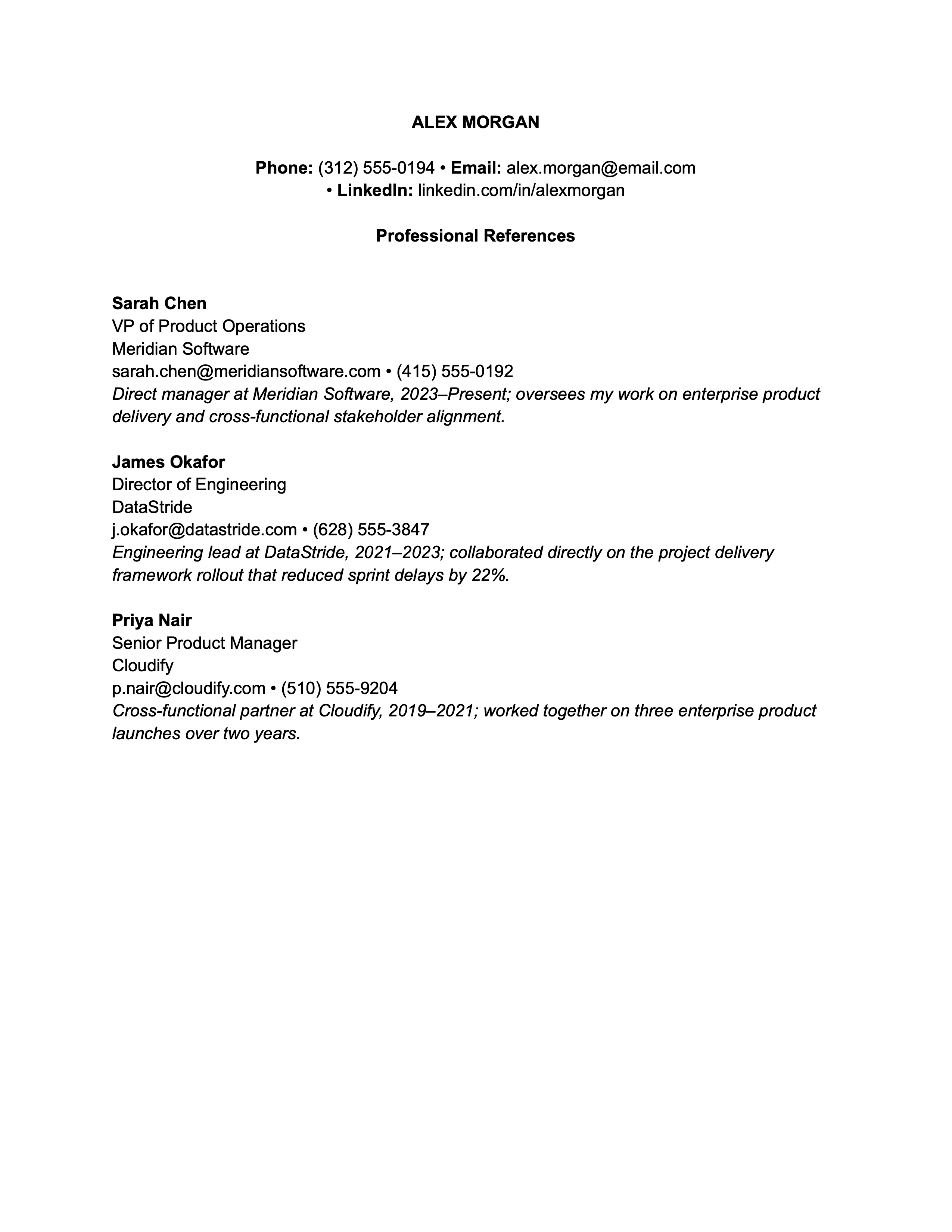
The contact section of the reference page is formatted in the same way as in a standard resume template, followed by the title "Professional References," and the list of referees. What works particularly well here, but is often omitted in practice, is the relationship explained for each referee. These descriptions mention the specific projects and the nature of collaboration between the referee and the candidate.
Downloadable Reference Sheet Templates
You can download the reference sheet template above in Word or PDF format and adapt it for your own referees:
When the Rule Changes: How to Write References on a CV
Academic and research hiring situations are different than standard industry ones, and it's common, even expected, to write references in a CV. Referees are often named in the document itself rather than in a separate reference paper. Typically, two or three academic referees are listed at the end of a CV, with each entry including their name, title, institution, email, and phone number. This is standard practice in the UK and European academic hiring and in the US academic job markets as well.
The reason the rules change is the different contexts and purposes of a resume and a CV. While resumes are tailored, concise application documents that demonstrate your qualifications for a specific job you're applying for, and are adapted for each application, CVs represent your full professional and academic record. In academic, scientific, or research settings, a committee considering an application may contact the references listed on a CV as part of a structured review process. On the other hand, this may be done later in the process.
When Employers Actually Check References
The check of the references included in a resume typically happens in the final phase of the hiring process:
- When they check: Most often, when the final offer is being considered, and all the interviews have been completed successfully.
- What they ask: They usually confirm the dates, titles, and general performance, sometimes with a specific question about the role.
- What they can't ask: In most markets, they are not allowed to ask for protected personal details (such as medical history) or the salary.
What this means for candidates is that the reference check is rarely an elimination round, and it's done to confirm a decision, not to discover new details. Still, a bad choice can hurt your position, so choosing a strong reference is more important than choosing many.
Build Your Resume First
References are the last step in the hiring process, and the first thing that will get you to that stage is the resume. If you need help writing or polishing your resume for your next job application, Toptal's AI resume builder guides you through the entire resume writing process, section by section, with custom content suggestions based on your experience and the role you're applying for.
FAQ
ATS Resume Score Checker
for Professional Roles
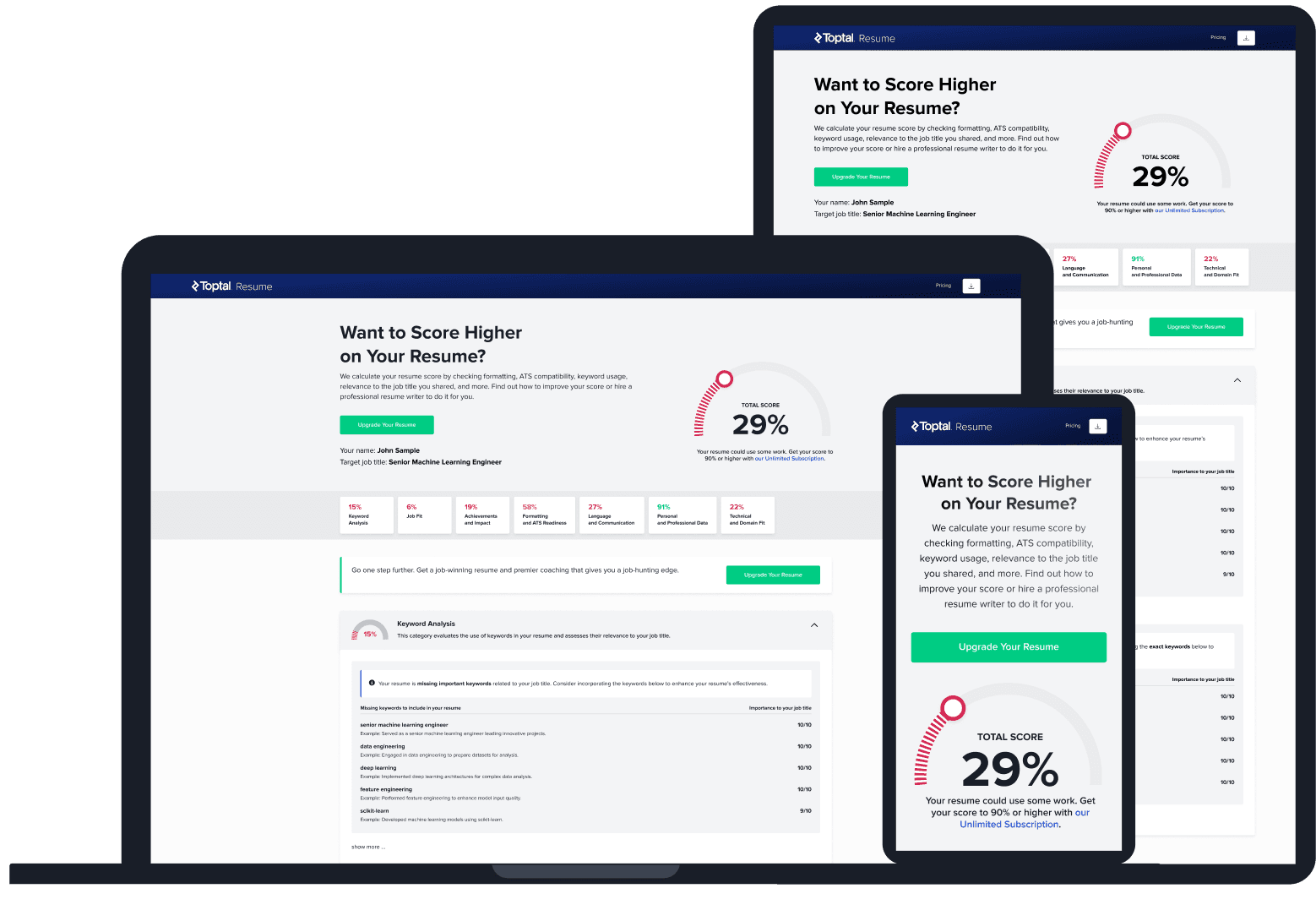
Upload your resume and tell us your target job title. Our system will analyze it the way a recruiter and ATS would—scoring it across core hiring dimensions and giving you personalized, role-specific feedback you can implement right away.
Read Next

Resume Tips
LinkedIn Profile vs. Resume: Key Differences and How to Use Each
A LinkedIn profile and a resume serve different purposes and different audiences. Here’s how each one works and how to manage both effectively.

By Borislav Stojkov
Principal Resume Writer
Borislav Stojkov is a Principal Resume Writer at Toptal Resume. His professional track record includes personally reviewing and rewriting more than 2,000 resumes for professionals across industries. In his direct work with clients and the development of AI-based resume-writing services, he focuses on ATS-optimized structure, modern template design, and recruiter-aligned writing and formatting standards.

Resume Tips
How Far Back Should a Resume Go? The 10–15 Year Rule Explained
For most job seekers, a resume should go back 10 years, extended to 15 only when older experience is directly relevant. Here’s how to decide.
By Borislav Stojkov
Principal Resume Writer
Borislav Stojkov is a Principal Resume Writer at Toptal Resume. His professional track record includes personally reviewing and rewriting more than 2,000 resumes for professionals across industries. In his direct work with clients and the development of AI-based resume-writing services, he focuses on ATS-optimized structure, modern template design, and recruiter-aligned writing and formatting standards.

Resume Tips
Cover Letter Format: How to Structure a Professional Cover Letter
A standard cover letter follows a specific section order, with specific rules and recommendations for length, font, margins, and file format that apply to every application.
By Borislav Stojkov
Principal Resume Writer
Borislav Stojkov is a Principal Resume Writer at Toptal Resume. His professional track record includes personally reviewing and rewriting more than 2,000 resumes for professionals across industries. In his direct work with clients and the development of AI-based resume-writing services, he focuses on ATS-optimized structure, modern template design, and recruiter-aligned writing and formatting standards.