How Far Back Should a Resume Go? The 10–15 Year Rule Explained
For most job seekers, a resume should go back 10 years, extended to 15 only when older experience is directly relevant. Here’s how to decide.


AUTHOR
Borislav Stojkov
Principal Resume Writer
Borislav Stojkov is a Principal Resume Writer at Toptal Resume. His professional track record includes personally reviewing and rewriting more than 2,000 resumes for professionals across industries. In his direct work with clients and the development of AI-based resume-writing services, he focuses on ATS-optimized structure, modern template design, and recruiter-aligned writing and formatting standards.
A resume should go back 10 to 15 years, and in practice, the standard for most job seekers is 10 years, extending to 15 only when older roles are relevant. The main reason is simple: The recruiters and hiring managers want to see your current and relevant experience, rather than what you did two decades ago, when work most likely wasn't the same. There are justified exceptions to this rule, and they will also be discussed in this guide.
Why the Answer Is a Range, Not a Rule
The answer to how many years a resume should go back is often a range, and not a single number, for a few reasons. Listing the last 10 years of experience can be a safe general rule because it keeps your resume current and avoids age discrimination, which is unfortunately not that rare. That said, 15 years can work well when your older jobs are more directly relevant to the one you're applying for, if the older employer is highly regarded, or if it helps give the right context to your career story.
Every hiring situation and every career journey is different, and the general rule is to go 10 years back, and extend to up to 15 years if your older experience really deserves to be included in the resume.
How Many Years Should a Resume Go Back, by Situation
The exact answer depends on your career level and specific situation, and the table below includes all common cases to help you decide quickly how far to go and how many jobs to list on a resume.
| Situation | How Far Back | Rule |
|---|---|---|
| Most job seekers (default) | 10 to 15 years, often including 3 to 6 roles | 10 years is the safe general rule in practice, extending to 15 when older experience is directly relevant |
| Recent graduates and students | Everything relevant to the target job | Include internships, volunteering, and projects, as you need everything relevant you have |
| Candidates with 2 to 15 years of experience | Jobs held after graduation | Leave out student or high school activities unless they are highly relevant to the role |
| Professionals with 15+ years of experience | Fall within the general rule: last 10 to 15 years | Depending on the space consumed, you can compress older relevant roles into a brief "Earlier Experience" section with titles and employers only |
| Executive-level professionals | 10 to 15 years, with exceptions | Significant board roles, major turnarounds, or founding roles can stay even if older |
| Career changer | Go back further if needed | Include even older roles, but only if those are the most relevant ones to your new direction |
| Older experience that matches the job | Include it regardless of the window | In this case, relevance is the priority, and cutting an old job that is the most relevant one is a missed opportunity |
| Employment gaps | Go back further if the full timeline matters | Showing the complete career story sometimes provides context for the gap |
| Many short-term jobs | Keep the 10-year window and focus on the timeline | Focus on the most important roles; very short jobs can be grouped or left out |
| One long-term employer | Include everything, but focus on the most recent and senior stage | A single long role can sometimes cover the whole window, but in such cases, the depth of expertise is good; you can skip or condense the entry-level part |
| A well-known company or impressive title | Keep even if older | Brand recognition can be very effective (for roles at high-profile employers) |
| Government or federal applications | Full career stories are normal, especially for background checks | Federal resume conventions are different, and you should follow USAJobs guidance |
| Academic or research roles (CV) | No limit | A CV is a complete professional and academic record, not a targeted resume |
| Specific industries | Rules vary | Different fields, such as academia, government, and healthcare, can vary, and you should check sector conventions |
The main principle at the heart of all the above cases is to include what is relevant to the role you're targeting and only what will make your application stronger. Consequently, that means that you should tailor your resume for every application. If you need help polishing it to apply for your next job, Toptal's AI resume builder can help you with personalized suggestions and resume-tailoring features for a specific job.
How Many Jobs Should You List on a Resume?
When it comes to how many jobs to list on a resume, those that focus on the most recent and most relevant experience typically list 3 to 6 work experience items. Generally, a larger number can make the resume read more like a career biography than a targeted job application. On the other hand, fewer than three might seem incomplete or thin. That said, entry-level applicants without experience aren't expected to have a rich employment history, so the rule bends depending on the specific situation.
For more experienced professionals, the year count and the job count come down to the same question: what to leave out and what to keep on the resume. Executive resumes can include more diverse positions held, while for others, one or two long-term jobs can provide enough depth. You should always consider relevance when defining your resume strategy.
What to Do With Older Roles: Prior Experience Section
If there are jobs that aren't shown in your work history, that doesn't necessarily mean that they have to disappear entirely from your resume. If you want to show that you've been working longer than the main work experience section shows, you can create a separate block named "Earlier Experience," "Early Work History," or "Prior Experience," where the positions will be listed without any descriptions, like in this example:
Earlier Experience
- Operations Manager, Greenfield Industries (2004–2008)
- Sales Associate, Retail Corp (2001–2004)
Listing the roles, companies, and dates is enough, without making readers go through all the details of a job that is now less central to your career. If a role is still directly relevant and important, it should be included in the main section, regardless of the date.
Dates: Which Ones to Keep and Which to Drop
The dates on your resume naturally indicate your age, and many candidates are unsure which dates to list and which to leave off. The rule varies depending on the resume section:
Employment Dates
The years should always be included when it comes to your work experience items (jobs) because otherwise the recruiter or hiring manager won't have a clear picture of your career timeline. When it comes to months, listing them is optional unless they're required in an online application platform. One practical note: Listing months can reveal gaps in your employment history, and omitting them can avoid unnecessary questions.
Education Dates
Even if your resume lists, for example, the last 12 years of experience, a degree from 20 years ago clearly indicates your age, without adding any value. To avoid any age bias or discrimination, don't include your graduation year. The common practice is to list it only if you graduated in the last 5 years, in which case it gives context to the fact that you don't have a longer track record on your resume.
Age Discrimination: What Trimming Does and Doesn't Do
When considering the right resume format for experienced professionals, we can't ignore the fact that age bias and age discrimination are real concerns. Trimming the resume is the most common advice to avoid it, but not at the expense of showcasing the depth of your experience. This strategy should be analyzed from all angles.
What trimming does first is hide the most obvious indications of age, such as graduation dates or old, less relevant roles from two decades ago. It's a valid and useful strategy, but you still want your resume to demonstrate your background. A resume that covers only the last 10 years of your career, although you started working 30 years ago, should still read as experienced. The goal is not to hide your age, but to present the current, relevant version of a long career.
The best advice you can get is to focus on your recent achievements and on skills that are currently in demand, such as AI or digital tool literacy. Trimming years doesn't, and shouldn't, remove your experience, but direct the reader's attention to the most relevant part of your career.
Special Cases With Different Rules
There are a few exceptions where applicants must list jobs from over 15 years ago:
- Government resumes and security clearance history: Although federal resumes allow omitting irrelevant experience, those jobs also require a background check step with all past employment details. Always check USAJobs guidance.
- Academic CVs: A CV isn't the same as a resume, and it includes your entire career history and is usually submitted for academic, research, and scientific positions.
- Regulated professions: Similar to federal jobs, many legal, financial, or healthcare roles require you to provide all your employment details. Again, your marketing resume (the one that shows qualifications in the first application step) can be tailored to some extent.
Examples of Older Roles That Should Stay
We've already mentioned that relevance is often more important than recency, and here are two examples of what that means in practice.
Example 1: The founding role
A marketing professional is applying for a CMO position, and his experience includes a founding role at a startup from 20 years ago. It shows building the brand from scratch, raising the first round of funding, and leading through the first acquisition. If the same achievements can't be found in the most recent jobs, the old role must stay on the resume, because it is most directly relevant to the target CMO role.
Example 2: The domain expert
A cybersecurity consultant is applying for a job at a financial services company, but his only strong financial services experience is from a job that ended more than 15 years ago, before he moved to the new field. It's clear that the older role is the one that connects all the other experiences to the position he's targeting now, and it shouldn't be left off.
To sum up, here's a general rule of thumb: If removing an older role makes your application weaker, it should definitely stay on your resume.
How Resume Length and Work History Connect
When deciding what to keep and what to trim, your choice will determine whether you use a one-page resume template or a two-page resume format. Here's how the length of work history typically affects the length of a resume:
- A one-page resume is typically used for more junior roles, student resumes, and entry-level resumes. It often includes less than five years of experience.
- Listing jobs from the past 10 to 15 years usually means having a one- to two-page resume for most candidates. Those with a 15-year window should be careful and consider using the condensed "Earlier Experience" section to keep it within two pages.
- Having a three-page resume is rarely a good option for most industry professionals, except for executive resumes or academic CVs.
Career Stage Walkthrough
The table below summarizes how far back a resume should go and what to include in it based on your career level.
| Career Level | Years of Experience | What to Include | Resume Length |
|---|---|---|---|
| Recent graduates | 0 to 2 years | Include everything: internships, volunteering, school projects | One page |
| Early to mid-career professionals | 2 to 15 years | Relevant paid roles held after graduation, with exceptions only if highly relevant | One to two pages |
| Late career | 15+ years | Most recent 10 to 15 years, with earlier and less relevant roles condensed | Two pages are normal |
It's important to add two special cases to the table above:
- Returning after a career break: Go as far back as needed to show your relevant experience. The one- to two-page rule still applies as with any other experienced professional.
- Career changers: You should include older roles if they strengthen your application by demonstrating transferable skills and relevant achievements for the new direction.
Before and After: How to Trim a 25-year History
To show you how trimming older experience works in practice, we can use an example of a supply chain director with 25 years of experience applying for a VP of Operations role. Here's the resume's skeleton before and after trimming:
Before: Full 25-year career history
- Operations Director, CurrentCo (2018–Present), with 5 bullet points as a description
- Supply Chain Manager, PreviousCo (2013–2018), with 4 bullet points as a description
- Logistics Manager, EarlierCo (2009–2013), with 4 bullet points as a description
- Supply Chain Analyst, OlderCo (2005–2009), with 3 bullet points as a description
- Distribution Coordinator, FirstCo (2003–2005), with 3 bullet points as a description
- Warehouse Associate, StartCo (2000–2003), with 2 bullet points as a description
After: Last 15 years + "Earlier Experience"
- Operations Director, CurrentCo (2018–Present), with 5 bullet points as a description
- Supply Chain Manager, PreviousCo (2013–2018), with 4 bullet points as a description
- Logistics Manager, EarlierCo (2009–2013), with 3 bullet points as a description
Earlier Experience
- Supply Chain Analyst, OlderCo (2005–2009), listed without descriptions
- Distribution Coordinator, FirstCo (2003–2005), listed without descriptions
In the "after" version, the oldest, entry-level warehouse role is completely omitted, but even the roles from more than 15 years ago are mentioned because they are somewhat relevant. Not all experience was hidden, but the focus was placed on the most recent and relevant jobs.
Build Your Resume
Deciding how far back to go in your resume is only the first step and the first decision you should make. The second step is to present the right experience effectively by listing the most relevant achievements and qualifications for the target role. Toptal Resume's AI resume builder guides you through the entire process with tailored and role-specific suggestions aligned with your experience and career level.
FAQ
ATS Resume Score Checker
for Professional Roles
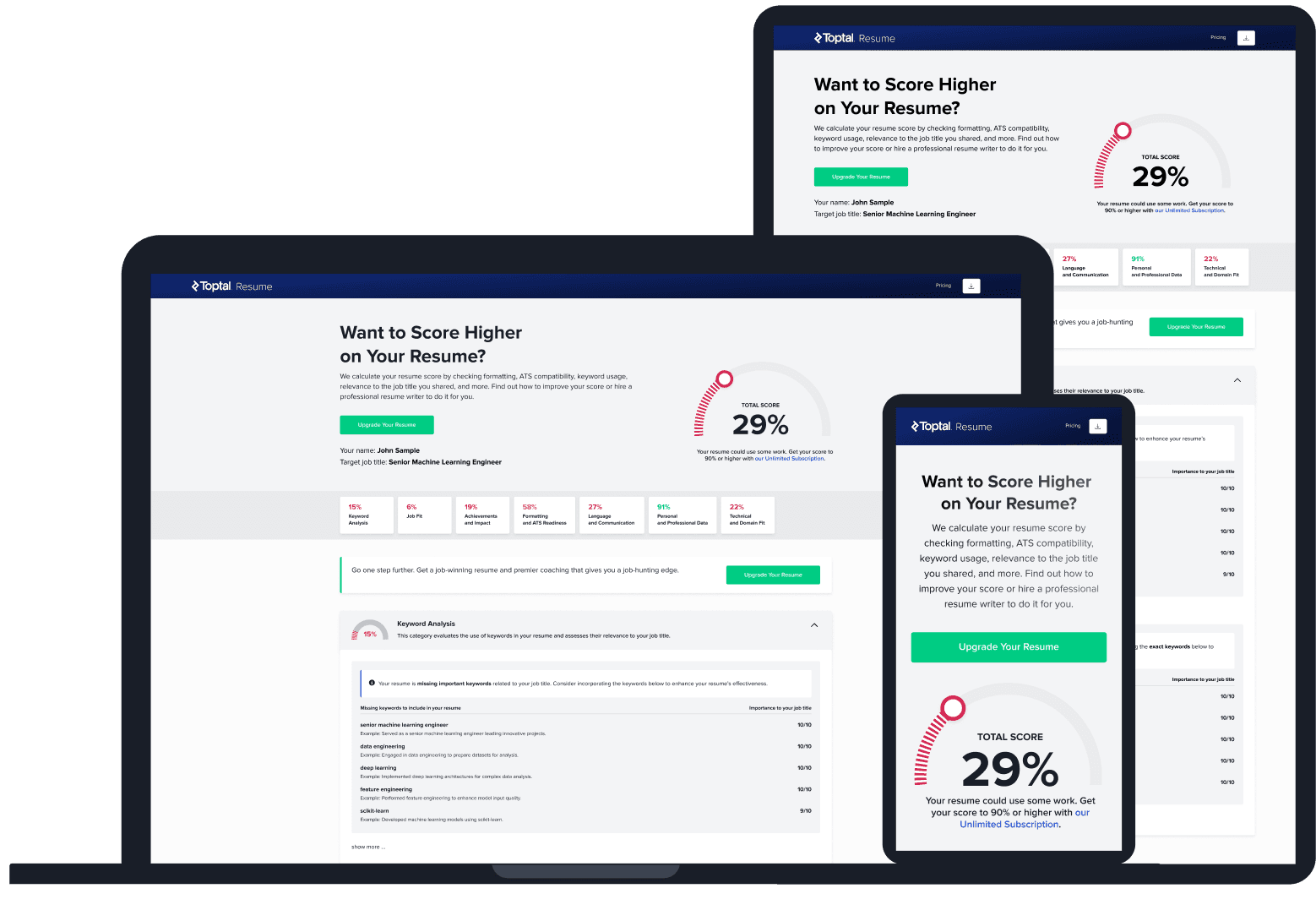
Upload your resume and tell us your target job title. Our system will analyze it the way a recruiter and ATS would—scoring it across core hiring dimensions and giving you personalized, role-specific feedback you can implement right away.
Read Next

Resume Tips
Cover Letter Format: How to Structure a Professional Cover Letter
A standard cover letter follows a specific section order, with specific rules and recommendations for length, font, margins, and file format that apply to every application.

By Borislav Stojkov
Principal Resume Writer
Borislav Stojkov is a Principal Resume Writer at Toptal Resume. His professional track record includes personally reviewing and rewriting more than 2,000 resumes for professionals across industries. In his direct work with clients and the development of AI-based resume-writing services, he focuses on ATS-optimized structure, modern template design, and recruiter-aligned writing and formatting standards.

Resume Tips
How Long Should a Resume Be
Find out how long your resume should be, whether one page is still a good choice, and if two pages or more actually make sense for your experience level.

By Inge Miscevic
Principal Career Coach
Inge Miscevic is a Principal Career Coach at Toptal Resume with over a decade of experience reviewing and improving thousands of resumes across industries. In her work with clients, she focuses on clear resume structure, effective formatting, and content that presents real experience in a way recruiters can quickly understand.

Resume Tips
Executive Resume: What Makes It Different and How to Write One
Executive resumes aren't longer versions of standard resumes. They're built around business impact at scale, a different audience, and strategic language throughout.
By Borislav Stojkov
Principal Resume Writer
Borislav Stojkov is a Principal Resume Writer at Toptal Resume. His professional track record includes personally reviewing and rewriting more than 2,000 resumes for professionals across industries. In his direct work with clients and the development of AI-based resume-writing services, he focuses on ATS-optimized structure, modern template design, and recruiter-aligned writing and formatting standards.