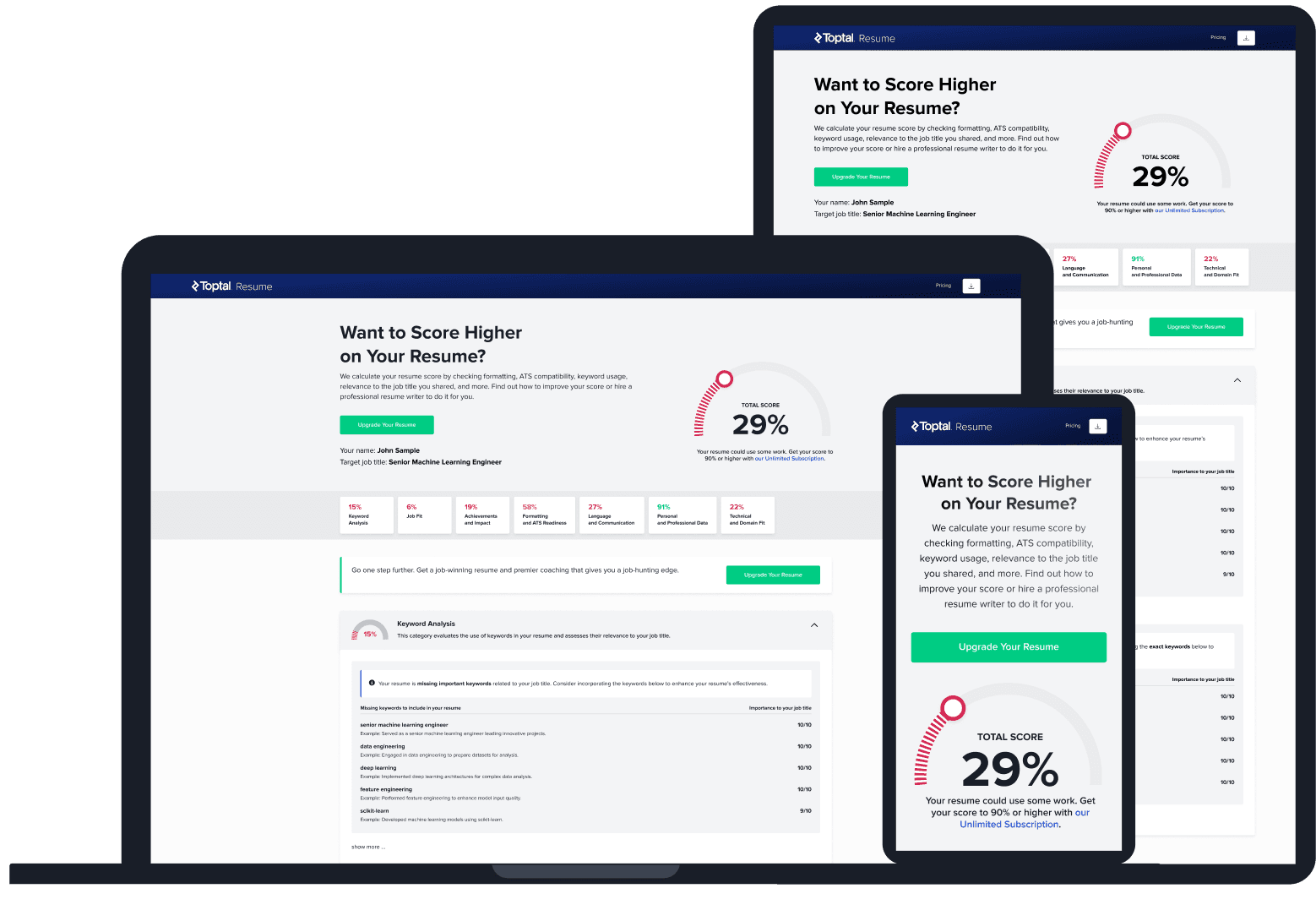
To check whether your current resume is aligned with all the expectations for an executive role, use Toptal Resume's ATS resume checker, which offers in-depth insights for your specific role and seniority level.
Executive Resume Length: Why the One-page Rule Stops Applying
Although advice varies on how long an executive resume should be, the answer is clear and defensible: The standard for an experienced executive-level professional is two pages, with three pages being acceptable for those with board memberships, leadership experience, speaking engagements, and publications. It's not simply about the number of years of experience, which applies to many other roles, but rather about the evidence required to make their case, which takes more space.
The one-page resume rule, often one of the main pieces of resume advice, especially doesn't work for seasoned job seekers with diverse backgrounds, where many details are equally relevant and important. For more junior applicants, this debate is thoroughly covered in our guide on one-page resumes.
Executive resume writing means presenting experience from a strategic perspective. The resume typically starts with a summary that is often titled "Executive Summary," instead of "Professional Summary." It includes a few sentences that state your personal brand, followed by information on the scope (e.g., how large the business is, how many people it employs, or the scale at which it operates). It should clearly connect you with the priorities of the organization you're applying for.
The template structure could be defined as follows:
Leadership identity + Impact + Strategic direction
It almost goes without saying that strong executive resume examples never lead with a resume objective, which is usually recommended only for candidates with little relevant experience or career changers.
Below, you can see two strategic resume summaries from two executive resume samples (for a CEO and a CFO):
CEO with two decades of experience leading technology transformation across $500M+ businesses in three continents. Builds high-performing leadership teams and drives complex transformations across private equity-backed and publicly listed environments, with extensive experience managing boards and diverse stakeholder groups.
CFO with extensive experience raising institutional capital, restructuring P&Ls following M&A, and building scalable finance organizations. Finance leader across SaaS, infrastructure, and professional services, with a track record spanning growth, transformation, and complex stakeholder environments.
If you need assistance with writing a resume summary tailored to any level of seniority, Toptal's AI resume builder offers targeted, AI-assisted rewrites and suggestions.
In strong-performing CEO resume examples, we always talk about using strategic rather than tactical language, and that's what makes it different from, for example, a typical manager resume. To be more specific, here's what counts as evidence of scale in an executive resume bullet points:
- P&L ownership: talk about your work experience related to revenue, margin, and EBITDA
- Headcount: describe the teams you built or organizations you restructured
- Market: market entry, expansion, share movement
- Transformation: digital, operational, or cultural
- Boards and investors: fundraising, M&A, board presentations
- Numbers should back all key achievements
Now, let's see it in practice, by showing the same accomplishments written as a manager and as an executive:
Of course, a strong manager resume example needs to demonstrate clear business results, but in an executive resume, you have to answer the question of what changed in the business because of your decision.
There are some resume sections that are more common for an executive resume format, including:
- Board memberships: list the company name and your role (e.g., non-executive director, independent director, or similar), along with dates.
- Advisory roles: list the company's name and explain your advisory capacity, along with a date range
- Speaking engagements: listing such engagements in any relevant conferences or panels can signal leadership in your field
- Publications: section for books, major articles, or white papers, which can be especially valuable for more academic-adjacent profiles
- Professional affiliations: here, you list industry bodies, professional associations, or committees (not exclusive to executives)
- Awards and recognition: board-level, industry, or peer recognition (also used for standard levels where relevant)
Not every executive resume needs to have all the above sections, but they demonstrate your strategic and leadership background.
Executive resumes often pass through multiple layers of review in the hiring process. The audience list includes four different readers who observe them from different perspectives:
- Applicant tracking systems (ATS) scan for specific keywords and are used for this level as well, especially in large organizations.
- Internal recruiters are the ones looking for a specific fit, even though they might not have deep technical expertise in the field.
- Retained search firms are often the most thorough readers, conducting a comprehensive analysis of the mandate fit.
- Boards and nominating committees are those who determine your strategic and cultural direction at the organizational level.
Based on the above, it's easy to understand why generic resumes don't perform well when it comes to executive positions, and executive resume writing in 2026 requires more specific signals of scope and leadership.
Those specific signals worth naming on an executive resume in 2026 are:
- AI fluency. This isn't about knowing how to use AI tools, but about leading AI strategies and transformations.
- ESG and DEI leadership. Executives are increasingly evaluated based on diversity, equity, and inclusion (DEI), or environmental, social, and governance (ESG) leadership. Make sure to specify outcomes, not just initiatives.
- Geopolitical and supply-chain resilience. Leaders who have experience working with trade disruption or multi-jurisdiction environments are particularly valued in today's business climate.
Writing an executive resume involves multiple layers, both in its content and in how readers assess it.
The specifics described above apply to all executive roles, whether they're CEO resumes, IT executive resumes, or VP-level executive resumes. In the paragraphs below, we'll go through individual executive resume examples to demonstrate the key characteristics and the changes for the five most-searched executive resume types.
CEO Resume
All effective CEO resume examples include the candidate's vision and the transformation they led, from the scale of the business to the results delivered for shareholders, owners, or investors. Their board communication and investor communication are important to emphasize, and the experience should describe their strategic mandate.
CFO Resume
CFO resumes are all about capital and financial architecture: fundraising, mergers and acquisitions (M&A), restructuring, and so on. Their technical certifications and credentials are important, but the primary goal is to showcase P&L scale and the capital outcomes.
COO Resume
The central part of a COO resume is the operational structure at scale. You need to specify the headcount managed, operational transformations (such as supply chain redesigns or post-merger integrations), cross-functional integration, and improved cost structures. Your operational decisions must be linked to business results.
VP Resume
VP-level resumes are somewhere between an executive and a senior manager. The main points are budget sizes, number of people led, and P&L responsibilities. Being directly responsible for revenue and costs will strengthen an executive's resume when demonstrated clearly.
IT & Technology Executive Resume
The key element in all strong-performing IT executive resume examples is demonstrating how technical leadership drives business outcomes. The most important differentiators in 2026 are AI strategy, digital transformation, and technology M&A.
The executive resume example in the images below features a technology executive with a background in digital transformation and P&L ownership. Measurable business outcomes are highlighted right away in the professional summary (sometimes also called executive summary for this level), and specific numbers are listed in each bullet point of the work experience: revenue growth from $42M to $118M, $14M digital transformation, 28% increase in enterprise contract value, and so on.
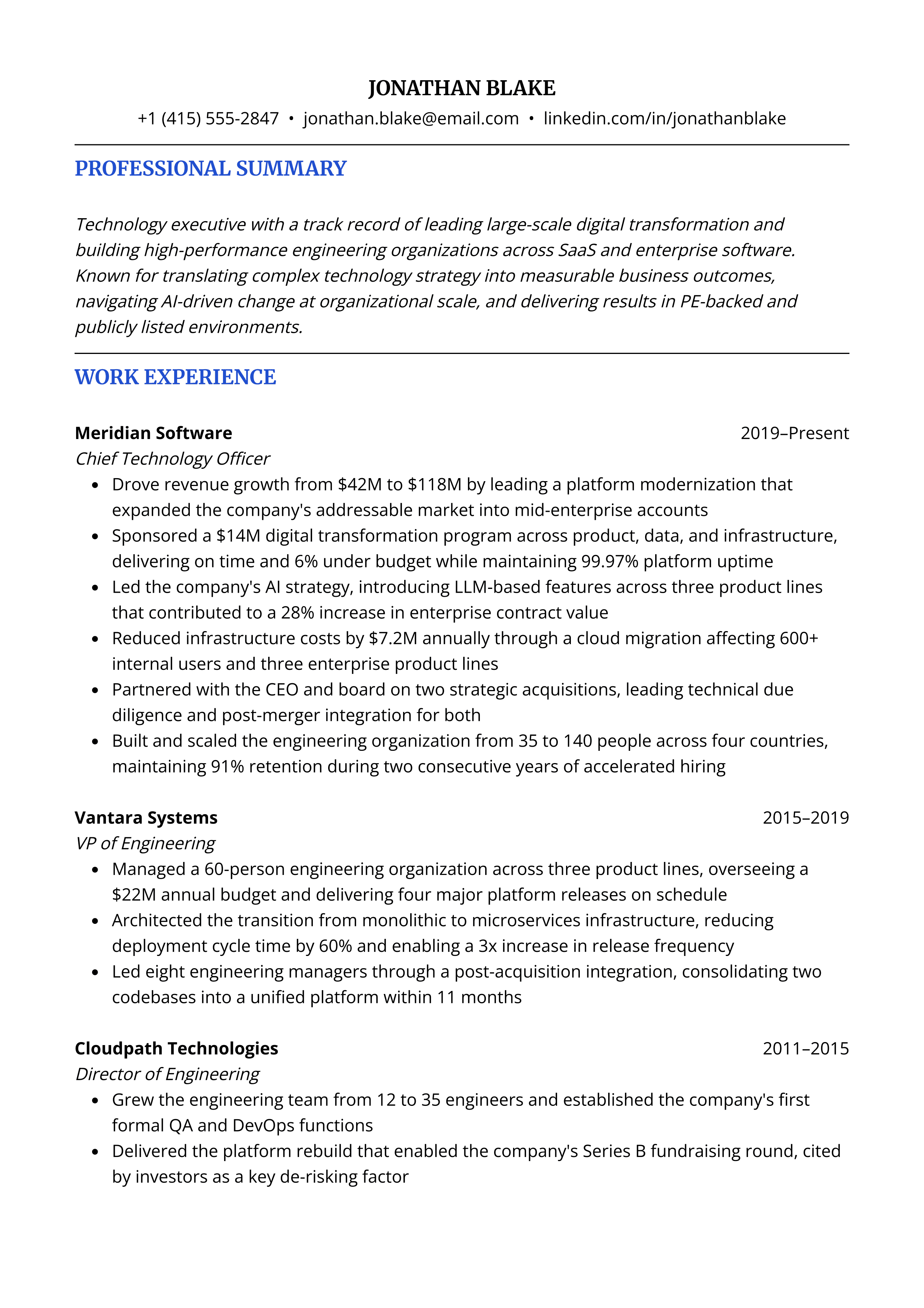
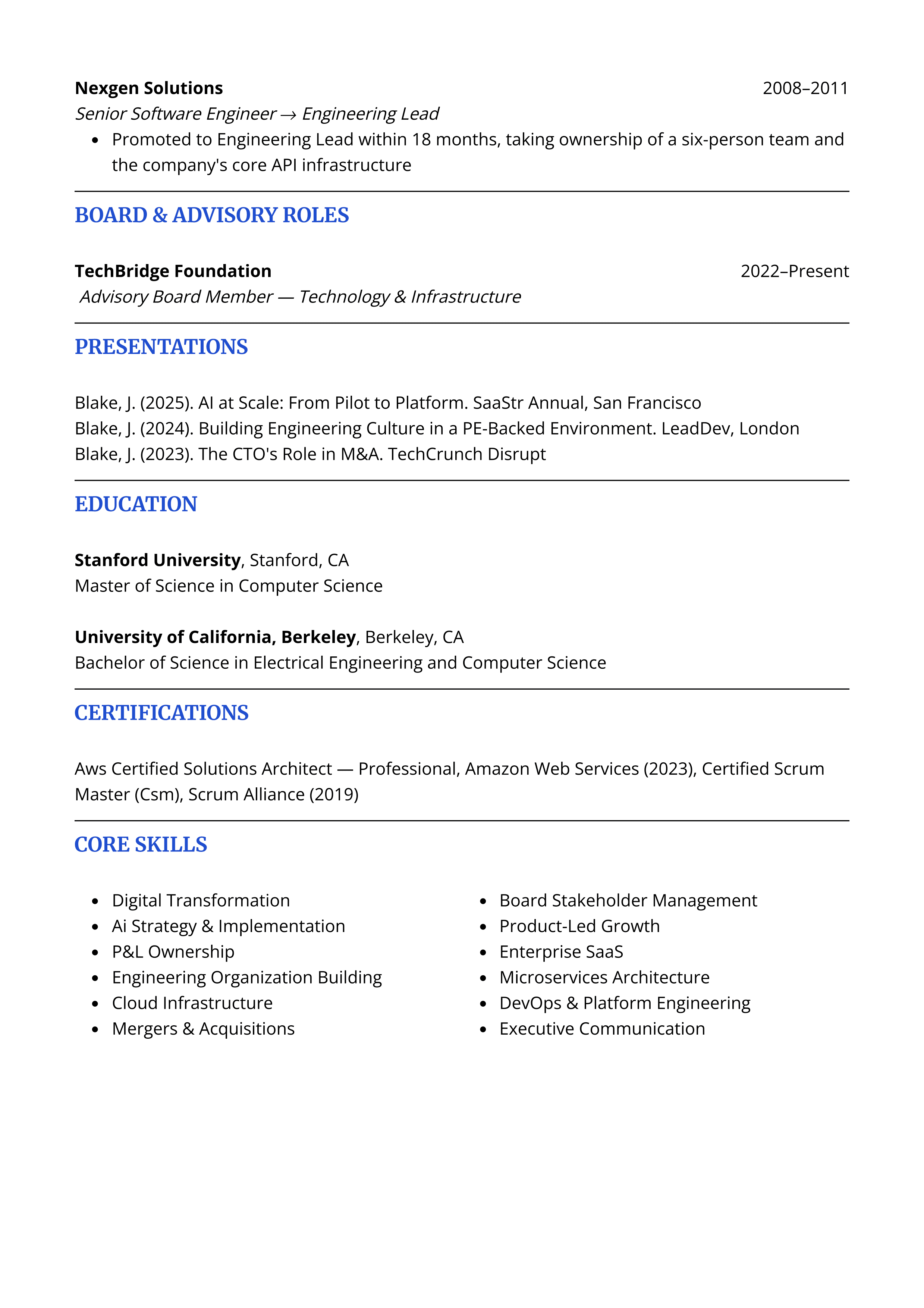
This IT executive resume template also includes additional sections that are not commonly found in standard resumes, such as Board and Advisory Roles ("Advisory Board Member for Technology & Infrastructure") and presentations at industry conferences. The core skills list strategic skills rather than merely technical ones. Also, note that this example spans two full pages, and that is perfectly acceptable and even expected.
You can download this executive resume and use it as a guide or template for creating your own.
The goal of any cover letter is to start a conversation with the targeted company and to introduce the candidate by demonstrating alignment with the company's goals, culture, and job requirements. Executive cover letters aren't structurally different, but the language and tone get more strategic at the executive level.
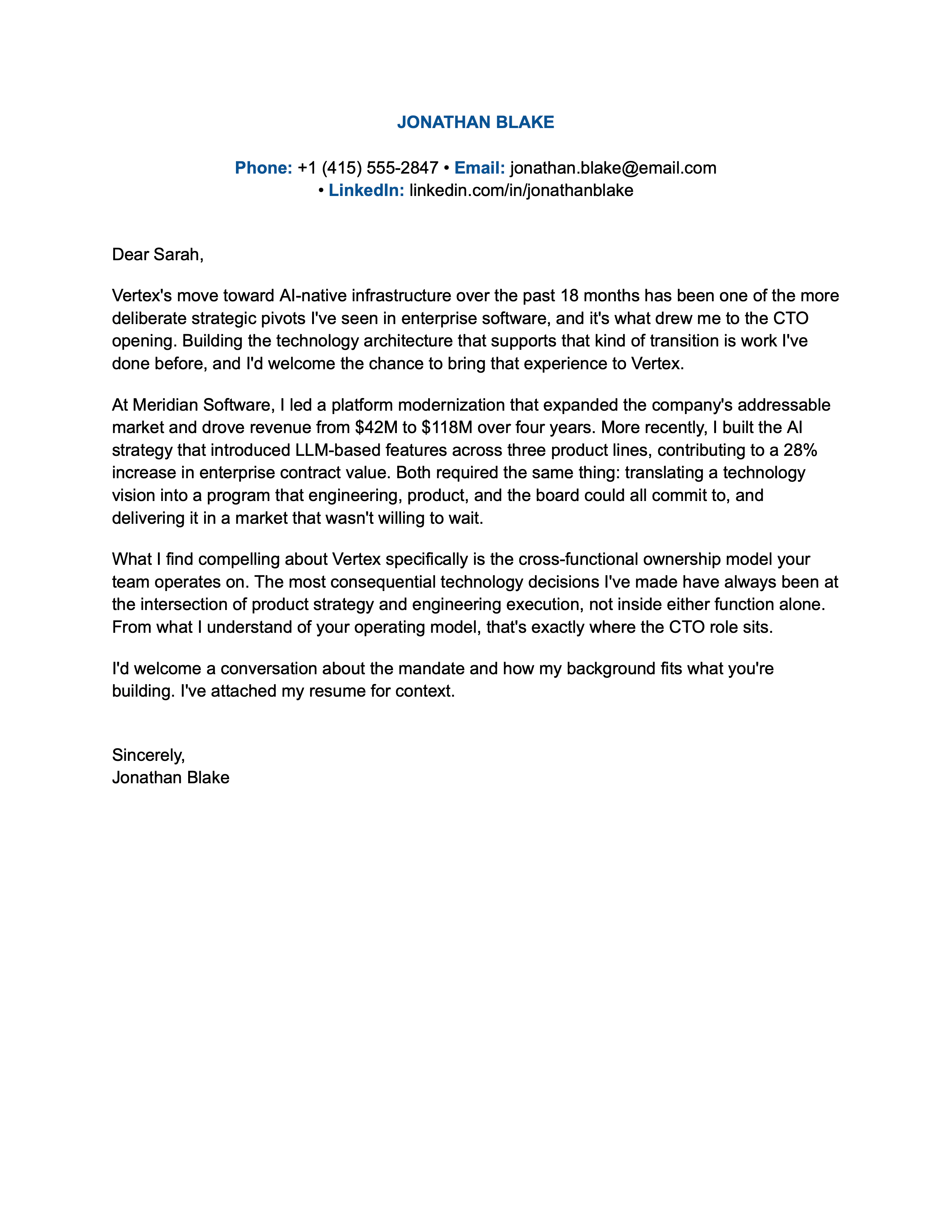
As you can see in the executive cover letter example shown in the image above, written for the IT executive resume example from the previous section, you need to demonstrate your mandate fit (for the CTO opening in this particular example), name one or two strategic achievements, and propose a conversation with the company's leadership.
If you need help, you can take advantage of Toptal Resume’s cover letter generator to write your next executive cover letter, as it creates content tailored to specific roles and seniority levels.
Executive resume writing services require high-level hiring experts and executive resume writers who can present your background through a business narrative that differs from standard resume writing. Toptal Resume's AI resume builder and ATS resume checker are tools built on expertise gained over years of executive resume writing, including an understanding of how executive recruiters and hiring committees evaluate candidates differently from standard recruiters. The builder provides role-specific suggestions tailored for executives, and the ATS resume checker scores your resume against the seniority signals demonstrated on your resume.