For most candidates with relevant experience, a resume summary is the stronger choice, but there are situations where an objective works better.


AUTHOR
Borislav Stojkov
Principal Resume Writer
Borislav Stojkov is a Principal Resume Writer at Toptal Resume. His professional track record includes personally reviewing and rewriting more than 2,000 resumes for professionals across industries. In his direct work with clients and the development of AI-based resume-writing services, he focuses on ATS-optimized structure, modern template design, and recruiter-aligned writing and formatting standards.
The main difference between a resume summary and a resume objective is their goal: While a resume summary highlights what you bring to an employer based on your skills and achievements, a resume objective states your professional goals and aspirations. This scope also affects the length of both, making the professional summary longer than a typical resume objective.
For most candidates with experience and relevant results in the industry they're applying to, a resume summary is often the stronger choice. That said, even though it's often considered outdated, there are hiring situations where a resume objective is a more effective solution and is completely acceptable for entry-level applicants and career changers.
A resume summary, often called a professional summary, is an introductory paragraph near the top of a resume that provides a brief overview of an applicant's professional background. The purpose of this resume section is to highlight your strongest skills and achievements and present a value proposition grounded in work experience. Typically, it's two to four lines long and illustrates what you can offer rather than what you're looking for.
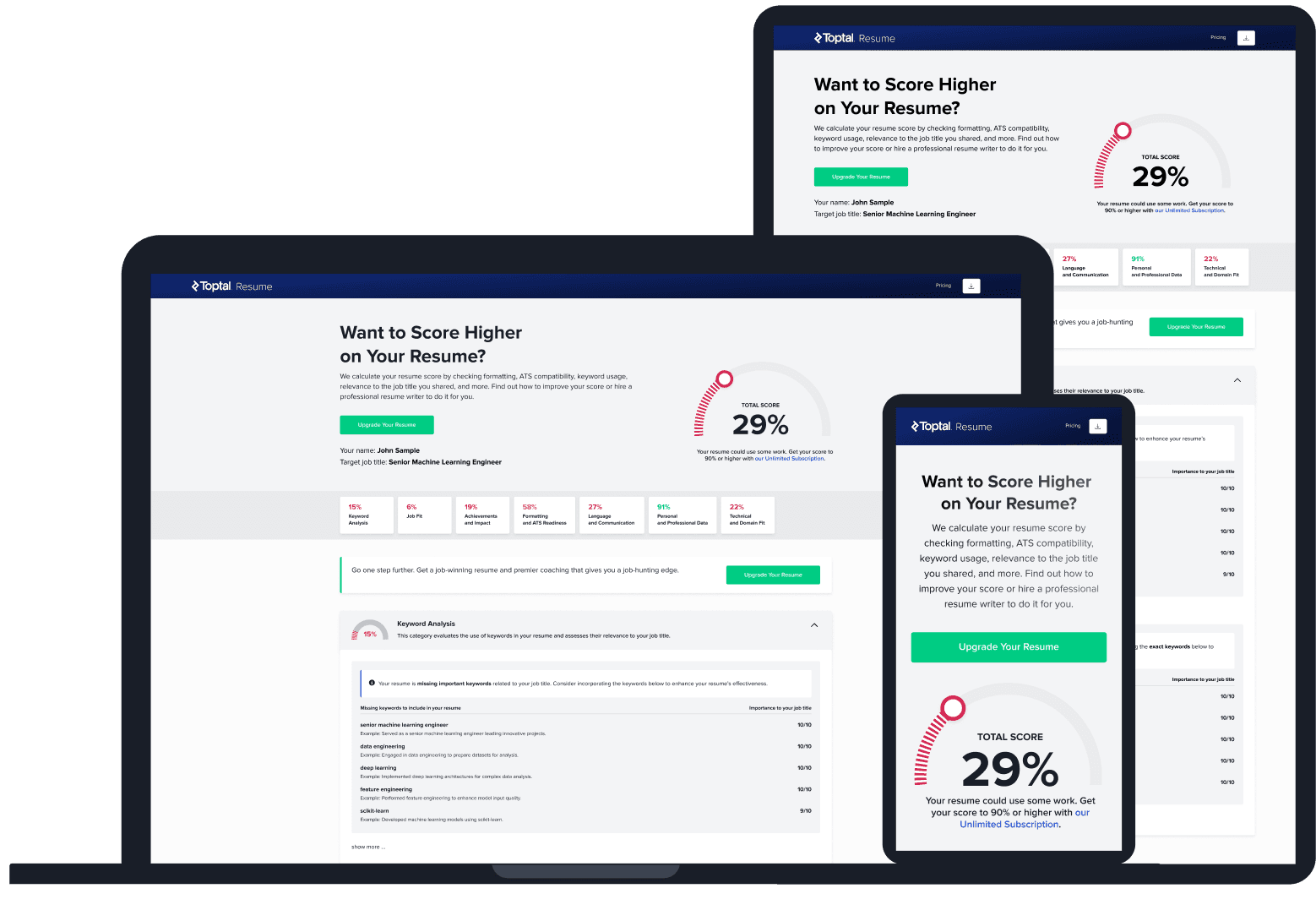
Upload your resume and tell us your target job title. Our system will analyze it the way a recruiter and ATS would—scoring it across core hiring dimensions and giving you personalized, role-specific feedback you can implement right away.
Read Next

Resume Tips
Chronological vs. Functional vs. Combination Resume: Which Format Should You Use?
Learn the differences between chronological, functional, and combination resumes, and which format fits your background best.
By Inge Miscevic
Principal Career Coach
Inge Miscevic is a Principal Career Coach at Toptal Resume with over a decade of experience reviewing and improving thousands of resumes across industries. In her work with clients, she focuses on clear resume structure, effective formatting, and content that presents real experience in a way recruiters can quickly understand.

Tools & Services
Best Resume Builder in 2026: How the Top Resume Builders Compare
Compare the best resume builders of 2026, learn what sets Toptal Resume apart, and find the right tool for your price, features, and career goals.
By Inge Miscevic
Principal Career Coach
Inge Miscevic is a Principal Career Coach at Toptal Resume with over a decade of experience reviewing and improving thousands of resumes across industries. In her work with clients, she focuses on clear resume structure, effective formatting, and content that presents real experience in a way recruiters can quickly understand.
Resume Tips
The Registered Nurse Resume: What Hospitals Actually Screen For
Learn what hospital recruiters actually screen for on a registered nurse resume, from licensure and specialty experience to quantified patient outcomes.
By Inge Miscevic
Principal Career Coach
Inge Miscevic is a Principal Career Coach at Toptal Resume with over a decade of experience reviewing and improving thousands of resumes across industries. In her work with clients, she focuses on clear resume structure, effective formatting, and content that presents real experience in a way recruiters can quickly understand.
A strong resume summary works best in most hiring scenarios, and is the only acceptable choice if you have enough relevant experience for the role you're applying for. In many cases, it starts by introducing yourself as a professional, with the role title. Optionally, you can quantify your experience at the beginning, then list your main qualities and most effective achievements.
It should always be tailored per application and frame your background for that specific role. Having a generic professional summary for all situations isn't a good strategy, as you may miss an opportunity to position yourself effectively right away. That's exactly what we at Toptal Resume kept in mind when developing our AI resume builder, which generates tailored summary suggestions based on your role and experience.
A resume objective is a short statement at the top of your resume, usually one to two sentences, that explains your career goals and what you're seeking in the role you're targeting. Unlike a resume summary, it doesn't focus on your results and track record, but on your professional aspirations. Resume objectives are generally considered outdated, and professional summaries are preferred, but there are still situations where they can be effective.
Entry-level job seekers and recent graduates aren't expected to have experience backed by strong achievements. That's why explaining your objectives can be a good strategy to state your readiness to learn in an environment where you'd be a strong fit. The same applies to career changers and those whose experience doesn't match the target role.
There's one important thing to keep in mind: Making it about your aspirations instead of your past work doesn't mean making it only about you and what you want. Your goals need to be aligned with the needs of your prospective employer. They will choose you because you're a good asset, not to help you materialize your career plans.
The main differences between a resume summary and a resume objective come down to their purpose, length, content, and the candidate they serve best. In the table below, you can find five dimensions of each, to help you determine which one is more suitable for your situation.
| Dimension | Resume Objective | Resume Summary |
|---|---|---|
| Best for | Entry-level roles, career changers, no directly relevant experience | Candidates with relevant experience and achievements |
| Length | One to two sentences | Two to four sentences |
| Focus | Your goals | What you offer |
| Typical content | Target role and any relevant qualifications | Experience, strongest skills, and quantified results |
| When to skip | When you have relevant experience | If you have no relevant experience |
Every hiring situation is specific and unique, and the criteria above can help you assess your position precisely when developing your job application strategy.
If you're unsure when to use a resume objective or if a professional summary suits you better, here's a straightforward guide on when to use each.
When to use a resume summary.
Use a resume summary, or professional summary, if you have previous work experience in the industry you're applying for, and you can highlight your core skills that are directly relevant to the role you're targeting. Also, if your track record includes achievements that demonstrate you're a strong fit for the job, your resume will benefit from having a compelling summary. Remember: a weak and generic summary is worse than no summary at all.
When to use a resume objective.
If you're applying for your first job or you've recently graduated, a resume objective can be a good way to go. It enables you to connect your professional aspiration to the role without overstating your experience. The same applies to career changers, who lack directly relevant experience.
That said, if you've had impressive personal, academic, or any side projects that confirm your skills and results relevant to the target role, the opening section of your resume can also be framed similarly to a professional summary. That brings us to the following conclusion: When in doubt, a well-crafted resume summary is a safer default for all candidates with any kind of relevant experience.
Strong resume summaries, or professional summaries, are always tailored to a specific role, industry, and career level. Below are three typical examples that align with our observations in practice.
Example 1: Experienced professional
Project Manager specializing in enterprise software delivery and infrastructure, with a track record of leading multi-million-dollar initiatives from planning through execution. Experienced in coordinating distributed engineering, product, and business teams, resolving delivery risks early, and turning ambiguous goals into clear execution plans. PMP-certified with extensive experience in Agile environments.
Example 2: Career changer
High school English teacher with 10 years of experience designing instruction, facilitating learning, and coaching diverse groups of 25–30 learners. Improved measurable learning outcomes by 34% through redesigned curriculum and targeted instruction. Now transitioning into corporate Learning & Development, bringing proven strengths in facilitation, communication, curriculum design, and learner engagement.
Example 3: Entry-level candidate
Marketing graduate with hands-on experience managing social media for three local businesses and completing an internship at a regional marketing agency. Skilled in content strategy, paid social, and campaign reporting, with a track record of growing managed social accounts by 40% during the final year of studies.
The examples above clearly show that the decision about whether to include a resume summary or objective doesn't depend solely on the length of experience but on the relevance of an applicant's qualifications. If you can demonstrate that you have skills and results under your belt, say it with an effective professional summary. Notice that each summary is tailored to a specific role and avoids generic phrases. They lead with a role title, follow with relevant skills or a specialty, and close with a measurable achievement or area of impact.
If you need assistance with assessing whether your professional summary is aligned with your target role, you can take advantage of Toptal Resume's ATS resume checker, which evaluates each section of a resume with detailed guidance on how to enhance it.
The same two examples used in the previous section (the entry-level application and the career changer) can also work well for resume objective examples, but without the condition that candidates have directly relevant experience for the role they're targeting. In such cases, a concise resume objective can be enough.
Example 1: Entry-level candidate
Marketing graduate seeking an entry-level digital marketing or content strategy role where training in consumer behavior, campaign analytics, and brand communication can contribute to business growth. Completed a semester-long internship supporting social media campaigns at a regional agency.
Example 2: Career changer
Former high school teacher seeking to transition into an HR role focused on employee relations, people operations, or talent development. Brings five years of experience managing sensitive conversations, coordinating with families and administrators, resolving conflicts, and applying institutional policies consistently.
As illustrated in the examples, a resume objective should always connect your goals to the employer's needs. It's not just about what you want from the job, but why your goals make you a motivated and relevant candidate for that specific role.
Whether you're crafting a resume summary or a resume objective, avoid the following mistakes that we encounter very often in practice:
The difference between a resume summary and a resume objective isn't just a matter of format. It comes down to honestly and realistically assessing where you are in the current phase of your career. It's about what you have to offer to your prospective employer. Whether you're writing a summary or an objective, Toptal's resume builder can help you in the resume-writing process with AI-assisted suggestions tailored to your target role and experience level.