Resume Examples
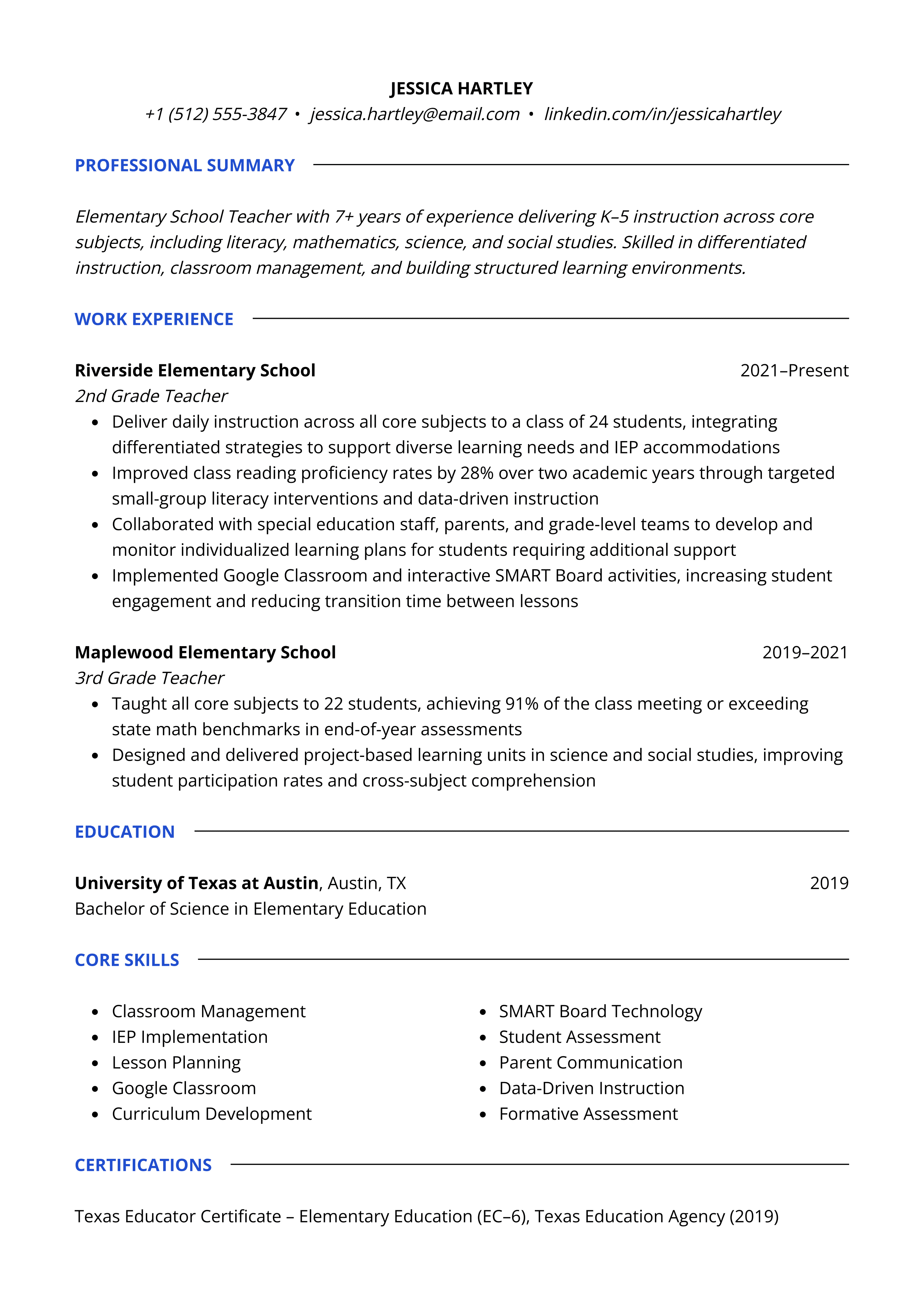
Elementary School Teacher
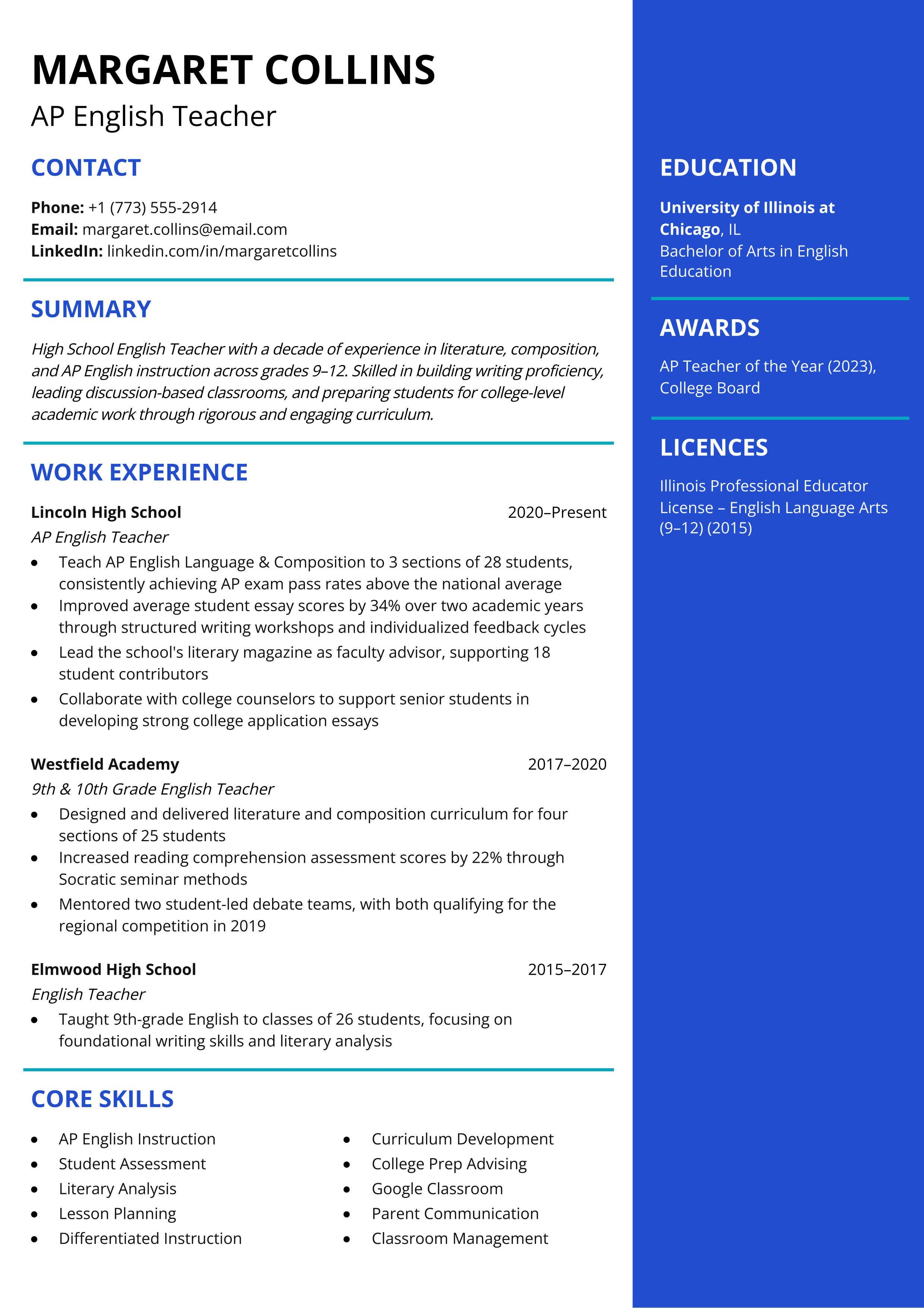
High School English Teacher
Start Your Resume Now
Use our AI resume writer to craft a professional resume that helps you land a job.
Elementary School Teacher
High School English Teacher
Start Your Resume Now
Use our AI resume writer to craft a professional resume that helps you land a job.
What Makes a Strong Teacher Resume?
A strong teacher resume helps a school quickly understand how you work and the difference you make for students. Hiring teams are often reviewing multiple applications at once, so the most effective resumes make key information easy to find.
Instead of focusing only on daily responsibilities, show the full scope of your work. Mention the grades and subjects you teach, the size of your classes, the programs you implemented, and the leadership responsibilities you took on. If you've mentored new teachers, led curriculum projects, coordinated school events, or supported intervention programs, make sure to include these experiences on your resume.
Results are important, but that doesn't always have to mean high test scores. For example, improvements in attendance, student engagement, graduation rates, or participation in school initiatives can all help demonstrate your impact. The goal is to help school leaders picture you in their classrooms as they read through your resume.
Professional Summary for Teachers
Your resume summary has one important goal, and that's leaving an impression that will make a school want to interview you. For experienced teachers, this section is a great opportunity to introduce your teaching background and subject expertise.
For example, if you're a middle school English teacher, you might want to highlight literacy growth and curriculum leadership, while someone who's an elementary teacher could focus on building classroom communities and improving reading outcomes.
If you're a student, recent graduate, career changer, or returning to education after time away, a professional summary can still work well. Focus on your certification status, teaching strengths, and the value you hope to bring to students.
This section has to stay brief, and two to three sentences are usually enough. Hiring teams want a snapshot of who you are as an educator rather than reading your detailed career story.
Key Skills for a Teacher Resume
The skills section should support the experience you've already described in your summary and work experience sections. School leaders want to see a mix of the tools, teaching practices, and classroom strengths you use every day.
Include core teacher competencies such as classroom management, lesson planning, curriculum development, and student assessment. Technical skills may include Google Classroom, Canvas, Schoology, Microsoft Teams, or SMART Board technology. Your interpersonal and soft skills also matter in education, especially parent communication, conflict resolution, and collaboration with special education teams.
Instead of creating a long list, focus on the abilities most relevant to the position. An elementary teacher, a special education teacher, and a high school mathematics teacher will often emphasize different strengths.
- Classroom Management
- Differentiated Instruction
- Curriculum Development
- Lesson Planning
- Student Assessment
- Positive Behavior Intervention & Supports (PBIS)
- Individualized Education Program (IEP) Implementation
- Google Classroom
- Parent Communication
- Data-driven Instruction
Resume Keywords for Teachers
Many schools use software to organize applications before they reach principals or hiring committees. That's why the language you use matters. The strongest keywords usually come directly from the job description, so make sure to review the posting carefully. However, make sure to only include terms related to your real-world experience, certifications, grade levels, curriculum frameworks, and instructional approaches. Keyword examples may include State Academic Standards, PBIS, Response to Intervention (RTI), English Language Learners (ELL), and Performance-based Assessment.
If you use tools such as Google Classroom, Canvas, or Schoology, mention them within your experience instead of just listing them without context. The goal isn't to add keywords for the sake of it. Instead, use the same language schools use when describing the work they need done. When your experience matches the position, that alignment should be easy to see throughout your resume.
- Positive Behavior Intervention & Supports (PBIS)
- Response to Intervention (RTI)
- English Language Learner (ELL) Instruction
- Performance-Based Assessment
- State Academic Standards
- Student Achievement Data
- Professional Learning Communities
- Special Education Collaboration
- Social-emotional Learning (SEL)
- Data-driven Instruction
- Blended Learning
ATS Optimization for Teacher Resumes
Most teacher resumes don't need a complicated design to stand out. In fact, simpler layouts are usually easier for hiring teams and applicant tracking systems (ATS) to review. Use clear section headings, standard fonts, and a straightforward structure.
Your teaching licenses, endorsements, and certifications should be easy to find because they're usually the first qualifications schools look for. It's best to avoid graphics, icons, colorful text boxes, and complex layouts that can cause formatting issues.
It's important to remember that your resume should help readers find information quickly. If a principal can immediately see your certification, grade-level experience, and classroom accomplishments, you're already making their job easier while increasing your chances of getting hired.
Design & Formatting for Teacher Resumes
When it comes to resume design, most schools prefer a clean, professional document they can easily scan. One page is often enough for early-career educators, while experienced teachers with leadership or coaching responsibilities may need two pages.
Choose a simple, readable font like Inter or Arial and keep consistent spacing throughout the document. Clear headings for experience, education, certifications, and skills make it easier for admins to find important information.
Instead of focusing on visual design, it's more helpful to focus on content organization. A well-structured resume leaves a stronger impression than a resume filled with colors, graphics, or decorative elements.
Common Mistakes in Teacher Resumes
- Listing classroom duties without showing student growth, achievement data, or measurable learning outcomes.
- Writing generic statements instead of describing specific programs, subjects, or grade levels taught.
- Leaving certifications and endorsements at the bottom of the resume instead of placing them near the top.
- Adding outdated technology while omitting current tools such as Google Classroom, Canvas, or Schoology.
- Using the same resume for every application instead of matching the requirements of the school and position.
Frequently Asked Questions
Most teachers can fit their experience on one page, while experienced educators may need two. A resume should include only information that supports your candidacy. Your focus should be on your teaching experience, certifications, student achievements, and leadership contributions rather than listing every responsibility from previous roles.