How to Write a Cover Letter That Gets You an Interview
Most cover letters fail not because of formatting, but because they don't answer the three questions every hiring manager is actually asking.

AUTHOR
Borislav Stojkov
Principal Resume Writer
Borislav Stojkov is a Principal Resume Writer at Toptal Resume. His professional track record includes personally reviewing and rewriting more than 2,000 resumes for professionals across industries. In his direct work with clients and the development of AI-based resume-writing services, he focuses on ATS-optimized structure, modern template design, and recruiter-aligned writing and formatting standards.
A cover letter that will get you an interview has to convey to the recruiter or hiring manager a clear picture of why you, why for that specific role, and why for that specific company. Many cover letters fail not because of the formatting, but because they don't answer those questions. An effective cover letter shows your knowledge of the company, your most impressive achievements, and your cultural fit. It stays concise and makes it clear that it's not a generic cover letter used for all applications.
What Companies Actually Look For in a Cover Letter
Before writing your next cover letter, it helps to understand what hiring managers actually look for when they open one. They aren't scanning for all your professional biography details, but the five signals listed and explained in the table below.
| Signal | What It Shows | How to Demonstrate It |
|---|---|---|
| Specific company and role knowledge | Your genuine interest and tailoring, not mass-applying | Mention their mission, a product, or a team detail |
| Quantified relevant achievement | Proof of your impact | Mention an accomplishment relevant to the role |
| Culture fit | Your communication style and team fit | An anecdote or relatable detail (not a list of adjectives) |
| Clear and concise structure | Your respect for the reader’s time | Three to four short paragraphs, without repeating the whole content of your resume |
After summarizing the main aspects of a strong cover letter, the rest of this guide will show you how to incorporate these signals into yours, paragraph by paragraph.
How to Write a Cover Letter: Step by Step
In addition to knowing what hiring managers look for, it's important to learn what to include in a cover letter. The guide below provides more specific cover letter tips and breaks the writing process into clear, straightforward steps.
Step 1: Header
The header of your cover letter should include your contact information: your name, email, phone number, and your LinkedIn profile. Always use a professional email address because you have only one opportunity to make a first impression on the reader. When it comes to design and formatting, it's also a good idea to make the header consistent with your resume style, for a more polished effect.
Step 2: Opening paragraph
After addressing the reader, write a short reference to the company and the role you're applying for in the opening paragraph. That immediately signals you're not sending a generic cover letter for all your applications. If you don't know the recruiter's or hiring manager's name, it's okay to open with "Dear Hiring Team/Manager."
Step 3: Body paragraph 1
The first paragraph of the body of your cover letter should include your most relevant achievement. An impactful detail right away, which is directly relevant to the target role positions you as a strong candidate, and it should mention what you did, why it mattered, and what the result was. It's not a resume bullet point, so you have more liberty in your communication style.
Step 4: Body paragraph 2
The second paragraph of the body is reserved for your culture fit and motivation, so tell a brief anecdote or specific reason why this company and role match your professional direction. Don't demonstrate your soft skills by listing adjectives about yourself, but show how you work and what you value.
Step 5: Closing paragraph
Finally, use the last paragraph of the body to express again your interest in the position and your enthusiasm for the next phase, which is the interview you're hoping for. This is a call to action, and you want the hiring team to make the next move. That said, overly eager expressions, like "I would be thrilled beyond words," could ruin everything you achieved in the previous paragraphs, so keep it professional.
Step 6: Sign-off
Conclude with a simple "Best regards" or "Sincerely," followed by your name. It's a standard, professional way to end a letter, and nothing else is needed.
If you want AI-assisted help drafting each section of your next cover letter, Toptal Resume's cover letter generator walks you through the process and tailors it to your resume and job description.
Cover Letter Example
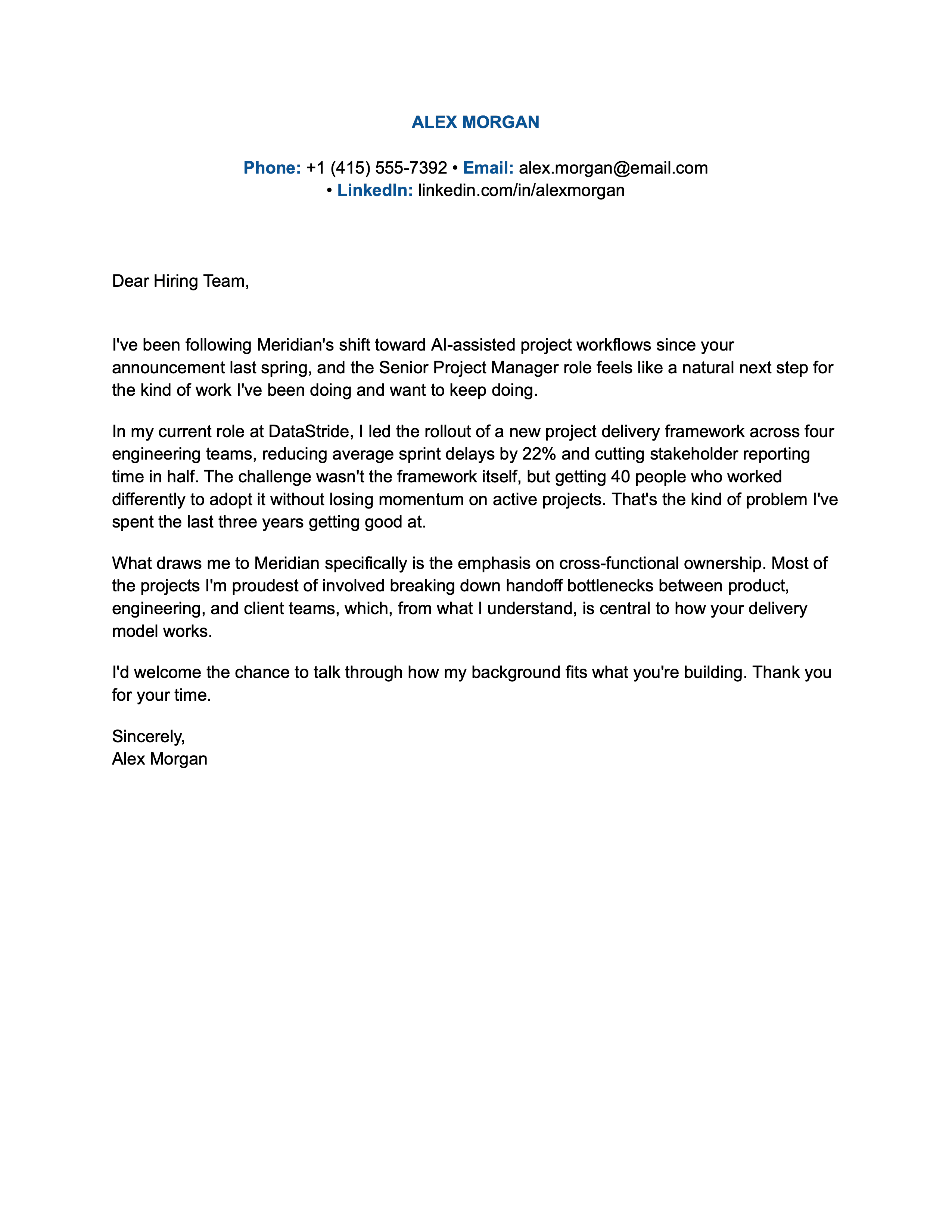
The cover letter example shown in the image below was written for a Project Manager applying to a mid-size SaaS company. The purpose of this example is to demonstrate all the discussed signals companies look for and the specific reasons behind each choice.
As with any strong cover letter, its content stays within one page. Before going into the details of this example, the overall structure illustrates all the above steps: it opens with a clear company reference, then moves to the body with a quantified delivery achievement, and closes with a forward-looking statement that signals genuine interest in the role rather than the job category in general.
Diving deeper into this cover letter's details, here's what particularly works well:
- The opening paragraph of Alex's cover letter references a specific company initiative: its shift towards AI-assisted workflows. This isn't written in generic enthusiasm and serves as the primary tailoring signal to the reader that the letter wasn't mass-sent.
- Moving to the next one, you can see that the first body paragraph in this example includes a relevant achievement with a few supporting metrics: a 22% reduction in sprint delays, 4 engineering teams, 40 stakeholders, and a cut in reporting time in half. His results are written more like a story than as resume bullet points.
- The second body paragraph in this example demonstrates culture fit through a specific professional preference, cross-functional ownership, and it's connected to what the company is known for. As you can see, the fit is shown through alignment, not adjectives.
- The closing paragraph is brief, forward-looking, and confident without being over-eager. It asks for a conversation, not a job.
You can find more tailored cover letter examples in our gallery, which have everything a recruiter needs to see: they're ATS-friendly, keyword-rich, and full of achievements and impact.
Common Mistakes That Get Cover Letters Ignored
Now that we've gone through all the aspects of a strong-performing cover letter, here are the five most often observed mistakes in practice when it comes to cover letter writing:
- Opening with "I'm writing to apply." There's nothing wrong with this wording, but it's a line that recruiters and hiring managers see so often that your cover letter definitely won't sound tailored.
- Repeating the content from your resume. A cover letter is a concise document that tells a story, and shouldn't look like a resume. It has a different purpose, so reading the same thing twice in a different form is a waste of time for the reader.
- Listing personal traits without demonstrating them. Proof of your fit is in the context you provide to the story, and listing adjectives like "dedicated team player with great communication skills" shows nothing.
- Not referencing the targeted company. If you don't mention anything specific about the company you're applying to, it will probably tell the hiring manager that you didn't do your homework and that your interest is low.
- Ending with passive wording. An effective closing is forward-looking and calls them to action. Avoid saying that you hope to hear from them and welcome the chance to discuss how your background fits what they're building.
The best cover letters show how candidates work and think, rather than describing them without a professional context or portraying their past work in detail as a resume does. Whether you're starting from scratch or refining an existing draft of your next cover letter, Toptal Resume's cover letter generator helps you build each section. If you'd also like help with building your resume with AI-assisted suggestions tailored to your role, try Toptal's resume builder.
FAQ
ATS Resume Score Checker
for Professional Roles
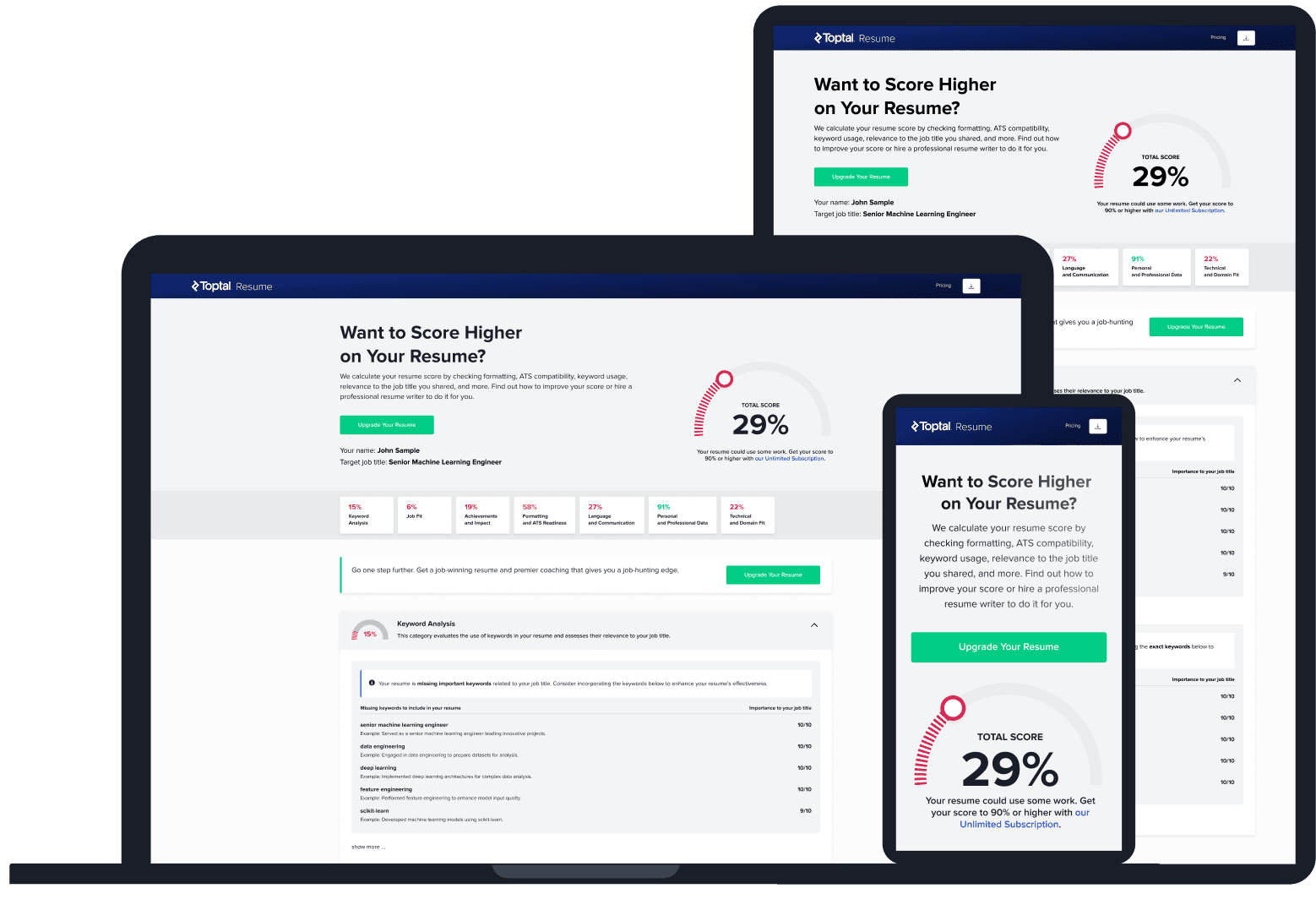
Upload your resume and tell us your target job title. Our system will analyze it the way a recruiter and ATS would—scoring it across core hiring dimensions and giving you personalized, role-specific feedback you can implement right away.
Read Next
Resume Tips
ATS Scores Explained: What is Good and How to Improve Yours
An ATS score is a tool’s estimate, not a pass mark. Here’s how to read yours, what to fix first, and when to stop.

By Borislav Stojkov
Principal Resume Writer
Borislav Stojkov is a Principal Resume Writer at Toptal Resume. His professional track record includes personally reviewing and rewriting more than 2,000 resumes for professionals across industries. In his direct work with clients and the development of AI-based resume-writing services, he focuses on ATS-optimized structure, modern template design, and recruiter-aligned writing and formatting standards.

Resume Tips
ATS-friendly Resumes: Formatting, Examples, and Common Mistakes
A resume that looks polished can still lose information when software reads it. Here’s how to spot the formatting problems and fix them.
By Borislav Stojkov
Principal Resume Writer
Borislav Stojkov is a Principal Resume Writer at Toptal Resume. His professional track record includes personally reviewing and rewriting more than 2,000 resumes for professionals across industries. In his direct work with clients and the development of AI-based resume-writing services, he focuses on ATS-optimized structure, modern template design, and recruiter-aligned writing and formatting standards.
Resume Tips
CV Formats Explained: Examples, Templates, and International Differences
CV format depends on where you’re applying and what type of role it is. Here’s how to identify the right document and adapt it for each context.
By Borislav Stojkov
Principal Resume Writer
Borislav Stojkov is a Principal Resume Writer at Toptal Resume. His professional track record includes personally reviewing and rewriting more than 2,000 resumes for professionals across industries. In his direct work with clients and the development of AI-based resume-writing services, he focuses on ATS-optimized structure, modern template design, and recruiter-aligned writing and formatting standards.