ATS Scores Explained: What is Good and How to Improve Yours
An ATS score is a tool’s estimate, not a pass mark. Here’s how to read yours, what to fix first, and when to stop.

AUTHOR
Borislav Stojkov
Principal Resume Writer
Borislav Stojkov is a Principal Resume Writer at Toptal Resume. His professional track record includes personally reviewing and rewriting more than 2,000 resumes for professionals across industries. In his direct work with clients and the development of AI-based resume-writing services, he focuses on ATS-optimized structure, modern template design, and recruiter-aligned writing and formatting standards.
There's no universal ATS pass score, and an ATS score from one resume checker can differ from another's, as they use different methodologies to analyze a resume, often against a specific job description. Also, the score from an online tool may use different criteria than an employer's hiring system, and no number is a guarantee of an interview. In this guide, we'll show you what ATS score checkers can and cannot tell you, how to implement the results obtained from them to improve your resume, and when further improving it stops being useful.
What Does a Resume ATS Score Actually Measure?
There are different kinds of measurements for ATS scores of resumes, and the table below outlines five aspects of resume analysis based on a tool's purpose and methodology.
| Score/Report Type | What It Can Tell You | What It Cannot Prove | Best Action |
|---|---|---|---|
| Job match score | How a specific resume checker compares your resume with a specific job description | That an employer uses the same evaluation criteria | Focus on the job requirements and the exact target role |
| Parsing or formatting feedback | Whether the tool used detects layout and formatting issues | That every hiring system will process the same document the same way | Check the text extracted from the document and fix the flagged issues |
| Writing or resume content quality score | Whether the language used, clarity, or content effectiveness meets the tool’s criteria | That a high score guarantees you qualify for that specific job | Improve specificity and human readability |
| Employer-side matching and ranking | How one employer’s configured criteria may categorize applicants | That applicants can reproduce that result with a public checker | Meet real job requirements and follow application instructions |
| No visible percentage | Employer-side ATS platforms often manage applicants through specific screening questions, search, or review that don’t include scores as numbers | That there’s a pass/fail percentage | Don’t assume a universal numeric score requirement |
On the employer's side, applicant tracking systems (ATS) and matching tools depend on the criteria set by recruiters and operate differently from public ATS resume checkers. Greenhouse's Talent Matching, for example, is designed as an assistive tool, not to make automated hiring decisions.
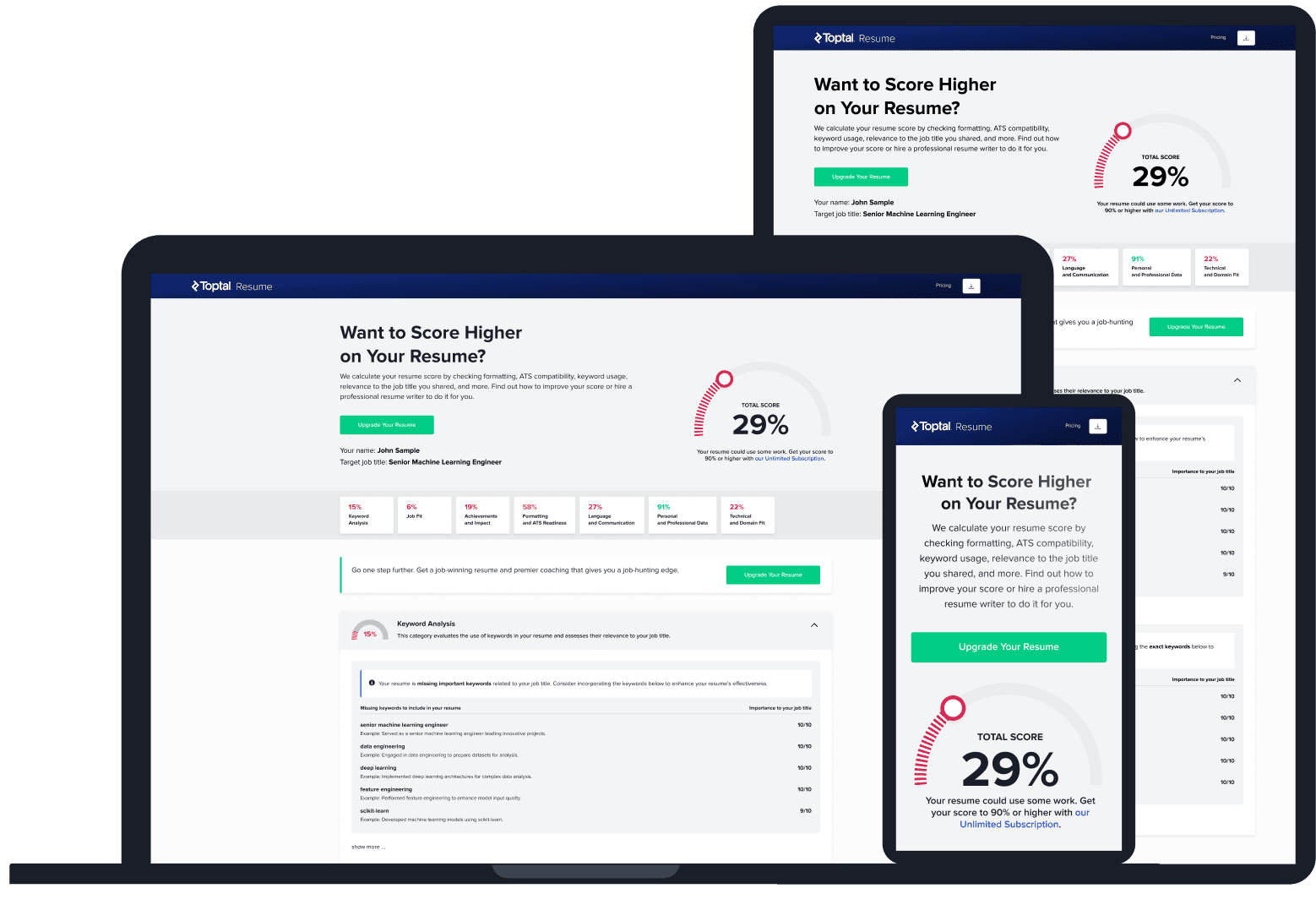
Toptal Resume's ATS resume checker assesses both the technical aspects, meaning the resume's ATS compatibility, and the quality of the content, with specific recommendations to make it both ATS- and recruiter-friendly.
Is 75 or 80 a Good ATS Score?
There's no absolutely good or bad ATS score for resumes because online tools use their own scales and criteria. For example, one ATS resume checker may place greater emphasis on keywords and formatting in its overall score, while another may value achievement-oriented language more. If you run your resume through different ATS score checkers, you'll likely end up with different scores in all of them.
Although certain tools commonly recommend a 75% or 80% threshold based on their methodologies, that's not a universal cutoff. Still, that doesn't mean you can't rely on such tools, as they offer real recommendations based on what they detected. If you get a score below 60%, your resume is most likely underaligned with the job requirements or has real formatting issues. All of that is worth checking before you apply, and, as with all tools, you should rely on your own judgment.
The numbers alone can't tell you how exactly an employer will evaluate your resume, but you can use them as directions and advice on which aspects of your resume you should focus on and potentially improve.
Why ATS Scores Vary Between Tools
A resume's score can significantly vary between different ATS score checkers, and what a good ATS score is depends on different factors:
- Keyword methodology: Some tools search for exact keywords, and, for example, "stakeholder management" and "managing stakeholders" will be scored differently. On the other hand, some tools recognize context, related terms, and synonyms.
- Category weights: One resume checker can calculate one dimension, for example, keyword coverage, as half of the overall score, while for others, it might be only 25% of the total score.
- Job description interpretation: Some resume analysis tools may treat every term in the job requirements as equally important, while others may prioritize certain terms.
- Product logic: Finally, every tool is a proprietary product that has its own logic and purpose. All measurements are legit, but they may be intended to measure different aspects of your resume.
Instead of the numbers, focus on the specific recommendations the tool provides and use them as guidance to improve your resume. Toptal's ATS resume checker offers highlights and recommendations for each category and dimension of your resume analysis: keyword analysis (of both exact and semantically included keywords), domain expertise, experience and achievements, project descriptions, quantifiable results, ATS compatibility, layout and readability, action-oriented language, language professionalism and clarity, and soft skills.
How to Improve Your ATS Score
The five-step method below will show you how to improve the ATS score of your resume and, consequently, tailor your resume for a job application. The goal is to make your resume genuinely stronger, not simply chase a number.
Step 1: Fix Parsing and Formatting Issues
If an ATS score checker flags an issue with your text readability, excessively complex layout, or non-standard fonts or section headings, address those first. If a resume is likely to be poorly processed by an ATS, that's the priority. You can also use one of Toptal Resume's ATS-friendly resume templates, which have been tested with both ATS score checkers and major hiring systems.
Step 2: Add Missing Keywords
ATS reports normally include a list of the keywords that are present in the job description or typically required for your role title that are missing from your resume. Add them wherever possible and only if they truly correspond to your experience. Avoid keyword stuffing, as modern ATS systems can recognize it.
Step 3: Reframe Your Bullet Points
Rewrite the bullet points in your work experience descriptions to emphasize your achievements. Instead of just listing duties and responsibilities, which sound like a job description and not a resume, mention project scopes, team sizes, business outcomes, results, and so on. If you need assistance with your resume content, Toptal Resume's AI resume builder offers you tailored suggestions based on your role title and experience.
Step 4: Check Your Writing Quality
Most resume analysis tools will flag common grammar, language clarity issues, or issues with the effectiveness of your content (such as weak or repeated verbs). Always write to say what you did and what you achieved, using strong, action verbs. Also, avoid vague phrases that could apply to any candidate.
Step 5: Review and Rerun the ATS Checker
Review your resume carefully to ensure every line reads naturally after the updates you've made to it. Otherwise, it might be less effective when it reaches a human reader. Run the resume checker again to check the new resume analysis.
Don't: add skills that you don't have, repeat the same keywords in one bullet point, or invent facts and achievements that aren't true to "please" the resume analysis tool.
ATS Score Report Example, Explained
The table below shows excerpts from a fictional ATS resume analysis report for an operations analyst resume checked against a job description that includes Excel, monthly reporting, stakeholder dashboards, and SQL.
| Sample Report Finding | Resume/Job Context | Recommended Edit | Incorrect Assumptions |
|---|---|---|---|
| The keyword “Excel” is recognized | The resume lists Excel in the skills section, and the job also requests it | Keep the skill and demonstrate how Excel was used (e.g., in reporting) | Mentioning “Excel” alone does all the work |
| Monthly reporting isn’t recognized | Although their reporting work included monthly reports, as required in the job description duties, the candidate wrote “prepared reports” | Clarify accurately by adding recurrence: “Prepared monthly performance reports for leadership” | The original wording doesn’t indicate that the candidate has the skill |
| SQL is missing | The job requests SQL, but the candidate doesn’t mention it, and they have never used it | Leave SQL off and assess whether the job is still a fit (whether SQL is a hard requirement) | Adding a skill that the candidate doesn’t have is acceptable for a higher score |
| An experience date is unreadable | The employer, role, and dates appear detached | Extract the text to verify that all the details related to one experience appear together | A high overall score guarantees that document parsing is correct |
| Impact detail weak | The candidate lists reporting duties without evidence of outcomes | Add specific, measurable outcomes that can be verified | An invented metric improves real job fit |
The important point that applies to all the details shown in the table above is that every update must be truthful, and improving your ATS score just to see a higher number will get you nowhere. ATS resume checkers are designed to help you demonstrate your job fit better, not to misrepresent your actual experience.
When to Stop Optimizing for a Higher ATS Resume Score
There are situations where optimizing your resume to get a higher ATS score simply stops making sense, or it's not needed at that step:
- The missing keywords/skills come from your lack of experience. If you don't have some skills flagged by an ATS score checker, adding them just to have a better ATS score means including false information. Never put skills that you couldn't defend during an interview on your resume.
- You have a good ATS score, but it reads awkwardly. If your resume doesn't read naturally, it might mean it's overoptimized and can be less effective for the recruiter phase.
- You've done the full tailoring pass, and your judgment tells you you've covered everything. If you've verified that the document can be parsed correctly, all the keywords are there, and you've adapted your bullet points to match the job requirements, further optimization can lead to your resume being over-engineered.
Final Checklist Before You Submit
Here's a quick checklist to make sure you've done a good ATS score optimization for your resume:
- All the keywords from the job posting that match your experience have been added.
- All the parsing issues reported by the ATS resume checker you used have been fixed.
- There are no skills you don't have that you couldn't defend during an interview.
- You've reframed a few bullet points to demonstrate the employer's job requirements.
- The document's file format is the one required in the job posting.
Remember, ATS resume checkers can be very useful to provide advice and guidance on what should be improved in your resume. Run your resume through Toptal Resume's ATS resume checker, then follow each section of its report to make your resume more effective for both ATS scanners and human readers in the next step. If you want to make sure you use an ATS-friendly template, Toptal's AI resume builder offers a collection of resume templates that are designed to work well with ATS systems.
FAQ
ATS Resume Score Checker
for Professional Roles
Upload your resume and tell us your target job title. Our system will analyze it the way a recruiter and ATS would—scoring it across core hiring dimensions and giving you personalized, role-specific feedback you can implement right away.
Read Next

Resume Tips
ATS-friendly Resumes: Formatting, Examples, and Common Mistakes
A resume that looks polished can still lose information when software reads it. Here’s how to spot the formatting problems and fix them.

By Borislav Stojkov
Principal Resume Writer
Borislav Stojkov is a Principal Resume Writer at Toptal Resume. His professional track record includes personally reviewing and rewriting more than 2,000 resumes for professionals across industries. In his direct work with clients and the development of AI-based resume-writing services, he focuses on ATS-optimized structure, modern template design, and recruiter-aligned writing and formatting standards.

Resume Tips
CV Formats Explained: Examples, Templates, and International Differences
CV format depends on where you’re applying and what type of role it is. Here’s how to identify the right document and adapt it for each context.
By Borislav Stojkov
Principal Resume Writer
Borislav Stojkov is a Principal Resume Writer at Toptal Resume. His professional track record includes personally reviewing and rewriting more than 2,000 resumes for professionals across industries. In his direct work with clients and the development of AI-based resume-writing services, he focuses on ATS-optimized structure, modern template design, and recruiter-aligned writing and formatting standards.
Resume Tips
Resume Examples: What Makes a Great Resume?
A resume example is most useful when you understand why specific choices were made. Here’s what three real-world examples reveal about strong resume writing.
By Borislav Stojkov
Principal Resume Writer
Borislav Stojkov is a Principal Resume Writer at Toptal Resume. His professional track record includes personally reviewing and rewriting more than 2,000 resumes for professionals across industries. In his direct work with clients and the development of AI-based resume-writing services, he focuses on ATS-optimized structure, modern template design, and recruiter-aligned writing and formatting standards.