The one-page resume rule is still relevant, but only when applied correctly. Here's how to decide what works for your specific situation.

AUTHOR
Borislav Stojkov
Principal Resume Writer
Borislav Stojkov is a Principal Resume Writer at Toptal Resume. His professional track record includes personally reviewing and rewriting more than 2,000 resumes for professionals across industries. In his direct work with clients and the development of AI-based resume-writing services, he focuses on ATS-optimized structure, modern template design, and recruiter-aligned writing and formatting standards.
A one-page resume is the right choice for many candidates in many hiring situations, but it's definitely not a universal rule and a target that everyone should aim for. Accepting the one-page myth as a strict convention, regardless of context, results in barely readable documents that can only harm your application. The real question isn't the number of pages, but whether every line in your resume is justified.
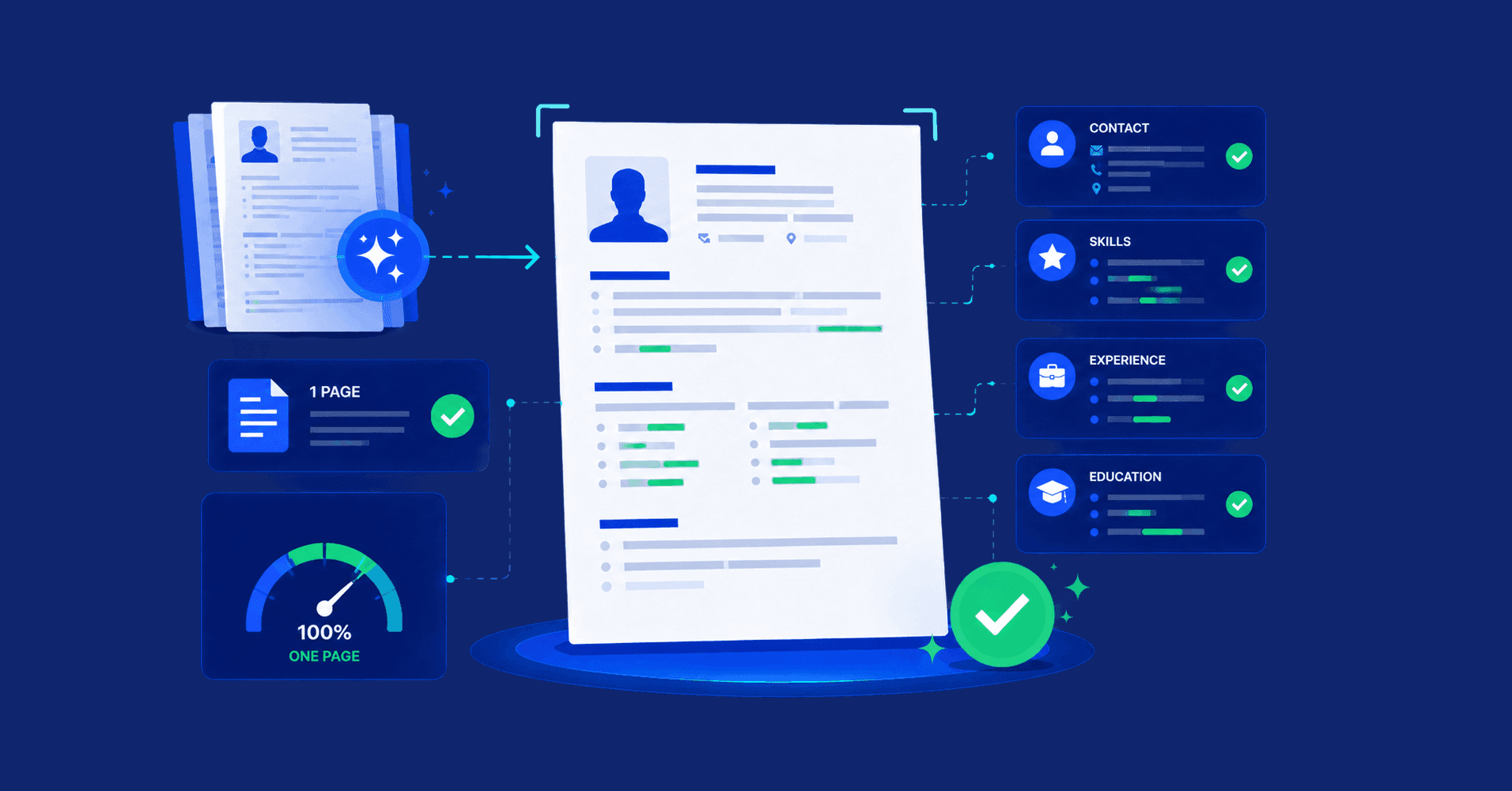
In this article, we'll help you decide which option is the best one for you and your specific situation. We'll provide a clear, practice-confirmed guide on how long a resume should be and which job seekers are not only allowed but also expected to have longer resumes. Finally, if you really need to trim your resume to one page, we'll explain how to do it. If you need additional guidance polishing it, Toptal's AI resume builder shows a real-time preview as you edit your resume, making it easy to see when a bullet or section gets excessively long.
Linking an expected resume length to a certain number of years of experience can be misleading. That number can be a useful starting point, but it's more important to assess realistically what kind of experience the career has included so far. Some guides may say "less than five years of experience means a one-pager."
Upload your resume and tell us your target job title. Our system will analyze it the way a recruiter and ATS would—scoring it across core hiring dimensions and giving you personalized, role-specific feedback you can implement right away.
Read Next

Resume Tips
Chronological vs. Functional vs. Combination Resume: Which Format Should You Use?
Learn the differences between chronological, functional, and combination resumes, and which format fits your background best.
By Inge Miscevic
Principal Career Coach
Inge Miscevic is a Principal Career Coach at Toptal Resume with over a decade of experience reviewing and improving thousands of resumes across industries. In her work with clients, she focuses on clear resume structure, effective formatting, and content that presents real experience in a way recruiters can quickly understand.

Tools & Services
Best Resume Builder in 2026: How the Top Resume Builders Compare
Compare the best resume builders of 2026, learn what sets Toptal Resume apart, and find the right tool for your price, features, and career goals.
By Inge Miscevic
Principal Career Coach
Inge Miscevic is a Principal Career Coach at Toptal Resume with over a decade of experience reviewing and improving thousands of resumes across industries. In her work with clients, she focuses on clear resume structure, effective formatting, and content that presents real experience in a way recruiters can quickly understand.

Resume Tips
The Registered Nurse Resume: What Hospitals Actually Screen For
Learn what hospital recruiters actually screen for on a registered nurse resume, from licensure and specialty experience to quantified patient outcomes.
By Inge Miscevic
Principal Career Coach
Inge Miscevic is a Principal Career Coach at Toptal Resume with over a decade of experience reviewing and improving thousands of resumes across industries. In her work with clients, she focuses on clear resume structure, effective formatting, and content that presents real experience in a way recruiters can quickly understand.
Now, let's imagine a young professional four years into their career who has led teams and delivered multiple products on a few jobs, and ask whether a recruiter would react badly to seeing their resume spill onto a second page. The answer is most likely that they wouldn't, because there's no reason to.
The table below can help you determine what really works best for you.
| Career Stage and Hiring Situation | Recommended Length | Why |
|---|---|---|
| Entry-level or early career candidates | One page | Limited relevant experience that wouldn’t justify a longer resume |
| Mid-career professionals (except academic contexts) | One to two pages | Enough relevant achievements to justify a longer resume |
| Senior professionals and those applying for executive and academic roles | Two or more pages are acceptable | Depth of accomplishments and breadth of experience are expected |
| Career changers | One page is preferred | Prioritizing only what’s relevant to the new direction |
As the table above shows, a one-page resume works for most candidates, but it can't be applied as a rule in all situations. A Senior Manager with 10+ years of experience can have a two-page resume where every detail matters, while those applying for executive roles often have additional experience, such as board membership, community leadership, and so on. Finally, for academic CVs, the length expectations are different, as they need to include a full professional and academic biography.
If you're unsure which category you fall into and how long your resume should be, ask yourself whether every line in your resume makes your application stronger. If the answer is no, your resume is most likely too long, regardless of its current page count.
The debate over whether the one-page resume rule is outdated has been ongoing for quite some time, and even Harvard Kennedy School acknowledges that experienced candidates can exceed one page. The point of those arguing against the strictness of the rule is valid: if you force a person with a 20-year career to fit all their experience into one page, it will most likely result in a poor resume.
That said, the debate can easily be misused to justify a lazy approach to resume writing and editing. It often happens that the candidates who are the first to say the rule is outdated are those who avoid doing the hard work and decide what really matters in their resumes for the role they're applying for.
The honest verdict is that the rule isn't outdated, but incorrectly applied. Indeed, a one-page resume works best for most job seekers, not because of some arbitrary formatting convention, but because many candidates don't have enough relevant content to warrant a two-page resume. What's good about the one-page rule is that it enforces discipline that will benefit both the applicant and the reader. Speaking of the reader, let's not forget an important fact in the hiring world: recruiters spend only seconds scanning resumes.
In our work reviewing thousands of resumes, we've observed that the main problem isn't job seekers having overly long resumes, but rather running long with the wrong content.
There's a common scenario where the question of career length and the relevance of resume content gets even trickier. Imagine a career changer with 15 years of experience, transitioning into a different field. Although it might seem like a situation in which a longer resume is acceptable, we have to keep in mind that most of their history becomes irrelevant, or noise for the reader.
That's why those shifting industries have to play strategically and include only skills and results that are related to the new target. We're not talking about hiding experience, but about positioning. Showing who you are matters, but even more is explaining why you can be a good candidate for the role. A one-page resume will answer that more effectively than a long professional biography.
Another useful tool for telling this story is your cover letter, which explains how your past aligns with what you want to be doing going forward. If you need assistance with drafting a cover letter targeted for your new role, try Toptal Resume's cover letter generator that creates output based on both your resume and job description.
If you've concluded that your resume would benefit from being more concise, you can find below a few straightforward, actionable steps that you can follow to create a strong-performing one-pager.
1. Remove the summary if it's not working
A strong professional summary is a useful section of a resume, but if there's not much to summarize, and it doesn't bring value, you can remove it. It's particularly common among students and recent graduates.
2. Condense older and less relevant roles
Recruiters usually focus on your most recent and relevant experience, so it's perfectly safe to trim jobs from more than 10 years ago, and entirely leave off those from 15 years ago and older.
3. Tighten your bullet points
Wherever possible, without losing effect and important details, reduce two-line bullets to one line. This also improves your writing and forces you to lead with your results rather than bury them in long descriptions.
4. Reduce your skills list
A long list that includes more than 20 skills, especially if they aren't really relevant for the role, can be a significant space consumer and even dilute the overall content of your resume. Create a curated list of 10 to 12 strongest and most relevant skills.
5. Remove all unnecessary sections
In practice, it often happens that candidates add sections that don't strengthen their job applications. To save valuable space (and make your presentation more effective at the same time), remove any outdated certifications, hobbies, or high school education, especially if you have a university degree.
The one-page rule in resume writing is not really about page count or some arbitrary convention. It's about including only what truly matters in your resume to make your presentation more impactful and avoid burying relevant content. If you want to condense your existing resume or build a new one from scratch, Toptal's AI resume builder helps you structure each section with AI-assisted suggestions tailored to your target role and experience level.