The Registered Nurse CV: What UK Hospitals Actually Look For
Learn what UK hospitals look for on a registered nurse CV, from NMC registration and resus training to ward experience and measurable patient outcomes.

AUTHOR
Inge Miscevic
Principal Career Coach
Inge Miscevic is a Principal Career Coach at Toptal Resume with over a decade of experience reviewing and improving thousands of resumes across industries. In her work with clients, she focuses on clear resume structure, effective formatting, and content that presents real experience in a way recruiters can quickly understand.
A registered nurse CV needs to do more than list your clinical experience. Recruiters and ward managers want to see that you're registered with the Nursing and Midwifery Council (NMC), that your experience fits the role, and that you understand the work of the ward or department you're applying to.
That means the strongest nursing CVs tend to put a few things in focus: your NMC registration and training, your clinical specialty and ward experience, the scope of your work, and specific examples of what you've achieved.
This guide walks through what to include on a registered nurse CV, how to present your experience, and what NHS trusts and private hospitals are likely to look for first.
What UK Hospitals Look For on a Registered Nurse CV
A nursing CV has some requirements that don't apply to most other professions. Before a recruiter gets into the details of your work history, they need to know that you're registered to practise and that your background fits the post.
- NMC registration and training: Make your NMC registration easy to find, including your field of practice (adult, children's, mental health, or learning disabilities) and your PIN. Add the training that's relevant to the role, such as resuscitation courses. Registration is one of the first things an employer checks, and they'll confirm it on the NMC register.
- Clinical specialty and ward experience: Hospitals recruit for specific wards, departments, and patient groups. Intensive care, A&E, acute medicine, surgical wards, and theatres aren't interchangeable, so your CV should make your specialty clear.
- Scope and outcomes: The number of patients you looked after, ward size, patient acuity, nurse-in-charge shifts, audits, and quality improvement projects give a recruiter a better sense of what you've actually handled than a list of general duties.
- Electronic patient records (EPR): If you've used Epic, Oracle Health (Cerner), System C CareFlow, Nervecentre, or another system named in the job advert, add it to your CV. Naming the system is more useful than writing "EPR experience."
- Clinical skills and judgement: Communication, teamwork, prioritisation, and working under pressure are all essential in nursing. On a CV, though, they can read as generic soft skills, so it's best to tie them to the clinical work you've done.
Research on nurse staffing has found associations between RN staffing and outcomes, including mortality, length of stay, and other measures of patient care. That doesn’t mean every nursing CV needs to contain statistics, but it does support the importance of showing the impact of your clinical work where you can.
Registered Nurse CV Essentials
Use these five areas as a checklist when reviewing your CV:
| Category | What It Is | Why It Matters |
|---|---|---|
| NMC registration & training | NMC PIN, field of practice, revalidation date, BLS/ILS/ALS, PILS/EPALS, post-registration courses | Shows you're registered to practise and trained for the role |
| Clinical specialty & ward experience | ITU, A&E, acute medicine, surgical wards, theatres, paediatrics, and other relevant settings | Shows whether your experience matches the ward |
| Scope and outcomes | Patient numbers, ward size, acuity, nurse-in-charge shifts, audits, quality improvement projects | Gives context and shows measurable impact |
| EPR and technology | Epic, Oracle Health (Cerner), System C, Nervecentre, and other relevant systems | Often named in job adverts; a quick credibility signal |
| Clinical skills | Communication under pressure, care coordination, triage, patient education | Generic soft skills read as filler; clinical framing reads as practical experience |
You don't need to force every category into every section of your CV. The goal is to make the most relevant information easy to find.
How to List Your NMC Registration and Training
For a registered nurse, your NMC registration is one of the most important pieces of information on the page. Don't make a recruiter hunt for it. Include your field of practice, your NMC PIN, and, if you like, the date your revalidation is due. If you're newly qualified and waiting for your PIN, say so, for example: "NMC registration pending (expected December 2026)."
Then list the training and qualifications that matter for the post. Common examples include:
- Basic Life Support (BLS)
- Immediate Life Support (ILS)
- Advanced Life Support (ALS)
- Paediatric Immediate Life Support (PILS)
- European Paediatric Advanced Life Support (EPALS)
- Post-registration qualifications, such as a critical care course or Manchester Triage System training
Put your registration and training near the top of the CV so a recruiter can find them quickly. Resuscitation certificates need renewing, so include the date you completed them or when they expire, and add courses you're currently completing with an "in progress" note.
If you're building your CV with Toptal CV, you can add your registration and training as dedicated sections and move them higher on the page when they're particularly important for the role.
How to Show Results on a Nursing CV
Writing strong nursing bullet points can be tricky. Not every part of clinical work has an obvious number attached to it, and you shouldn't invent one just to make a bullet sound more impressive. Instead, look for details that show the scale or nature of your work.
- Patient allocation and ward scope: "Cared for level 2 and 3 patients on a 1:1 and 1:2 basis in a 20-bed adult ICU at a major trauma centre" tells the reader more than "provided care to patients."
- Clinical outcomes: If you contributed to an improvement with a measurable result, include it. For example: "Contributed to an 18% reduction in central line infections over 18 months by improving care bundle compliance and leading peer training."
- Process improvements: Changes you made to patient education, documentation, or other ways of working can also show impact. "Introduced a standardised teach-back approach that improved discharge education compliance" gives more context than "educated patients at discharge."
- Leadership and training: If you've supported students as a practice supervisor, guided newly registered nurses through preceptorship, led a quality improvement project, or regularly taken charge of the ward, add it to your bullets. "Supported five newly qualified nurses through their preceptorship" is much stronger than "supported new staff."
You don't need a number in every bullet. A specific detail about the patients you cared for, the setting you worked in, or the responsibility you took on can be just as useful.
If you’re not sure whether your CV gives enough detail about your experience, Toptal's ATS checker can help you review the resume as a whole.
Applying for NHS Roles
Many NHS posts are advertised on NHS Jobs or Trac, and many of them ask you to complete an online application form rather than upload a CV. The form usually includes a supporting statement, where you show how you meet the essential and desirable criteria in the person specification.
Your CV is still worth keeping up to date. You can draw on it when completing application forms, and private hospitals, nursing agencies, and some trusts ask for a CV directly. Whichever route you take, treat the person specification as your checklist, and make sure every essential criterion is covered with a clear example.
Registered Nurse CV Examples
These registered nurse CV examples show two different approaches. The first is a newly qualified nurse applying for their first Band 5 post, and the second is an experienced Band 6 nurse with several years of critical care experience.
Example 1: Newly Qualified Nurse
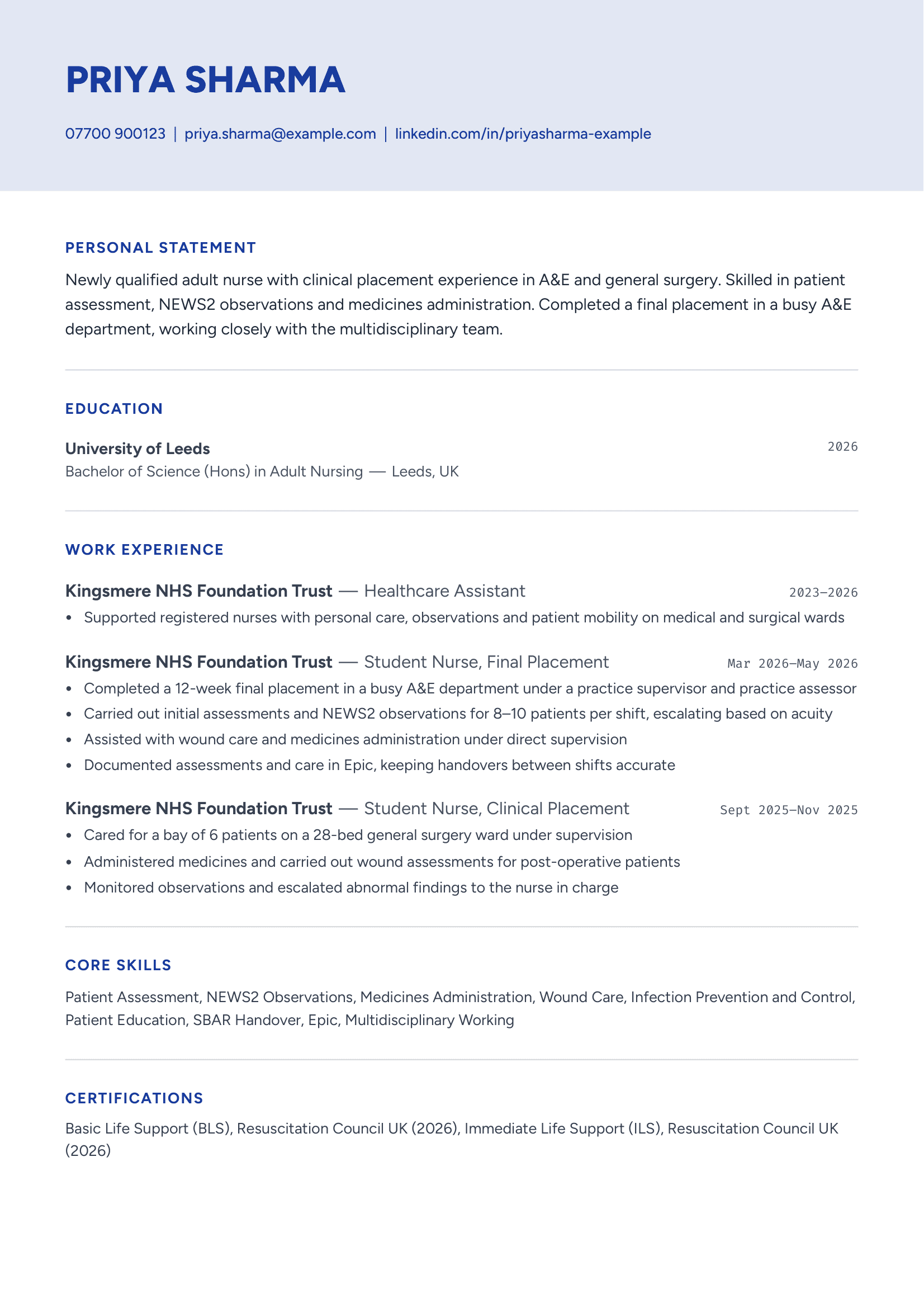
The newly qualified nurse CV example below includes the standard CV sections: contact details, NMC registration, training, personal statement, clinical placements, work experience, skills, and education. The candidate hasn't worked as a registered nurse yet, so their clinical placements are presented like work experience, with details about the setting, ward type, responsibilities, and EPR use. A healthcare assistant role adds paid experience alongside their training.
The CV also puts NMC registration and training near the top and uses the personal statement to establish the candidate's clinical focus. This gives the reader a quick picture of the training and experience the candidate brings to their first registered nurse post.
Here's what works well in this CV example:
- Registration and training near the top. The pending NMC registration, BLS, and ILS show the candidate's eligibility straight away.
- A specific clinical focus in the personal statement. The statement names the candidate's final placement in A&E rather than relying on generic language about being a motivated newly qualified nurse.
- Placements with useful detail. The entries give context about the candidate's clinical training, including the setting, ward type, responsibilities, and EPR use.
- Relevant clinical skills. The skills section focuses on patient assessment, NEWS2 observations, medicines administration, and other practical competencies.
For newly qualified nurse CVs, including placements, training, and hands-on experience shows what you've already learned and practised before your first registered post. If you're writing a CV with no healthcare experience at all, our no-experience CV guide covers how to structure it around transferable skills and training.
Example 2: Experienced ICU Nurse
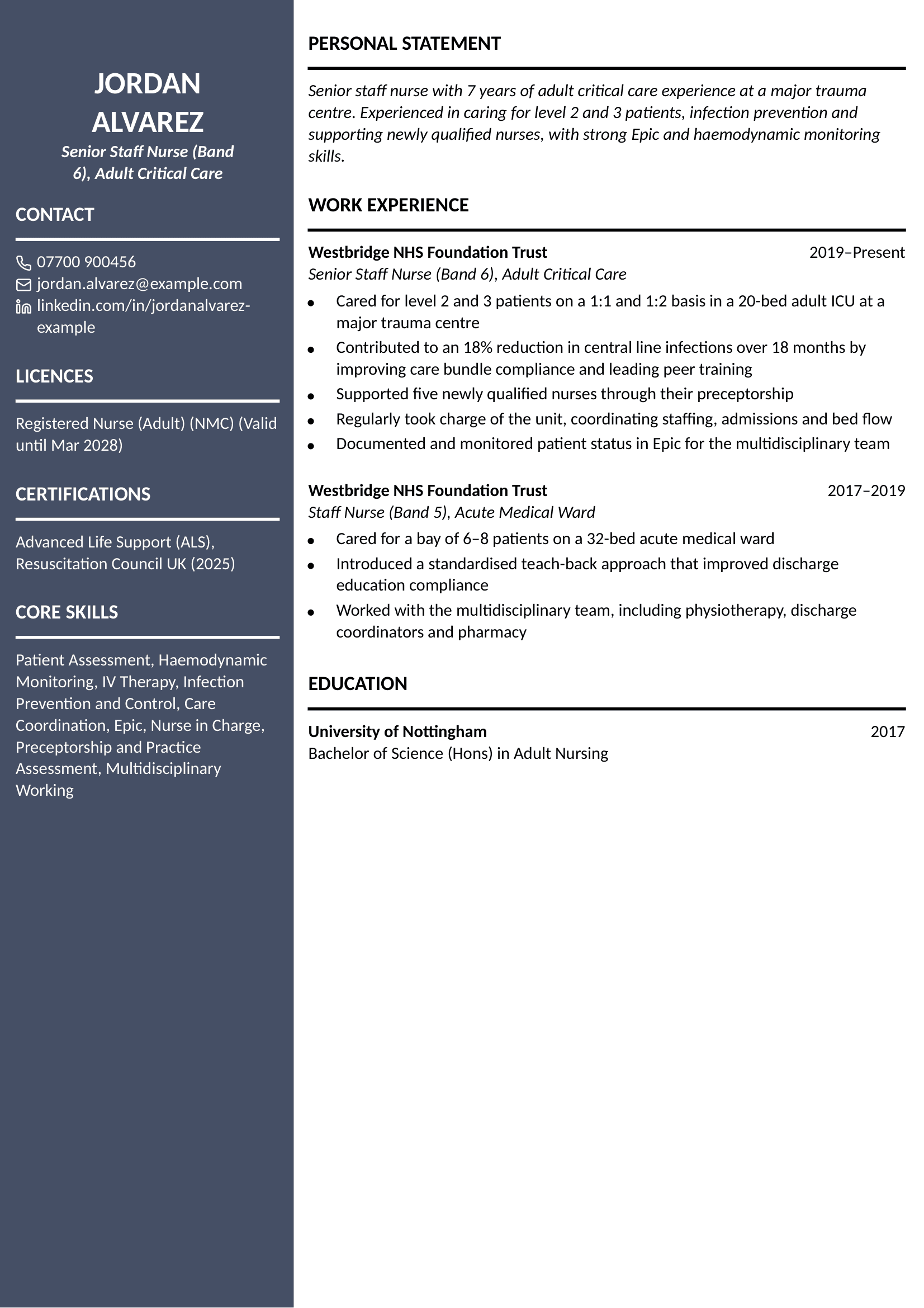
The experienced ICU nurse CV example has a different story to tell. It leads with specialty experience and gives the reader a sense of the nurse's scope and impact before getting into every detail of the work history. The personal statement explains the candidate's critical care background, while the work experience section gives context such as levels of care, unit size, major trauma centre status, and quality improvements.
This example works because:
- The personal statement gives the candidate's ICU specialty, years of experience, and a measurable result in just a few lines.
- The experience section adds context, including levels of care, unit size, major trauma centre status, and responsibilities such as nurse-in-charge shifts.
- The bullets include outcomes and extra responsibilities. Details like the infection reduction and preceptorship support add information beyond routine patient care.
- The specific EPR is named. "Epic" tells the reader more than a general reference to electronic patient records.
- NMC registration appears at the top of the CV. ALS and a post-registration critical care course reinforce the specialty.
The same approach works outside critical care. An A&E CV, for example, should make emergency experience, triage (such as Manchester Triage System training), patient acuity, and relevant training easy to spot. A children's nursing CV should give more weight to paediatric experience and courses such as PILS or EPALS.
Common Mistakes on Registered Nurse CVs
A few issues come up repeatedly on nursing CVs:
- Listing duties without context. "Provided patient care" describes almost every nursing post. Add the ward, patient group, scope, or outcome that makes your experience specific.
- Leaving out registration details. Include your NMC PIN, field of practice, and registration status, plus anything else the employer asks for.
- Burying your training. If ILS, ALS, or a post-registration course is important to the post, don't hide it at the bottom of the page.
- Being vague about your specialty. "Registered nurse" isn't enough to tell a hospital whether you've worked in the setting they're recruiting for. Name the ward and patient group.
- Using the same CV for every role. An ICU application and an A&E application shouldn't necessarily lead with the same experience. Use the job advert and person specification to decide what to move forward.
- Adding personal details UK employers don't need. UK CVs don't usually include a photo, date of birth, or marital status. Contact details are enough.
Build Your Registered Nurse CV
A registered nurse CV isn't the same as a general office CV, and much generic advice misses what recruiters and ward managers actually look for. Make your NMC registration easy to find, show what kind of nursing you've actually done, and give enough detail for the reader to understand the scope of your work. Toptal's AI CV maker guides you through each section with AI-assisted suggestions tailored to your role and experience level, and the ATS CV checker can review your resume before you apply.
FAQ
ATS CV Score Checker
for Professional Roles
Upload your CV and tell us your target job title. Our system will analyse it the way a recruiter and ATS would—scoring it across core hiring dimensions and giving you personalised, role-specific feedback you can implement right away.
Read Next

CV Tips
The No-experience CV: How to Land Your First Job
A guide to writing your first CV using coursework, projects, and other experience you already have.
Recruiter Insights
Why Most Tech CVs Fail: Target Role Misalignment
Many tech CVs get rejected due to poor alignment with target roles. Learn how to write a CV that matches applicant tracking systems (ATS) expectations and recruiter priorities, with practical CV writing tips you can apply right away.

By Tracie Close
Job Search & Career Strategist
Tracie Close is a job search and career strategist specialising in job search optimisation, CV writing, and employer branding. With more than 16 years of experience supporting recruiters, HR teams, and job seekers, she brings deep insights into hiring practices and applicant tracking systems (ATS). She holds a Bachelor of Arts in Communications and Writing Arts from Rowan University and has led digital strategy projects for global tech firms.

Tools & Services
What Is an ATS CV Checker—and How Can It Help You Improve Your Tech CV?
An ATS CV checker can spot missing keywords, poor formatting, and vague descriptions before tech recruiters see your CV. Learn how to use these tools to refine your CV, improve your ATS score, and land interviews at top tech companies.
By Tracie Close
Job Search & Career Strategist
Tracie Close is a job search and career strategist specialising in job search optimisation, CV writing, and employer branding. With more than 16 years of experience supporting recruiters, HR teams, and job seekers, she brings deep insights into hiring practices and applicant tracking systems (ATS). She holds a Bachelor of Arts in Communications and Writing Arts from Rowan University and has led digital strategy projects for global tech firms.