Resume Examples
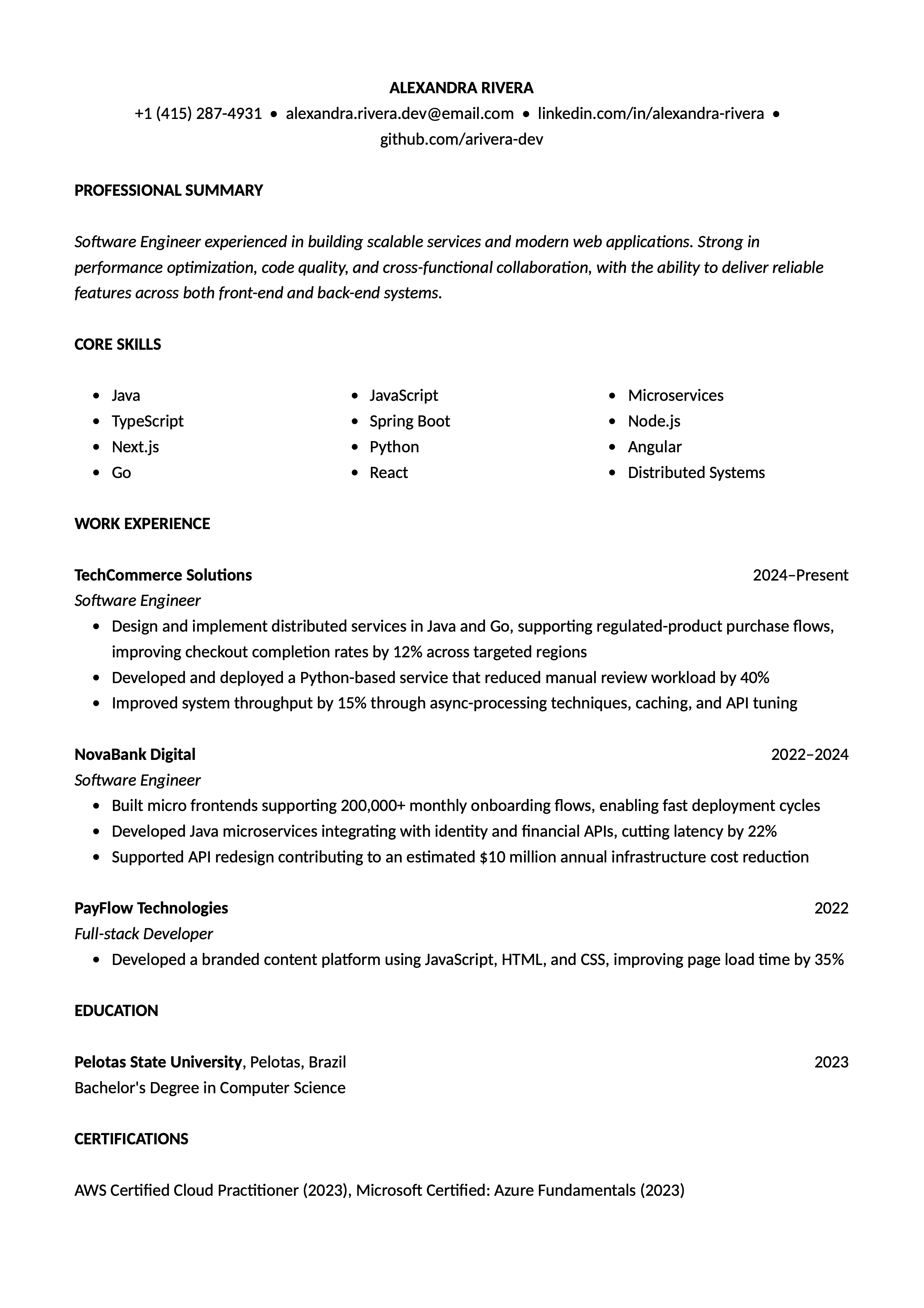
Software Engineer
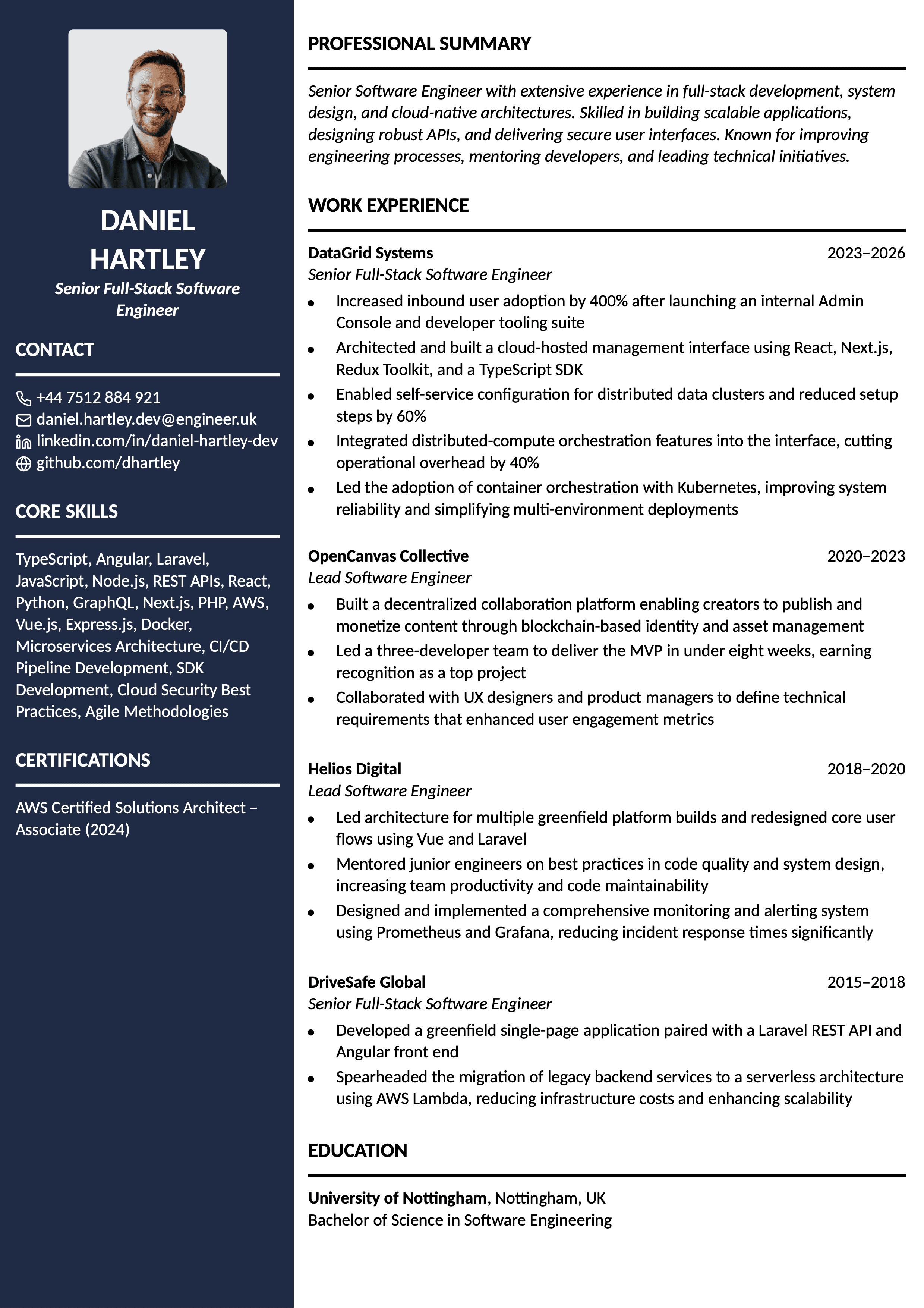
Senior Software Engineer
Start Your Resume Now
Use our AI resume writer to craft a professional resume that helps you land a job.
Software Engineer
Senior Software Engineer
Start Your Resume Now
Use our AI resume writer to craft a professional resume that helps you land a job.
What Makes a Strong Engineering Resume?
A strong engineering resume clearly shows your technical expertise, problem-solving abilities, and the results you helped achieve. Employers want to quickly understand what you worked on, how you approached technical problems, and the results your work helped deliver.
Your resume should highlight relevant technical skills, certifications, software, and project experience related to your field, whether that's software, mechanical, civil, electrical, or industrial engineering. Mentioning tools, programming languages, platforms, or methodologies commonly used in your industry can also help employers quickly identify your background and areas of expertise.
Strong engineering resumes focus on measurable results instead of only listing responsibilities. For example, you might mention improving system performance, reducing downtime, increasing production efficiency, supporting large-scale infrastructure projects, or automating manual workflows. Clear project details, technical context, and measurable outcomes often make engineering experience simpler for recruiters and hiring managers to evaluate.
Professional Summary for Engineering Roles
For most engineering roles, a professional summary is more effective than a traditional resume objective. Resume objectives are generally considered outdated because they focus more on what the candidate wants, while modern summary sections focus on technical expertise, project experience, and the value you bring to a role.
A strong summary statement gives recruiters a quick overview of your specialization, experience level, and strongest technical strengths. For example, software engineers may mention Python, AWS, Kubernetes, or system architecture, while mechanical or civil engineers may highlight CAD software, manufacturing processes, infrastructure projects, or regulatory standards.
For entry-level engineers or recent graduates, this section can also highlight internships, technical projects, research experience, certifications, or transferable technical skills.
Key Skills for an Engineering Resume
An engineering resume should include a mix of technical skills, engineering tools, and role-specific competencies that match the position you're applying for. Recruiters often use the skills section to quickly identify the software, systems, and engineering methods relevant to your role.
The strongest skills sections focus on relevant hard skills instead of broad or generic terms. Depending on your field, this may include programming languages, CAD software, cloud platforms, testing frameworks, data analysis tools, manufacturing systems, or project management methodologies. For example, software engineers may list Python, AWS, Docker, or Kubernetes, while mechanical or civil engineers may include AutoCAD, SolidWorks, MATLAB, or Lean Manufacturing.
It's also important to support technical skills with real project experience throughout the resume. Employers are usually more interested in how you applied your skills in real engineering environments than in a long list of tools alone.
- Python
- Java
- AWS
- Kubernetes
- Docker
- AutoCAD
- SolidWorks
- MATLAB
- CI/CD Pipelines
- Agile Methodologies
Resume Keywords for Engineering Roles
The keywords on an engineering resume should match the technologies, tools, and responsibilities mentioned in the job description while still accurately reflecting your real experience and technical background. Many employers use applicant tracking systems (ATS) to help organize applications, so using relevant technical language can make your qualifications easier to identify and evaluate.
Strong resume keywords often include engineering methodologies, technical systems, certifications, programming languages, cloud platforms, testing frameworks, or project-related terminology related to your field. For example, software engineering roles may mention APIs, microservices, cloud infrastructure, or CI/CD pipelines, while mechanical or civil engineering jobs may focus more on CAD software, manufacturing processes, compliance standards, or infrastructure projects.
Instead of adding keywords just for visibility, use them naturally throughout your experience, projects, and skills sections. The strongest resumes connect technical terms to real engineering work, measurable outcomes, and practical project experience.
- System Architecture
- Cloud Infrastructure
- Technical Documentation
- Process Optimization
- Root Cause Analysis
- Infrastructure Projects
- API Development
- Quality Assurance
- Data Analysis
- Cross-functional Collaboration
ATS Optimization for Engineering Resumes
Many engineering employers use applicant tracking systems to filter applications before resumes reach recruiters or hiring managers. Simple formatting helps applicant tracking systems process resume content more reliably and reduces the risk of parsing issues.
An ATS-friendly resume usually has a simple single-column layout, clear section headings, and standard formatting. It's best to avoid heavy graphics, tables, icons, or overly complex designs that can create parsing issues in systems like Workday, Greenhouse, or iCIMS.
It's also important to use technical keywords naturally throughout your resume, especially in your skills, projects, and experience sections. For engineering roles, employers often look for specific tools, programming languages, certifications, systems, or methodologies related to the position. Mentioning technologies like Python, AWS, Kubernetes, AutoCAD, MATLAB, or CI/CD pipelines in the context of real projects can help strengthen both clarity and relevance.
Design & Formatting
Engineering resumes usually work best with a clean, structured layout that makes technical information easy to scan. Recruiters and hiring managers review resumes quickly, so strong organization and readability are usually more valuable than visually complex layouts.
A simple resume format with clear section headings, consistent spacing, and readable fonts like Calibri, Arial, Helvetica, or Inter is generally the safest choice. Most engineering resumes also benefit from a single-column layout because it improves readability and works better with applicant tracking systems.
Your formatting should help employers quickly identify technical skills, certifications, programming languages, project work, and measurable results. Avoid heavy graphics, decorative icons, complex tables, or dense blocks of text that can make technical experience harder to review. A clean structure with strong organization usually makes engineering resumes feel more professional and easier to evaluate.
Common Mistakes in Engineering Resumes
- Listing technologies or programming languages without showing how you used them in real engineering projects.
- Focusing only on responsibilities instead of measurable results like improved performance, reduced downtime, or increased efficiency.
- Using overly technical language without enough context for recruiters or non-technical hiring managers to understand the impact.
- Leaving out certifications, licenses, or technical training relevant to your engineering field or specialization.
- Including outdated technologies or irrelevant technical skills that do not match the target role or job description.
Frequently Asked Questions
Most engineering resumes should be one page long, especially for entry-level and mid-level roles. Senior engineers with extensive technical, leadership, or project experience may use two pages if the content stays relevant and easy to scan. Focus on the experience, tools, certifications, and project results that best match the role you're applying for.