There are eight commonly used standard parts of a cover letter, and they should follow the order below:
- Contact block: the first section that includes your name, contact details, and links.
- Date: full written date (for letterhead-style cover letters). Unnecessary in email applications.
- Recipient/company details: the reader's name and title, company name, and the reference code, which is sometimes listed in the job posting.
- Salutation: "Dear (Name)," or "Dear Hiring Manager" is all you need.
- Opening paragraph: The first paragraph of text that mentions the role and ideally a company detail.
- Body paragraphs: here's where you show your relevant skills and experience, without repeating all the details from your resume.
- Closing and call to action: restates your interest and proposes the next step.
- Sign-off: "Sincerely," + your name (typed or signature).
Changing the order of the above blocks isn't recommended when formatting a cover letter, as it can weaken it structurally. For example, avoid leading with your achievements before you even name the role you're applying for or closing without a call to action. When it comes to how to design it, you can explore Toptal Resume’s collection of cover letter templates.
If you're struggling with structuring the cover letter format for your next job application, the guide below explains how to format a cover letter in a few clear steps.
Contact Section
In addition to your name, include your phone number and email address, and make sure that it's a professional email address. Your location is optional, but it shouldn't include your full street address, only the city. If relevant for the role, add a GitHub link, along with your LinkedIn URL.
Date
If you're using a more traditional cover letter format that includes the date when you wrote it, it's better to write it in full ("September 29, 2026," instead of "9/29/2026"). The right place for it is below the section with your contact information and before the block with the recipient details. Today, many cover letters are sent via email, so the date isn't needed, as the information is already in the email details. Of course, don't forget to attach your resume.
Recipient Details
Research the hiring manager's or recruiter's name before writing your cover letter, as many postings name the relevant contact. Otherwise, the company title will do, and you can add the reference code below it, if included in the posting.
Salutation
The standard phrase for all cover letter formats for job applications is "Dear" followed by the reader's name, if you know it. If not, "Dear Hiring Manager" is totally acceptable, and you should just avoid using "To whom it may concern," as it's considered outdated. This element can’t be skipped, and it’s included even in the most basic cover letter format.
Opening Paragraph
The first paragraph should mention the role you're applying for, without saying "I am writing to apply for," which is very generic and isn't informative. Instead, you can open with a detail related to the company, which demonstrates that you've done some research.
Body Paragraphs
This is the central part of the cover letter, and it should connect you to the role you're applying for. You can mention your most relevant skills and one or two achievements that demonstrate you're a strong fit for the job. You should never repeat all the details from your resume.
Closing and Call to Action
In the final part of the cover letter, repeat your interest in the position and conclude with a so-called "call to action," which is a forward-looking phrase that invites them to make the next step. Confidently say you're open to further discussion about your fit, but avoid being presumptuous.
Sign-off
"Sincerely," or "Best regards," followed by your name, is a classic way to end a cover letter, and it's enough; you don't need to invent an unusual phrase for this section. If you're submitting the cover letter physically, you can add your handwritten signature.
A cover letter is a supporting document that is submitted with your resume, and it should tell the same story. If you need help with writing one that reflects both your resume's content and the job description requirements, you can take advantage of Toptal Resume's cover letter generator.
As shown in the table at the top of this guide, a standard cover letter format always follows these specifications and formatting numbers:
To see how this cover letter format looks in practice, explore Toptal Resume's gallery of cover letter examples.
Let's take a look at how a professional cover letter format translates in practice. The cover letter shown in the image below is formatted according to the specs in the previous section. It's the cover letter described in our guide on how to write a cover letter, but updated to include the complete letterhead format, including the date (September 17, 2026) and the reference code from the job posting ("Ref: SPM-2026-047").
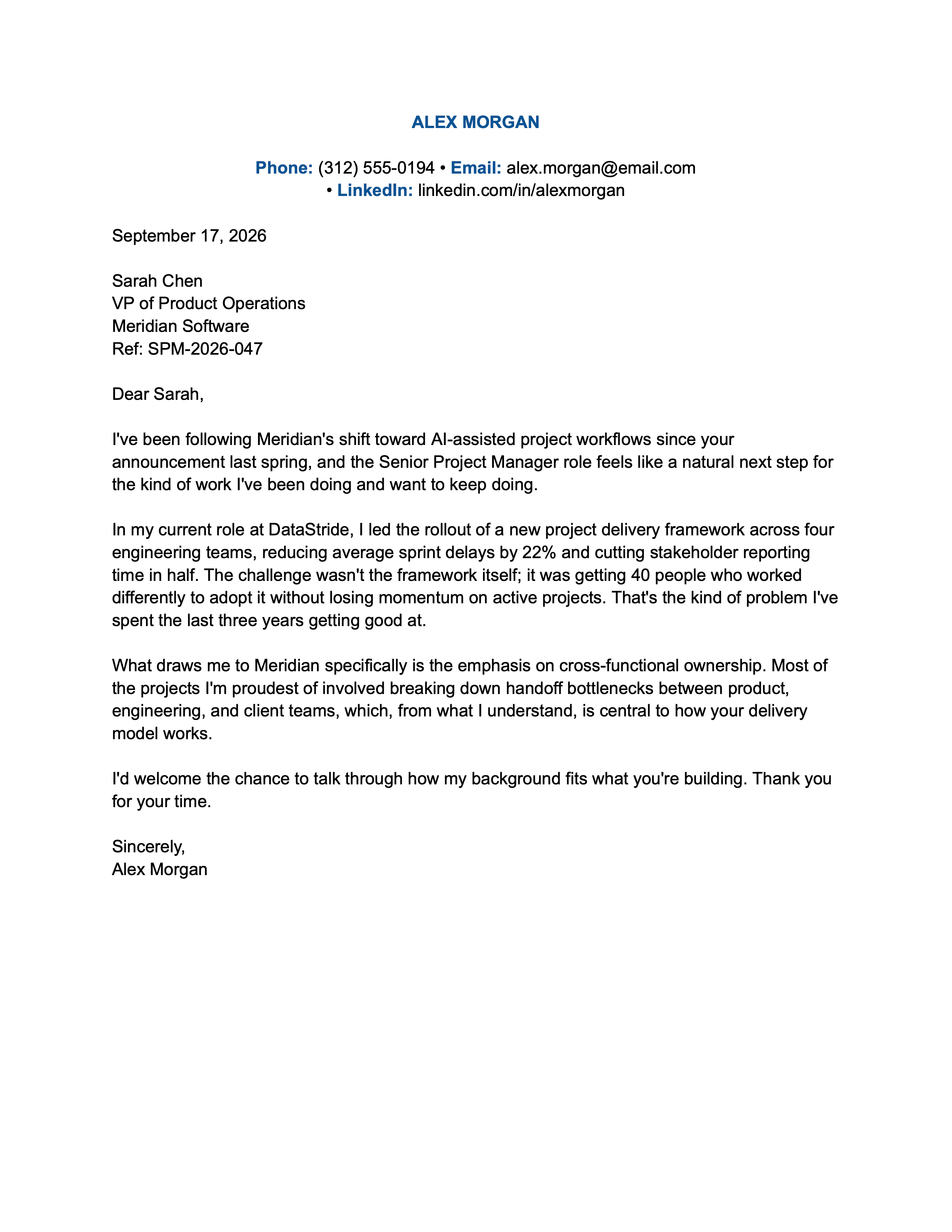
The contact section is placed no more than 2 inches from the top of the page, the date is written in full, and the posting reference code is placed before the section with the recipient's details. Regarding the content, the opening paragraph mentions the company and the role, followed by the applicant's qualifications for the job described in the two central paragraphs (project delivery framework leadership, cross-functional ownership, and so on).
The closing part is confident yet humble, and the candidate welcomes the opportunity for further discussion and shows appreciation for the reader's time.
You can download the cover letter format example analyzed above as both a PDF and a Word (.docx) document:
We recommend submitting a PDF file for most applications, and using a cover letter in Word format only when the job posting requires it. If you need assistance with the cover letter content, build your cover letter directly in Toptal Resume's cover letter generator.
An online cover letter format is slightly different than a standard cover letter format. Here are the main rules to follow for email cover letters and online application forms:
- No contact section: Your name and email address are already included in the message information, so there's no need to list everything at the top. Online forms typically add them to separate fields.
- No recipient details: Similar to the above, with the recommendation to include the reference code in the subject line of the email. The cover letter starts with "Dear [Name]."
- The body stays the same: The structure that includes three to four paragraphs of text describing your qualifications applies to online submissions as well.
United States and Canada
All the formatting rules defined so far apply to all the job applications made in the U.S. The Canadian cover letter format is nearly identical and follows the same rules regarding the length, formatting, and block order. Some specifics that are worth mentioning: use Canadian English spelling, mention your bilingual skills if the role is Quebec-based, and your work permit if you're not a Canadian citizen. Although the date formatting is different for numeric dates (YYYY-MM-DD), writing the date in full is acceptable and natural for Canadian cover letters.
United Kingdom and Europe
There are terminological and practical differences in job application documents between Europe and the U.S., mostly related to the distinction between a resume and a CV. That said, there are fewer when it comes to cover letters. You can follow the same rules, but the tone of the cover letter can be slightly more formal, for example, in the UK. It's also common to use the Europass cover letter format.
An entry-level cover letter follows the same structure as a standard cover letter, with the difference being in the content of the cover letter body. As you can see in the example shown in the image below, the evidence doesn't come from a formal professional engagement, but more often from academic achievements, projects, or volunteering experience.
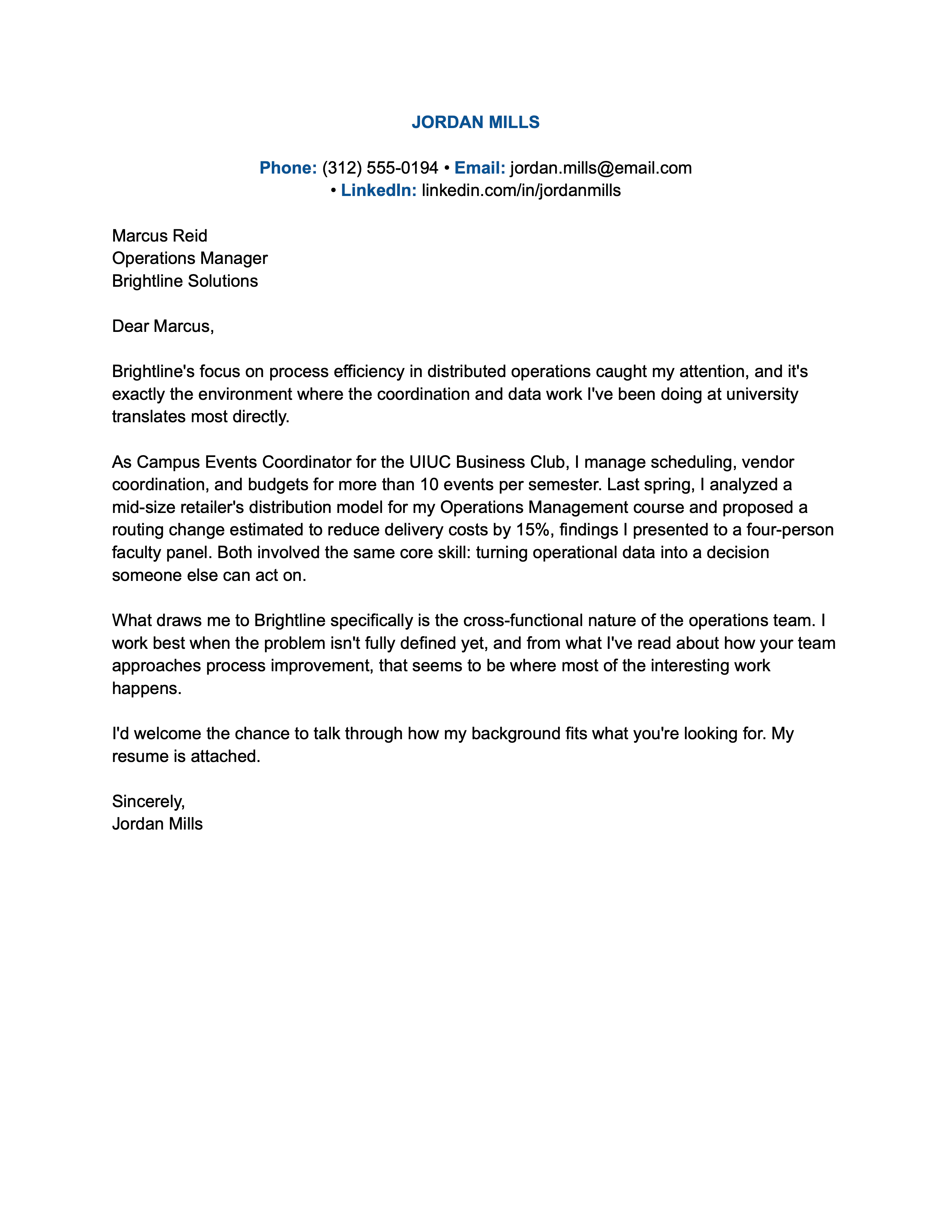
Although a cover letter format for an internship or a first job still aims to present your background professionally, the expectations aren't the same, and the tone can be slightly warmer, showing that you're still learning. If you'd like to learn more about entry-level job applications, see our complete guide on how to write a resume when you have limited experience.
Here are the most common mistakes related to cover letter formatting and what not to do when writing your next cover letter:
- Running over one page. Regardless of career level, many applicants include too much detail in their cover letters. If you exceed one page, cut the least relevant parts.
- Using a smaller font to add more content. Using a font smaller than 10 pt isn't good practice, and you should cut less relevant content instead.
- Repeating all the content from your resume. The cover letter should highlight the most relevant details to create context and tell a story. Your sentences shouldn't sound like bullet points.
Whether you need a cover letter for an internship or for a senior job application, the format doesn't change significantly. Still, its content should be adapted, and Toptal Resume's cover letter generator delivers tailored documents for all career levels, using the best cover letter format and formatting practices. Additionally, the resume you submit with the cover letter should be polished for each application, and using an AI resume builder with resume-tailoring features for a specific job will help you tell your professional story cohesively.