Building a CV for Construction Jobs That Gets You Hired
Construction CVs fail when they're written like typical office CV. Learn what foremen actually screen for and how to fix that.

With so much advice available across the internet on what generally should be on a construction CV, the more important thing to keep in mind when putting together a CV is what hiring managers look for when scanning one. What foremen or site supervisors actually look at first when screening construction CVs are safety certifications, trade-specific credentials, and proof of project-based reliability.
The guide below doesn’t offer generic CV recommendations; it’s written around how construction hiring works in practice.
What Construction Hiring Managers Look for First
From the foreman-screening perspective, the elements your construction CV should cover, and the ones hiring managers look for before reading a single bullet point in your job descriptions, are the following:
- Safety certifications: HSE compliance is typically a must-have for work on many commercial and building sites. They are the most important signals of reliability.
- Trade-specific credentials: a forklift operator license, crane certification, or plumbing and electrical licences convey your readiness for the job.
- Project experience: The scope of the projects you've worked on should state whether they are commercial or residential, their square footage, and their budget ranges. Those details show the complexity of the work.
- Reliability evidence: Communicate how long you worked for previous employers, your consistent employment in the industry, and mention your safety track record.
Many construction CVs are ineffective because they read like office CVs and look like a list of duties rather than showcasing credentials and project outcomes.
Construction CV Essentials
A construction CV that performs well and can help you land a job typically covers the five categories set out in the table below, and office-style CVs often don’t address them properly.
| Category | What to Include | Example |
|---|---|---|
| Certifications and Licences | CSCS card (Construction Skills Certification Scheme), First Aid at Work (FAW), forklift or crane certification, trade licences | “CSCS Gold Card (2023)” |
| Technical and Trade Skills | Blueprint reading, specific equipment, trade specialty | “Interpreted blueprints for 20+ residential builds" |
| Soft Skills | Teamwork, punctuality, or on-site communication | “Completed all assigned tasks on schedule across 3 consecutive projects” |
| Project-based Achievements | Scope, budget, timeline, safety record | "Completed 12,000 sq ft commercial buildout on schedule with zero safety incidents" |
| Format | One to two pages, depending on career level, clearly visible certifications | Certifications and licences are placed before the work history, in the upper part of page one |
Once you’ve properly covered all the categories above, the construction hiring manager will instantly have a clear image that you’re a strong fit for the job.
Certifications and Licences: What to List and Where
There are construction-specific certifications and credentials that immediately position and distinguish you from other candidates.
Essential credentials for construction jobs:
- OSHA 10 is typically an entry-level safety standard required on many commercial sites.
- The CSCS Green Card is typically an entry-level safety standard required on many commercial sites.
- SMSTS (Site Management Safety Training Scheme) is a supervisory-level safety certification expected for forepersons and site managers.
- First Aid at Work (FAW) or Emergency First Aid at Work (EFAW) is a standard requirement for many government-regulated job sites.
- A forklift operator licence is required under PUWER (Provision and Use of Work Equipment Regulations) for anyone operating powered industrial trucks.
- Trade licences, such as the Gas Safe Register (for gas engineers), NICEIC or JIB ECS card (for electricians), and WaterSafe (for plumbers), are highly specific to each trade.
Where to put them on your CV: Your construction certifications should never be buried at the bottom of the CV, and the hiring manager should be able to see them without having to scroll a lot.
How to format them: Naturally, start with the certification name and optionally add the issuing organisation. Other significant details are the year it was issued and, if applicable, the year it expires. If a certification is still in progress, it’s also a good idea to note it (e.g., "SMSTS (In Progress)") rather than omitting the certification altogether.
If you need help positioning and formatting your certifications, Toptal's CV maker provides structure with dedicated sections for certifications and licences. The possibility to reorder CV sections that it offers works particularly well for a construction CV template.
How to Write Project-based Achievements
Effective work experience descriptions should be results-oriented, but this can be challenging for construction worker CVs, which are specific.
Here are the aspects of your professional results that you should keep in mind when describing your experience:
- Project scope. When describing a project, include details such as floor area, number of units, or building types. For example, “Contributed to building a 45,000 sq ft commercial warehouse from foundation to fit-out” clearly shows concrete results, while “Worked on construction projects” says nothing.
- Timeline and delivery. “Completed projects on time” is pretty vague, so it’s better to use a more specific description, such as “Delivered framing phase 3 days ahead of schedule, enabling earlier electrical first fix.”
- Budget context. Instead of simply saying “Helped reduce costs,” try “Identified a material substitution that saved approximately £8,000.”
- Safety record. A bullet like “Followed safety procedures” won’t make you stand out, but “Maintained zero safety incidents across 18 months and 4 project sites” will.
Of course, it’s not a must to include all of the above dimensions in every single bullet. Even one or two specific and concrete details will make your job description look credible. To check whether your achievements are written strongly enough and will make you stand out, try Toptal CV's ATS score checker for a deeper evaluation.
Construction CV Examples
The construction worker CV examples in this guide cover the two most typical scenarios. The first CV example was written for an entry-level general labourer building their first professional CV, and the second example features an experienced construction manager with a project-based track record.
Example 1: General Laborer (Entry-level)
The General Labourer CV example in the image below includes all the standard CV sections (Contact, Summary, Work Experience, Skills, Certifications, Education) but is tailored to the needs of an entry-level construction worker. We chose a construction CV template that positions certifications at the top of the document, based on how construction hiring managers screen entry-level applicants. Also, in the construction CV skills section, the focus is on reliability and equipment familiarity rather than generic soft skills.
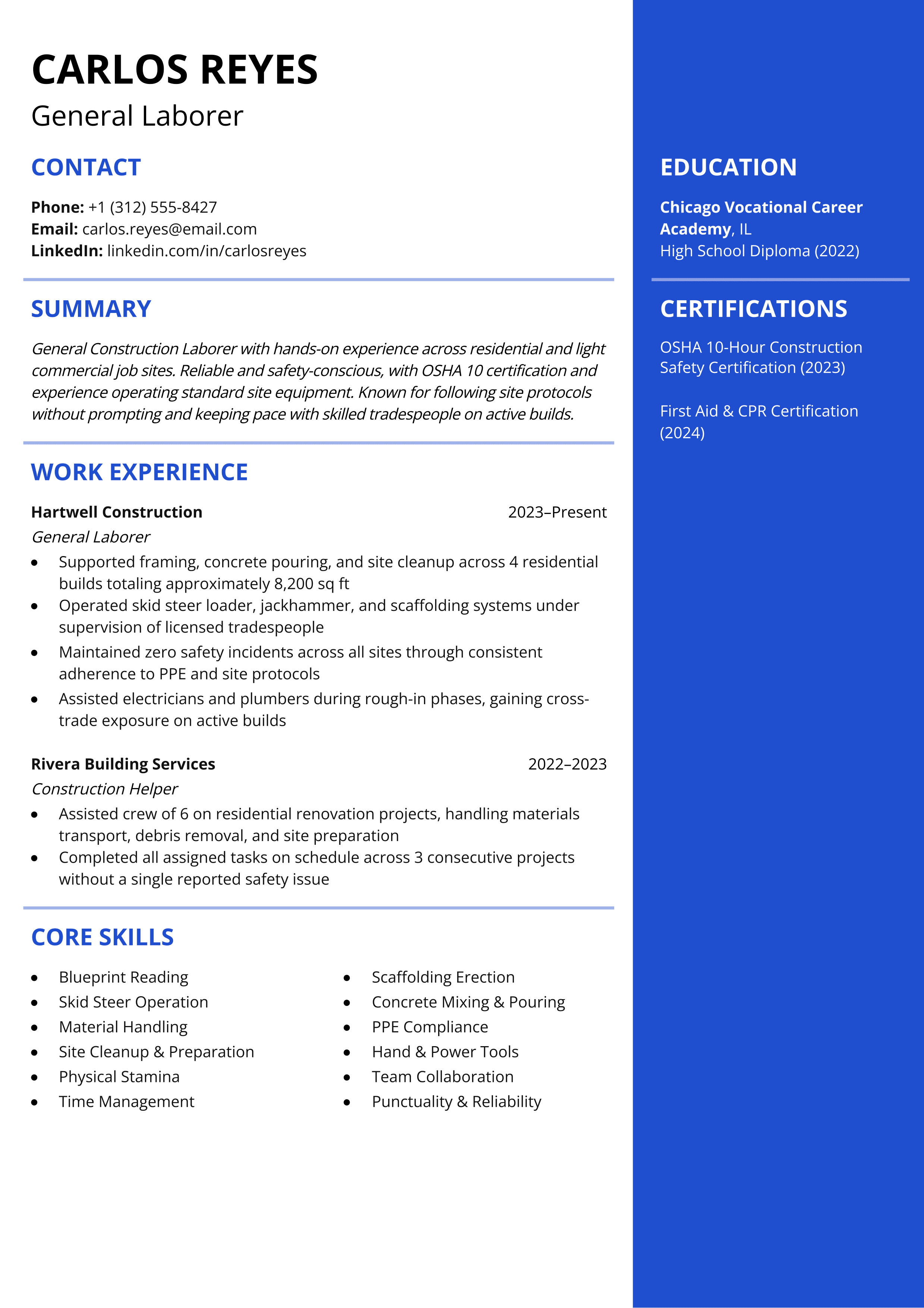
Here’s what works well in this CV example:
- Certifications (CSCS Green Card and First Aid at Work (EFAW)) are displayed prominently at the top of the page because they are the first thing the screener will look for.
- The certifications are also mentioned in the professional summary at the top, along with project types (commercial and residential sites), and relevant skills (protocols and collaboration).
- The bullet points in the work experience section don’t list daily tasks, but showcase specific project details and results (4 buildings, 8,200 square feet, zero safety incidents).
- The skills section includes specific equipment and competencies (skid steer, concrete mixing, blueprint reading, site cleanup, and so on).
Example 2: Construction Project Manager (Experienced)
Similar to the previous example, the Construction Project Manager CV in the image below includes the standard CV sections: Contact, Summary, Work Experience, Skills, Certifications, and Education. It positions the managerial profile right away by mentioning project types and the track record of delivering them on time, within scope, and on budget. The stated safety record is also what a hiring manager at a main contractor cares about most in a management-level hire.
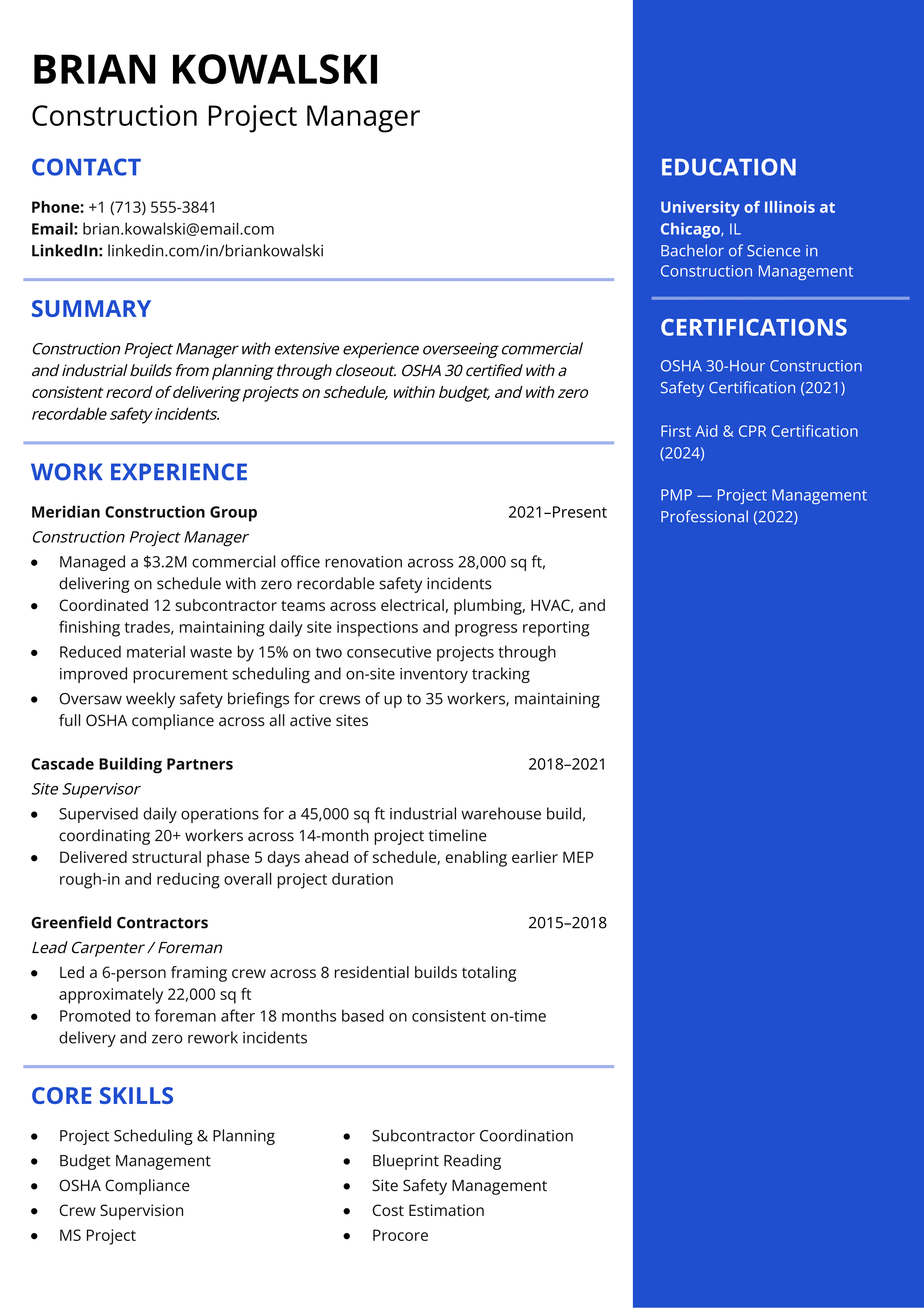
Here’s what works well in this CV example:
- The summary outlines project delivery and the most important certification (OSHA 30) and emphasises experience and safety before the reader starts reading the work experience section.
- All bullet points in the work experience descriptions include concrete metrics ($3.2 million budget, 28,000 sq ft, 12 subcontractor teams, 15% reduction in material waste, coordination of 20+ workers, and so on).
- The certifications section, which is placed near the top, lists both safety credentials and trade-specific licences: OSHA 30-Hour Construction Safety Certification, First Aid & CPR Certification, and PMP (Project Management Professional).
Common Mistakes in Construction CVs
The most frequent mistakes in writing a construction resume, or similar trade-specific resumes, are:
- Using the bullet points in the work experience section to list everyday duties, instead of concrete results.
- Leaving off construction certifications and trade licences, which are usually hard requirements for the job.
- Burying the certifications and licences at the bottom of the CV, making it hardly visible to recruiters.
- Not specifying the project type and scale, as residential and commercial buildings require different sets of skills.
- Sending the same CV for all construction applications, without tailoring it for the specific trade and seniority level.
A construction CV is not the same as a general office CV, and most of the generic advice you can come across misses what foremen and construction hiring managers usually look for. Whether you’re applying for your first construction job or your next construction project management role, Toptal's AI CV maker guides you through each section with AI-assisted suggestions tailored to your role and experience level.
FAQ
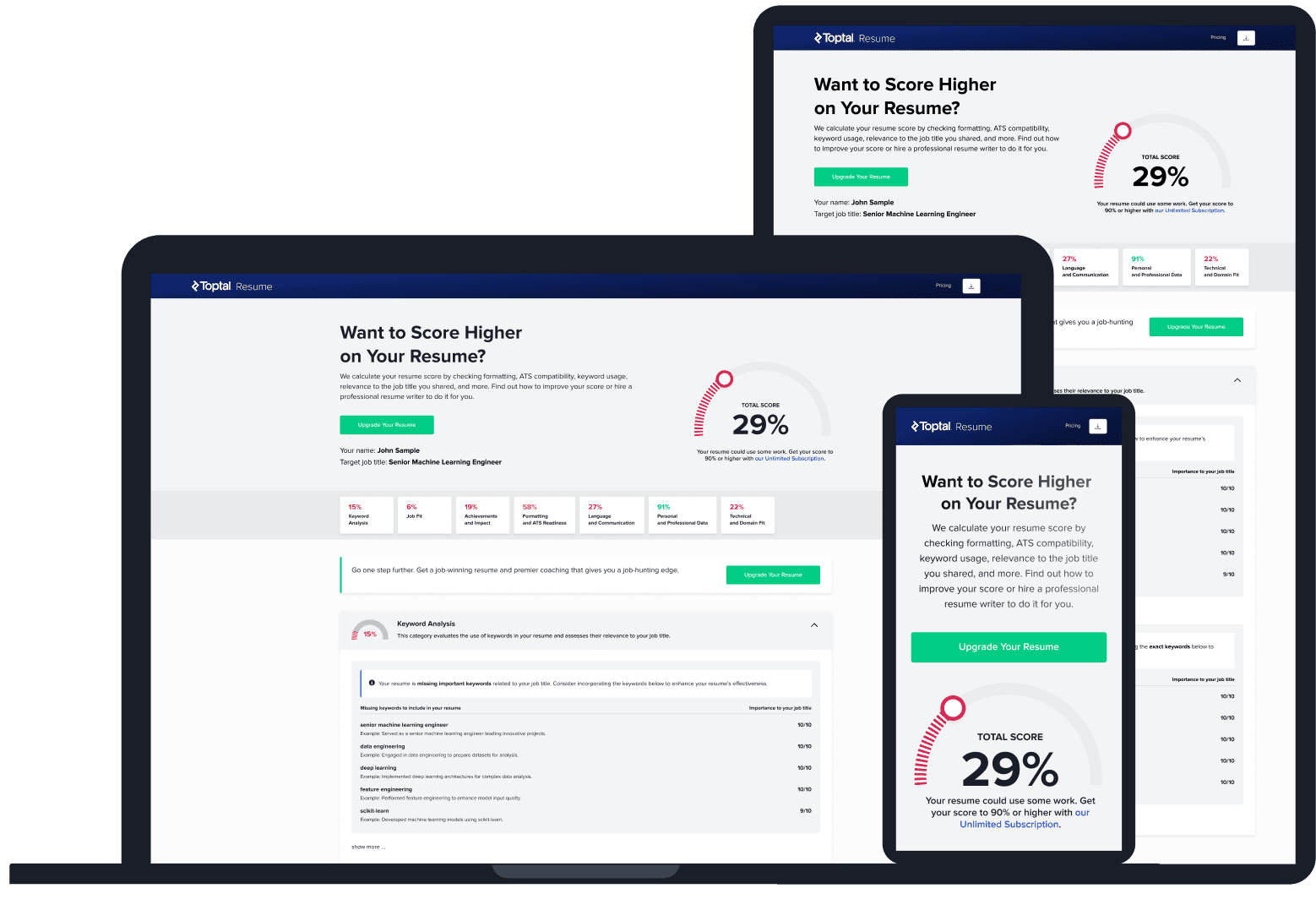
ATS CV Score Checker
for Professional Roles
Upload your CV and tell us your target job title. Our system will analyse it the way a recruiter and ATS would—scoring it across core hiring dimensions and giving you personalised, role-specific feedback you can implement right away.
Read Next

Resume Tips
The Registered Nurse CV: What UK Hospitals Actually Look For
Learn what UK hospitals look for on a registered nurse CV, from NMC registration and resus training to ward experience and measurable patient outcomes.

By Inge Miscevic
Principal Career Coach
Inge Miscevic is a Principal Career Coach at Toptal Resume with over a decade of experience reviewing and improving thousands of resumes across industries. In her work with clients, she focuses on clear resume structure, effective formatting, and content that presents real experience in a way recruiters can quickly understand.

CV Tips
The No-experience CV: How to Land Your First Job
A guide to writing your first CV using coursework, projects, and other experience you already have.

Recruiter Insights
Why Most Tech CVs Fail: Target Role Misalignment
Many tech CVs get rejected due to poor alignment with target roles. Learn how to write a CV that matches applicant tracking systems (ATS) expectations and recruiter priorities, with practical CV writing tips you can apply right away.

By Tracie Close
Job Search & Career Strategist
Tracie Close is a job search and career strategist specialising in job search optimisation, CV writing, and employer branding. With more than 16 years of experience supporting recruiters, HR teams, and job seekers, she brings deep insights into hiring practices and applicant tracking systems (ATS). She holds a Bachelor of Arts in Communications and Writing Arts from Rowan University and has led digital strategy projects for global tech firms.