Resume Format for Career Changers: Why a Combination Resume Usually Works Best
A guide to choosing a resume format for a career change: how chronological, functional, and combination resumes compare, and how to build the one that works for most online applications.


AUTHOR
Inge Miscevic
Principal Career Coach
Inge Miscevic is a Principal Career Coach at Toptal Resume with over a decade of experience reviewing and improving thousands of resumes across industries. In her work with clients, she focuses on clear resume structure, effective formatting, and content that presents real experience in a way recruiters can quickly understand.
A guide to choosing a resume format for a career change: how chronological, functional, and combination resumes compare, and how to build the one that works for most online applications.
When you’re changing careers, you’ll often be told to use a functional resume. The reasoning makes sense: it puts your skills ahead of your job titles, which helps when your latest role isn’t directly related to the one you want. For online applications, though, that advice can work against you. Some applicant tracking systems (ATS) can have trouble interpreting skills-based layouts, and recruiters may struggle to see where your skills came from.
For most career changers applying online, a combination resume, also called a hybrid resume, is the safer choice. It places your transferable skills near the top of the page, then backs them up with a dated work history. You can tailor the resume for your next role without leaving out the background recruiters expect to see there. Keep a functional version for resumes you send directly to a person.
How the Three Resume Formats Compare
The main difference between these formats is the point of emphasis: a reverse-chronological resume focuses on your work history, a functional resume groups experience by skill, and a combination resume brings skills forward while keeping the employment timeline intact.
Here’s the full breakdown:
| Criteria | Reverse-chronological | Functional | Combination (hybrid) |
|---|---|---|---|
| Useful for | Professionals with a consistent work history | Non-standard histories, direct submissions | Career changers applying online |
| ATS behavior | Parses reliably | May be harder for ATS to interpret accurately | Parses reliably |
| Focus area | Your latest role and responsibilities | Skill groups without context | Relevant skills backed by work experience |
| Employment gaps | Visible in the timeline | Less visible, which some recruiters might misinterpret | Visible |
A chronological resume can work well for a career change if your recent responsibilities support the move. Functional resumes are an option if you have a non-standard work history, and a combination resume is worth considering when you need to connect your previous work to a new role, especially when you’re applying online. For a full comparison of each format beyond career changes, see Toptal’s guide to chronological vs. functional vs. combination resumes.
Chronological Resume Format: Where It Fits
A reverse-chronological resume lists your most recent job first, followed by earlier positions. Employers are familiar with this structure, and it’s easy to follow the progression from one role to the next.
You may have more relevant experience than your current title suggests. Someone moving from operations into project management, for example, might already coordinate teams, manage deadlines, track budgets, and resolve delivery problems. If those responsibilities feature prominently in the work history, a chronological resume can make a convincing case for the career move.
You can start with Toptal’s chronological resume template and see whether a summary and skills section give your experience enough emphasis. If you have achievements that need more space, a combination format gives you room to present them first.
Functional Resume Format: What It Is and When It Works
A functional resume, also called a skills-based resume, groups experience under headings such as Curriculum Development, Project Coordination, or Customer Relationships. Examples from different jobs, volunteer work, and projects can sit under the same heading. The employment section often contains little more than job titles, employers, and dates.
It’s easy to see why this can seem like a good idea to career changers, for example, if you developed relevant skills over several positions, but none of your role titles match the one you’re pursuing now. Using a skills-based format would help you highlight those skills rather than leaving them scattered across unrelated job descriptions.
Coursera’s functional resume guide describes this format as an option for people pursuing a new career path when their previous experience isn’t directly relevant. The concern is how well the resume works once it leaves your hands, particularly when you’re applying through an employer’s website.
Two things deserve attention before you choose a skills-based layout: how the resume is processed and how easily a recruiter can follow your experience.
Applicant Tracking Systems Could Interpret It Differently
Applicant tracking systems vary in their capabilities and how employers configure them. Many can extract information from resumes and make it searchable. Alternative layouts can still affect how well that information is captured and connected.
Coursera warns that ATS “may not accurately interpret alternative resume formats.” Its guide recommends a chronological resume for online applications and a functional version for situations where you submit it directly to a recruiter or hiring manager. It also suggests a chronological resume with a dedicated skills section as an alternative.
CareerOneStop, the US Department of Labor’s career resource, raises a similar concern. Its resume formatting guide says that a functional format without a detailed work history “may be misinterpreted by employers, or rejected by applicant tracking systems (ATS).” The guide also recommends the combination format for people who want to highlight transferable skills or refocus their experience for a career change.
Neither source says every functional resume will run into trouble; one employer may process it without difficulties, while another may have trouble interpreting the information. In most cases, you won’t know which system you’re dealing with when you apply, which is one reason CareerOneStop says a combination format works well for most people. It gives you both the skills-forward format and keeps a standard work-history section.
Recruiters Still Need to See Where Your Skills Come From
Skills need some context for recruiters to understand what you did, where you did it, and how closely that experience relates to the target job. Adding skills like “project coordination” or “stakeholder communication” without any explanation doesn’t give them enough information to assess your abilities.
If you were a teacher applying for a corporate learning and development position, your curriculum design, coaching, and assessing learner progress would all be relevant. A functional resume can group examples under those skills, but a missing or shortened work history can be confusing and leave the reader with less information about your career. A combination resume lets you present the relevant skills first, then show the teaching role and dates below. The reader can make the connection without having to search for the employment details.
A functional layout can also draw attention away from gaps in employment. That can be useful in some circumstances, but removing most of the timeline can raise concerns of its own. Recruiters won’t all react the same way, and an employment gap isn’t automatically an issue, but keeping the history visible ensures transparency and gives them more context to work with.
When a Functional Resume Makes Sense
A functional resume can be useful when you’re sending it directly to someone who can assess the examples in context. That might be a hiring manager you’ve met through networking, a contact who has asked to see your background, or a client considering you for a freelance project.
The format can also help bring together experience from paid work, volunteering, and projects that don’t fit neatly into a conventional employment history. Grouping those examples by skill can give the reader a better sense of what you’ve done.
Keep enough detail to show where the experience came from by organizing the examples by skills without making your employment history disappear. Job titles, employers, and dates are useful for the recruiters, even when skills are prioritized.
Combination Resume Format: How to Build One
You don’t need an elaborate layout to make this format work. Put the information most relevant to the new role near the top, then use your work history to show where your experience comes from.
A practical section order is:
- Contact information: Your name, phone number, professional email address, and relevant links.
- Professional summary: A short introduction to your background, transferable skills, and target role.
- Core skills: The capabilities that matter for the job you’re applying for.
- Selected achievements: Examples that show those capabilities in practice.
- Work experience: Your roles, employers, dates, and relevant accomplishments, newest first.
- Education and additional qualifications: Degrees, certifications, training, and other relevant credentials.
You can combine the skills and achievements sections if you have only a few strong examples. Keeping them separate may help if you have enough relevant evidence to fill both. There’s no need to add sections just to make the resume look more like a combination format.
1. Back Up Your Skills With Achievements
In a combination resume, the core skills section is a short list, and the selected achievements section is where you back those skills up. Six to eight skills are usually enough, as long as each one matters for the target role. Toptal’s guide to hard skills vs. soft skills explains the difference and where each type belongs on your resume.
Each selected achievement should connect a listed skill to a result. A teacher moving into learning and development, for example, might write:
- Curriculum Development: Developed and delivered instruction for groups of 28 learners, adapting materials to different learning needs
- Learner Assessment: Used learner performance data to assess progress and adjust instruction, contributing to a 34% improvement in outcomes
The work history can be used to give more information about the teaching role itself. For help choosing which experience to highlight and how to describe it, see Toptal’s guide to reframing unrelated experience on a career change resume.
2. Include the Work History
List employers, job titles, and dates in reverse-chronological order. Recent roles usually need more detail, especially when they contain achievements that support your application. Older or less relevant positions can take up less space.
Three to five bullets for a recent role is a reasonable starting point. Older jobs might need only one or two, or a shorter entry without bullets that keeps the timeline clear. If a past role is highly relevant to your target role, it's okay to include more detail.
You don’t need to repeat every achievement from the skills section. If you’ve already described how you developed a curriculum, use the work-history entry to show the scope of the role or explain another responsibility.
How far back you go depends on your experience and the job you’re targeting. A good approach is to keep older roles that demonstrate relevant skills or progression, or help explain your background. Trim details that don't add much value to the application. Toptal’s guide to how far back your resume should go covers this in more detail.
3. Keep It Simple
You don't always need a separate achievements section to have a combination resume. Coursera’s guide suggests a lighter version: keep a chronological layout and add a dedicated skills section. That’s usually enough when your employment history is straightforward, and your relevant qualifications are easy to connect to the target role.
A combination resume gives you more room to bring relevant achievements to the front. Use the examples that help explain why and how your previous experience fits the new job. If a summary and skills section already make the connection clear, stick to a simple layout.
Functional and Combination Resume Examples
The difference between functional and combination resumes becomes clearer when both formats use the same candidate’s experience. The examples below show the resume of a teacher moving into learning and development.
1. Functional Resume Example
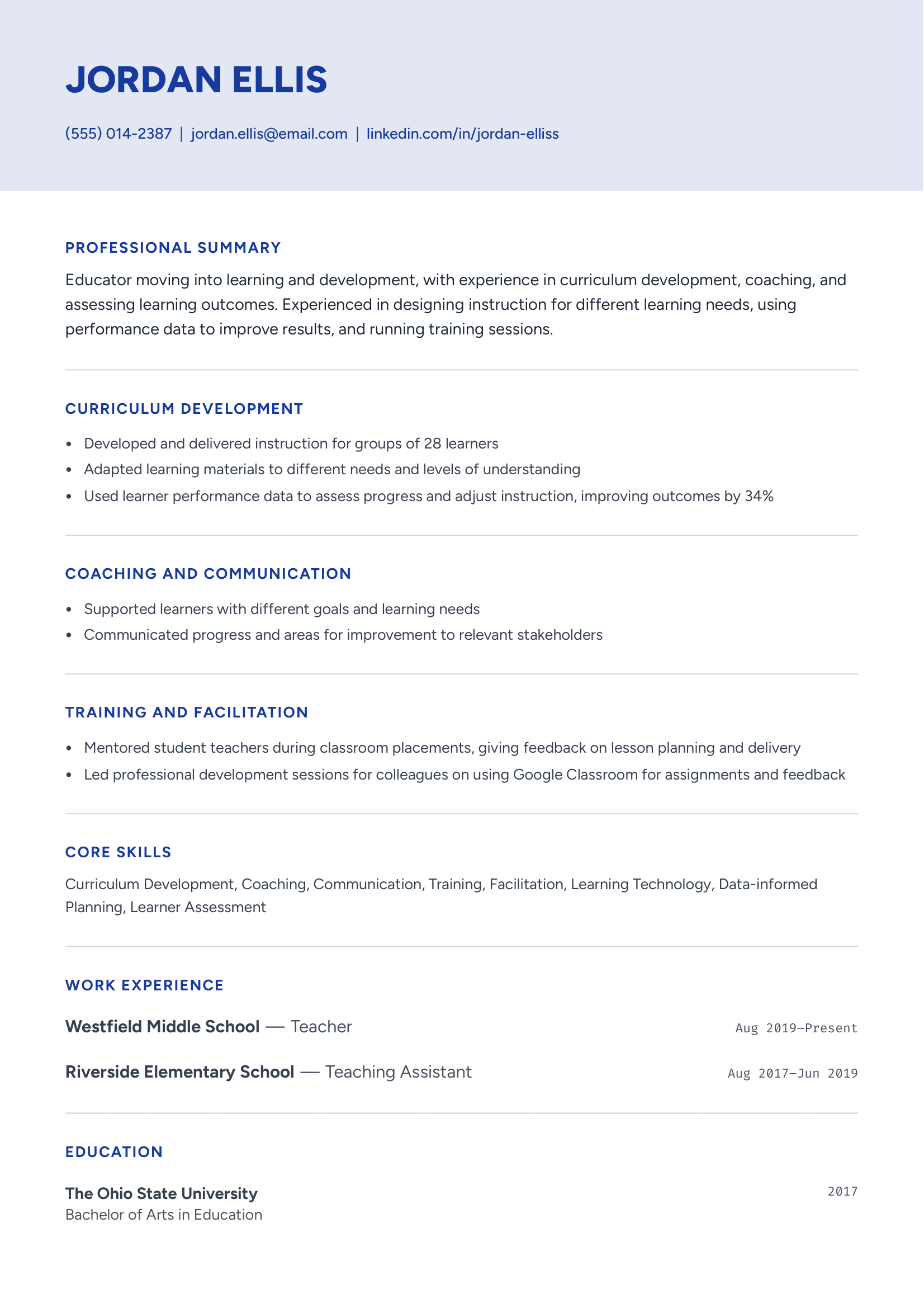
The skills are easy to find, but the example gives little context about the candidate’s employment. The reader needs to look elsewhere in the resume to see which role the work belongs to and when it took place.
2. Combination Resume Example
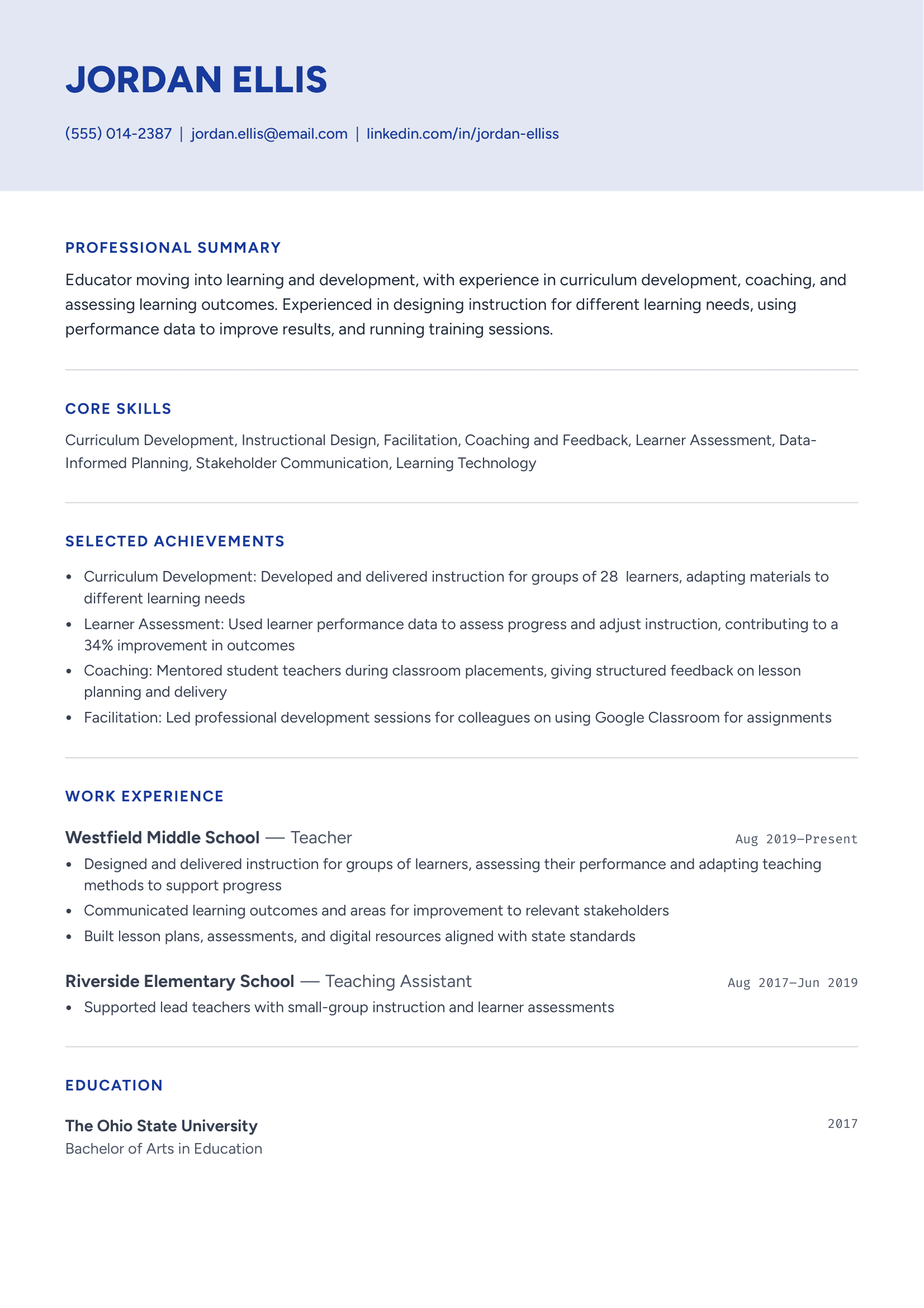
The second version identifies the role and dates without pushing the relevant skills down the page. Its work-history bullets don’t repeat the selected achievements. They describe the scope of the role instead. Both examples above were built in Toptal Resume’s builder, using custom sections for the skill groups and selected achievements. You can download the full combination resume example as a PDF and adapt the structure to your own background.
Which Format Fits Your Situation?
Your work history and the kind of move you’re making can help you choose. Here are some common scenarios explained:
- Changing industries but staying in the same role: A chronological resume may be enough if your responsibilities and achievements carry over. Use the summary to explain how your experience applies in the new industry.
- Changing roles but staying in the same industry: A combination resume can help when your job titles don’t reflect the skills required for the new role.
- Changing both industry and role: Start with a combination resume if you have relevant achievements to support the move. Put those examples near the top so the reader can see the connection before reaching your previous titles.
- Returning after a long break: A combination resume can bring relevant experience back into view. If much of your evidence comes from projects or volunteering, a functional layout may also be worth considering for a direct submission.
- Moving from military to civilian work: A combination resume can highlight relevant operational, technical, or leadership experience in a way that civilian employers will recognize, while keeping your service history visible.
These are starting points. If your recent experience already fits the target role, a standard chronological resume may be all you need.
Build a Resume That Supports Your Career Move
Once you’ve chosen a format, you’ll need to decide which achievements deserve space near the top and how to describe your previous responsibilities for the role you’re pursuing.
Toptal’s resume builder can help you structure the document, identify skills from your existing experience that may be relevant to the target role, and tailor it to a specific job ad. After drafting, the ATS resume checker can help you review how the resume aligns with the position.
Our career change resume guide goes into more detail on describing unrelated experience and showing how it applies to your next role.
ATS Resume Score Checker
for Professional Roles
Upload your resume and tell us your target job title. Our system will analyze it the way a recruiter and ATS would—scoring it across core hiring dimensions and giving you personalized, role-specific feedback you can implement right away.
Read Next

Resume Tips
Best Free ATS Resume Checkers: Tools Tested and Compared
One resume and one job description run through seven ATS checkers to show what each really offers for free and how useful the reports are.

By Borislav Stojkov
Principal Resume Writer
Borislav Stojkov is a Principal Resume Writer at Toptal Resume. His professional track record includes personally reviewing and rewriting more than 2,000 resumes for professionals across industries. In his direct work with clients and the development of AI-based resume-writing services, he focuses on ATS-optimized structure, modern template design, and recruiter-aligned writing and formatting standards.

Resume Tips
Cover Letter for Internship: Examples, Template, and Writing Tips
No paid experience? Coursework, projects, and volunteering can prove your fit. Here’s how to turn them into a letter.
By Borislav Stojkov
Principal Resume Writer
Borislav Stojkov is a Principal Resume Writer at Toptal Resume. His professional track record includes personally reviewing and rewriting more than 2,000 resumes for professionals across industries. In his direct work with clients and the development of AI-based resume-writing services, he focuses on ATS-optimized structure, modern template design, and recruiter-aligned writing and formatting standards.

Job Market Trends
How Understanding Applicant Tracking Systems (ATS) Can Land You a Top Tech Job
Nearly all Fortune 500 companies use ATS to screen applicants. Understand how these systems parse resumes so yours doesn't get filtered out.

By Amanda Menin
HR & Career Strategy Expert
Amanda Menin is a Talent and Organizational Strategy expert specializing in hiring practices, resume optimization, and applicant tracking systems (ATS). With more than 20 years of experience across technology, healthcare, and consulting, she offers practical insight into how employers evaluate candidates. She holds a master’s in industrial and organizational psychology and is a SHRM Senior Certified Professional (SCP).