Hard Skills vs. Soft Skills: What They Are and Where They Go on Your Resume
Hard skills go in your dedicated skills section. Soft skills go in your experience bullets. Here’s why that distinction matters and how to apply it.

AUTHOR
Borislav Stojkov
Principal Resume Writer
Borislav Stojkov is a Principal Resume Writer at Toptal Resume. His professional track record includes personally reviewing and rewriting more than 2,000 resumes for professionals across industries. In his direct work with clients and the development of AI-based resume-writing services, he focuses on ATS-optimized structure, modern template design, and recruiter-aligned writing and formatting standards.
Hard skills are often called technical skills, and they are teachable, measurable, and required to do a job. On the other hand, soft skills are more behavioral and interpersonal, and they show how you perform the job. For your resume, it's not only important to know the difference but also where to showcase them. A dedicated resume skills section is where you typically list hard, or technical skills, while soft skills should be demonstrated in your job descriptions.
Hard Skills vs. Soft Skills: The Comparison
The table below shows all dimensions of the differences between hard skills and soft skills, including where to put them on a resume, and how they're scanned and assessed by both recruiters and applicant tracking systems (ATS).
| Dimension | Hard Skills | Soft Skills |
|---|---|---|
| Also called | Technical skills | Workplace skills, people skills, interpersonal skills |
| Definition | Technical and practical knowledge acquired through education, work, or practice | Skills that showcase how you work, both alone and with others |
| Examples | Python, Spanish, SQL, financial modeling, AutoCAD, CPA, AWS, Salesforce, GAAP | Communication, collaboration, adaptability, problem-solving, leadership |
| How they’re acquired | Taught and certifiable: on-the-job, courses, degrees | Mostly developed through experience |
| How they’re proven | Certification, portfolio, test, years of applied use | In context, describing how you took an action and achieved a result |
| Where to put them on a resume | A dedicated skills section for ATS and recruiters to scan + in the bullets | Within your work experience bullets, with demonstrated outcomes |
| How many to list | Around 10 of the strongest and most relevant ones in the dedicated skills section for most applicants | Demonstrated in bullet points as outcomes, where they fit naturally |
| ATS behavior | ATS scanners look for them to verify job fit | More important for human readers |
| Importance by seniority | Entry and mid-level professionals, as well as those in technical roles | Important for all levels, but get more decisive with seniority, where leadership matters the most |
| Common mistakes | Listing tools you never used, or stuffing with obvious ones like Microsoft Word | Listing mere traits with no evidence ("excellent communicator," "team player") |
| Current trends | AI tools, digital and data literacy are expected for most professional roles, not just in tech | As more candidates use AI for resumes, avoid AI fluff by using them in a context with hard skills |
What Counts as a Hard Skill
Learning how to write technical skills in a resume means, before all, being clear about what can be included among them. Here's a categorized list with examples covering the seven most important groups of skills:
- Software and tools (computer skills): list the most relevant ones that you actually used, like Python, SQL, Salesforce, AutoCAD, Adobe Creative Suite, Google Analytics, Tableau, SAP
- Languages: if relevant for the job, languages like Spanish, Mandarin, French, or German are often listed with proficiency level (basic, native, fluent, and so on)
- Technical and engineering skills: depending on the specific field, they can include mechanical drafting, circuit design, structural analysis, CAD modeling, etc.
- Machinery and equipment: forklift operation, CNC machining, laboratory instrumentation
- Data and analytics: skills like A/B testing, statistical modeling, machine learning, data visualization, and ETL pipelines are essential for any data-related role
- Certifications and licenses: Credentials that show a job-related skill, such as CPA, PMP, AWS Certified Solutions Architect, OSHA 30, Series 7
- Methodologies: Agile, Scrum, Six Sigma, GAAP, IFRS
All skills that can be learned, verified, and certified belong in the dedicated skills section, and they should also be demonstrated in the bullet points. If you need help determining which skills to include, Toptal's AI resume builder offers tailored suggestions based on your experience and the job you're targeting.
What Counts as a Soft Skill
Unlike hard skills, soft skills don't need to be explicitly named to match the job requirements, but demonstrated in the context of your bullet points. Here are the seven most common soft skills categories:
- Communication: skills demonstrated through written communication, public speaking, active listening, and presentation skills
- Collaboration: those showing your cross-functional teamwork, stakeholder management, or conflict resolution
- Adaptability: show in practice your resilience, comfort with ambiguity and uncertainty, or change management skills
- Problem-solving: needed to showcase your critical thinking, analytical reasoning, creative problem-solving, etc.
- Leadership: skills that include people management, coaching and mentoring, and decision-making
- Emotional intelligence: a range of skills that prove self-awareness, empathy, relationship building, giving and receiving feedback
- Learning: continuous learning, picking up new tools quickly, and intellectual curiosity
Based on the above, the rule is clear: If it's a behavior rather than a technique needed to complete a job, it's a soft skill.
Where Each Type Actually Goes on a Resume
If you're unsure about how to write about skills in your resume, follow the guide below on each type of skill and each section of the resume in which they can be included.
Hard Skills: How to Write the Skills Section of Your Resume
The resume skills section is a part of a resume where the most important skills for a job are listed so both human and machine readers can see them at a glance. The skills shown in it are typically the keywords that ATS scanners look for, and it should be easily parsable, either as a vertical list or a comma-separated list of the most relevant skills. Generally, you should list 8 to 12 skills, though in some industries and roles, it's common to list more. What's important is not to create a keyword dump, which can hurt your application.
Additionally, listing them in the skills section is not enough, and hard skills should be demonstrated and included in the work experience bullet points as well. Showcasing how you used your technical skills to achieve a result is the strongest evidence of your job fit.
To check whether your skills section matches the keywords required in the posting, Toptal Resume's ATS resume checker provides a thorough analysis of your resume against the target job.
Soft Skills: Weaving Them Into Work Experience Bullets
Listing soft skills, such as communication or leadership, in the resume's skills section is likely to be perceived as fluff because it tells the recruiter nothing. Instead, they should be proven in the bullet points that describe your achievements by saying, for example, that you led weekly syncs to reduce project delays by 30%. Also, soft skills are rarely hard requirements for the job, so there's no need to use the exact words. Your goal is to prove them contextually.
Exception to the Rule
For some roles, especially client-facing ones, soft skills (e.g., conflict resolution or active listening) can be listed in the job description. In such cases, it's completely fine, even recommended, to include them in the skills section of your resume as well.
How Many Skills Should You List?
Writing the skills section is a task that should be approached strategically, and to help you decide how many skills to list on your resume, here are some straightforward rules to follow:
- Hard skills in the skills section: Having a list of around 10 skills should be enough to prove your fit for the job. It should be tailored to the job description for each application.
- Soft skills: Don't list them in the skills section at all, with exceptions, but demonstrate them in the bullet points in the work experience section. There's no strict number, and you can include them wherever they fit naturally.
- Trimming: If a skill isn't relevant to the target role and if it's not mentioned in the job description, you can cut it. Also, if there are more required or relevant skills for your role, you can expand the skills section.
For more advice related to choosing the right skills for your resume, see our complete guide on resume skills.
Proving Soft Skills Instead of Claiming Them
When writing about skills in a resume, listing your soft skills simply as adjectives is a very common mistake we see in practice. To turn claimed traits into proven results, follow this three-step method:
- Identify the skills you want to show
- Think of a situation in your experience when you applied that skill
- Describe the situation, the action you took, and the result achieved
The examples in the table below present four concrete bullet points before and after applying the method above.
| Soft Skill | Before | After |
|---|---|---|
| Communication | "Excellent communicator with strong presentation skills" | "Presented quarterly roadmap to a 12-person executive team, securing buy-in for a $2M infrastructure investment" |
| Leadership | "Natural leader with team management experience" | "Rebuilt an underperforming team of six through weekly one-on-ones and a structured feedback that improved retention from 60% to 90%" |
| Adaptability | "Adaptable and comfortable with change" | "Onboarded to a new tech stack mid-project when the client switched platforms, delivering on the original deadline with zero scope reduction" |
| Problem-solving | "Strong problem-solver with analytical mindset" | "Identified a billing error affecting 400 accounts, built a reconciliation process in two days, and recovered $180K in outstanding revenue" |
Notice that none of the examples above name the soft skills explicitly, and the rewritten bullets don't include the words "leadership," "communication," or "problem-solving." When writing about soft skills in your resume, you demonstrate them through your experience.
Matching Skills to the Job Posting
When deciding which skills to put on a resume, the first thing you should do is to read the job description carefully and include all the required skills naturally.
Step 1: Identify the Required Skills
Go through the job description and map all the tools, technologies, and methodologies that are required for the role you're targeting. Those are the keywords ATS most often looks for, and you should include all that match your experience.
Step 2: Mirror the Language From the Posting
Try to use the same terminology as they do in the job posting, but you don't have to obsess over it. Today, many ATS systems use semantic matching and can understand context and synonyms within the content of your document. For example, saying that you "led a team" when you need to include "team leadership" as a keyword is fine.
Step 3: Avoid Keyword Stuffing
Including too many keywords when it's not justified and doesn't sound natural can hurt your application, as ATS software, which is increasingly AI-based, can detect unnatural keyword density. You don't need to repeat the same skill five times verbatim in a single work experience item. Mentioning it once with a concrete result and listing it in the skills section is more effective than placing it everywhere.
Balance Between Hard Skills and Soft Skills by Industry and Career Level
How many hard and soft skills to include in a resume depends significantly on your industry, role, and career level. When it comes to the differences based on your specific field and role type, here are the most common variations and specifics:
- Engineering, data, and technical roles: The skills section in these resumes is almost exclusively focused on hard skills, including the stack, tools, and methodologies. Soft skills are woven into bullet points only if highly relevant, such as leading teams or managing stakeholder expectations.
- Management, sales, and client-facing roles: In these roles, the balance shifts toward soft skills. The question of where to list skills on the resume remains the same, but there are more soft skills to demonstrate in the bullet points, such as communication and relationship-building.
- Healthcare, legal, and regulated jobs: Here's where licenses and certifications serve as the primary proof of your hard skills. They are listed in a dedicated section of your resume.
The skills included in a resume also vary depending on your career stage and seniority level:
- Entry-level resumes: The skills section plays an important role, as there's not much experience to demonstrate them. The list can include hard skills learned through education, personal projects, or internships, as well as a few soft skills relevant to the job, such as collaboration and leadership.
- Mid-career professionals: For most applicants, the skills section is reserved for hard, technical skills, while soft skills should ideally be demonstrated only in the bullet points.
- Executive resumes: These resumes are all about showcasing strategic and leadership skills, grounded in demonstrated business outcomes. Here, the skills list becomes secondary, and technical skills are an important context, but they're rarely the main focus of the resume.
Skills-based Resume or Functional Resume: When the Format Changes
Skills-based resumes, also known as functional resumes, use a format that lists key achievements by skill and does not follow a chronological timeline. They are particularly useful for career-change resumes, applicants with longer employment gaps, or anyone whose relevant experience doesn't come from recent jobs, or is related to other kinds of work (freelance, projects, volunteering, etc.).
For other candidates with steady career progression, a chronological resume format (also known as reverse-chronological) is the safest option, as recruiters most expect it. There's also a hybrid format that combines the two: the content is listed by skills, followed by a concise list of jobs in chronological order.
For detailed advice on how to write a skills-based resume, see our full guide on different resume formats and when to use them.
How to List Hard Skills and Soft Skills on a Resume: A Full Example
The examples below show two versions of how to write skills on a resume. The scenario is as follows: a mid-career manager who wants to showcase both his hard and soft skills, including core management skills, tools, leadership, and communication.
Version 1: Skills handled badly
In the example below, soft skills are listed as adjectives in the "Core Skills" section, along with obvious tools, such as Microsoft Office. A list like this proves nothing, and it reads pretty generic.
CORE SKILLS
Stakeholder Management, Leadership, Communication, Microsoft Office, Problem-solving, Teamwork, Project Management, Excel, Time Management, Adaptability, Detail-oriented, Self-motivated
Version 2: Skills handled correctly
CORE SKILLS
Agile, Scrum, Financial Planning, Project Management, SQL, Tableau, Jira, Confluence, Asana, A/B testing
(Note: Skills can also be grouped by category)
WORK EXPERIENCE
(One exemplary experience bullet with a soft skill demonstrated)
"Facilitated weekly cross-functional syncs across product, engineering, and design, reducing sprint carry-over by 40% over two quarters"
The skills section here lists the most relevant competencies, methodologies, and tools that ATS looks for, while the bullet point demonstrates interpersonal skills with a specific result. Ideally, project management skills are demonstrated in the dedicated certifications section (e.g., PMP Certification).
Build Your Resume
Knowing which skills to list and where to put them on a resume is one of the most important aspects of a resume that performs well with both ATS systems and human readers. Toptal Resume's AI resume builder guides you through the skills section with specific suggestions based on your target role and experience, and the ATS resume checker confirms your skills match the job before you apply.
FAQ
ATS Resume Score Checker
for Professional Roles
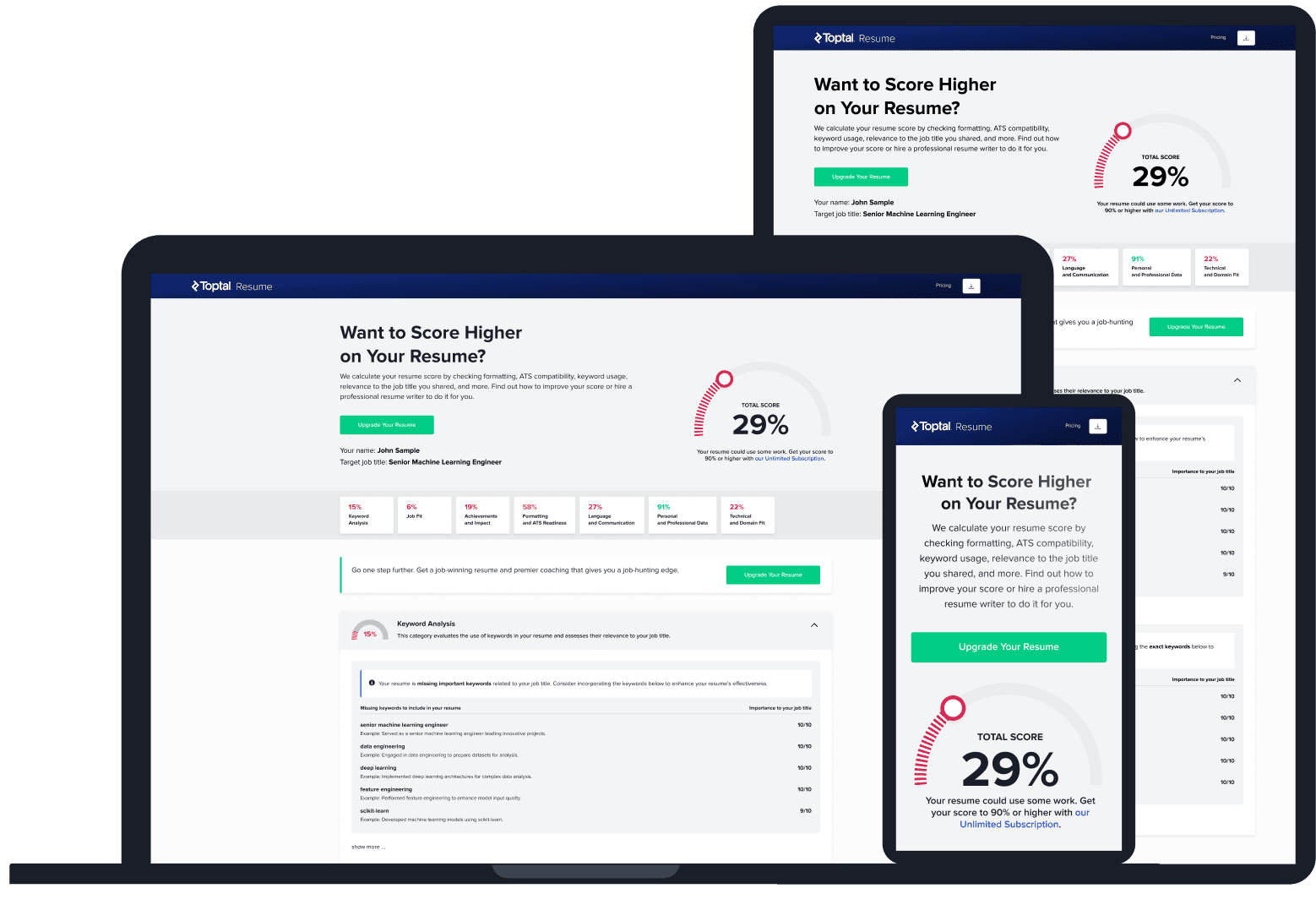
Upload your resume and tell us your target job title. Our system will analyze it the way a recruiter and ATS would—scoring it across core hiring dimensions and giving you personalized, role-specific feedback you can implement right away.
Read Next
Resume Tips
Resume Templates That Work: Formats, Examples, and How to Choose
The right resume template depends on your goals and experience, not your design preference. Here’s how to choose one that works for both ATS systems and human reviewers.

By Borislav Stojkov
Principal Resume Writer
Borislav Stojkov is a Principal Resume Writer at Toptal Resume. His professional track record includes personally reviewing and rewriting more than 2,000 resumes for professionals across industries. In his direct work with clients and the development of AI-based resume-writing services, he focuses on ATS-optimized structure, modern template design, and recruiter-aligned writing and formatting standards.
Resume Tips
Follow-up Email After Applying for a Job: Templates and Tips
A follow-up email after applying should be sent once, at the right time, and with something worth saying. Here’s how to do it without hurting your chances.
By Borislav Stojkov
Principal Resume Writer
Borislav Stojkov is a Principal Resume Writer at Toptal Resume. His professional track record includes personally reviewing and rewriting more than 2,000 resumes for professionals across industries. In his direct work with clients and the development of AI-based resume-writing services, he focuses on ATS-optimized structure, modern template design, and recruiter-aligned writing and formatting standards.

Resume Tips
Entry-level Resume: How to Write a Resume With Little or No Experience
An entry-level resume with no work experience isn’t empty: it’s built from projects, coursework, volunteering, and other evidence that proves you’re ready.
By Borislav Stojkov
Principal Resume Writer
Borislav Stojkov is a Principal Resume Writer at Toptal Resume. His professional track record includes personally reviewing and rewriting more than 2,000 resumes for professionals across industries. In his direct work with clients and the development of AI-based resume-writing services, he focuses on ATS-optimized structure, modern template design, and recruiter-aligned writing and formatting standards.