Follow-up Email After Applying for a Job: Templates and Tips
A follow-up email after applying should be sent once, at the right time, and with something worth saying. Here’s how to do it without hurting your chances.

AUTHOR
Borislav Stojkov
Principal Resume Writer
Borislav Stojkov is a Principal Resume Writer at Toptal Resume. His professional track record includes personally reviewing and rewriting more than 2,000 resumes for professionals across industries. In his direct work with clients and the development of AI-based resume-writing services, he focuses on ATS-optimized structure, modern template design, and recruiter-aligned writing and formatting standards.
Sending a follow-up email after a job application is a delicate situation and should be handled with care. The most appropriate approach is to wait one to two weeks after applying, send a short email to a named person, and follow up at most once more if you don't get a reply. The email should be under 150 words and, ideally, include one more thing not on your resume. This guide explains when and how to follow up on a job application and offers concrete follow-up email templates you can use for your next job application.
Standard Follow-up Email Template
Deciding on how long to wait to follow up after applying for a job is the first step, and the second is writing the actual message. Below is a complete, copyable, and sendable follow-up email template. You only need to fill in the sections in brackets and, if applicable, adjust the body line to include something your application didn't already include.
Subject: Follow-up: [insert job title] Application, [insert your name] ([if available, also insert the reference number from the posting])
Dear [insert recruiter's or hiring manager's name. "Hiring Team," only if the name can't be found],
I applied for [insert job title] on [insert the application date], and I wanted to follow up briefly. I greatly appreciate your time, as I know you must be working through many applications.
I'm still very interested in the role, and I'm confident I can contribute to your team, particularly in [mention one specific area from the job description]. Since submitting my application, I [mention a short, highly relevant update: if you've started/completed a certification, finished a relevant project, achieved a significant result]. I've attached my resume and cover letter for your convenience.
Could you let me know whether the role is still active or when you expect to be in touch with candidates?
Best,
[insert your name]
[insert your phone number]
This follow-up email template works well for the following reasons:
- Your application details are included in the subject line, so the recruiter can easily find your application.
- The email body adds a relevant detail, making the message more useful rather than a generic follow-up.
- Ends with a question, as emails without one don't invite a reply.
Always attach your resume to the follow-up email you send after a job application, as it gives you another opportunity to demonstrate your fit for the role. If you need help polishing your resume for your next application, Toptal's AI resume builder helps you create an effective, targeted document by guiding you through each section and offering tailored content suggestions based on your experience and the role you're applying for.
How Long to Wait Before You Follow Up on a Job Application
The right timing to follow up on a job application depends on the specific situation, and the table below covers all scenarios, including the timing and the reason for it.
| Situation | When to Follow Up | Why |
|---|---|---|
| Standard online application | 1 to 2 weeks after applying | The standard window, which leaves enough time for the initial screening |
| The posting states a closing date | 1 week after the closing date | Following up before applications close means that the recruiter has to act before they’ve started |
| The posting states a decision timeline | A few days after the stated date | The posting already makes the timing clear, and it’s a permission to reach out |
| You were referred by someone inside | 3 to 5 days | A referral typically shortens the window, and the person who referred you can also check internally |
| A recruiter or agency submitted the application for you | Follow up with the recruiter, not the employer | You shouldn’t go around the recruiter representing you |
| Senior or executive role | 2 to 3 weeks | Longer processes with more stakeholders |
| No contact name available | Same window, but sent to the “careers” inbox or their recruiter on LinkedIn | No name is not a reason not to follow up, and you should just change the channel |
| The posting has been reposted or is still live after a month | One short check-in, then move on | It usually means that the process restarted, and not that your application is being considered |
| After a direct rejection | Once, within a week, to ask to be considered for future roles | A separate template is below: short, no argument |
The Follow-up Email Specification
Every section and every dimension of the follow-up email sent after applying for a job has its purpose. The table below explains what each line in the message does and the rationale behind every rule.
| Element | What It Contains | Rule |
|---|---|---|
| Subject line | Job title and your name | The recruiter can easily find you (also, add the reference number if the posting lists it) |
| Greeting | The hiring manager’s name | Makes the message more personal. Use “Dear Hiring Team” instead of “To Whom It May Concern” if the name can’t be found |
| Opening line | Name the role and the date you applied | Gives the reader context to act without additional search |
| Second line | Acknowledge that they’re working through applications | Shows respect for their time and sets a non-demanding tone |
| Body | Reaffirm your interest and fit in one sentence + one thing your application didn’t say | A relevant detail, such as a recent result or a new certification, can make a difference |
| Ask | One clear, low-friction question | Asking whether the role is still open or when decisions are expected isn’t demanding |
| Attachment | Reattach the resume and cover letter | Name the file “Firstname-Lastname-Resume.pdf” |
| Sign-off | “Best,” “Best regards,” or “Kind regards” plus your name and phone number | No inventions are needed, and including the phone number makes replying or calling easy |
| Length | Under 150 words | You don’t want to overwhelm the reader by repeating the details known from the application |
| Tone | Warm, brief, no pressure | Demanding follow-ups can hurt your goals |
| Send time | A weekday morning | An email sent at the end of the day or on a weekend can get overlooked |
| Frequency | One follow-up and one final check-in | More than that is pointless |
Who to Send It to and How to Find Them
Many applicants know what to write in a follow-up email after applying for a job, but still don't send it because they're unsure who to reach out to. Here are the four most common channels of communication, listed by relevance, and practical tips on how to find the right person:
- Hiring manager. Your first choice, and their name is sometimes listed in the job posting, either as the manager or as the person to whom applications are sent. You can also search for them on LinkedIn, using the company's name and their likely title (for example, "Head of Marketing" or "Engineering Manager").
- Recruiter. Many listings include the recruiter's name or the name of the designated person in the HR team. Read the entire posting carefully, including any "apply via" details.
- Careers email. If no one listed above can be found, you can use the general careers email (usually careers@company.com or jobs@company.com) listed on the company's website.
- LinkedIn message. If you can't find the email address, you can also reach out to the recruiter or hiring manager on LinkedIn using the same message as the follow-up email described.
How Many Times to Follow Up and When to Stop
The rule is:
One follow-up → One final check-in → Then stop
You should follow up once using the follow-up email template provided and explained above, and that's your main contact after applying for a job. If you don't receive a response within a week or two, you can send one final check-in message. It's typically shorter, with one line restating your interest and another asking for updates. You don't need to include additional details or attach your resume and cover letter. After that, there's no point in constantly reaching out, and you should shift your focus and energy to other applications.
A phone call isn't a good option, as recruiters prefer email communication and written procedures over unsolicited calls. The exception could be a situation when the recruiter has already called you.
What to Say and What to Add in the Follow-up Email Body
When it comes to the content of the follow-up email sent after applying for a job, the most important part is the body. Of course, the introduction and the question about any updates are necessary, but the central part can make the difference, and it has three jobs:
- Acknowledge their workload: Say that you understand that they are busy and show appreciation for their time. That's the tone you want to open with.
- Reaffirm your fit: Don't repeat your entire resume; instead, use a line or two to connect your experience to a specific job requirement.
- Add another detail that your application didn't include: This is what makes the follow-up email more than a nudge. You can mention a result you've achieved since applying, a new certification, a project that is directly relevant to the role, or a specific reason why this company appeals to you that wasn't in the cover letter.
Follow-up Email Templates for Specific Situations
The standard follow-up email template works in most situations, but the three cases shown below would benefit from slightly different wording.
After a Referral
Subject: Follow-up: [Job title] Application, [Your name] (referred by [Referrer])
Dear [Recruiter's name],
I applied for the [role title] role [last week or on a specific date] after [Referrer's name] suggested I reach out [or say they submitted the referral for you], and I just wanted to follow up to confirm my application came through.
What particularly appeals to me about [company or the role] is [a specific detail about it], and I think my background in [mention one specific, highly relevant area (can be pulled from the posting)] fits very well with what you're looking for. [Your referrer's name] can also speak to my work if that's helpful.
Is there anything else you need from me at this stage?
Best,
[Your name]
[Your phone number]
The first introductory paragraph provides context for the referral, and the second paragraph is the differentiator.
When a Recruiter Submits Your Application
(Note: this follow-up email is sent to the recruiter, not to the employer)
Subject: Follow-up: [Job Title] at [Company Name (if selected externally)]
Hi [Recruiter's name],
I just wanted to check in on the [Role Title] role at [Company Name, if it's an external recruiter]. I've submitted everything required and am still very interested in the opportunity.
Do you have any updates on the selection timeline or next steps in the process? Happy to provide anything additional if needed.
Thanks,
[Your name]
[Your phone number]
The first paragraph provides the context of the application process, while the second part is your ask, framed positively.
After a Rejection
Subject: Thank You: [Role Title] Application
Dear [Recruiter's or hiring manager's name],
Thank you for the update and for letting me know about the [Role Title] position. I appreciate your taking the time to consider my application, and I completely understand the decision.
I remain genuinely interested in [Company Name] and would welcome the opportunity to be considered for any future roles that might be a better fit. I'll keep following your openings, and please feel free to reach out if something comes up.
Best,
[Your name]
In the first paragraph, acknowledge their decision and thank them for their time, and in the second paragraph, confirm your interest in the company.
What Not to Do When You Follow Up on a Job Application
There are five common and specific mistakes that candidates make when following up after applying for a job that should be avoided:
- Frequent emails: Sending weekly or even daily follow-ups will make you remembered for the wrong reason.
- Offensive or guilt-based language: Don't put them on the defensive by saying you haven't heard anything from them and that you're waiting for an answer.
- Contacting multiple people: Contacting different people simultaneously works against you in the same way as frequently contacting the same person.
- Sending the same email again: If you want to check in after the first follow-up, send a shorter email, not the same one.
- Calling the main switchboard: Those calls get filtered, and you likely won't reach the person you wanted.
What Silence Usually Means
Silence after a follow-up is not a verdict on you. Many employers never send rejections, so no reply can mean any of the following:
- The process is still running, and you're still being considered.
- The position has been filled, but they haven't sent notifications yet.
- The process is on hold.
Whatever the reason, you should never take it personally and should refocus your energy if you don't hear back even after the second check-in email.
Should You Reattach Your Resume to the Follow-up Email?
Yes, you should always attach your resume and cover letter to a follow-up email because having everything in one place makes it easy for them to review. Also, the email may be forwarded to a person who hasn't seen your application at all.
If not stated otherwise in the original job posting, submit both documents as PDF files, with the following file names: "Firstname-Lastname-Resume.pdf" and "Firstname-Lastname-Cover-Letter.pdf."
Build a Resume Worth Following Up On
If your follow-up emails get unanswered, the problem might be the application, not the email. Tailor your resume to each application and make sure to address every job requirement. Toptal Resume's AI resume builder can help you polish your resume to build a strong starting point, and the ATS resume checker provides an in-depth analysis to verify your resume is likely to reach the recruiter.
FAQ
ATS Resume Score Checker
for Professional Roles
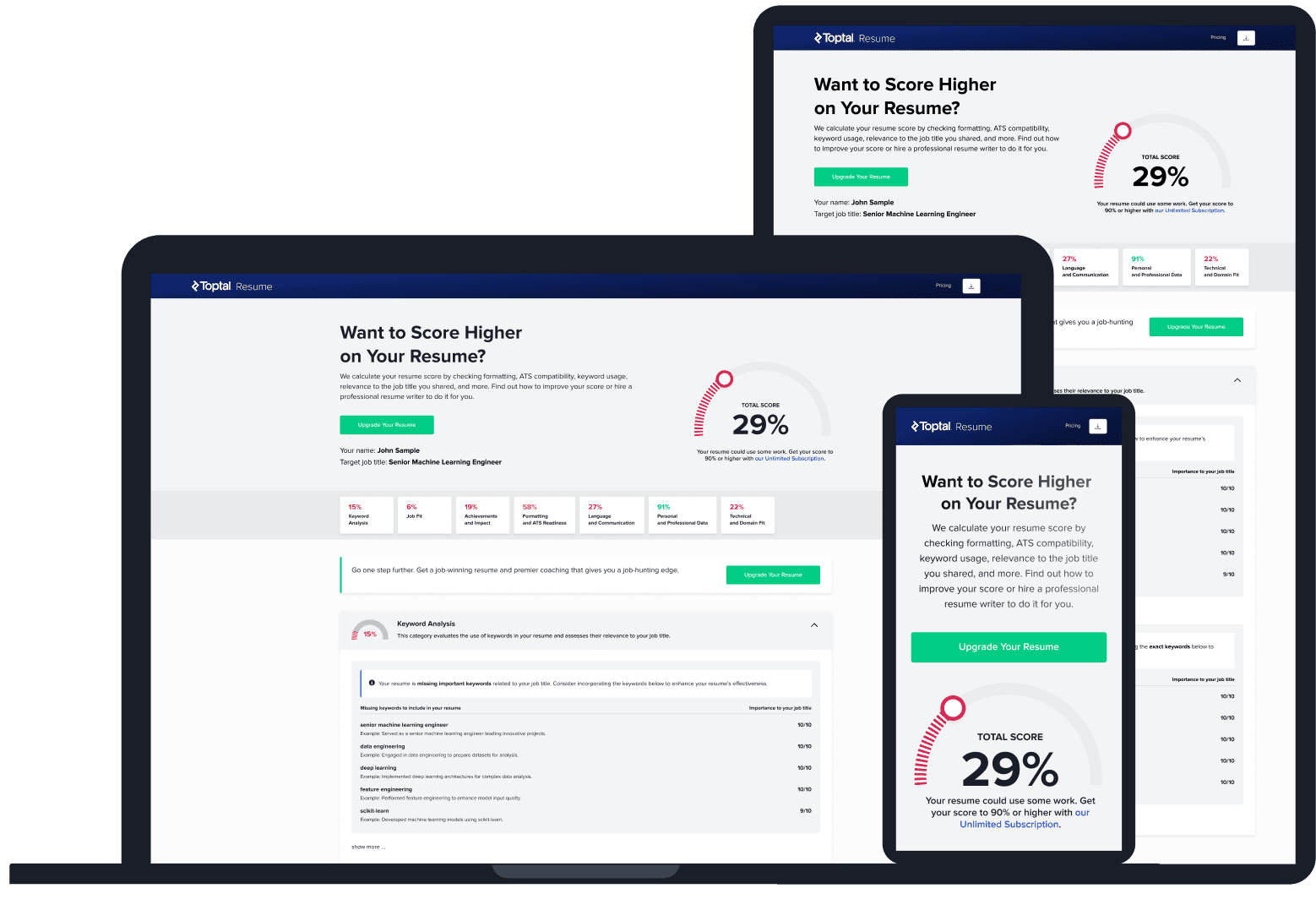
Upload your resume and tell us your target job title. Our system will analyze it the way a recruiter and ATS would—scoring it across core hiring dimensions and giving you personalized, role-specific feedback you can implement right away.
Read Next
Resume Tips
Resume Templates That Work: Formats, Examples, and How to Choose
The right resume template depends on your goals and experience, not your design preference. Here’s how to choose one that works for both ATS systems and human reviewers.

By Borislav Stojkov
Principal Resume Writer
Borislav Stojkov is a Principal Resume Writer at Toptal Resume. His professional track record includes personally reviewing and rewriting more than 2,000 resumes for professionals across industries. In his direct work with clients and the development of AI-based resume-writing services, he focuses on ATS-optimized structure, modern template design, and recruiter-aligned writing and formatting standards.
Resume Tips
Hard Skills vs. Soft Skills: What They Are and Where They Go on Your Resume
Hard skills go in your dedicated skills section. Soft skills go in your experience bullets. Here’s why that distinction matters and how to apply it.
By Borislav Stojkov
Principal Resume Writer
Borislav Stojkov is a Principal Resume Writer at Toptal Resume. His professional track record includes personally reviewing and rewriting more than 2,000 resumes for professionals across industries. In his direct work with clients and the development of AI-based resume-writing services, he focuses on ATS-optimized structure, modern template design, and recruiter-aligned writing and formatting standards.
Resume Tips
Entry-level Resume: How to Write a Resume With Little or No Experience
An entry-level resume with no work experience isn’t empty: it’s built from projects, coursework, volunteering, and other evidence that proves you’re ready.
By Borislav Stojkov
Principal Resume Writer
Borislav Stojkov is a Principal Resume Writer at Toptal Resume. His professional track record includes personally reviewing and rewriting more than 2,000 resumes for professionals across industries. In his direct work with clients and the development of AI-based resume-writing services, he focuses on ATS-optimized structure, modern template design, and recruiter-aligned writing and formatting standards.