A chronological resume, also called a reverse-chronological resume, puts your most recent experience first. From there, the work history moves backward in time. This is the format most people will recognize, and it works well when your recent experience is relevant to the role you want.
A typical chronological resume outline includes:
- Resume header and contact information
- Professional summary
- Skills
- Work experience in reverse-chronological order
- Education
- Additional sections where relevant
This outline makes your career timeline easy to follow. A recruiter can quickly see where you’ve worked, what you’ve done, and how your responsibilities have progressed over time. Harvard's career guidance recommends listing information within resume sections in reverse-chronological order and keeping the overall document consistent and easy to follow.
A chronological resume is usually a good choice if you:
- Have a steady work history.
- Have recent experience relevant to the role.
- Have worked consistently in the same field or a related area.
- Have progressed through related positions or taken on increasing responsibility.
- Want recruiters to see your career progression clearly.
The trade-off is that this format puts your timeline to the front. If you have significant gaps, frequent short-term roles, or a recent position that has little connection to your target role, it will be noticeable. That isn’t necessarily a reason to avoid the format. If your experience is relevant overall, it may be more useful to present your history clearly and give more space to the roles and achievements that support your application.
If this structure fits your background, start with Toptal’s Chronological Resume Template.
A functional resume puts more emphasis on skills and achievements than on the timeline of your employment. Instead of organizing the main part of the resume by job, it groups relevant experience under skill categories or areas of expertise.
For example, someone targeting a project management role might organize their experience around:
- Project planning and delivery
- Stakeholder management
- Process improvement
- Team leadership
The experience behind those skills can come from different jobs, projects, education, volunteer work, or other settings.
A functional resume may be worth considering if you:
- Are changing careers and have transferable skills but limited experience in the new field.
- Are returning to work after a significant break.
- Are re-entering the workforce after caregiving or education.
- Have relevant experience from freelance, contract, volunteer, academic, or project work.
- Are applying for a role where your strongest qualifications aren’t closely tied to your recent job titles.
The advantage is that you can bring the most relevant skills forward without requiring a recruiter to look for them across several jobs. There’s an important distinction here, though. You shouldn't use the functional resume to make your work history disappear. Recruiters still need enough context to understand where your skills came from and how you used them. Employers, dates, roles, and other essential information should still be clear even if they aren’t the main focus.
The structure can also affect how easily some applicant tracking systems (ATS) interpret the information. Modern systems can extract and organize information from resumes, but an unconventional structure can make it harder to connect a skill or achievement to the experience behind it. Clear headings and consistent formatting can help. CareerOneStop similarly recommends standard section headings and warns that limited work-history detail can create issues for both employers and ATS.
If you’re searching for a functional resume template or functional resume example, keep the emphasis on clarity. The point is to make relevant skills easier to find, not to hide the career history behind them. The skills you highlight should still be supported by specific evidence to show where that experience came from. Toptal currently focuses on reverse-chronological resumes, so a dedicated functional resume template isn't available yet.
A combination resume sits somewhere between the two formats. It gives skills and relevant achievements more prominence near the beginning of the resume, while still presenting your work experience in reverse-chronological order. That can be useful when you have a solid work history, but your job titles don’t fully reflect the experience that matters for your next role.
A typical structure might include:
- Resume header and contact information
- Professional summary
- Core skills or areas of expertise
- Selected achievements
- Work experience in reverse-chronological order
- Education
- Additional sections
For example, if you're a marketing manager applying for a product marketing position, your previous roles probably don't have “product marketing” in the title. Despite that gap, you might have led customer research, collaborated with product teams, and supported product launches. A combination resume gives your transferable skills more visibility while still showing where that experience was gained.
A combination resume can be a good fit if you:
- Are changing careers but have strong, relevant transferable skills.
- Have a solid work history that you don’t want to downplay.
- Have developed relevant skills across several different roles.
- Want to connect older or less obvious experiences to your current career goal.
- Need more space to explain why your background fits the role than a classic chronological format provides.
The main risk of this format could be repetition. If your skills and achievements section simply repeats everything from your work experience, the resume can become longer without adding much information. The two sections should work together, with the opening section showing what makes you relevant and the work history providing the evidence behind it.
Toptal currently offers a chronological resume template rather than dedicated combination or functional templates, so candidates using a combination format would need to structure those sections themselves.
The three formats put emphasis on different places. A chronological resume makes the career timeline easiest to follow. A functional resume puts skills and achievements first. A combination resume gives space to both skills and work history.
Start with your recent experience. If your current or most recent work is relevant to the role you’re applying for, and your career history tells a reasonably clear story, chronological is usually the simplest choice.
Do you have a steady work history and relevant recent experience?
Go with a chronological resume. If your recent roles support the job you want, there's no reason to make your resume structure more complicated.
Are you changing careers?
Look at how much relevant experience you already have. If you have strong transferable skills and a solid work history, a combination resume can help connect the two. If most of your relevant experience comes from projects, freelance work, volunteering, education, or other experience outside your main career, a functional format may give those skills more room.
Are you returning to work after a significant gap?
A functional format can put more emphasis on the skills and achievements you want employers to notice. A combination resume may be a better fit if you also have a strong work history that remains relevant to the role.
Do your job titles undersell your experience?
A combination resume may help if the skills that qualify you for your target role are spread across different positions and aren’t obvious from your titles alone.
Are you considering a different format to hide parts of your background?
That’s usually a sign to reconsider. A functional or combination resume should help a recruiter understand your experience, not make important parts of your career harder to find.
There’s also a simpler way to decide: imagine the person reviewing your resume knows nothing about you. What part of your background would you need to explain to them in most detail? If your career history makes your fit for the role clear, a chronological format is usually enough. If your skills need to be connected across different jobs or types of experience, a different format may give you more room to do that.
Once you’ve decided on a format, the next step is deciding what to include and where it belongs. Start with a simple resume outline before you spend time polishing the wording. This gives you a clear structure to work from and helps you see which parts of your experience deserve the most space.
The emphasis will depend on the format. In a chronological resume, make your most relevant roles and achievements easy to find. In a functional resume, support each skills section with specific proof and enough work history to provide context. In a combination resume, ensure the skills section adds new context instead of only repeating your work experience.
In every format, keep basic elements like contact information easy to find. From there, give the most space to the experience and achievements that support the role you want. You can build your resume from scratch with the Toptal resume builder or start with Toptal’s chronological template if that structure fits your background.
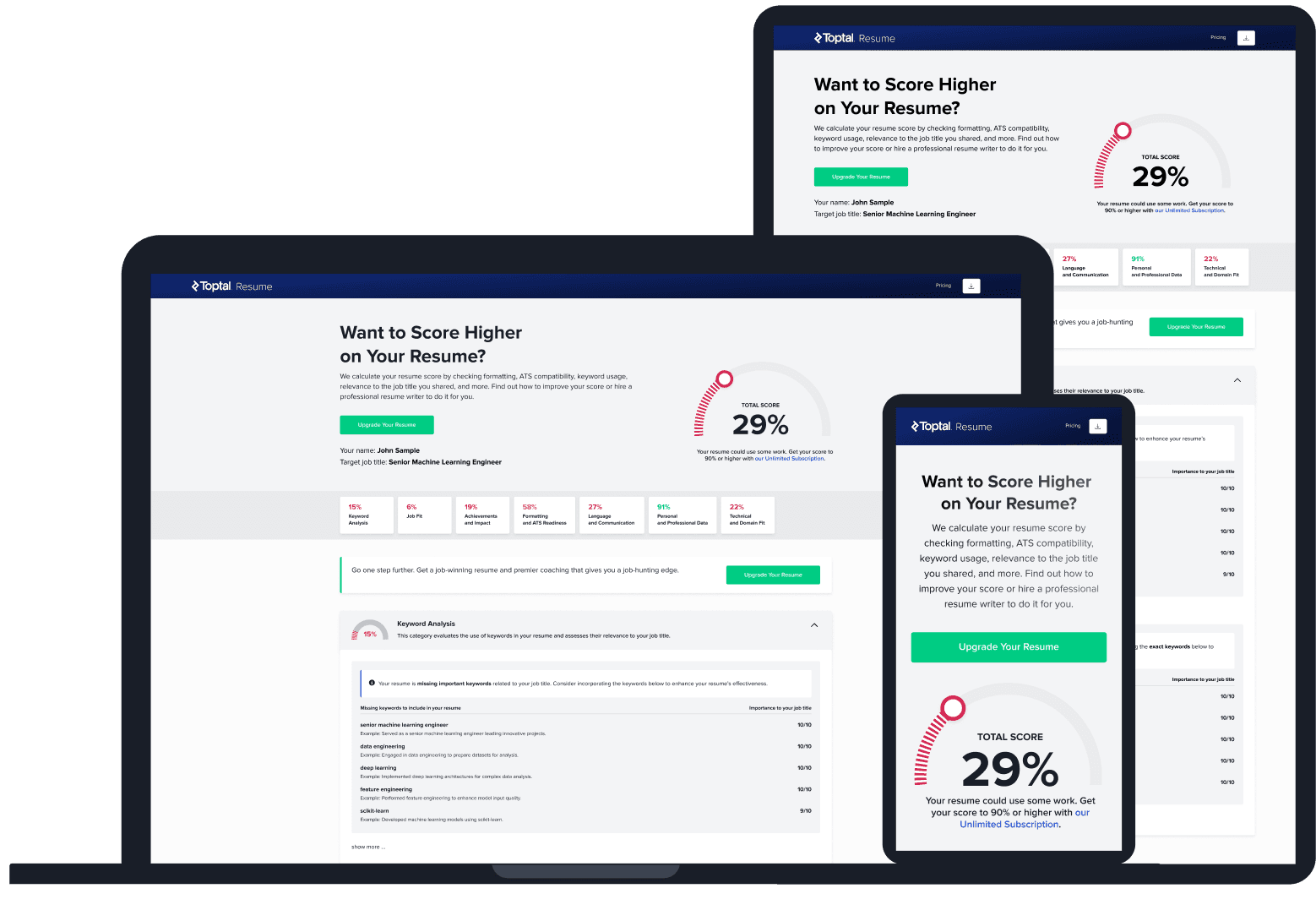
Before you submit the finished resume, review it against the job description. Make sure the relevant skills are easy to identify and that your experience provides enough evidence to support them. You can also use Toptal’s ATS resume checker as a final review to see how clearly your resume presents your experience and qualifications.