Cover Letter for Internship: Examples, Template, and Writing Tips
No paid experience? Coursework, projects, and volunteering can prove your fit. Here’s how to turn them into a letter.


AUTHOR
Borislav Stojkov
Principal Resume Writer
Borislav Stojkov is a Principal Resume Writer at Toptal Resume. His professional track record includes personally reviewing and rewriting more than 2,000 resumes for professionals across industries. In his direct work with clients and the development of AI-based resume-writing services, he focuses on ATS-optimized structure, modern template design, and recruiter-aligned writing and formatting standards.
Writing a cover letter for internship applications means proving your fit for the position when you have no work experience to showcase, but that doesn't mean you don't have any practical skills and achievements that can get you hired. The key is to compensate for a lack of previous job experience with what you have: school or personal projects, volunteering, and any part-time engagements, always bringing your skills forward.
Employers hiring interns don't expect an experienced professional, but they do expect a skilled candidate who aligns with their business needs. Based on what we know works from years of working with students, graduates, and entry-level job seekers, this guide will help you learn how to make your case effectively with concrete examples, rewrites, and templates.
Writing a Cover Letter for an Internship Still Means Showing Evidence (Not Just Enthusiasm)
A well-performing cover letter makes it clear to the prospective employer why they should hire a candidate for that specific role at that specific company. It's a one-page document that supports and introduces a resume, but the two use different approaches to achieve the same goal: a resume is a detailed list of an applicant's professional background, including all relevant work results and required competencies. On the other hand, a cover letter allows for a more personal touch when showcasing your role and overall fit with the company, while still demonstrating your achievements and relevant skills.
The same goes for cover letters written for internship applications, but the source of evidence shifts a bit. Similar to writing a resume when you don't have work experience, an internship cover letter showcases your strongest assets, which naturally don't come from paid work experience: your education, skills, volunteering experience, or academic projects. It's never enough to simply express your enthusiasm to work and learn at a specific company, as it can't make you stand out from other candidates.
Passion is good, but it must be proven by concrete things: show where your skills come from and how you used them to achieve specific results or solve specific problems. As confirmed by the Job Outlook 2026 survey from the National Association of Colleges and Employers, 70% of employers use skills-based hiring, and you should make a clear connection between the skills you have and the job you're applying for.
Understanding Good Internship Cover Letter Examples: Do's and Don'ts
First of all, your cover letter shouldn't repeat all the details from your resume. You should pick a few of the most relevant ones from the ad and use them to explain why you'd be great in that role, and even include points that can't be found in the resume. Adding a relatable detail helps you demonstrate your cultural fit, which goes beyond the resume.
Having more liberty regarding the document's formality doesn't mean submitting an unstructured brain dump of randomly listed details, no matter how impressive they are. A proper cover letter format for internship applications includes the following sections, each of them with a specific purpose:
- An opening paragraph, after addressing the reader, is where you should mention the role you're applying for and instantly link it to your skills and experience.
- The first body paragraph is where you showcase the selected relevant achievements using concrete evidence from your background.
- After that, explain why that specific company: say what draws you to it, show your familiarity with their work, and how that aligns with your background and goals.
- End by restating your interest and inviting them to make the next move.
A cover letter for an internship implies a candidate with no experience, or with limited experience, so you shouldn't apologize, and you should own your career stage and frame it proactively: You haven't worked in the field yet in a paid job, but you've got what the internship position calls for.
The Internship Cover Letter Format: A Practical Example
The internship cover letter example in the image below features a fictional candidate, Sam Rivera, follows the approach outlined above, and reflects best practices proven over years of work with job seekers at all career levels. It offers evidence of the skills Sam gained and applied through his coursework and projects, demonstrates his role and company fit, frames his stage positively, and, most importantly, doesn't invent experience.
This cover letter is tailored to the following internship position and hiring scenario: Sam, a marketing student, is applying for a Marketing Analytics Internship at Tidewater Marketing Group. The main requirements of the job description include the following skills and responsibilities: Excel/Sheets, reporting, data analysis, presentations, and collaboration.
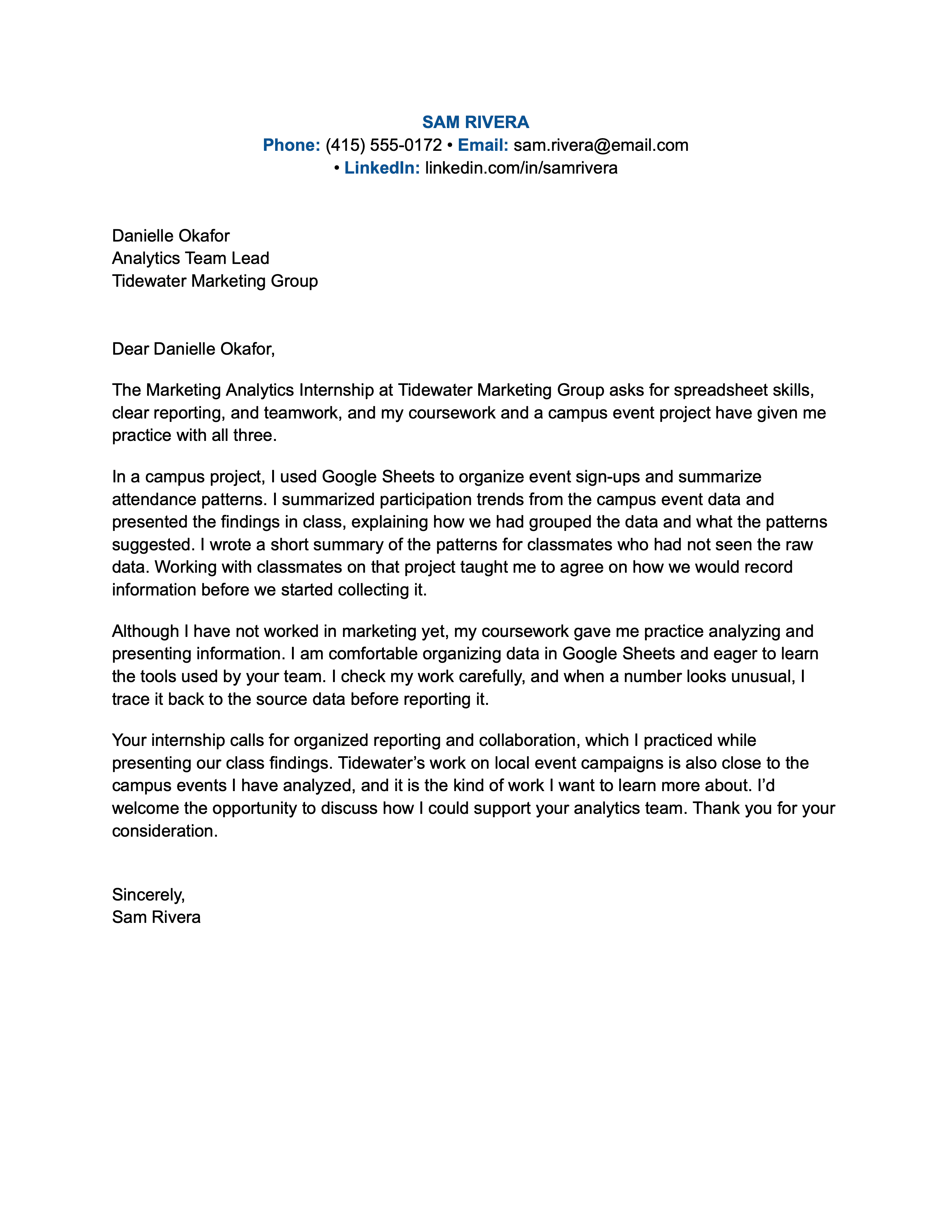
All the job requirements are skillfully addressed in the example in the image above, showing what to put in a cover letter instead of job experience:
- He begins the letter by linking his background to the role he's applying for: his spreadsheet skills, reporting experience, and teamwork stem from his university activities.
- In the central part of this internship cover letter, Sam demonstrates how he applied the required skills practically by explaining how he used Google Sheets to organize event sign-ups and summarize patterns, analyzed and presented information, and collaborated with teammates on the project.
- Before the sign-off, he demonstrates his understanding of the company's work by aligning his skills with Tidewater's current local event campaigns and restates that his skills match their goals and needs, even though he hasn't worked in marketing yet.
The same approach can be applied regardless of the internship type and works for all fields and industries. Let's now imagine a scenario in which Sam Rivera is a software engineering student targeting an internship at a tech company, Pinecrest Software. This time, we can skip the optional segment acknowledging the lack of experience:
Dear Danielle Okafor,
The Software Engineering Internship at Pinecrest Software asks for solid Python fundamentals and clear documentation, and a course project of mine gave me practice with both.
For a Python coursework project, I built a small tracking tool and documented how to test it. The tool lets a user add, update, and list tasks stored in a file, and I wrote tests for each of those actions along with a short README explaining how to run them. When a test failed after I changed how tasks were saved, I traced the problem to a formatting error in my code and corrected it before submitting.
Pinecrest's focus on tools for small engineering teams appeals to me because testing and documentation were the parts of my project I enjoyed most, and I would like to learn how professional teams handle them. I would be glad to talk about how I could support your team this summer. Thank you for your time.
Sincerely,
Sam Rivera
This method is built into Toptal Resume's cover letter generator, which produces a cover letter in a few simple steps: you upload your resume, paste the job description, and generate a tailored document that matches your achievements to the job's requirements and expectations.
What Can Count as Evidence Instead of Job Experience
In the example from the previous section, Sam is applying for a marketing internship, but the same approach can be used for any internship. The table below shows how you can turn club involvement, volunteering, part-time jobs, or lab work into impactful evidence in your cover letter across fields and industries.
| What You Have | What It Can Demonstrate | How to Write It | Best Use |
|---|---|---|---|
| Course project that involved spreadsheet analysis | Data organization and communication | “In a class project, I cleaned a survey dataset in Excel and presented three patterns to my team.” | Data/marketing internships |
| Coding project with a repository | Practical programming and testing | “For a Python coursework project, I built a small tracking tool and documented how to test it.” | Software internships |
| Student club event planning | Coordination and follow-through | “I coordinated volunteer shifts for a campus event and kept participants updated as plans changed.” | Operations internships |
| Part-time customer service job | Communication under real deadlines | “Working at a store taught me to resolve customer questions and keep accurate shift handoffs.” | Customer success internships |
| Course research or lab work | Evidence gathering and synthesis | “I compared source findings for a research assignment and summarized limitations in a short report.” | Research internships |
Writing Tips for Content Tailoring
We've seen what a strong internship cover letter looks like and which elements and formatting to follow, but let's now take a closer look at the details. The table below shows writing techniques and how to write specific claims in an internship cover letter when you have no experience. The key is to avoid generic, vague phrases, use results-oriented language, stay honest, and not invent facts that aren't supported by your actual experience.
The excerpts below compare parts of Sam Rivera's letter in a "before and after" format to help you master your writing for an effective internship cover letter.
| Don’t | Do |
|---|---|
| Express generic enthusiasm, like “I am passionate about marketing and data.” | Showcase actual relevant work you’ve done: “In a campus project, I used Google Sheets to organize event sign-ups and summarize attendance patterns.” |
| Exaggerate your experience level by saying things like “I have extensive industry experience.” | Stay honest, without fabrications: “Although I have not worked in marketing yet, my coursework gave me practice...” |
| Pretend expertise that isn’t supported, such as “I have mastered every analysis tool.” | You should always demonstrate your skills, but without false claims: “I am comfortable organizing data in Google Sheets and eager to learn the tools used by your team.” |
| Claim the company fit without saying why, such as “I would be a great fit for any company.” | Be specific about the role: “Your internship calls for organized reporting and collaboration, which I practiced...” And show your knowledge of the company: “Tidewater's work on local event campaigns is also close to the campus events I have analyzed…” |
| Make up numbers to sound impressive: “My project increased attendance by 40%.” | List your own, real achievements: “I summarized participation trends from the campus event data and presented the findings in class.” |
In internship cover letters, your assets are your skills and education, and your experience comes from coursework, projects, volunteering, or part-time work; there's no need to exaggerate. Another essential aspect of a good cover letter is specificity. Just as you should tailor your resume for each application, you should use the same approach for cover letters, and avoid using one generic document for all applications.
Internship Cover Letter Template: Adapt It for Each Application
Although you should adapt your cover letter for every internship application, make sure to follow its structure and the one-page format with paragraphs that cover your fit for the role and the company, backed by your most relevant skills and achievements. To make it easier for you to write a cover letter for your next internship application, below is a cover letter template you can use by replacing the content in brackets with your own details.
Dear [First Name Last Name],
The [Internship Title] at [Company] asks for [one requirement from the listing], and [Relevant project or coursework] gave me practice with it.
[Evidence of work: what you did in that project, course, club, volunteer role, or part-time job, which tool or method from the listing you used, and what you learned and achieved.] (Optional honest sentence about your stage) Although I have not worked in [field] yet, [the skills that make you a good fit].
What particularly draws me to [Company] is [reason for interest: one specific thing about this company’s or team’s work that connects to what you want to learn].
Thank you for your time. I would be glad to talk about how I could support [team or department] this [season or semester].
Sincerely,
[Your name]
When it comes to the cover letter's layout and style, it's good practice to use a design that mirrors your resume. Toptal Resume's AI resume builder comes with a selection of ATS-friendly resume templates ranging from simple to more creative ones, and you can choose the one that suits your cover letter the most.
Final Take: What to Check Before Submitting and Mistakes to Avoid
An effective internship cover letter that will land you the position you're targeting has to be based on your skills, education, and results that don't need to come from a paid job: use your coursework or personal projects, volunteer work, and any part-time engagements relevant to the internship. Don't praise yourself without evidence or fabricate achievements; focus on what you accomplished and explain how you used your skills. As we showed in Sam Rivera's internship cover letter example, you can address your career stage proactively and positively, and that is completely fine and expected.
Always read the posting carefully, map the requirements, and follow the instructions on the file format. If not specified, always submit a PDF file, as it preserves the original layout and formatting. Be concise and don't exceed one page by repeating all the details from your resume. Pick a few of the most important requirements from the job description, and use them to demonstrate your fit. It's okay to be a little more personal than the resume's tone, and try to include the name of the person you'll be addressing in the cover letter. Everyone likes to see their name, rather than "To whom it may concern."
Cover letters are targeted, and you should tailor yours for every internship application. There's no point in sending a generic one that could apply to any candidate. If you need assistance tailoring its content, try Toptal Resume's cover letter generator, which analyzes the job requirements, matches them to details from your resume, and creates a customized cover letter ready to send.
FAQ
ATS Resume Score Checker
for Professional Roles
Upload your resume and tell us your target job title. Our system will analyze it the way a recruiter and ATS would—scoring it across core hiring dimensions and giving you personalized, role-specific feedback you can implement right away.
Read Next
Resume Tips
Best Free ATS Resume Checkers: Tools Tested and Compared
One resume and one job description run through seven ATS checkers to show what each really offers for free and how useful the reports are.

By Borislav Stojkov
Principal Resume Writer
Borislav Stojkov is a Principal Resume Writer at Toptal Resume. His professional track record includes personally reviewing and rewriting more than 2,000 resumes for professionals across industries. In his direct work with clients and the development of AI-based resume-writing services, he focuses on ATS-optimized structure, modern template design, and recruiter-aligned writing and formatting standards.

Job Market Trends
How Understanding Applicant Tracking Systems (ATS) Can Land You a Top Tech Job
Nearly all Fortune 500 companies use ATS to screen applicants. Understand how these systems parse resumes so yours doesn't get filtered out.

By Amanda Menin
HR & Career Strategy Expert
Amanda Menin is a Talent and Organizational Strategy expert specializing in hiring practices, resume optimization, and applicant tracking systems (ATS). With more than 20 years of experience across technology, healthcare, and consulting, she offers practical insight into how employers evaluate candidates. She holds a master’s in industrial and organizational psychology and is a SHRM Senior Certified Professional (SCP).

Resume Tips
Resume Format for Career Changers: Why a Combination Resume Usually Works Best
A guide to choosing a resume format for a career change: how chronological, functional, and combination resumes compare, and how to build the one that works for most online applications.

By Inge Miscevic
Principal Career Coach
Inge Miscevic is a Principal Career Coach at Toptal Resume with over a decade of experience reviewing and improving thousands of resumes across industries. In her work with clients, she focuses on clear resume structure, effective formatting, and content that presents real experience in a way recruiters can quickly understand.