How to Write a Tech CV for Software Engineering Roles
If you’re a software engineer looking to land tech interviews, a clear, focused CV is essential. Learn how to write a software engineer CV that highlights your tech skills, demonstrates impact, and passes ATS screening.

AUTHOR
Audrey Goodson Kingo
Career Expert
Audrey Goodson Kingo is a book author and a renowned journalist covering careers and HR. She has advised insurance giant Aon on work-life balance and shared her expertise with CNN, Good Morning America, MSN, and more.
If you’ve built impressive technical skills and speak multiple programming languages but still struggle to land interviews, you’re not alone. Even highly qualified software engineers face fierce competition in today’s job market—especially as AI continues to reshape the role and raise expectations.
Still, software engineers remain some of the most in-demand and well-compensated professionals in tech. But in a tight talent market, an effective tech CV is essential—one that clearly showcases your skills, project outcomes, and measurable impact.
Writing a strong software engineer CV isn’t as straightforward as it might seem. A strong CV emphasises results rather than just responsibilities and is formatted to pass applicant tracking systems (ATS), which many large companies use to screen candidates.
Whether you’re creating a software engineer CV from scratch or tailoring one for your next role, the expert guidance below will help you structure a tech CV that’s readable, relevant, and ready to appeal to both ATS filters and today’s busy hiring managers.
What Makes a Strong Tech CV for Software Engineers?
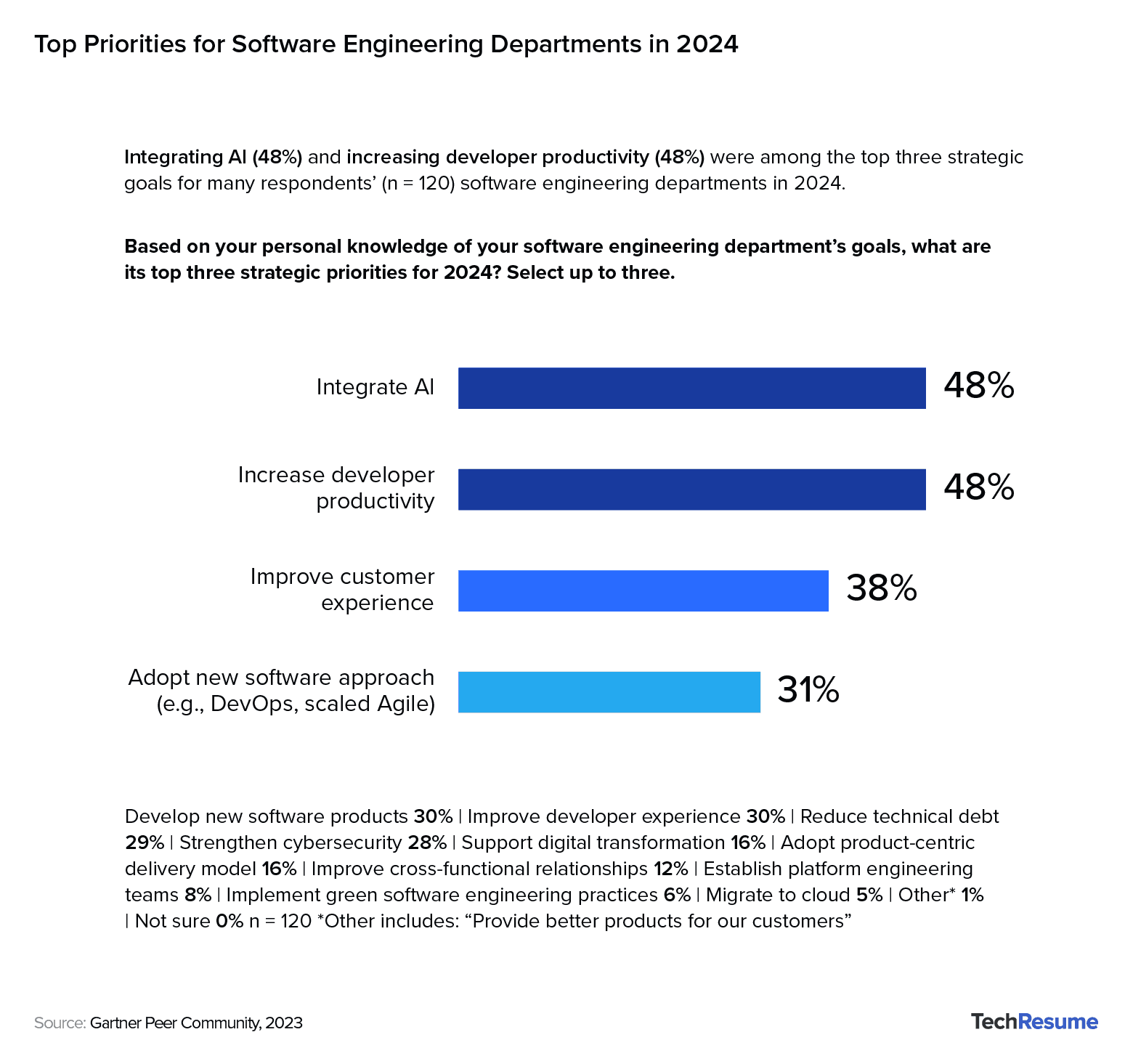
Software engineering teams are under pressure to deliver faster and smarter, especially as AI integration and productivity improvements top the list of 2024 priorities, according to Gartner research. In response, hiring managers are prioritising candidates who can demonstrate not just technical skills but business-relevant impact.
To stand out, your CV should highlight outcomes that align with those priorities, such as infrastructure cost savings, system performance gains, or improved user experience. And if you have experience in high-demand areas like AI, machine learning, or automation, showcase those skills early and clearly.
Tech hiring managers today are also looking for very specific skills, tailored to the role and organisation. That’s why a strong software developer CV is clear and concise, and showcases relevant experience in each section. For inspiration, many candidates turn to software engineer CV examples or a software developer CV template to better understand the structure employers expect. Tech candidates early in their careers (with five years of experience or less) should aim to keep their CV to one page.
More senior professionals may extend to two pages if needed to cover relevant accomplishments. Regardless of level, avoid including hobbies, soft skills, or generic objectives—these add little value and can distract from your core qualifications.
Pro Tip: Recruiters spend 6 to 10 seconds on the first pass of a CV, so make key info scannable.
How Should I Format My Tech CV for Readability and ATS?
Even the best candidates can get overlooked if they submit a CV that’s not ATS-friendly. In fact, ATS tools can lead to qualified candidates being screened out, especially when systems are poorly configured or too rigid. That’s why choosing the right CV format for software engineer roles is essential—it ensures both human readability and ATS compatibility.
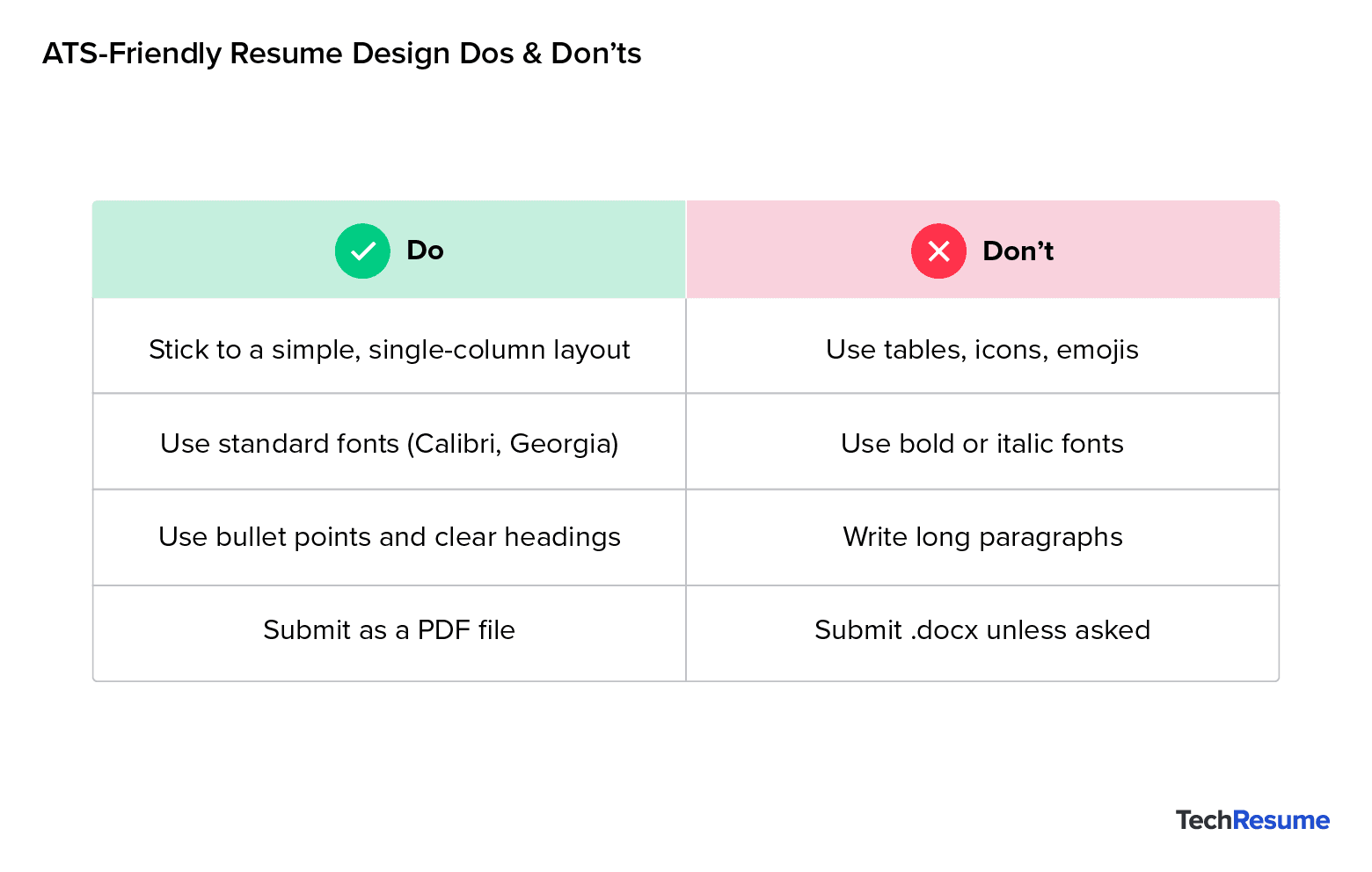
To keep your CV both human-readable and compatible with ATS filters, stick to a simple, single-column layout. Also, use standard fonts like Calibri or Georgia and skip using bold or italic. Moreover, avoid using tables, icons, emojis, or graphics, which may not pass an ATS filter.
Concise bullet points—ideally one to two lines, beginning with strong action verbs—help highlight achievements without overwhelming the reader. In addition, most CVs should be submitted as PDFs unless stated otherwise in the job application.
How Do I Write a Tech CV Summary That Works?
Candidates for roles at top companies—like Google, which receives 3 million CVs a year—have only a few seconds to make an impression, given the sheer volume of applications recruiters must sift through. A well-written CV summary can convince a recruiter to keep reading by providing a brief overview of your experience and accomplishments.
An ideal CV summary should convey your technical identity, years of experience, relevant skills, and key differentiators in 2-4 lines. For example: “Software Engineer with extensive experience building scalable back-end APIs and cloud-native services in Go, Python, and AWS. Known for reducing infrastructure costs and improving deployment pipelines.”
“In a crowded hiring market, a strong summary can immediately set a candidate apart. We look for signals of technical focus, clarity, and how well a candidate’s strengths align with the requirements of the role.”
— Marisa Goldberg, Senior Director of Recruiting at Toptal
Avoid buzzwords like “hard worker” or “go-getter” and vague phrases such as “motivated team player.” Instead, tailor the summary to reflect your role focus—for example, back end, front end, full stack.
How Do I Showcase Technical Skills Effectively?
Skills have always played a central role in tech hiring decisions, but now, more than ever, they’re critical. In PwC’s 28th Annual Global CEO Survey, 23% of CEOs said a lack of skilled workers was a major threat to their companies.
Filling those gaps is a top priority for many HR professionals, which is why it’s crucial for software engineering candidates to showcase their relevant technical chops for every role, in both the skills and work experience parts of their CV.
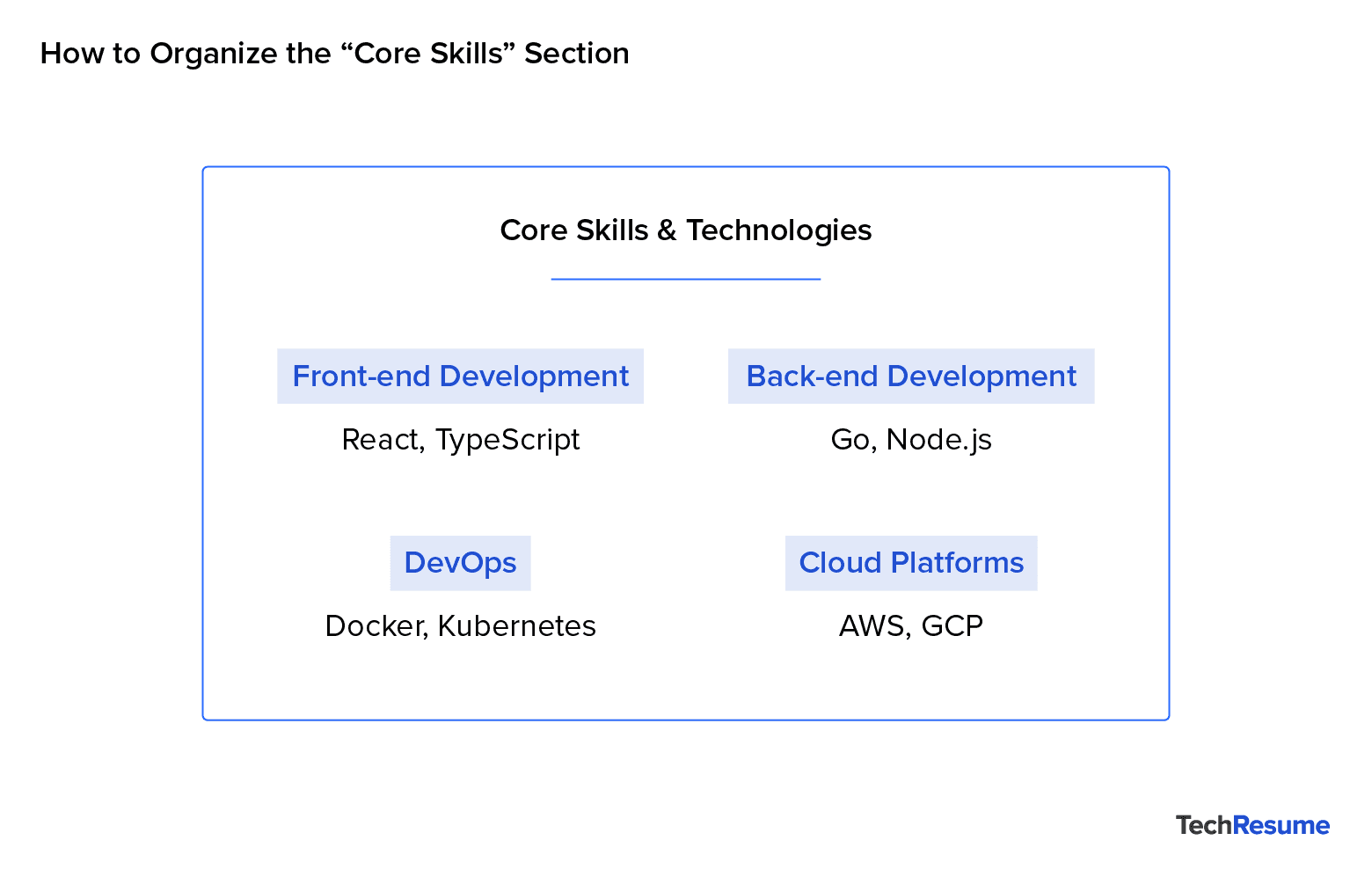
Your technical skills should be immediately visible near the top of your CV, ideally in a dedicated “Core Skills” section listing 10 to 20 relevant tools, frameworks, and languages. Because recruiters often scan quickly, prominently displaying technical competencies can make a big difference.
“One of the biggest red flags I see in CVs is a mismatch between the skills listed and what the role actually requires. Highlighting relevant technologies—upfront and in context—shows me that a candidate has the capabilities that matter most for the job.”
— Marisa Goldberg, Senior Director of Recruiting at Toptal
To improve clarity, group skills into categories (front end, back end, DevOps). Prioritise those most relevant to the job you're applying for and to emerging trends in the industry. AI and machine learning are among the most in-demand skills today.
Pro Tip: Include your GitHub link in the header alongside your LinkedIn profile to highlight your code quality and project contributions. Many recruiters check it even before reviewing your CV in detail.
What Should I Include in My Work Experience Section?
It can be challenging to condense your career into a few paragraphs in the “Work Experience” section of your CV, but brevity is your ally since it forces you to focus on your key accomplishments. Remember, recruiters want to know about your results, not just your responsibilities.
When writing this section, use a clear format that includes your job title, company, and dates of employment. Each entry should feature concise bullet points—ideally 5-10 for your current role and fewer for previous positions—highlighting your technical accomplishments. Emphasise outcomes such as speed improvements, cost savings, or scaling success, and mention specific tools or technologies only when they’re central to the result.
Effective bullet points start with a strong action verb like “advanced” or “improved” and connect the action, the result, and the tools or technologies used to achieve it. For example, instead of writing “Improved CI/CD pipeline,” you could write: “Reduced CI/CD build time by 70% by implementing parallel testing workflows using CircleCI and Docker.”
Pro Tip: Avoid long lists of technologies in your “Work Experience” bullets. Instead, focus on outcomes and highlight how you used tech to achieve those results.
What About Tech Certifications, Education, and Extras?
While technical skills and experience are the backbone of your CV, education and certifications still play a supporting role. A college degree is worth mentioning, even as many employers shift towards skill-based hiring. In fact, research from SHRM shows that a majority of executives and HR professionals are open to treating alternative credentials as equivalent to traditional degrees in some cases.
That said, this section should be concise. List each degree on its own line, and omit your graduation year if it was more than five years ago to help avoid age bias. Only include certifications if they’re relevant and recent, such as a DevSecOps or AWS credential for cloud-related roles.
Apart from that, make sure to skip listing hobbies, references, photos, or other extraneous details, which can distract from your qualifications and impact ATS compatibility. Save these personal details for the interview to keep your CV concise and focused.
Common Mistakes to Avoid When Writing a Software Engineer CV
Many strong candidates lose out on opportunities because of preventable CV mistakes. Using flashy design elements, listing outdated technologies, or repeating vague responsibilities instead of measurable outcomes can hurt your chances, especially with ATS filters. Refrain from including irrelevant or outdated experiences, soft skills, or filler sections, and always tailor your CV to match the specific job description.
Pro Tip: Don’t forget to proofread. Typos in a tech CV signal carelessness.
Final Checklist for a Software Engineer CV
Before applying, make sure you’ve adhered to the best CV format for software engineers. Do a final check so your CV:
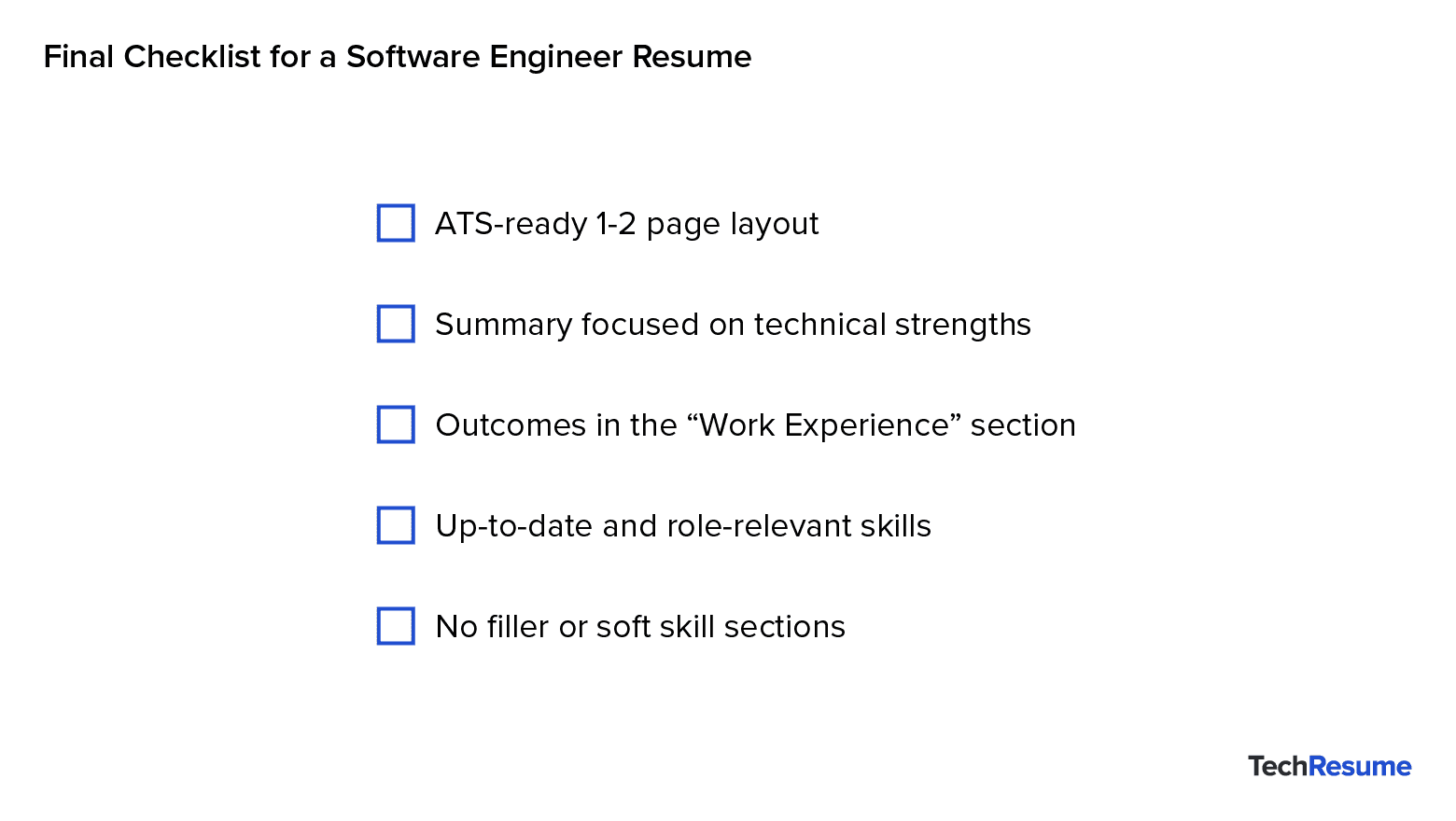
- Features an ATS-ready format and a clean and readable 1-2 page layout
- Includes a summary focused on technical strengths
- Shows outcomes or impact in your “Work Experience” section
- Features skills that are up-to-date and relevant to the job description
- Omits soft skills or filler sections (hobbies, objectives, images, references)
Need Help Creating a Software Engineer CV That Gets You Hired?
In an era when AI is transforming software engineering and making the labour market increasingly competitive, it’s important for software developers to submit a strong CV that is clear, concise, results-oriented, and relevant not only to the job in question but also to the wider trends reshaping tech.
But CV tips for tech jobs can be inconsistent and confusing, especially given the rapid rate of change in the industry. Toptal Resume takes the guesswork out of crafting a compelling, ATS-optimised CV. Its ATS score checker can check for role-relevant keywords, measuring how closely your language matches the job description, and assessing whether the structure is fully compatible with ATS. Take advantage of Toptal Resume’s proven expertise to stand out in a competitive industry and snag a coveted software engineer role.
FAQs: How to Write a Tech CV for Software Engineering Roles
ATS CV Score Checker
for Professional Roles
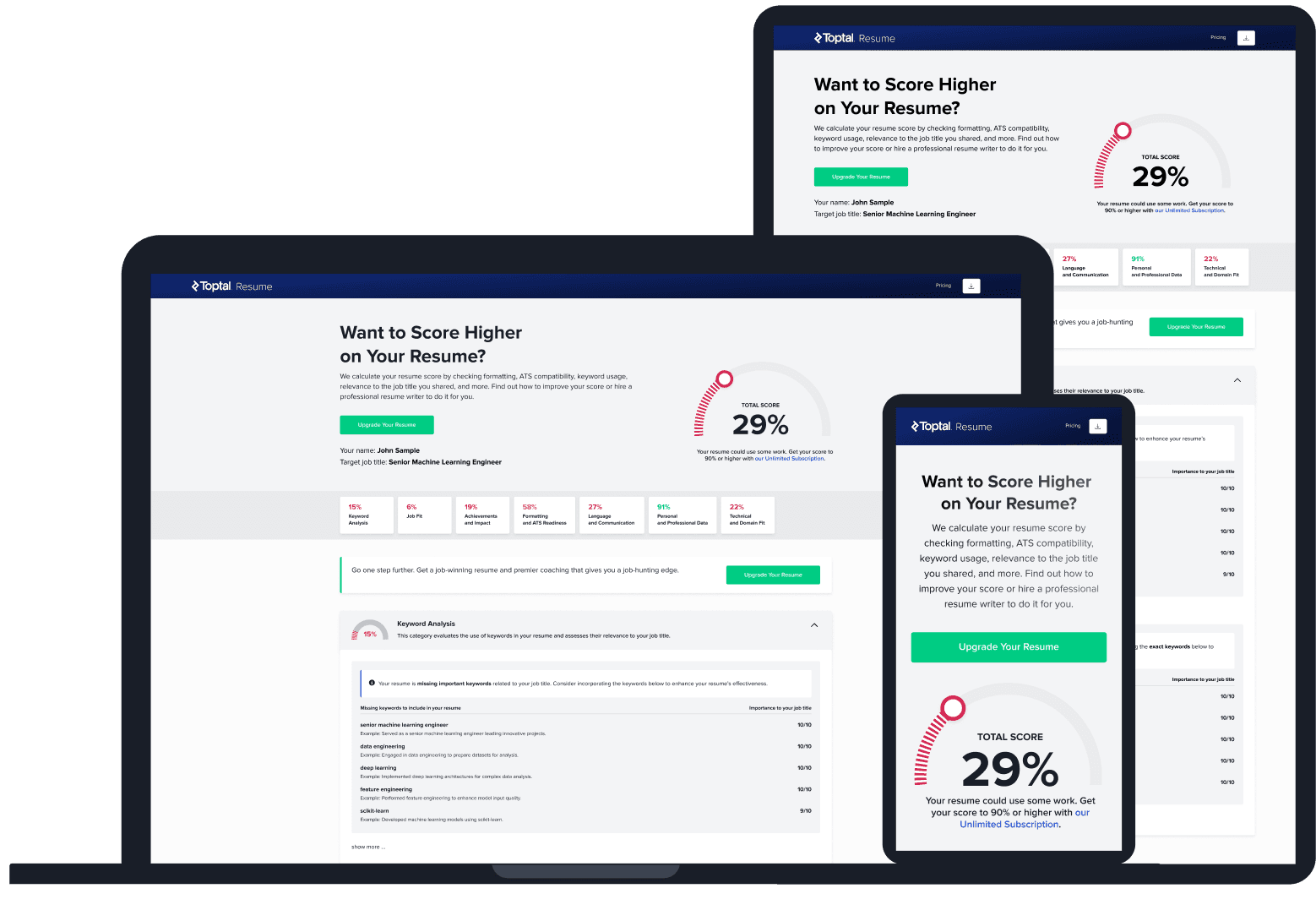
Upload your CV and tell us your target job title. Our system will analyse it the way a recruiter and ATS would—scoring it across core hiring dimensions and giving you personalised, role-specific feedback you can implement right away.
Read Next

Tools & Services
CV Checker vs. ATS Score Checker: What’s the Difference?
Not all CV tools are built for the same purpose. Understanding the difference between a CV checker and an ATS score checker can help ensure your tech CV passes the filters and reaches the right recruiters.

By Audrey Goodson Kingo
Career Expert
Audrey Goodson Kingo is a book author and a renowned journalist covering careers and HR. She has advised insurance giant Aon on work-life balance and shared her expertise with CNN, Good Morning America, MSN, and more.

Job Market Trends
How Understanding Applicant Tracking Systems (ATS) Can Land You a Top Tech Job
Applicant Tracking Systems (ATS) are now used by nearly all Fortune 500 companies to handle the surge in job applications. For tech professionals, understanding how these systems parse applications can mean the difference between being filtered out and moving forward in the hiring process.

By Amanda Menin
HR & Career Strategy Expert
Amanda Menin is a Talent and Organisational Strategy expert specialising in hiring practices, CV optimisation, and applicant tracking systems (ATS). With more than 20 years of experience across technology, healthcare, and consulting, she offers practical insight into how employers evaluate candidates. She holds a master’s in industrial and organisational psychology and is a SHRM Senior Certified Professional (SCP).

Interview Prep
From ATS to Interview: Ensuring Your Tech CV Passes Automated Tech Screening
Most tech CVs are screened out before a recruiter ever sees them. Discover how to optimise yours with the right CV formatting techniques to pass the applicant tracking system (ATS) filters and get noticed.
By Audrey Goodson Kingo
Career Expert
Audrey Goodson Kingo is a book author and a renowned journalist covering careers and HR. She has advised insurance giant Aon on work-life balance and shared her expertise with CNN, Good Morning America, MSN, and more.