How to Tailor Your Resume for Each Job Application
Resume tailoring isn’t rewriting your resume from scratch. It’s a focused method that adjusts four key elements to match each job you apply for.


AUTHOR
Borislav Stojkov
Principal Resume Writer
Borislav Stojkov is a Principal Resume Writer at Toptal Resume. His professional track record includes personally reviewing and rewriting more than 2,000 resumes for professionals across industries. In his direct work with clients and the development of AI-based resume-writing services, he focuses on ATS-optimized structure, modern template design, and recruiter-aligned writing and formatting standards.
Resume tailoring isn't the same as rewriting a resume, and it typically requires adapting four things: the summary, the order and framing of the most important bullet points, the skills section, and the keywords used. This guide presents the Tailoring Pass method with step-by-step instructions on how to customize a resume for each job you're applying for when you have a well-crafted starting point. Implementing this approach with a document that doesn't require a substantial rewrite can take up to 30 minutes to match your resume to a job posting, making your job search more efficient.
The Tailoring Pass Overview: What Changes and What Stays the Same
The table below summarizes which elements should be customized when you tailor a resume to a job description, as well as which ones should be kept unchanged.
| Element | What to Change | How to Decide |
|---|---|---|
| Professional summary | Rewrite every time to include the target role and the most relevant skills and achievements for the job | Name the role you’re applying for, a few of the strongest and most relevant skills/requirements, and one or two pieces of evidence (achievements) related to the posting’s priorities |
| Job title line (if included in your resume’s header) | Match the posting’s title, but only if it’s honest to do so | If your actual title doesn’t match the one from the posting (“Marketing Specialist” vs. “Marketing Coordinator”), use your real title and weave in the posting’s wording into the summary. Alternatively, drop the title listed under your name |
| Skills section | Reorder and emphasize the ones required in the job posting | To match your resume to a job posting, list the skills required and preferred by the employer that you genuinely have, and use their words naturally |
| Keywords and phrasing | Use the posting’s vocabulary where it accurately describes your experience | Use the terms from the job description (e.g., where the posting spells out an acronym, do the same on first use). Don’t force words that don’t fit, as semantic matching understands related language and context |
| Bullet order within a work experience entry | Relevance is more important than chronology | The top bullets do most of the work, so place there the ones matching the expected outcomes described in the posting |
| Bullet content | Rewrite a few bullets so the framing matches the posting’s priorities | Keep the achievement, but adjust the framing and use the metrics the employer cares about |
| Which roles to focus on | Expand the most relevant role and condense the rest | A role in your work experience that matches the posting should be described with more bullets, and the other ones can have a line or two |
| Certifications | Place at the top of the section anything the posting names as required or preferred | If a certification is listed in the posting and you have it, make it instantly visible |
| Length and section order | Usually stays unchanged | Tailoring is not reformatting and changing the whole structure of your resume |
| What never changes | Role titles, employer names, dates, degrees | Tailoring never means misrepresentation of facts |
The most common mistake in tailoring a resume for a job application is changing the wrong things, such as formatting or role titles in your work experience, or completely ignoring required resume keywords from the job description.
The Tailoring Pass: A Step-by-Step Guide
The method summarized above consists of five steps that should take you around 30 minutes to tailor a resume to the job description, while a light pass that only adjusts the skills section and slightly rephrases the summary can take as little as 10 minutes.
The approach described below is also implemented in the "Tailor to a job" feature of Toptal Resume's AI resume builder: You can paste the job description directly in the builder and instantly receive recommendations on how to customize your resume for each job you're applying for.
Step 1: Read the Posting for What It Actually Says
The first step is reading the job posting carefully and identifying the following things:
- What's repeated: Any skill, tool, or expected outcome that is repeated more than once in the job description should be your priority when tailoring your resume.
- What's required and what's preferred: Everything that represents a hard requirement for the job has to be clearly visible in your resume. You should first match that list and then address what's preferred (while staying honest).
- What the expected outcomes are: All job postings typically include a list of duties and responsibilities, and you should demonstrate your related achievements clearly.
Step 2: Extract the Keywords
Applicant tracking systems look for specific keywords in a resume. Identify the needed resume keywords from the job description, as they are the most important thing that will lead you to having an ATS-friendly resume. Here are the four categories of keywords that you should map:
- Job title: The most obvious one, but we've seen in practice that many applicants don't mention the specific role even once on their resumes.
- Hard skills and tools: All the software, platforms, and methodologies mentioned in the job description.
- Certifications: Credentials are often listed as either required or preferred, so they should be prominent on your resume.
- Expected outcomes: If the posting says that the candidate will be hired to "drive growth," you should prove how you drove growth in your previous jobs.
You should pay attention to the posting's spelling and abbreviations. For example, if it says "Applicant Tracking System (ATS)," you should spell the term out on first use.
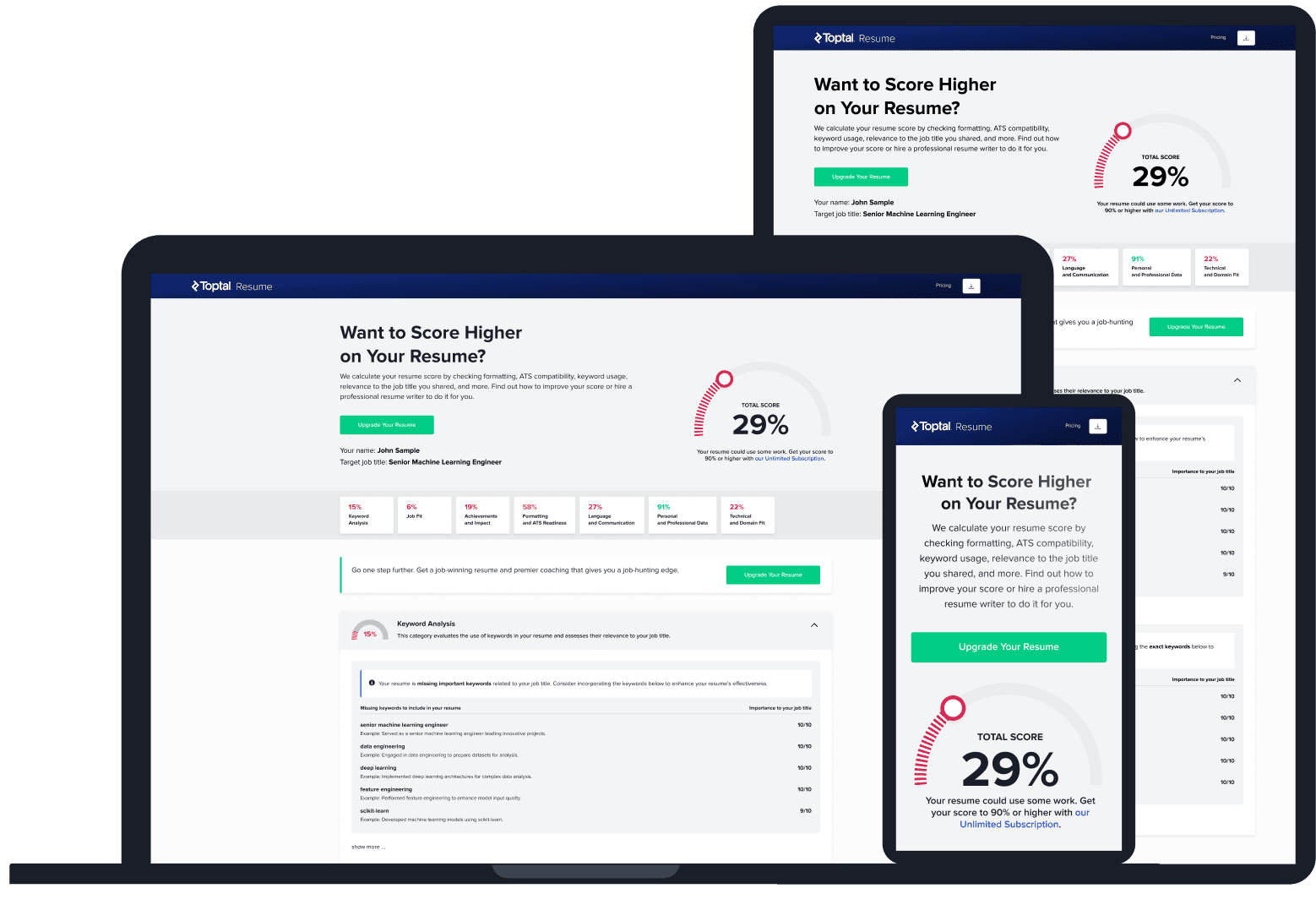
If you need help, you can use an ATS score checker to determine which important keywords for your target role are missing from your resume. Toptal Resume's ATS resume checker provides a comprehensive list of the keywords included, keywords missing, and the ones that are semantically included and can be identified from the context.
Step 3: Rewrite the Summary
Rewriting the professional summary is a powerful way to tailor a resume to a job description, as it frames the entire narrative of the document and is the first thing that a reader sees. Here's a formula that works:
Mention the target role title + two requirements (skills) you match best + a proof (ideally quantified) related to the posting's own priorities.
If the job opening is for a marketing specialist, don't start with "Experienced marketing professional." It's not incorrect, but it doesn't match what they're looking for. Continue by listing a few most important requirements, which, in the case of a marketing specialist, can be the most important skills from the job description (e.g., "experienced in paid search and marketing automation"). Then confirm it with evidence from your past work, like "reduced cost per lead by 34% across three consecutive quarters through channel mix optimization."
Step 4: Reorder and Rewrite Bullets
This step of resume tailoring includes two interventions in the bullet points of your work experience entries:
- Reordering the bullets: Once you've identified what matters most to the employer, place the bullets that demonstrate it at the top.
- Rewriting (reframing) two to four: Where needed, rephrase a bullet point to include the most important metric, while keeping the essence of the achievement that was already there.
Your original bullet can say that you "led the onboarding redesign and improved NPS by 18 points," but if the posting states that churn reduction is what's expected, you can rewrite the bullet to say that you "reduced 90-day churn by 24% by redesigning the onboarding experience," and add any additional detail (like "in collaboration with..." if cross-functional collaboration is expected).
Step 5: Adjust the Skills Section
A skill's priority is determined from the job posting, and the most important ones should be instantly visible to the reader scanning your resume. A curated skills section is also one of the most important parts of an ATS-friendly resume. If the job description mentions a skill you have, but it's not included in your resume, make sure to include it.
On the other hand, if your current skills section includes skills irrelevant to the job, you can remove them. A short, targeted skills list performs better than a long, generic one for both ATS keyword matching and human readability.
What Tailoring Is Not
Resume tailoring isn't about tricking or outsmarting the reader or the ATS, but a strategic approach that will help you highlight your most relevant qualifications for the job. It often happens that tailoring leads to misrepresentation, but being dishonest will get you nowhere.
When you customize a resume for each job, changing emphasis is not only acceptable, but the most effective job application strategy you can use. Reordering your bullet points or skills, reframing the summary, or refocusing a bullet point all serve to that purpose. It shows that you understand the requirements and keep your audience in mind.
On the other hand, changing the facts stated in a resume can't be legitimate or useful. If you change a title, degree, or employer name, it can be easily discovered during a background check. Also, if you claim to have a skill that you don't have, you won't be able to defend it during an interview. The simple rule is: Whatever you couldn't defend in a conversation, don't put it on the resume.
Using AI to Tailor Your Resume: Dos and Don’ts
The rise of AI has made many aspects of our everyday life easier, and it can certainly help you tailor your resume to a job description. That said, in some cases, it falls short and can be counterproductive if not used properly and thoughtfully. Here's a quick breakdown of how and when to use AI to tailor a resume.
What AI is useful for:
- Extracting keywords from a long job description, which can save you a lot of time
- Mapping out the gaps between the requirements listed in the posting and your current resume version
- Generating a first draft of a rewritten professional summary or bullet point in the work experience description
What can work against you:
- Using the generic output that sounds like every other AI resume (recruiters can easily recognize it)
- Invented "facts" (hallucinations), where numbers and outcomes don't match your original content, nor your experience
- Significant voice mismatch. Although resume writing requires a very formal and formulaic language, when the rewritten version doesn't sound like you at all, it creates remarkable inconsistency between the resume and the interview
Check Your Work Before Sending
Once you're done with tailoring your resume for a job application, verify whether you now have a targeted, ATS-friendly resume by following these three steps:
- Re-read it with the posting in mind. Go back to the job description from the posting and confirm that all the requirements are now included in your resume, and that it matches its tone and terminology.
- Check the ATS compatibility. If an ATS can't parse the information contained in your resume, it might never reach a human reader. Standard formatting rules still apply: avoid text boxes and multiple columns, and use standard section headings.
- Use an ATS score checker. An ATS checker, or, in some regions, an ATS CV checker, compares your resume with the job description and can be very handy as the final step in your resume tailoring.
Toptal Resume’s ATS resume checker not only detects the keywords included in or missing from your resume, but also provides a comprehensive resume assessment from a recruiter's point of view. The dimensions in a resume analysis include your achievements, overall background, language used, skills demonstrated, and more.
How Much Time Is Needed to Tailor a Resume for Each Job?
If customizing your resume for each job application takes you forever, the problem is most likely your initial version, so tailoring ends up being writing it all over again. The best way to go is to invest some time in creating a solid "master version" that will be tailored according to the method described above. Then, you have three scenarios that will determine the time needed:
- Full pass (around 30 minutes): For job applications where you're a good fit, and you need to adjust the summary, a few bullet points, and the skills section.
- Light pass (around 10 minutes): For job applications where you're a partial fit, and there is not much content tailoring to be done. Only touch the summary and the skills list.
- No pass (0 time): A common scenario is mass applying with a single generic resume for all applications. The inconvenient truth is that if you don't tailor it at all, the application is probably not worth sending at all.
Tailoring in Practice: A Worked Example
Let’s now see how tailoring works in practice by customizing the summary, a bullet point, and the skills section against a specific job description.
The job posting: A B2B company is hiring for a senior content strategist, and the requirements include content strategy, SEO, marketing automation, and cross-functional collaboration. The expected outcomes listed in the job descriptions include “driving organic growth,” “building content programs,” and “partnering with product and sales.”
| Element | Before | After |
|---|---|---|
| Summary | “Content strategist with experience in B2B marketing, blog writing, and SEO.” | “Senior Content Strategist with six years of experience building B2B content programs that drive organic growth. Grew organic traffic by 140% over 18 months through SEO-led editorial strategy and marketing automation integration.” |
| Top bullet | “Managed the company blog and social media channels, producing weekly content.” | “Built a content program from scratch that reached 140% organic traffic growth over 18 months, integrating SEO strategy with HubSpot automation to qualify and route 200+ monthly leads.” |
| Skills section | Content Strategy, Copywriting, Social Media, SEO, Email Marketing, WordPress, Canva | Content Strategy, SEO, Marketing Automation (HubSpot), Cross-functional Collaboration, B2B Content Programs, Editorial Planning, WordPress |
As shown above, three targeted changes can transform a resume from a generic one to one that showcases evidence of what the employer is looking for. And it took less than 30 minutes.
Build Your Tailored Resume
Tailoring works best when the current resume, or the base for tailoring, is already strong. Toptal's AI resume builder helps you both create the base and tailor it to a job description. Whether you're writing your resume from scratch or customizing it for a specific job application, you can download the finished document and run it through the ATS score checker to verify each tailored version against the specific job description before you send it.
FAQ
ATS Resume Score Checker
for Professional Roles
Upload your resume and tell us your target job title. Our system will analyze it the way a recruiter and ATS would—scoring it across core hiring dimensions and giving you personalized, role-specific feedback you can implement right away.
Read Next

Resume Tips
LinkedIn Profile vs. Resume: Key Differences and How to Use Each
A LinkedIn profile and a resume serve different purposes and different audiences. Here’s how each one works and how to manage both effectively.

By Borislav Stojkov
Principal Resume Writer
Borislav Stojkov is a Principal Resume Writer at Toptal Resume. His professional track record includes personally reviewing and rewriting more than 2,000 resumes for professionals across industries. In his direct work with clients and the development of AI-based resume-writing services, he focuses on ATS-optimized structure, modern template design, and recruiter-aligned writing and formatting standards.

Resume Tips
Should You Include References on a Resume?
References don’t go on a resume, not even “References available upon request.” Here’s what to do instead and how to prepare a strong reference sheet.
By Borislav Stojkov
Principal Resume Writer
Borislav Stojkov is a Principal Resume Writer at Toptal Resume. His professional track record includes personally reviewing and rewriting more than 2,000 resumes for professionals across industries. In his direct work with clients and the development of AI-based resume-writing services, he focuses on ATS-optimized structure, modern template design, and recruiter-aligned writing and formatting standards.

Resume Tips
How Far Back Should a Resume Go? The 10–15 Year Rule Explained
For most job seekers, a resume should go back 10 years, extended to 15 only when older experience is directly relevant. Here’s how to decide.
By Borislav Stojkov
Principal Resume Writer
Borislav Stojkov is a Principal Resume Writer at Toptal Resume. His professional track record includes personally reviewing and rewriting more than 2,000 resumes for professionals across industries. In his direct work with clients and the development of AI-based resume-writing services, he focuses on ATS-optimized structure, modern template design, and recruiter-aligned writing and formatting standards.