The most common career change resume problem isn't irrelevant experience. It's describing relevant experience in the wrong language.

AUTHOR
Borislav Stojkov
Principal Resume Writer
Borislav Stojkov is a Principal Resume Writer at Toptal Resume. His professional track record includes personally reviewing and rewriting more than 2,000 resumes for professionals across industries. In his direct work with clients and the development of AI-based resume-writing services, he focuses on ATS-optimized structure, modern template design, and recruiter-aligned writing and formatting standards.
When it comes to career change resumes, it's all about framing your experience appropriately. The chronological progression of your career becomes secondary, and your main goal is to present your skills and achievements in line with your new direction. The most common problem is not that the professional background is irrelevant, but that it's not described in the language of the target position. The paragraphs below present concrete guidance on how to write a resume for a career change, with real-world career change resume samples.
A career-change resume isn't just a standard resume with a professional summary that's lightly touched. There are a few elements that need to be reframed carefully, and the table below shows what actually works in that shift.
| Element | Standard Resume | Career-change Resume |
|---|---|---|
| Format |
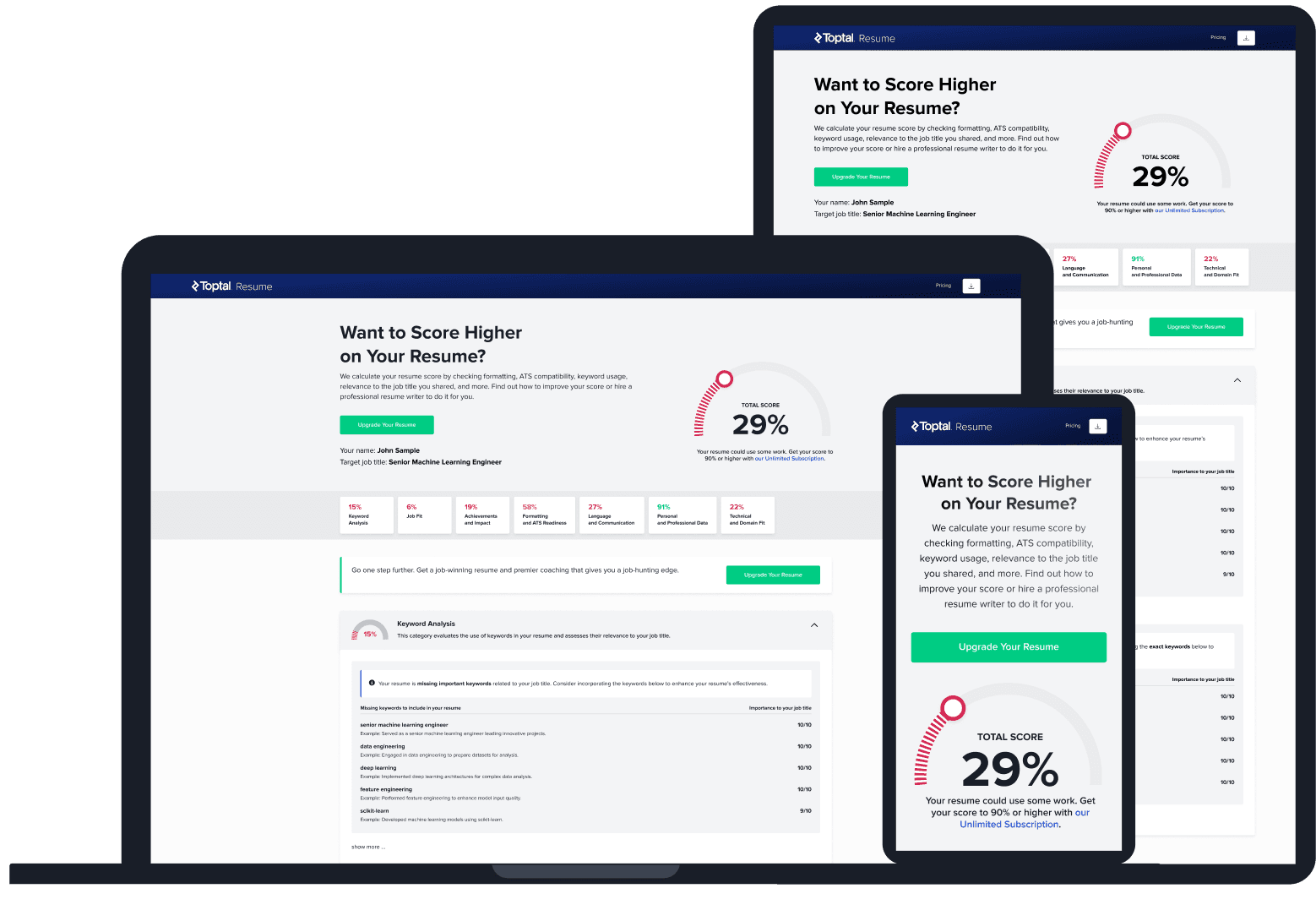
Upload your resume and tell us your target job title. Our system will analyze it the way a recruiter and ATS would—scoring it across core hiring dimensions and giving you personalized, role-specific feedback you can implement right away.
Read Next
Resume Tips
How Long Should a Resume Be
Find out how long your resume should be, whether one page is still a good choice, and if two pages or more actually make sense for your experience level.
By Inge Miscevic
Principal Career Coach
Inge Miscevic is a Principal Career Coach at Toptal Resume with over a decade of experience reviewing and improving thousands of resumes across industries. In her work with clients, she focuses on clear resume structure, effective formatting, and content that presents real experience in a way recruiters can quickly understand.
Resume Tips
Executive Resume: What Makes It Different and How to Write One
Executive resumes aren't longer versions of standard resumes. They're built around business impact at scale, a different audience, and strategic language throughout.
By Borislav Stojkov
Principal Resume Writer
Borislav Stojkov is a Principal Resume Writer at Toptal Resume. His professional track record includes personally reviewing and rewriting more than 2,000 resumes for professionals across industries. In his direct work with clients and the development of AI-based resume-writing services, he focuses on ATS-optimized structure, modern template design, and recruiter-aligned writing and formatting standards.
Resume Tips
Teacher Resume, Cover Letter, and Letter of Interest: A Complete Toolkit for Educators
A practical guide to the three career documents teachers need, with examples and role-specific tips for every teaching level and specialty.
By Borislav Stojkov
Principal Resume Writer
Borislav Stojkov is a Principal Resume Writer at Toptal Resume. His professional track record includes personally reviewing and rewriting more than 2,000 resumes for professionals across industries. In his direct work with clients and the development of AI-based resume-writing services, he focuses on ATS-optimized structure, modern template design, and recruiter-aligned writing and formatting standards.
| Reverse-chronological |
| Combination or hybrid format, with skills and selected achievements being typically listed before the chronological work experience |
| Top of the page | A professional summary highlighting your expertise in the current field | A professional summary or resume objective that mentions the transition |
| Work experience bullet points | Achievements described in the language of your current field | Same achievements described using the vocabulary of the new field |
| Skills | Supporting section that is often placed near the bottom | Section tailored to the target job requirements, typically placed above the work experience |
| Education, professional development & certifications | For most professionals, a brief section at the bottom | Expanded to include any professional training relevant to the new direction |
| Projects or volunteer work | Optional | Any professional engagement related to the new field can be valuable for credibility |
| Length | 1 to 2 pages for most candidates | More often, a one-pager with condensed older experience that isn’t relevant |
To find out more about how to create a concise career change resume, see our detailed guide on one-page resumes.
As mentioned above, the core problem isn't your professional experience itself, but the words used to describe it. Let's imagine a teacher transitioning into corporate L&D. They worked with 28 students across different plans, and their work typically includes tracking their performance, reporting the outcomes to parents, and so on.
If the candidate only uses words like "parent-teacher communication" or "classroom management," the reader (be it a recruiter or hiring manager) might not be able to quickly link their achievements to the skills required for the job in learning and development, so it's better to rephrase them and say "stakeholder management," "data-driven decision-making," and "client communication." The context might be different, but the skills applied are perfectly aligned.
To help you identify them, Toptal's AI resume builder suggests the skills from your existing experience to highlight on your resume to match the role you're targeting.
To help you understand how to write a career-change resume, we've created a three-step method you can easily follow.
Step 1: Pull the most important requirements from the job posting
It's essential to read the job description carefully and identify which skills, responsibilities, and outcomes the employer is looking for.
Step 2: Use the equivalents from your own experience
Think about what you've done at your past jobs that corresponds to what they're looking for. It doesn't matter if it happened in a different context, was called differently, or was realized on a different scale.
Step 3: Rewrite the content using their language
The substance of your experience will remain the same, but the words used in your description should match the vocabulary of the target position. They will immediately recognize and understand it.
The above resume tips for career change don't suggest misrepresenting your experience, but rather describing it in terms related to the field you're targeting.
The method described in the previous section will be applied differently in different career change resume examples. The bullet samples below demonstrate how to frame your transferable skills depending on the specific career change situation.
| Career Change | Before | After |
|---|---|---|
| Operations → Project Management | "Oversaw daily warehouse operations including staff scheduling, inventory management, and vendor coordination" | "Managed cross-functional workflows across a 12-person team, coordinating vendor relationships and resource allocation" |
| Teaching → Learning & Development | "Taught AP English Language and Composition to three sections of 28 students" | "Designed and facilitated a structured learning program for groups of 28 participants, applying outcome-based assessment to improve performance by 34%" |
| Retail → Customer Success | "Assisted customers on the shop floor and handled complaints and returns" | "Managed high-volume customer interactions across in-person and follow-up channels, resolving complaints with a consistent satisfaction record" |
| Publishing → Marketing | "Edited and proofread content for accuracy, style, and audience fit across print and digital publications" | "Developed and refined audience-targeted content across print and digital channels, aligning editorial decisions with reader engagement and publication goals" |
It's important to note that none of these examples fabricate experiences that don't exist, and all the bullets are rewritten to match the vocabulary of the new target field.
A combination (or hybrid) resume format is often recommended for career changers because it combines the skills-based (also known as functional) format with the standard reverse-chronological format, making it easy for recruiters to see your career path. While the functional resume format lists your experience by skill only, the hybrid format lists your relevant skills first, often followed by the most relevant achievements, and adds a chronological timeline of your past jobs.
Placing your skills first, right after the professional summary, lets you open with the most relevant aspects before the reader sees your earlier role titles. It's also common to list your most important achievements before your work experience in reverse-chronological order. When it comes to what the skills list should include, always tailor it to the job requirements in the posting.
We recommend using the combination format rather than the functional one because, in functional resumes, the work experience timeline is generally hidden, which might raise questions among recruiters and hiring managers.
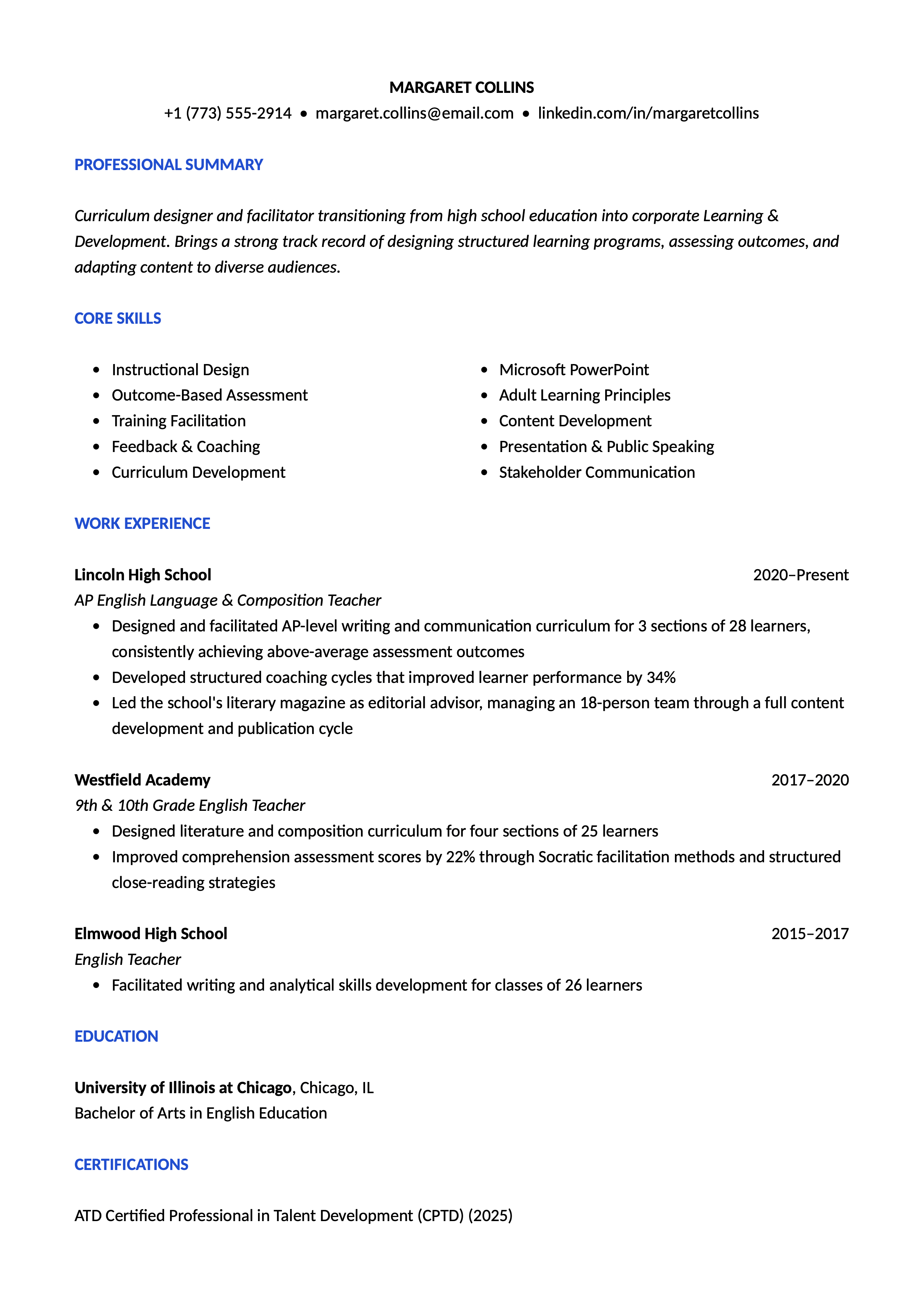
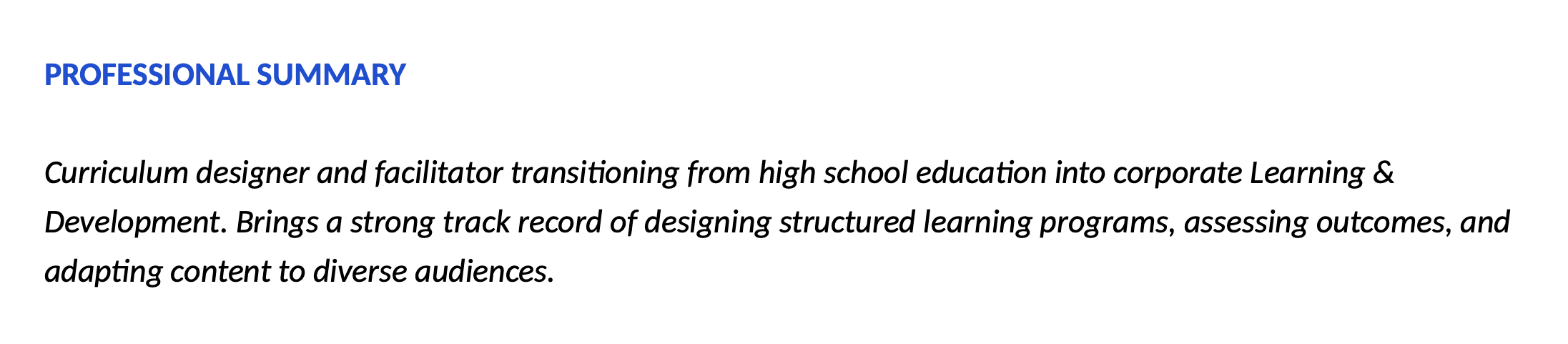
The professional summary section for career changers is specific because it explicitly mentions the transition into a new field. As you can see in the career change resume summary example in the image below, for a teacher transitioning into L&D, it should highlight transferable skills, and the template structure for this section can be defined as follows:
Current (ex) background + transferable skills(s) + new, target direction

In this kind of career situation, you should avoid writing a generic professional summary that could be applied to anyone. Additionally, career changers can use a resume objective instead, a more concise alternative to a resume summary that more clearly states an applicant's professional goals.
If you have no formal (or paid) professional experience in the new field, any relevant certifications, courses, or projects become valuable assets for your career-change resume. Here's what to include:
The above-listed elements aren't a replacement for your work experience, but can be a strong proof of your preparedness for the new job.
The career change resume example shown in the image below uses a format where the skills are placed near the top, right after the professional summary. It's the same situation as in the previous section, where a high school teacher wants to apply for a job in corporate L&D, and the relevant skills like coaching, curriculum development, and stakeholder communication are instantly visible to the reader.

The professional summary mentions the applicant's professional transition, transferable skills, and background. The bullet points mention specific, quantifiable results that are not worded to apply exclusively to a school context (28 learners, learning performance improvement, curriculum design, team management, comprehension assessment score, and so on).
You can also download this career change resume sample as a free resume template to adapt to your own career situation.
Having a tailored and aligned cover letter for career change situations can be really helpful, as cover letters give you the opportunity to describe your career transition before a recruiter or hiring manager moves to reading your resume.
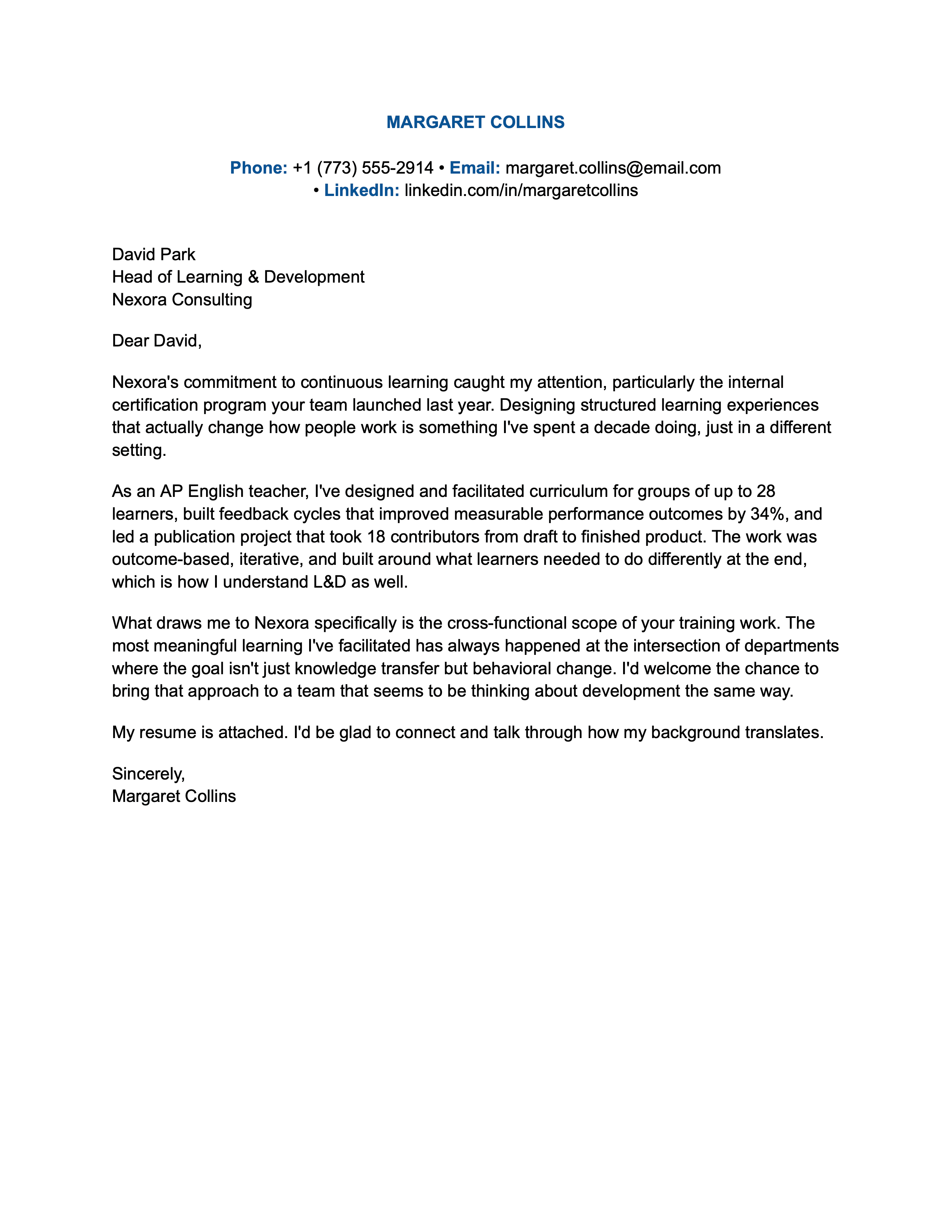
As illustrated in the image below, all strong career change cover letter examples acknowledge the professional field shift and link earlier experience to the requirements of the new position. In this cover letter sample, the teacher is applying for an L&D position at a consulting company.

It's important to note that all the results from the earlier classroom work (learner groups and their performance, project management, etc.) experience remain valid, but they have been reframed to align with the candidate's new direction. If you need assistance with determining which aspects of your background are relevant for your target job and need to be emphasized, Toptal Resume's cover letter generator offers guidance to create tailored cover letters.
Having a thoughtfully designed resume helps you make an important career shift and potentially a life-changing move. If you need career change resume help, Toptal Resume's extensive experience with resume writing services is built into an AI resume builder that can help you along the way, with job-specific suggestions and tailored rewrites.