

Hire Android Developers
Hire the Top 3% of Freelance Android Developers
Our Android developers specialize in creating engaging, high-performance apps for IoT devices and the Google Play ecosystem. From intuitive user interfaces to complex back-end integrations, they deliver applications that delight users while meeting your business goals, ensuring smooth functionality across all Android devices.
Hire a Top Android Developer Now
No-Risk Trial, Pay Only If Satisfied.






Hire Freelance Android Developers

Gabor Biro
Freelance Android Developer
Verified Expert in Engineering
Portugal
Toptal Member Since August 4, 2021
Gabor is a senior/lead Android engineer with 10+ years of Android experience and 15+ years in software. He's worked at Facebook, Deliveroo, Goldman Sachs, and startups, and most recently built and owned Somnology's Android app largely from scratch. Strong in Kotlin, Jetpack Compose, Coroutines/Flow, architecture, BLE, health-data integrations, automated testing, and CI/CD, Gabor is comfortable owning products end to end and working directly with back-end, iOS, QA, and product teams.
Show More
Andrzej Chmielewski
Freelance Android Developer
Verified Expert in Engineering
Poland
Toptal Member Since January 19, 2017
Andrzej is a seasoned mobile developer with 10 years of experience in native app development for Android and iOS and three years in Flutter. He's skilled at building apps from scratch, proposing robust architectures, and leading teams. He follows a test-driven or behavior-driven development (TDD/BDD) approach and has extensive experience in unit and integration testing. Andrzej is also experienced in building sophisticated CI/CD pipelines for the timely delivery of high-quality apps.
Show More
Anna Lozytska
Freelance Android Developer
Verified Expert in Engineering
France
Toptal Member Since October 28, 2021
With over 10 years of experience on projects in different industries and development stages, Anna gained a ground skillset that combines both front and back-end domains with a strong focus on creating scalable, high-quality code and excellent UX. Her aspiration for product success makes her a self-starter and proactive team player on the edge of engineering and product management.
Show More
Fábio Pinho
Freelance Android Developer
Verified Expert in Engineering
Portugal
Toptal Member Since May 31, 2021
Fábio is a passionate senior Android engineer with 13 years of experience. He has been building challenging mobile apps since the beginning of the Android era and is the organizer of the largest Android event in Portugal (www.lisbon.droidcon.com). Fábio has been working with major worldwide companies in the past few years, including Volvo and Reddit, and also has experience in other fields, such as classifieds, fintech, and logistics.
Show More
Steven Liu
Freelance Android Developer
Verified Expert in Engineering
Taiwan
Toptal Member Since May 6, 2022
Steven has been a game developer for over nine years with great enthusiasm for game development. He's helped develop and publish multiple titles on Android, iOS, and PC Steam platforms. He loves to work with artists and designers to create great experiences for players. He is a strong problem solver and a good communicator. He can work fast and efficiently, whether solo or leading and working with a team.
Show More
Ben Leung
Freelance Android Developer
Verified Expert in Engineering
Hong Kong
Toptal Member Since July 5, 2022
Ben is an experienced full-stack developer specializing in Android and iOS app development. With six years of mobile app expertise and three additional years in back-end development, he boasts a wealth of experience. Ben's impressive career includes delivering successful projects across various sectors like banking, travel, and employment. His skills encompass both front-end and back-end development, allowing him to create robust and efficient applications.
Show More
Rodrigo Varela
Freelance Android Developer
Verified Expert in Engineering
Australia
Toptal Member Since December 7, 2020
Rodrigo is a software engineer with over a decade of experience developing applications for various industries and working with teams around the globe. He has a computer science degree from Buenos Aires University and specializes in Android, Kotlin, Java, PHP, APIs, Bash, and databases. Rodrigo is a focused, organized, and productive developer who has led many teams, managed entire full-stack development projects, and excelled as a collaborative individual contributor.
Show More
Muhammad Usama Shabbir
Freelance Android Developer
Verified Expert in Engineering
United Arab Emirates
Toptal Member Since March 13, 2017
Usama has a Bachelor of Science degree with honors in Telecommunication Engineering along with 12 years of experience in software development. Currently, he is a Senior Software Engineer and Team Lead at the Dubai Police. Usama specializes in native Android application development.
Show More
Luke Lin
Freelance Android Developer
Verified Expert in Engineering
Canada
Toptal Member Since February 20, 2020
Xu Lin is an experienced Android developer who proudly focuses on writing beautiful, efficient, readable code. He has zero tolerance for bugs—they actually make him uncomfortable. Xu Lin loves learning new things and has a number of certifications, including CFA Level 1 and AWS Solution Architect Associate. He developed the Android app for DirectTv that served over 10 million users.
Show More
Pedro Francisco de Sousa Neto
Freelance Android Developer
Verified Expert in Engineering
Brazil
Toptal Member Since August 25, 2025
Pedro has over 13 years of hands-on experience in Android development, specializing in app architecture, feature implementation, and delivering scalable, high-quality mobile solutions. Focused on the fintech sector for the past six years, Pedro has built secure and reliable financial applications. Throughout his career, he has contributed to industries such as professional tools, fitness, banking, healthcare, and social networks.
Show More
Eduard Carreras
Freelance Android Developer
Verified Expert in Engineering
Spain
Toptal Member Since January 27, 2017
Eduard has spent 15 years working on the IT system behind the distribution of the results of the Olympic Games. His experience ranges from project management to development in different languages. He's a passionate developer of Android applications since 2011—creating and publishing apps under the brand Poquesoft with more than 500,000 downloads in the Google Play Store.
Show MoreDiscover More Android Developers in the Toptal Network
Start HiringA Hiring Guide
Guide to Hiring a Great Android Developer
Android engineers are experts in building apps for Android, the mobile operating system that serves as the backbone for billions of devices. This guide to hiring Android developers features best practices for the hiring process, tips on writing the job description, and interview questions and answers that will help you identify the right candidates for your company.
Read Hiring GuideAndroid Hiring Resources
More Resources to Hire Android Developers
Job Description TemplateInterview QuestionsCommon MistakesTips and PracticesToptal in the press
... allows corporations to quickly assemble teams that have the right skills for specific projects.

Despite accelerating demand for coders, Toptal prides itself on almost Ivy League-level vetting.

Our clients


Creating an app for the game


Leading a digital transformation


Building a cross-platform app to be used worldwide


Drilling into real-time data creates an industry game changer
Testimonials
How to Hire Android App Developers Through Toptal
1
Talk to One of Our Client Advisors
A Toptal client advisor will work with you to understand your goals, technical needs, and team dynamics.
2
Work With Hand-selected Talent
Within days, we’ll introduce you to the right dedicated Android app developer for your project. Average time to match is under 24 hours.
3
The Right Fit, Guaranteed
Work with your new Android application developer for a trial period (pay only if satisfied), ensuring they’re the right fit before starting the engagement.
EXCEPTIONAL TALENT
How We Source the Top 3% of Android Developers
Our name “Toptal” comes from Top Talent—meaning we constantly strive to find and work with the best from around the world. Our rigorous screening process identifies experts in their domains who have passion and drive.
Of the thousands of applications Toptal sees each month, typically fewer than 3% are accepted.
Toptal Android Case Studies
Discover how our Android developers help the world’s top companies drive innovation at scale.
CASE STUDY
Fintech Mobile App for Top 5 Financial Firm
CASE STUDY
Android and iOS apps for automotive manufacturer
CASE STUDY
Mobile app for global airline
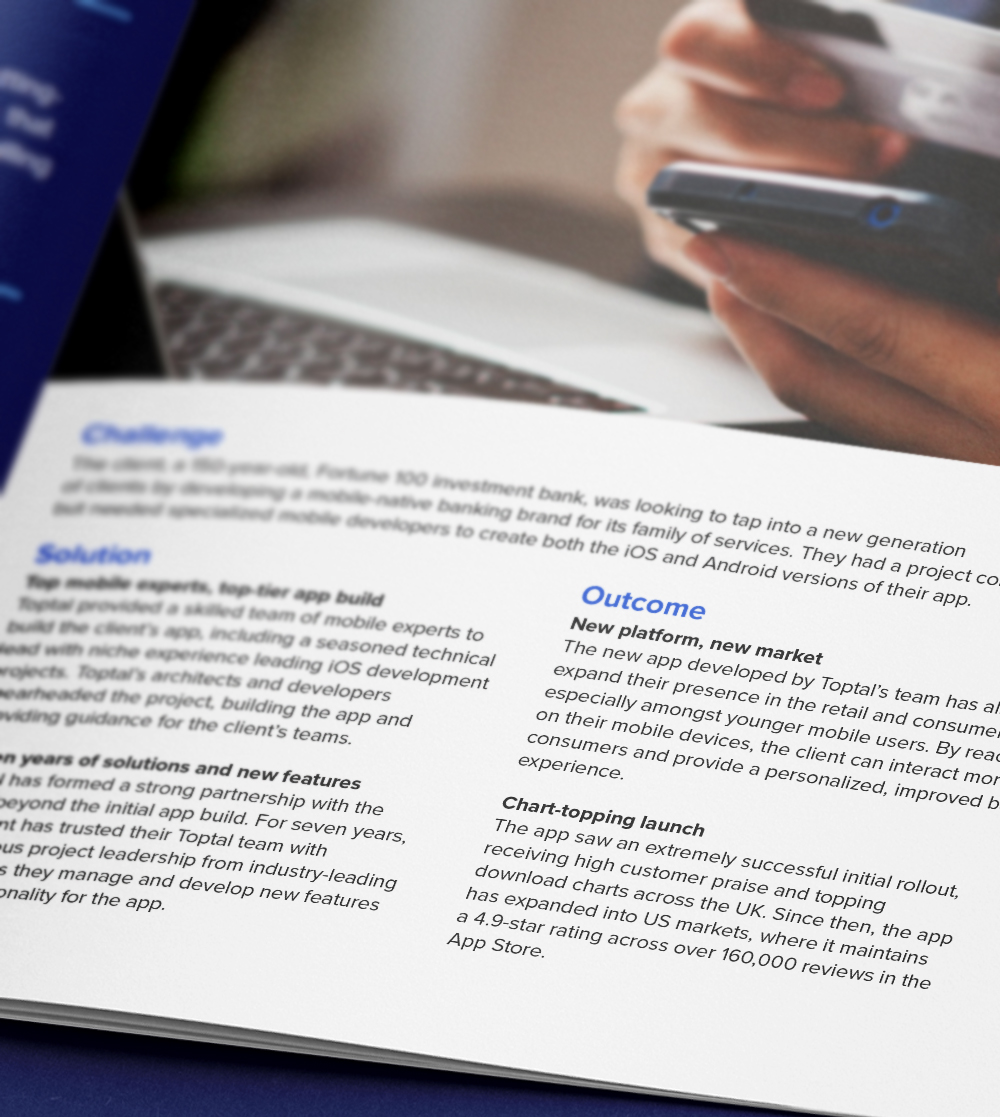
Top-five global financial services firm partners with Toptal to reach new market with fintech Android fintech app.
Challenge: The client, a 150-year-old, Fortune 100 investment bank, was looking to tap into a new generation of clients by developing a mobile-native banking brand for its family of services. They had a project concept, but needed specialized mobile developers to create both the iOS and Android versions of their app.
Solution: Toptal provided a skilled team of iOS and Android experts to build the client’s app, including a seasoned technical lead. Toptal’s architects and developers spearheaded the project, building the app and providing guidance for the client’s teams.
Impact: The new app developed by Toptal’s team has
allowed the client to expand their presence in the
retail and consumer banking sector, especially
amongst younger mobile users. The app saw an extremely successful initial rollout, receiving high customer praise and topping download charts across the UK. Since then, the app has expanded into US markets, where it maintains a 4.9-star rating across over 160,000 reviews in the App Store.
RELATED CAPABILITIES
- iOS
- Android
- Mobile App
Toptal’s developers and software architects have played a pivotal role in building our app from the ground up. Their commitment to excellence and continuous delivery of new functionality aligns perfectly with our vision for our app, ensuring its ongoing success.
Managing Director, Consumer & Wealth Management
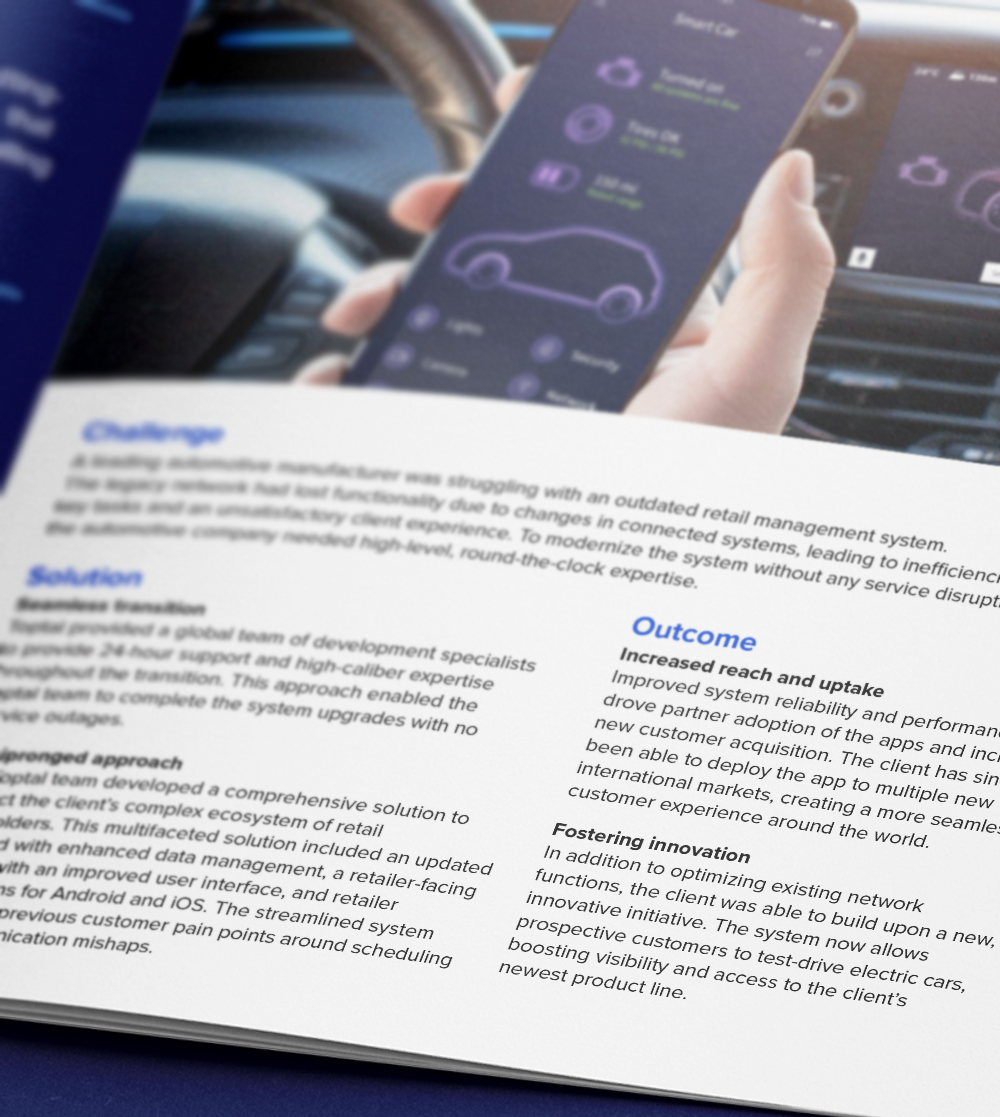
Toptal Helps Fortune 500 Auto Brand Improve CX With Android App and Legacy System Overhaul
Challenge: A leading automotive manufacturer was struggling with an outdated retail management system. The legacy network had lost functionality due to changes in connected systems, leading to inefficiencies in key tasks and an unsatisfactory client experience.
Solution: The Toptal team developed a comprehensive solution to connect the client’s complex ecosystem of retail stakeholders. This multifaceted solution included an updated back end with enhanced data management, a retailer-facing website with an improved user interface, and retailer applications for Android and iOS.
Impact: Improved system reliability and performance drove partner adoption of the apps and increased new customer acquisition. The client has since been able to deploy the app to multiple new international markets, creating a more seamless customer experience around the world.
RELATED CAPABILITIES
- Mobile App
- iOS
- Android
- Software Development
- Node.js
The most gratifying aspect was realizing the significant contribution I made and seeing it appreciated. It was fulfilling to see how my expertise and ideas could shape a large-scale product.
Asi Farran
Senior Full-stack Developer
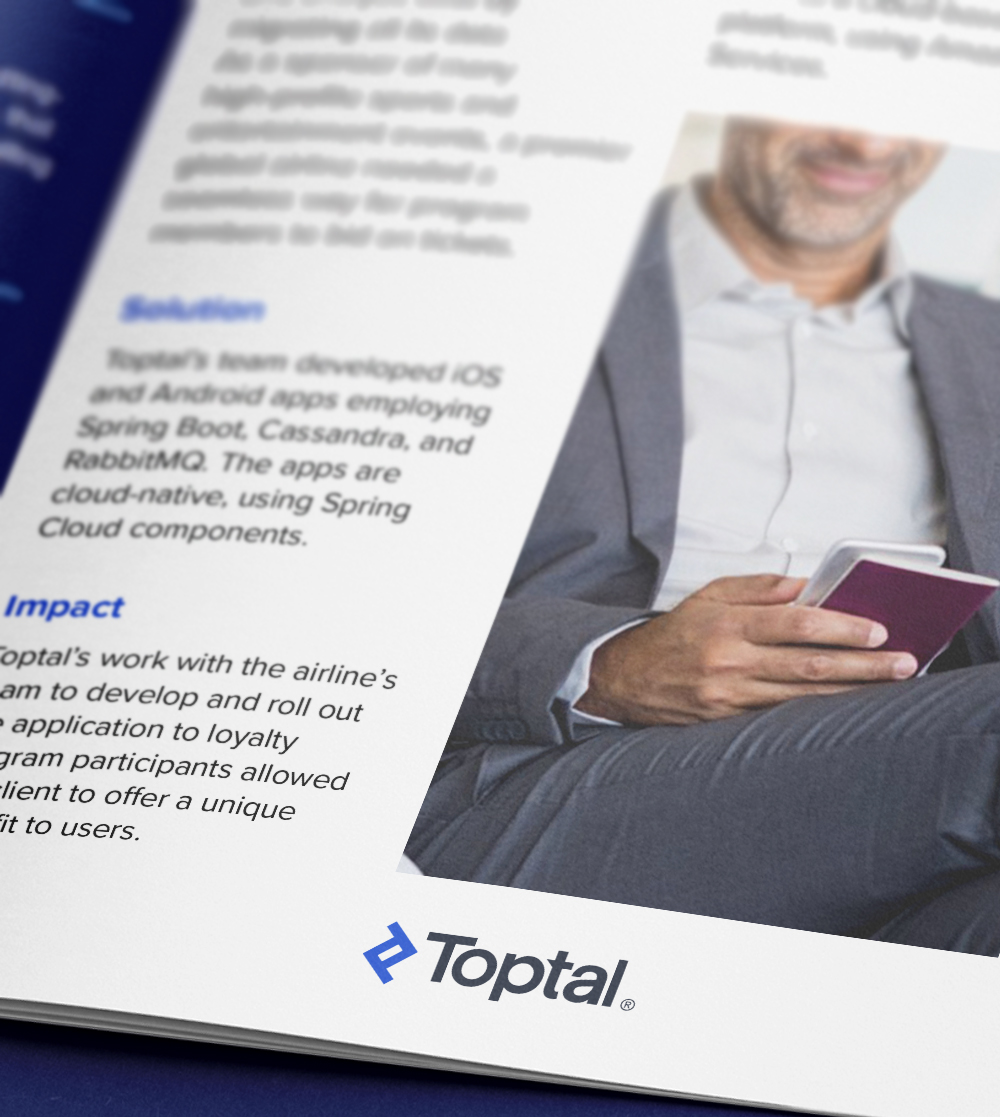
Creating an Android app for loyalty members requires specialized skills.
Challenge: As a sponsor of many high-profile sports and entertainment events, a premier global airline needed a seamless way for program members to bid on tickets.
Solution: Toptal’s team developed iOS and Android apps employing Spring Boot, Cassandra, and RabbitMQ. The apps are cloud-native, using Spring Cloud components.
Impact: Toptal’s work with the airline’s team to develop and roll out the application to loyalty program participants allowed the client to offer a unique benefit to users.
RELATED CAPABILITIES
- Mobile App
- iOS
- Android
- Spring Boot
- RabbitMQ
Toptal was able to quickly provide us with elite talent. Working closely with our team, Toptal Talent team members completed our project with sensational results.
Principal Architect - Innovation
Global Airline
Capabilities of Android Developers
Toptal experts specialize in building high-performing, user-centric, and intuitive applications that run seamlessly on smartphones, tablets, and other Android devices.
Native App Development
Kotlin’s concise, expressive syntax and Java’s mature ecosystem make these two interoperable programming languages well-suited for comprehensive Android app development. Toptal developers are proficient at using them to build high-performance applications that are compatible with a wide range of devices.
UI/UX Design
Intuitive and visually appealing user interfaces are critical to user satisfaction and engagement. With in-depth knowledge of design guidelines and Google’s Material Design principles, our developers create smooth, consistent, and user-friendly experiences that drive an application’s overall success.
Integrating Built-in Features
Integration with Android devices’ many built-in features—including GPS, camera, Bluetooth, and fingerprint authentication—can significantly extend an application’s functionality. Toptal app developers are pros at leveraging these capabilities to deliver robust, immersive, and secure applications that fully exploit the platform’s potential.
Real-time Feature Development
Implementing real-time features like live chat, push notifications, and dynamic content updates is crucial to meeting modern users’ expectations and ensuring an app’s overall usability. Our developers are skilled at employing WebSockets, Firebase Cloud Messaging, and Firebase Realtime Database to create highly responsive applications that provide up-to-the-second information.
Mobile Payment Gateways
Integration with Google Pay and third-party payment solutions like Stripe enables secure, convenient, and fast in-app transactions for one-time purchases and subscription-based fees. Toptal Android programmers take full advantage of these services to streamline the payment process and customize it to your specific needs.
Offline Data Access and Syncing
Making data available offline allows users to interact with an app uninterrupted by any connectivity issues that may arise. Our Android experts are adept at using SQLite and Room for local storage and synchronization once Internet connection is restored.
Wear OS and Android TV App Development
Expanding to Wear OS and Android TV broadens an application’s reach considerably. Our developers specialize in creating cohesive cross-device experiences so that users can switch between devices seamlessly, whether checking notifications on their smartwatch or streaming content on their TV.
Performance Optimization
User retention rates hinge on how optimally an app performs on various devices, including those with lower specifications. Toptal Android specialists reduce load times, minimize memory usage, and decrease drain on battery life so that your application runs smoothly, no matter the device it’s running on.
Security and Privacy
Safeguarding user data and protecting an app’s integrity are fundamental to an application’s long-term success and sustainability. To achieve this, Toptal developers follow best practices for data encryption, secure API communication, and user authentication with OAuth 2.0, Google Identity Services, and biometric security systems.
Google Play Store Submission and Optimization
Apps must be reviewed and approved by Google before they can be distributed to the Play Store’s billions of monthly users. Our expert developers guide you through every step of the submission process, from verifying your app complies with all applicable guidelines to enhancing its visibility for better rankings.
Trusted by 25,000+ Clients Worldwide
Find the Right Talent for Every Project
Accelerate your project with versatile, expert talent. From short-term solutions to long-term collaboration, Toptal delivers impactful results.
Senior Android Developers
Senior Android app developers bring deep technical expertise and advanced problem-solving skills to address your most complex challenges. Toptal’s rigorous vetting process provides access to professionals who combine robust technical experience with proven leadership.
Dedicated Android Developers
Dedicated Android app developers focus exclusively on your projects, leverage advanced Android expertise, and align with your long-term objectives to enable seamless integration and deliver high-quality outcomes.
Offshore Android Developers
Offshore Android app developers combine exceptional expertise with competitive rates, making them ideal for scaling projects efficiently. Operating across multiple time zones, they provide global coverage and 24/7 support for time-sensitive requests.
Remote Android Developers
Remote Android app developers offer top-tier expertise worldwide, removing location barriers to connect you with the best talent for your projects. They integrate seamlessly with distributed or hybrid teams, enabling flexible collaboration from anywhere.
Key Android Skills and Technologies
Tap into our Android developers’ mastery of fundamental technologies to develop powerful and reliable applications.
Android Languages and Frameworks
Android Jetpack Libraries

C#

Dart

Flutter

Ionic

Java

Jetpack Compose

Kotlin

.NET MAUI

React Native

Xamarin
Android Libraries, Tools, and Platforms

Android SDK

Android Studio
Bitrise

Firebase

Gradle

Git

GitHub Actions

JUnit

SQLite
Related Skills

Wear OS

Android Auto

Android TV
FAQs
The cost associated with hiring an Android developer depends on various factors, including preferred talent location, complexity and size of the project you’re hiring for, seniority, engagement commitment (hourly, part-time, or full-time), and more. In the US, for example, Glassdoor reported the annual total pay range for Android developers is $81,000 to $141,000 as of April 2025. With Toptal, you can speak with an expert talent matcher who will help you understand the cost of talent with the right skills and seniority level for your needs. To get started, schedule a call with us. It’s free, and there’s no obligation to hire with Toptal.
To hire the right Android app developer, it’s important to evaluate a candidate’s experience, technical skills, and communication skills. You’ll also want to consider the fit with your particular industry, company, and project. Toptal’s rigorous screening process ensures that every member of our network has excellent experience and skills, and our team will match you with the perfect Android developers for your project.
Android developer demand is at an all-time high. The global demand for this highly technical role has soared with the proliferation of Android devices and the growth of the mobile app industry. The employment of Android developers is predicted to rise by 21% from 2018 to 2028.
Typically, you can hire Android developers with Toptal in about 48 hours. For larger teams of talent or full end-to-end project delivery, timelines may vary. Our talent matchers are highly skilled in the same fields they’re matching in—they’re not recruiters or HR reps. They’ll work with you to understand your goals, technical needs, and team dynamics, and match you with ideal candidates from our vetted global talent network.
Once you select your Android application developer, you’ll have a no-risk trial period to ensure they’re the perfect fit. Our matching process has a 98% trial-to-hire rate, so you can rest assured that you’re getting the best fit every time.
Toptal developers are outstanding at native Android development using Java, Kotlin, and a variety of specialized tools that can be integrated into mobile applications. Toptal can also provide access to top-quality mobile developers who can code Android applications using cross-platform frameworks such as Flutter, Ionic, Xamarin, or React Native to create two identical mobile apps using a single source code, packaging one app for iOS and the other for Android.
To hire the right Android programmer, it’s important to evaluate a candidate’s experience, technical skills, and communication skills. You’ll also want to consider the fit with your particular industry, company, and project. Toptal’s rigorous screening process ensures that every member of our network has excellent experience and skills, and our team will match you with the perfect Android developers for your project.
At Toptal, we thoroughly screen our Android experts to ensure we only match you with the highest caliber of talent. Of the more than 200,000 people who apply to join the Toptal network each year, fewer than 3% make the cut.
In addition to screening for industry-leading expertise, we also assess candidates’ language and interpersonal skills to ensure that you have a smooth working relationship.
When you hire dedicated Android app developers with Toptal, you’ll always work with world-class, custom-matched Android developers ready to help you achieve your goals.
You can hire Android application developers on an hourly, part-time, or full-time basis. Toptal can also manage the project end-to-end based on your specific requirements as part of our Consulting and Services offerings. Whether you hire a Android developer for a full- or part-time position, you’ll have the control and flexibility to scale your team up or down as your needs evolve. Our Android developers can fully integrate into your existing team for a seamless working experience.
We make sure that each engagement between you and your Android developer begins with a trial period of up to two weeks. This means that you have time to confirm the engagement will be successful. If you’re completely satisfied with the results, we’ll bill you for the time and continue the engagement for as long as you’d like. If you’re not completely satisfied, you won’t be billed. From there, we can either part ways, or we can provide you with another Android developer who may be a better fit and with whom we will begin a second, no-risk trial.
Explore Related Toptal Services
Looking for an end-to-end business solution? Browse Toptal's portfolio of services.

How to Hire Android Developers

Verified Expert in Engineering
10 Years of Experience
Amar is a veteran Android developer who has worked with companies such as Reddit, Goldman Sachs, Mercedes Benz, and Volvo. At Reddit, he contributed to the official Android app, which has more than 100 million downloads, and at Volvo, he led the team that built the consumer app’s analytics service, managing 50 million daily events. He has also served for more than five years as the Toptal Community Leader for Sarajevo, Bosnia and Herzegovina.
Previous Role
Senior Android DeveloperPreviously at


Android App Developer Demand Is at an All-time High
The global demand for Android programmers has soared with the proliferation of Android mobile devices and the growth of the mobile app development industry. With more than 3.5 billion Android users worldwide, the platform has dominated its competition since 2012 and now holds approximately 75% of the global mobile OS market share. It’s no surprise, then, that skilled Android developers have become essential to modern software teams.
However, the existing high demand for full-time Android app programmers is only one reason hiring Android app developers is uniquely challenging. The field of Android application development is complex and ever-evolving, making it tough to find the right person who not only possesses the necessary technical skills, but also stays abreast of the latest industry trends, tools, and best practices. In this vibrant and fast-paced field, a one-size-fits-all approach to hiring a dedicated Android developer simply doesn’t work.

This hiring guide explores the specific attributes that set top-notch Android application developers apart from those who are merely average, to help established companies and startups find the perfect candidates. You will learn how to identify the candidate who is ideal for your specific business needs. We also provide tips for writing effective job posts, and share strategies for navigating the assessment and hiring processes effectively.
What Attributes Distinguish Quality Android Developers From Others?
Building and maintaining applications for communication, e-commerce, entertainment, learning, and planning activities, Android specialists are instrumental in creating the digital experiences that billions of people interact with on their smartphones.
The marks of a typical Android developer lie in their technical expertise, proficiency with programming languages, such as Java or Kotlin, effortless use of Android Studio, and strong understanding of the Android SDK (software development kit). The traits that differentiate a quality developer from others include:
Knowledge of Android Fundamentals
At the heart of a quality developer’s skill set is a deep understanding of Android’s architecture components, including the concept of the Android application life cycle, which is, essentially, the end-to-end journey an app takes from the moment it’s opened to the moment it’s closed.
This is important because Android users are accustomed to keeping several apps open simultaneously and seamlessly switching from one to another. By mastering the app and activity life cycle concepts, a proficient programmer ensures this multitasking experience remains smooth, efficient, and performant.
Performance Efficiency and Battery Optimization Skills
A quality Android developer recognizes that while portable mobile devices are powerful, they do not operate with unlimited resources. Guided by factors such as battery life and device performance, the developer ensures that an app does not scare off users by draining a device’s battery quickly. Candidates should apply strategies to ensure that the mobile applications they create are not only functional and user-friendly, but also conservative with respect to a device’s limitations.
To ensure minimal battery usage, look for engineers who write clean and efficient code, continually monitor and optimize their code’s performance, and follow best practices for background tasks, syncs, and updates. Skilled developers are proficient in using development tools, such as Profiler (integrated into Android Studio), to identify performance bottlenecks, memory leaks, and CPU-intensive processes that may lead to excessive battery consumption. The expert monitors network traffic, disk operations, and external communications, like Bluetooth or GPS.
Experience With Modern Architectural Patterns
To create scalable and maintainable code, Android engineers must be well-versed in modern architectural patterns such as Model-View-ViewModel (MVVM) or Model-View-Intent (MVI) and clean architecture. Understanding and implementing architectural patterns allows for more efficient root-cause analysis and remediation, faster onboarding of new dedicated team members, and an overall increase in code-writing productivity.
Android specialists also grasp and effectively employ the principles of both object-oriented and functional programming. Kotlin, the official language of Android development, supports both paradigms. Object-oriented programming enables mobile app developers to build modular code, which can simplify a complex application. Functional programming, on the other hand, emphasizes immutability and first-class functions, which can lead to safer, more predictable, and easier-to-test code. A skilled Android app developer not only understands these concepts, but also knows when to use each paradigm for optimal efficiency and effectiveness.
An Understanding of the Android System’s Diversity
The diverse Android spectrum, from high-end smartphones to budget mobile devices, offers a colorful range of screen sizes, hardware capabilities, and operating system versions. A skilled engineer, therefore, understands that adaptable and flexible code ensures optimal performance and usability across all devices. This, in turn, leads to greater user satisfaction and increased market penetration.
Lifecycle Management and Support Services
Hiring the right Android programmer depends on where your app is in the development lifecycle. Each stage requires different strengths, from planning and architecture to testing, deployment, and post-launch support.
-
Ideation and planning: During this phase, the team determines who the app is for and what it will do. Stakeholders collect requirements and set KPIs and performance goals. Android app developers review planned features and determine whether they are realistic to build. They make technical recommendations on which programming languages are best suited for developing the app, such as Kotlin or Java, and identify design dependencies, including integrations and APIs, then provide estimates of how long the work may take and how much it may cost.
When hiring at the ideation stage, prioritize programmers who ask thoughtful questions, have strong communication skills, and have a broad understanding of the Android development ecosystem.
-
UI/UX design: Next, the team designs what the app will look like and how users will move through it. At this stage, developers help ensure designs meet Android user expectations for how apps should look and function. They check that the app can work across different devices and determine how each part of the design will translate into functional code.
When hiring at this stage, look for developers who understand intuitive Android design and can work closely with designers. Strong candidates know how to support visual appeal and usability without sacrificing app performance.
-
Architecture and setup: Once the plan is clear, the team lays the foundation for the app. This includes the parts users see and the systems that run in the background. Developers decide how the app should be organized. They may use patterns like MVVM or Clean Architecture. They also set up tools like Git to track code changes and prepare systems that help test and release new versions more smoothly.
When hiring for this stage, look for developers who can make sound architecture choices and set up a codebase that future team members can understand and maintain. This covers everything from writing modular, well-organized code blocks to documenting dependencies and release procedures.
-
Development: This is where the app is built. Developers write code for both user-facing features and the systems that handle data and operations behind the scenes. They connect the app to external services via APIs and set up local databases to ensure it runs smoothly from one action to the next.
When hiring at this stage, look for developers who write clean code and have direct experience with the tools your project requires. You can spot premium applicants by reviewing their past work. Portfolios, live apps, and GitHub projects can reveal insights about how they organize code and solve problems.
-
Testing and QA: This is the phase where the team hunts for anything that makes the app hard to use, like bugs, crashes, and slowdowns.
Common tasks include:
- Debugging: Developers review problems identified by QA or automated tests, then fix them one by one.
- Writing automated tests: They build new tests or improve old ones to ensure fixed bugs don’t return.
- Refactoring: They clean up the code and improve its performance using test feedback.
- Deployment & monitoring: They manage CI/CD pipelines and monitor test environments for crashes, API errors, or unexpected behavior.
When hiring for this stage, look for developers who treat testing and QA as part of the development process, not as an afterthought. Strong candidates should be able to explain how they prevent regressions, debug crashes, write automated tests, and validate performance across different Android devices before new features reach users.
-
Deployment: Once the app is ready, it is packaged and submitted to the Google Play Store for users to download. An Android expert creates the final release build and makes sure it is stable and secure. They may also help prepare the app’s store listing, specifically writing the release notes and privacy details.
When hiring at this stage, prioritize developers who understand Play Store requirements and have experience managing releases.
-
Post-launch maintenance: Post-release support is essential for maintaining app performance. After launch, real users begin using the app, which means feedback, crash reports, and performance issues start to appear. Experienced developers monitor crashes and fix urgent problems quickly. They proactively update the app to support new Android versions, fix bugs, improve performance, and, with the team, add features requested by users. This ongoing support keeps the app stable and aligned with user and business needs.
When hiring at this stage, look for programmers who can swiftly address updates, incorporate user feedback, and tackle any challenges that emerge after the app’s launch. Strong applicants should be able to provide support without disrupting user experience. This ongoing maintenance not only keeps the app running smoothly but also helps it adapt to evolving user needs and technological advancements.
Awareness of Industries Served and Business-specific Customization
To deliver functional and useful applications, developers should have an understanding of the unique demands and challenges of specific industries. Whether it’s healthcare, finance, retail, education, or entertainment, each sector has its own requirements and regulatory considerations. Additionally, applications are typically customized to meet the specific objectives of each client. This involves close collaboration with stakeholders to understand their vision, challenges, and user expectations. A successful application provides a personalized user experience, increases user engagement, and ultimately drives business success by addressing the unique needs of each client.
A Mindset of Continuous Learning
With the constantly evolving technology landscape, a quality software engineer is a proactive learner who is informed and aware of the latest developments in the Android ecosystem, including trends; software; related tools, such as helpful frameworks and libraries; and hardware. They are quick to adopt new tools and practices that can improve the overall user experience of the apps they build. Android engineers should be familiar with standard libraries such as Hilt (dependency injection), Jetpack Compose (UI), kotlinx.coroutines (data streamlining), and Retrofit (API calls), and actively seek out new libraries to enhance productivity.
Complementary Technology Skills for Android
The platform spans from standard smartphones to smart appliances and cars, so hire Android app developers with the appropriate complementary skill set to tackle your app’s specific objectives. The following technologies may be relevant, depending on project requirements:
Core Android development: Core Android developer skills form the foundation of most programs in the ecosystem. Applicants do not need to know every tool in this stack, but should have proficiency in Java or Kotlin and familiarity with Android Studio and Android SDK.
- Kotlin: Kotlin is the preferred programming language for most Android projects. It is a concise, expressive language that integrates well with Java, making it ideal for new apps or updates to existing Java codebases. It also works well with modern Android tools, like Jetpack Compose, and is especially useful for apps that need frequent updates because the code is typically easier to read and modify over time. When hiring Android app developers with Kotlin expertise, look for applicants who can explain how they have used the language in real projects. Strong programmers will understand Kotlin syntax, coroutines, null safety, Java interoperability, and how Kotlin works with the Android SDK and Jetpack libraries. For senior roles, ask experts how they structure their code to keep it readable as the app grows.
- Java: A long-standing programming language in Android development. While Kotlin is now preferred for many new Android projects, Java is still widely used because many existing apps were built with it. When working on modernization projects for legacy codebases or integrating with older software or enterprise systems, a Java-proficient developer may be essential. When hiring Android experts for Java-based engagements, prioritize applicants who understand Java fundamentals, object-oriented programming, Android SDK usage, memory management, and Java interoperability with Kotlin. For senior roles, ask how they approach reducing technical debt and deciding when it makes sense to refactor Java code into Kotlin.
- Android SDK: A software development kit that hosts common tools, libraries, APIs, documentation, and system components developers use to create apps for Android-powered devices. No matter the project requirements, applicants should be familiar with the Android SDK. It enables features, such as app components, permissions, notifications, debugging, and much more. When hiring Android application developers, look for applicants who can explain how they have used Android SDK components in projects. Strong candidates can speak to how SDK features affect functionality, performance, and the overall user experience.
- Android Studio: Android Studio is the official integrated development environment for Android app development. It’s useful because it brings a multitude of tools into a single workspace. Android Studio lets programmers work with the Android SDK, manage emulators and connected devices, inspect layouts, debug performance issues, and much more. For most Android projects, familiarity with Android Studio is a fundamental skill. When hiring Android application developers, ask how they’ve used Android Studio in their projects. Their answers may include everything from designing features to writing unit tests.
- Gradle: Most Android apps are complex. They rely on many libraries and need different settings for testing, debugging, and release. Gradle keeps track of these pieces and ensures the right code, dependencies, and configurations are included for each app version. When hiring Android developers, check whether they understand how Gradle works. Strong candidates can explain the role Gradle played in previous projects. Answers may include everything from updating libraries to configuring build variants and more. For senior roles, ask for an example of a project that was delivered more efficiently with Gradle.
Networking and data: Android applications need to retrieve, store, and manage data across both online and offline environments. A practiced Android developer understands how apps communicate with APIs, handle network requests, manage asynchronous data operations, and store information locally when connectivity is limited.
Common tools for networking and data management include:
- RESTful APIs enable communication between an app and back-end web servers to fetch, send, update, and delete data.
When hiring Android developers, look for candidates who can explain how they handle requests and responses and keep data synced between the app and the server. For larger or more complex apps, ask experts how they handle unreliable connections, retries, and offline functionality.
- Retrofit is a networking library that helps Android apps communicate with servers. Instead of writing custom code for each network request, programmers use Retrofit to define what the app needs from the server and how to handle each request. Retrofit is popular because it keeps networking code clean and easier to manage.
When hiring Android app developers, ask how they’ve used Retrofit in their previous engagements. For larger projects, ask whether they’ve used Retrofit with Kotlin coroutines or RxJava to manage asynchronous requests, or whether they have experience supporting caching and offline access.
- RxJava is a reactive programming library used to manage asynchronous tasks in Android apps. In layman’s terms, it helps developers handle work that happens in the background without stalling the app’s main interface. RxJava is especially useful in apps with complex data flows. For example, it can help coordinate several API calls, process user actions in sequence, or update the UI when new data becomes available. While many newer Android projects use Kotlin coroutines and Flow, RxJava is still common in legacy, enterprise, and data-heavy, real-time applications.
When hiring app developers for RxJava projects, applicants should understand observables, schedulers, error handling, and how to prevent memory leaks. For more senior roles, ask expert developers how they decide when to use RxJava, Kotlin coroutines, or Flow.
- SQLite is a lightweight database built into Android that lets apps store data directly on a user’s device. Programmers use it when an app needs to save information locally, reduce mobile data usage, or continue working when an internet connection is limited. In modern Android projects, many developers use Room to access SQLite.
When hiring an Android app developer for SQLite-centric projects, investigate how each applicant structures local data, writes queries, and prevents stored data from becoming outdated.
- Room is a Jetpack library that gives Android programmers a cleaner way to work with SQLite databases. Much like SQLite, developers use Room to store app data locally, support offline functionality, and reduce the amount of raw SQL needed for common database tasks. It is often used for features that need to remain available when connectivity is limited.
If hiring for a project that relies heavily on local data, ask the developer if they know how to define entities and DAOs. Can they write efficient queries? Are they comfortable using Room with tools like Kotlin Flow, coroutines, or RxJava? For more complex initiatives, ask how they keep the local database in sync with the server and what happens if the app displays outdated data.
- Firebase is a set of Google Cloud services that includes various tools for developing mobile applications, including authentication, cloud computing, integration with external services, and cloud storage. For Android application developers, it can provide back-end services without requiring the team to manage all server infrastructure directly.
When hiring for apps that rely heavily on cloud services or real-time data, strong developers can speak to which Firebase services they’ve used in past engagements and why they chose them. For more complex projects, ask expert developers how they prevent Firebase from becoming disorganized or expensive as the app evolves.
Testing and performance: To catch issues before they reach users, an Android app developer should be well practiced in testing and performance optimization. Android apps run across many devices, screen sizes, and OS versions, so top-tier developers should know how to engineer and implement thorough end-to-end QA.
The following are standard tools used by Android Developers for testing and performance optimization:
- JUnit is a testing framework that Android developers use to write local unit tests. Android’s documentation describes local tests as tests that run on the local JVM and help evaluate app logic faster, though they cannot fully interact with the Android framework. Instead, these tests run in isolation on a developer’s workstation, making them useful for quickly checking app logic before code moves deeper into QA. Common JUnit test cases include utility functions, data processing logic, ViewModels, repositories, and business rules. JUnit may also be paired with tools like Mockito or MockK when developers need to replace dependencies with controlled test doubles.
When hiring Android developers for testing initiatives, look for candidates who can explain what they test with JUnit and why. For senior roles, ask how they blend unit tests with integration, UI, and end-to-end tests to catch regressions without slowing down the release process.
- Espresso is an Android testing framework for writing automated UI tests. It helps developers verify that screens behave as users expect when navigating an app. It is often used for login flows, checkout paths, form submissions, navigation, and other features where broken UI behavior would directly affect users.
When vetting Android developers for testing initiatives, prioritize applicants who can explain how they write stable UI tests and work with QA teams to catch regressions before new features ship. For senior roles, ask how they decide which flows are worth automating and how they balance Espresso tests with unit tests, manual QA, and device testing.
- Firebase Crashlytics is a real-time crash reporting tool. Developers can use it to review stack traces, identify affected devices, spot recurring crash patterns, and prioritize fixes based on severity and user impact. Crashlytics also works with Android Studio’s App Quality Insights, which helps programmers investigate crash data directly in their development environment.
When hiring, look for applicants who can explain how they use Crashlytics and how they prioritize issues they discover. For senior roles, ask how they use crash reporting to prevent resolved issues from reappearing.
- Android Studio Profiler is useful when an app loads slowly or performs poorly on certain devices. It shows CPU activity, memory usage, network requests, and energy consumption, so developers can identify how tasks are impacting performance.
When hiring Android app developers to optimize performance, ask applicants to describe how they investigate memory leaks, slow methods, heavy network calls, or battery drain, and how they use profiler data to make improvements before issues reach production.
- Gradle Profiler is a tool Android experts use to measure and improve build performance. It’s especially useful for large Android projects where builds can become slower over time. Developers may use Gradle Profiler to benchmark build speed, compare builds, test dependency upgrades, and identify regressions before they slow down the whole team. It can also help diagnose issues with custom plugins, annotation processors, Kotlin compilation, or multi-module project setups.
When hiring application developers for large apps, ask candidates how they manage Gradle configuration and keep build workflows efficient. For senior roles, ask Android experts how they have used build profiling or CI/CD feedback to prevent build regressions.
Version control and delivery: These tools help Android developers manage code changes and release updates. They are especially useful when multiple developers are contributing to the same app or when releases need to move through testing, review, and deployment without breaking existing functionality.
- Git allows software engineers to better collaborate, track changes, and manage multiple versions of code, all of which lead to a more structured and efficient mobile application development process. When vetting Android application developers on versioning, seasoned applicants should understand standard procedures such as branching, pull requests, merge conflicts, code reviews, and how to keep changes organized before they move into testing or production.
- Continuous Integration and Continuous Delivery (CI/CD) help ensure that code is bug-free and performs as expected. An experienced Android engineer writes automated tests using tools like Espresso or JUnit. Additionally, by applying CI/CD practices, which enable faster, more efficient app releases, the entire development process can be streamlined. When hiring Android developers for testing, prospects should understand how CI/CD supports reliable app delivery and should be able to explain how automated tests, build checks, and release pipelines help prevent regressions to keep updates moving smoothly from development to deployment.
Cross-platform development: When a team needs to build for Android and iOS without maintaining two fully separate codebases, they call on developers well versed in cross-platform development. When hiring an Android programmer for a multi-platform application, look for candidates who understand both the benefits and trade-offs of cross-platform development, especially around performance, native device access, long-term maintenance, and platform-specific user expectations.
Proficiency in the following frameworks and languages can be useful:
-
Flutter is Google’s cross-platform framework for building apps from a shared codebase. It can be useful for teams that want to launch on Android and iOS while maintaining a consistent user experience across platforms.
-
React Native is a cross-platform framework that allows developers to build mobile apps using JavaScript and React. For Android developers, React Native expertise can be valuable when a project uses shared cross-platform code but requires Android-specific expertise to fine-tune platform-specific behavior.
-
JavaScript can be a good-to-have skill, particularly if your project involves cross-platform development, working with frameworks such as React Native. JavaScript may also help Android application developers collaborate more effectively with front-end or full-stack teams.
UI and layout: Android apps need to work across different screen sizes, devices, orientations, and accessibility settings. When hiring an Android developer, proficiency with the following tools can indicate that they know how to support UI implementation and transform design requirements into functional interfaces.
- Material Design is Google’s design system for Android interfaces that feel intuitive and visually consistent. It provides guidance on common interface elements, including buttons, cards, navigation, typography, spacing, color, motion, and responsive layouts.
When hiring developers for UI implementation, ask them to articulate how they use Material Design components and guidelines while balancing brand requirements, accessibility, and app performance.
- Jetpack Compose is a modern Android toolkit for building user interfaces with Kotlin rather than traditional XML layouts, which can speed up UI development. Jetpack Compose is useful for apps that need responsive layouts, animations, and frequent UI changes. It pairs well with Material Design across different Android devices.
When hiring for interface implementation, note how programmers choose when to use Jetpack Compose, how they handle legacy XML views, and how they keep Compose UI code organized as the applications grow.
- ConstraintLayout helps application developers build responsive Android interfaces with a flatter view hierarchy by defining relationships between elements instead of nesting them inside multiple containers. View hierarchy is how Android organizes screen elements in parent-child layers. When layouts are built with too many nested containers, Android has to do more work to render each screen. With ConstraintLayout, a developer can tell the system to place a button below an image or align text to the edge of a parent container without relying on a nested hierarchy. This makes complex screens easier to manage and faster to render. ConstraintLayout also works with Android Studio’s Layout Editor, so developers can visually adjust the user interface instead of editing every XML detail manually.
When hiring Android developers for UI implementation, applicants should be able to explain when they use ConstraintLayout and how they test layouts across different screen sizes and devices.
Design collaboration: Developers often work closely with designers to turn visual concepts into functional app interfaces. This requires understanding design files, user flows, accessibility requirements, and platform-specific Android behavior.
The following tools enable collaboration among Android experts and design resources to ensure the final app reflects the intended design while meeting performance expectations:
-
UI/UX design familiarity is a major advantage for Android programmers, as creating an intuitive, user-friendly interface is key to any successful app. While not necessarily a coding skill, understanding basic UI/UX principles can greatly enhance an Android developer’s effectiveness. Knowledge of Google’s guidelines for Material Design, Jetpack Compose UI for layout design, and tools such as Sketch or Figma can be beneficial.
-
Figma is a collaborative design tool that helps teams work from a single source of truth. Android developers use Figma to review design files, inspect layout details, export assets, analyze user flows, and translate UI/UX designs into functional Android screens. It’s especially useful during handoff because it helps developers see how an interface should look and behave before they begin implementation. Developers can reference design specs and collaborative notes instead of relying on screenshots or written instructions alone.
Sketch is a digital design tool used to create app mockups and interface layouts. Similar to Figma, Android developers use Sketch to inspect layout dimensions, review color values for copy, understand user flows, and export icons or visual assets.
When hiring for UI implementation, ask applicants what collaboration tools they have experience using. While responses may not always include Figma or Sketch, Android programmers should be familiar with tools and processes for reviewing design files, collaborating with designers, tracking conversations, and documenting outcomes, changes, and implementation decisions.
Advanced or specialized development: Some Android projects require niche skills beyond standard app development. Apps that involve augmented reality, 3D imaging, video processing, gaming, computer vision, or performance-critical features often require developers with lower-level programming knowledge, advanced mathematical expertise, or experience with specific hardware. These skills are not required for every Android role, but may be critical to vet when an app depends on complex visuals, real-time processing, or highly optimized performance.
- The Native Development Kit (NDK) allows for the use of languages such as C and C++, whose native libraries can be leveraged and reused. It can be useful for performance-sensitive features, reusable libraries, low-level graphics, audio processing, gaming, physics simulations, or other CPU-intensive tasks.
When hiring Android experts for performance-sensitive projects, ask whether applicants have used the NDK and why they chose it. Thorough responses will cover when lower-level code is necessary, how native code works alongside Kotlin or Java, and how they manage performance when NDK libraries are involved.
- C and C++ are lower-level programming languages that Android programmers might use through the Native Development Kit. While most Android apps are built primarily with Kotlin or Java, C and C++ can be useful when an app needs highly optimized performance, low-latency processing, or graphics-heavy functionality (such as gaming, real-time audio and video processing, image processing, physics simulations, cryptography, computer vision, and other computationally intensive applications).
When hiring Android experts with C or C++ experience, applicants should be able to explain why native code was needed, how it interacted with Kotlin or Java, and how they handled memory management and performance trade-offs.
- 3D, augmented reality, and XR application features may require expert developers who understand spatial design, 3D models, and rendering performance. These projects can involve placing 3D objects into a scene, supporting interactive product previews, building immersive experiences, or using camera and depth data to connect digital content with the real world. Android programmers with 3D or spatial development experience may have worked with 3D model asset formats, AR engines like ARCore or Jetpack XR, graphics APIs like OpenGL ES, game engines like Unity, and other rendering or spatial development tools. They understand how model size, geometry, lighting, textures, and device performance all affect app functionality and user experience.
When hiring Android developers for 3D, AR, or XR projects, ask applicants what types of spatial or 3D experiences they have built. Knowledgeable applicants can explain how they handled rendering performance, device compatibility, asset optimization, user interaction, and testing across devices.
Choosing the Right Android Tech Stack
When choosing the right developer for your engagement, start by listing the technologies your project requires. For a simple Android app, you may only need a developer who knows Kotlin, Java, the Android SDK, and API integration. If your app is more complex, you may need additional skills in offline databases, CI/CD, performance monitoring, or cross-platform frameworks. The exact mix will depend on your app’s requirements.
If you want one developer to support the entire project, look for an expert with strong native Android experience and enough back-end knowledge to work with APIs, databases, and DevOps teams.
For larger projects, you may need a team of Android specialists to cover UI, architecture, testing, deployment, and long-term maintenance.
Matching your hires to your tech stack and team workflows is one of the most important steps in the Android developer hiring process.
How Can You Identify the Ideal Android App Developer for You?
To identify the ideal Android specialist, first you need to identify the development services you need, then align candidates’ expertise and experience with the scope and complexity of your project and business objectives.
A great candidate will have a portfolio of past successful projects that are similar to your initiative. If the candidate will be working as part of a development team, then they will need the communication and soft skills that allow them to articulate their ideas and solutions effectively. They will also likely be familiar with your industry and be able to deliver within the prescribed time frame and budget.
What Expertise and Experience Level Should You Target?
Before you can answer this question, you need to be clear on what differentiates junior, mid-level, and senior talent:
|
Seniority
| Description |
Total Pay Range
(USD)
|
Junior | Generally, a junior developer will require more guidance and support than a mid-level or senior developer. They can be successful if you have the resources to provide mentoring and oversight. | |
Mid-level |
A mid-level developer can handle more complex tasks independently. They set coding best practices and solve more complex problems. They may have some experience with project management and team collaboration.
A mid-level developer can build apps from the ground up, as well as scale and maintain them.
| |
Senior |
A senior developer has extensive experience and deep knowledge of Android development practices. They can handle complex, large-scale projects, lead teams, and mentor less-experienced team members.
A senior developer makes strategic decisions about technology and architecture. They often contribute to setting the overall direction of a project. When hiring senior programmers, it’s also important to consider candidates with PHP knowledge for seamless integration with backend systems and API development.
|
Source: Glassdoor
Note: These numbers represent salaries as reported by Glassdoor’s proprietary machine-learning model, which uses salaries collected from its users and available government data to make pay predictions.
The level to target largely depends on the complexity of your project and the resources available to you. A junior developer is suitable if:
- Your project is relatively straightforward.
- The app is aimed at a modestly sized user pool.
- The code will not require frequent updates.
- Your team is able to back up the junior developer.
A mid-level or senior developer is more appropriate if:
- The project is complex, requiring advanced debugging and problem-solving skills.
- The app is aimed at a large number of users.
- The codebase is extensive and may require continuous updates.
- The developer will carry the project independently.
The more experienced the developer, the higher the salary they will command. However, they will also bring more value to the project and work more efficiently than a junior developer, potentially making them more cost-effective.
Engagement Models and Flexibility Overview
To effectively meet diverse project demands, there are a variety of engagement models that businesses can explore.
Some of the more popular models include:
- Dedicated team: With this model, a group of dedicated Android app developers works exclusively on a single project. This approach is ideal for long-term projects requiring ongoing development and support.
- End-to-end development services: This model covers the entire software development lifecycle, from concept to deployment, ensuring seamless integration and consistent quality. This model is beneficial for startups or companies without an existing development infrastructure.
- Scalable team structure: With a scalable team structure, the size and composition of the development team can be adjusted based on project phases and needs. This helps manage costs and ensures the right expertise is available at each stage.
Additionally, adaptable options allow the development approach to be customized to align with unique project requirements, timelines, and budgets.
Engagement Model Comparison Chart:
Hiring Model | How it Works | Best for | Tradeoffs |
In-house / direct hire | You recruit Android developers as full-time employees on your payroll. | Long-term product ownership, core IP development, and close team integration. | Higher overhead from salary, benefits, recruiting, onboarding, and retention, but strong continuity and company alignment. |
Staff augmentation / outstaffing | You hire vetted Android experts through an external partner to join your existing team. | Scaling quickly, filling specific skill gaps, or accelerating a roadmap without a full-time hire. | More flexible than direct hiring, but requires clear ownership, documentation, and communication practices. |
Dedicated Android app developer | A provider builds and manages a team focused on your project, often including dedicated Android developers, QA, and project managers. | Long-term app development, startups without internal mobile infrastructure, or companies outsourcing a full function. | Dedicated Android developers provide deep focus and scalable coverage, but the model works best when product strategy and decision-making remain clearly defined. |
|
Freelance / contract Android developer
| You hire independent Android developers, typically for scoped work. | Bug fixes, audits, prototypes, MVPs, or specialized short-term tasks. | Often fast and flexible, but availability, continuity, and long-term ownership may be limited. |
Remote Android developers | You hire Android programmers who work outside your physical office, either independently or as part of another model. | Accessing a wider talent pool, covering specialized skills, or supporting distributed teams. | Can improve hiring speed and access to expertise, but dependent on strong communication, time zone planning, and thorough documentation. |
Offshore Android developers | You hire remote Android programmers or teams based in another country, often through an outsourcing, outstaffing, or dedicated team model. |
Reducing hiring costs (typically), expanding access to specialized talent, or supporting development across time zones.
|
Can lower labor costs, provide access to specialized talent, and increase service coverage times, but requires strong documentation, overlap hours, and seamless communication practices.
|
On-site Android developers | Developers work from your office or shared physical workspace. | Teams that need close, typically real-time collaboration, device testing, hardware access, or highly sensitive work. |
Easier face-to-face coordination, but usually limits the talent pool and may increase salary or relocation costs.
|
Hire Dedicated Android App Developers
For long-term initiatives or projects requiring deep platform expertise, many companies choose to hire dedicated Android app developers. This model provides consistent access to engineers who are fully focused on your product. It allows for faster iterations, deeper product knowledge, and greater alignment with business goals. A dedicated Android developer also helps streamline collaboration, increase accountability, and drive quality across every development phase.
If your team is distributed or you’re expanding your search beyond local talent, many companies now hire remote Android developers to access a broader talent pool. Platforms that allow you to hire Android developers online make it possible to evaluate candidates across time zones and work styles. In some cases, businesses may bring on an Android coder for a targeted task or short-term need, while others prefer longer-term integration with dedicated team members.
Hire Remote Android Developers
Companies often hire remote Android developers when they need cost flexibility, want to hire quickly, or need access to specialized expertise that may be difficult to find nearby. Instead of limiting the search to candidates in one area, remote hiring allows teams to find developers with the right experience regardless of location.
When managed well, remote Android programmers can be one of the most flexible ways to strengthen a team or accelerate delivery. The key is to establish clear communication practices, documentation expectations, communication channels, and availability windows from the engagement’s onset.
As an extension of the remote-hiring model, companies can also hire offshore remote Android programmers. This approach can be especially useful when a team needs to scale quickly or access Android specialists without competing in high-cost, low-supply local hiring markets.
While time zone differences are often framed as a communication challenge, the nature of application development can make offshore hiring a strength. Team members working across regions may provide broader coverage throughout the day, making it faster to detect issues.
Patches, new feature releases, testing, and other activities that may affect users can also be scheduled when most of the user base is offline.
With the right onboarding and oversight, remote Android experts are one of the fastest ways to locate and hire new talent, while enabling budget and resource flexibility.
Cost Transparency
When engaging developers on a contract basis, make sure all potential costs are understood. This is the case whether paying hourly or per project. Remote and offshore hiring may give companies more budget and resource flexibility, especially when local Android talent is expensive or limited. However, the lowest rate is not always the strongest value. Teams should weigh salary differences against technical fit, communication practices, onboarding time, quality control, and long-term support needs. No matter which hiring model best supports your engagement, costs for all aspects of a project should be detailed, including development, testing, and maintenance, as well as any regional cost variations. This transparency builds trust with developers and ensures that expectations are managed effectively, reducing potential conflicts.
How Does Hiring an Android App Developer Compare to Hiring for iOS?
The process of hiring an Android app developer may differ significantly from hiring an iOS developer due to several factors.
First, the skill sets of Android and iOS developers vary greatly, as do the tech stacks required for each type of project. The best Android developers will be proficient in Java and Kotlin, and have familiarity with Android Studio, Google’s official development environment. iOS developers are proficient in Swift or Objective-C. They also often use Xcode for software development.
Second, design guidelines for each platform vary. Android follows Google’s Material Design, while iOS adheres to Apple’s Human Interface Guidelines. Each provides a distinct look and feel, and understanding these nuances is essential for creating apps that feel native to the respective platforms.
Third, device constraints play a role. Android is open-source and free to any smart device manufacturer. As such, Android models are many and diverse, ranging in quality, features, and even pricing. An Android engineer needs to be flexible and sensitive to these variations and accommodate low-end devices as well as top-of-the-line products. In contrast, iOS devices are limited to a few high-quality products manufactured exclusively by Apple. An iOS developer is an expert who understands Apple’s unique operating system and hardware specifications.
While some experienced developers have overlapping skills in both Android and iOS development, it’s important to weigh the benefits of breadth versus depth. A specialist in one platform can provide deep expertise and nuanced understanding, leading to potentially higher-quality apps. Conversely, a developer proficient in both might be beneficial for simpler projects that aim to launch on both platforms simultaneously. Your decision should align with your project needs and strategic business goals.
Final Pre-hiring Checklist
To help you pinpoint the Android expert who’s right for your project, consider these steps:
- Define your project scope and business requirements. Clearly define the scope of your project. What features do you want your application to have? What problems will it solve for its users? Who is your target audience?
- Identify your team’s skills gap. Look at the skills available within your team. Identify the areas lacking in expertise. Are you missing key development skills? For instance, you may need an Android engineer specifically experienced with camera, video, Snapchat filters, or 3D animations. You may need a developer who is familiar with a certain industry.
- Formulate a problem statement. Articulate the key problems you expect your developer to solve. These can be technical challenges, like optimizing the app for battery efficiency, or business challenges, like developing an app that engages a specific user demographic.
- Set your budget. Determine how much you are willing or able to spend. This will help you further refine your search and balance between skill level and cost, keeping an eye on both the candidates’ expertise and hourly rate.
With these questions answered, you will have a solid foundation to begin writing a job description for the role.
How to Write an Android Developer Job Description for Your Project
To hire top Android application developers, begin by crafting an effective job post. Make sure to choose a job title that clearly defines the role (for example, “Android Developer: Social App ”). Describe the objective of the app, its target(s), and its audience(s), and any important functionality you want to build. This is important to let a prospective developer know whether their expertise matches your needs.
Outline the project’s specifics. Provide the necessary detail, but be as concise as possible. Choose clarity over quantity, as you will have time to discuss more information about your project and business goals during the interview process. Regardless, a prospective developer should be informed about the technology stack you are working with, any extra skills you require, and complementary technologies they would deal with daily. For example, if you are looking for a professional with experience in Kotlin, make sure to list Kotlin in your job description. If you don’t want to focus on experience with certain programming languages and you would rather hire a developer who has previously worked with APIs, Android Studio, or even Agile methodologies in general, list these skills instead or additionally.
Communication and Collaboration
Beyond technical abilities, effective communication skills are vital for successful collaboration. Regular updates facilitate teamwork and ensure that all stakeholders are aligned and informed throughout the development process. Be sure to list communication, as well as other relevant soft skills, such as problem-solving, time management, and leadership.
Geographic and Team Information
Provide some information about the geographic distribution and organizational structure of the development team. This will help candidates understand who they will be working with and, for remote workers, which time zones the other team members are working in. In addition, discuss the various roles on your in-house development team and their responsibilities; this provides insight into the team’s working style.
Social Responsibility and Personal Growth
A company’s commitment to social responsibility and personal growth reflects positively on a development team and is attractive to most candidates. Talk about some of your company’s initiatives for team development and upskilling, as well as how you are making a positive impact on society.
Company Culture and Values
Talk a bit about the company and its culture, emphasizing benefits like work-life balance and a supportive work environment. A positive company culture and shared values are essential for team motivation.
Clarity will help attract candidates who are well suited for the unique challenges of your project.
What Are the Most Important Android Developer Interview Questions?
During the interview process, ask questions that allow you to assess both the technical proficiencies of the candidate and their problem-solving skills. Here are a few examples to provide a solid starting point for your interview process:
Can you describe a project where you had to optimize the performance of an Android application? What challenges did you face, and how did you overcome them?
The candidate should provide a clear account of a specific project they worked on. They should detail the challenges they faced, the strategies they used to address those challenges, and the results of their efforts. For senior developers, expect specificity and detail in the descriptions of the tools and techniques they used.
How do you ensure that an app provides a consistent user experience across different devices?
Look for an answer that demonstrates an understanding of the diversity of Android devices. Candidates should discuss the importance of writing flexible and adaptable code. An app should be tested on multiple devices, screen sizes, and OS versions.
How do you approach writing code that’s efficient in terms of battery usage?
The candidate should demonstrate a clear understanding of how different coding practices can impact battery usage. They might discuss strategies like reducing unnecessary network calls, using wake locks sparingly, or managing resources efficiently.
How do you stay updated with the latest trends and best practices in app development?
The candidate should demonstrate a commitment to continuous learning. They might mention following key blogs, attending conferences, participating in online forums, or taking courses.
Case Studies and Success Examples
To showcase a developer’s expertise and problem-solving capabilities, ask them to describe real-world examples of successful projects. In fact, describing an unsuccessful project can also provide insight on a candidate’s understanding of the technology, as well as their problem-solving skills.
Why Do Companies Hire Android Developers?
As the demand for Android engineers continues to soar due to the proliferation of mobile devices and applications, it is important to be aware of best practices to identify the right candidate for your development project.
In this guide, we explored key skills, interview questions, and personal attributes to look for when hiring an Android developer to build high-performance apps that will support your business goals. A solid technology stack is important, but so are communication skills to ensure a good rapport between the developer and the rest of the team. Make sure to lay out project requirements in detail, and do not forget to describe what you look for in a cultural fit for your development team. Expert app developers are not so easy to find, and following these steps carefully will help you find the perfect fit to bring your project to success.
The technical content presented in this article was reviewed by Vladimir Shalimov.
Featured Toptal Android Publications


Top Android Developers Are in High Demand.