
Adopting Agile: The Latest Reports About The Popular Mindset
Adopting Agile methodologies can be a challenge, but for many teams the benefits outweigh the learning curve.

Adopting Agile methodologies can be a challenge, but for many teams the benefits outweigh the learning curve.

Sandra Petrova
Sandra is a Senior Content Editor, particularly interested in the future of work. Her most valuable talent is searching under every rock to discover important information which she incorporates into well-written, insightful posts. When she’s not typing in Google Docs, you can find her reading a fantasy novel, binging on Netflix, or watering her plants.
Adopting Agile methodologies can be a challenge, but for many teams the benefits outweigh the learning curve.
When Christine created her tech startup for waste management and recycling, she and the team decided to follow the Waterfall methodology. Separate focus teams were formed for design, build, test, and deploy. Unfortunately, they soon began to notice a number of defects. Deadlines were often missed, software developers were working overtime, and the financial loss was substantial.
After three years of unsuccessful management, Christine switched to the Scaled Agile Framework. Within a few months of adopting this new methodology, her startup’s teams were cooperating effectively, critical and major defects were reduced, overtime was eliminated, and products were being delivered on time.
Companies around the world are switching from traditional Waterfall management to the Agile mindset which is regarded as a highly successful, efficient methodology.
Scrum and Kanban Agile frameworks are widely used by all types of organizations. Agile helps businesses adapt to complex and highly competitive product environments.
How popular is Agile and what have companies learned through their experience? What are the most commonly used Agile methodologies and tools? Let’s take a closer look.
Benefits of Agile
The traditional Waterfall methodology has slowly been losing popularity because the Agile mindset has proven more useful for software development and has many benefits.
Here are some major benefits of agile adoption, according to a report by Planview:
- Changes the way organizations work. The Agile method introduces a new way of thinking and working. Unlike the Waterfall approach which is highly linear, the Agile method emphasizes flexibility and a team-based approach to development.
- Creates more productive ways of working. Instead of creating tasks and schedules, work is divided into phases known as “sprints.” Each sprint usually lasts for a few weeks, and team members follow a running list of deliverables. When the sprint is complete, all work can be reviewed and evaluated by the project team.
- Provides faster, more regular feedback. Agile teams don’t use development plans that are reviewed once every few months. Instead, they provide results within weeks. Since work is reviewed more often, there’s room for faster feedback from the project manager and the customer. This allows teams to make corrections during the process to deliver an end product that satisfies users.
- Encourages knowledge sharing. During each sprint, team members can learn something new and share information as they progress. The Agile method is a collaborative process and offers an opportunity for growth and close contact with colleagues. There’s also constant feedback from the customer, which reduces the chances of delivering a product that misses user expectations.
- Offers higher revenue opportunities. Thanks to constant feedback, knowledge sharing between team members, and time-boxed sprints, the company is well prepared to launch successfully and see fast revenue from product sales.
Reasons for Adopting Agile
One of the longest-running reports on Agile software development is The State of Agile. The 12th annual report explored the usage of Agile practices and the most used Agile methodologies.
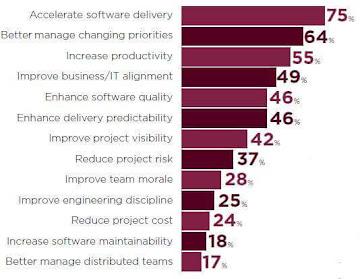
The report also investigated the significant reasons for adopting Agile and discovered:
- 75% of companies said that accelerated software delivery is their number one reason for adopting Agile.
- 64% said that the enhanced ability to manage changing priorities is what made them choose Agile.
- 55% listed “increased productivity” as their primary reason.
- 49% stated that an improved business/IT alignment was their main reason.
- 46% chose the Agile method because of the enhanced software quality.
- 17% of companies chose the Agile method to improve the management of distributed teams. This suggests that more companies are adopting Agile processes for distributed teams.
The Most Commonly Used Agile Methodologies
The State of Agile report also explored the most commonly used Agile methodologies among software development teams. The Agile Scrum methodology is by far the most widely used but it does have some weaknesses. To make up for the shortcomings in Scrum, a large number of companies are using other Agile methodologies, or a hybrid of methods to achieve success.
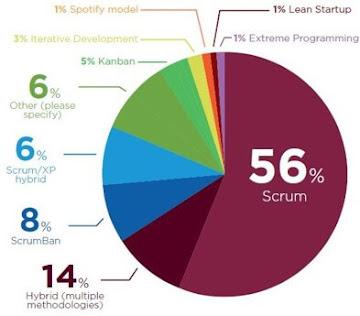
- 56% of teams use the Scrum methodology. They like that Scrum divides complicated tasks into user stories and visualizes them in the workflow.
- 14% of teams use a Hybrid combination of multiple Agile methodologies.
- 8% of teams use Scrumban, a popular hybrid of Scrum and Kanban.
- 6% use Scrum/XP Hybrid, two Agile processes that work well together.
- 5% of teams use the Kanban method. Kanban teams use a visual planning tool and the Kanban board, which shows each project on a card. The cards move through columns as the project progresses.
Scrum Statistics
Companies that are searching for an all-encompassing framework to implement the Agile mindset, often choose the Scrum framework. The reason for Scrum’s popularity is its ability to help teams move and learn faster. Although standalone Scrum is used by 56% of teams, if you calculate the hybrid methodologies that include it, Scrum is used by 83% of companies.
The State of Scrum 2017-2018 explored the growth of Scrum, its success rate, and reasons for adopting the framework, among others. The report is based on a survey of nearly 2,000 Scrum and Agile practitioners who are members of the Scrum Alliance.
According to the report’s findings:
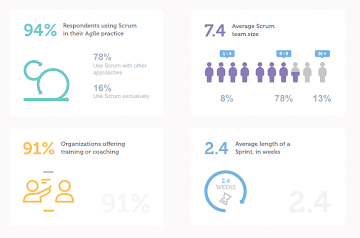
- 94% of respondents use Scrum in their Agile practice. 78% of them use Scrum with other frameworks while 16% use Scrum exclusively.
- The average size of a Scrum team is 7 members.
- The average length of a Sprint is 2.4 weeks, while the average duration of a Scrum project is 11.6 weeks.
- The top certification in 2017 was the ScrumMaster certificate with nearly 85% of respondents receiving certification for ScrumMaster. Many reported choosing it for the significant financial benefits.
- 40% of respondents received a Product Owner certification.
- 24% became certified as Scrum Coaches.
- The majority of companies today provide both online and in-house training.
Challenges With Implementing Scrum
What do all Scrum teams have in common? They all have to deal with the intricacies of Scrum implementation. Whether a team struggles with organizational culture or with transitioning from traditional Waterfall methodologies, these important considerations should be addressed before implementation.
From the State of Scrum 2017-2018 report:
- 51% of respondents say an organizational design culture makes it more difficult to adopt Agile methodologies and scale.
- 44% of teams struggle to transition from traditional Waterfall.
- 41% say they’re challenged by not having clearly defined metrics for identifying and measuring success.
- 40% say aligning with other projects in a portfolio is a major issue.
- 38% of teams struggle with a lack of trust.
- 34% of teams struggle with a lack of enthusiasm among team members and Product Owners.
Agile Scaling Methods and Approaches
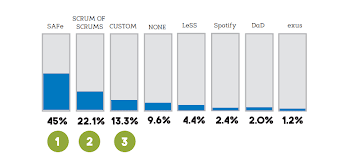
To get insights into the fast-evolving Agile landscape, cPrime conducted a survey that included more than 5,000 respondents. The findings of the study show that among the Agile Scaling Frameworks, SAFe is by far the most popular. The second most widely used framework is Scrum of Scrums, while third in popularity is the custom framework.
cPrime insights:
- 45% of respondents prefer SAFe, the most popular Agile scaling method. It’s a set of organization and workflow patterns that help companies scale lean Agile practices.
- 22% use the Scrum of Scrums scaling method. This method is often chosen when multiple teams are working on a project. Its goal is to help teams collaborate and coordinate their work.
- 13% prefer custom-made Agile scaling methods.
- 4% of respondents use the LeSS framework.
Use of Agile Project Management Tools
In addition to Agile scaling methods, cPrime also surveyed respondents about Agile project management tools. These tools are crucial to running Agile projects and keeping teams aligned at each stage of the development process. Teams can choose from an array of Agile project management tools suitable for various industries and teams of all sizes. Agile project management tools are helpful for creating and arranging tasks, managing priorities, and releasing exemplary software.
Here are some of the findings:
- 61.8% of respondents said they use Atlassian’s products, JIRA and Confluence.
- 34.7% said they use Spreadsheets to help them with their tasks.
- 21.8% said their preferred choice of Agile project management tool is the Microsoft Team Foundation Server.
- 20.4% use Google Docs as an Agile project management tool.
- 18.7% prefer using Rally to help them track and release great software.
- 9.8% of respondents said their favorite Agile project management tool is VersionOne.
Conclusion
Companies who are resistant to transitioning from Waterfall management may want to revisit the benefits of Agile adoption which include an improved work culture, customer satisfaction, client loyalty, and timely product delivery.
Agile is a widely used project management approach for delivering modern software products.
Quick final facts:
- 75% of companies said that accelerated software delivery is their number one reason for adopting Agile.
- 56% of teams use standalone Scrum, but when hybrid methodologies are factored in that number jumps to 83%.
- Organizational design culture is the biggest challenge for implementing Scrum.
- The top certification in 2017 was the ScrumMaster certificate.
- SAFe is among the most used Agile scaling methods and approaches.
- Atlassian’s JIRA and Confluence are the most popular Agile project management tools today.