
How to Estimate the Cost of Software Development
Software development involves more than writing code. It includes solving business problems, building reliable systems, and delivering seamless user experiences. Yet, the cost of building software depends on several variables.

Software development involves more than writing code. It includes solving business problems, building reliable systems, and delivering seamless user experiences. Yet, the cost of building software depends on several variables.

Ann Kuss
Ann is a growth-oriented tech leader with more than 13 years of experience building and scaling remote teams for startups and global brands. She has helped companies expand internationally across 17 countries. A Kyiv-Mohyla Business School graduate and MIM Kyiv alumna, Ann is also an active mentor supporting the development of junior tech talent.
Table of Contents
- Factors Affecting Costs of Software Development
- Pricing Models for Development Projects
- Dedicated Team Model
- FAQ
Software development involves more than writing code. It includes solving business problems, building reliable systems, and delivering seamless user experiences. Yet, the cost of building software depends on several variables.
A simple app will not cost the same as an AI-driven platform. Project scope, team structure, technical complexity, timeline, and technology stack all influence the final budget. As AI-assisted coding, distributed teams, and flexible hiring models reshape software development, pricing has also become more variable.
This guide breaks down the factors that drive software development costs so you can plan your budget more effectively.
Factors Affecting Costs of Software Development
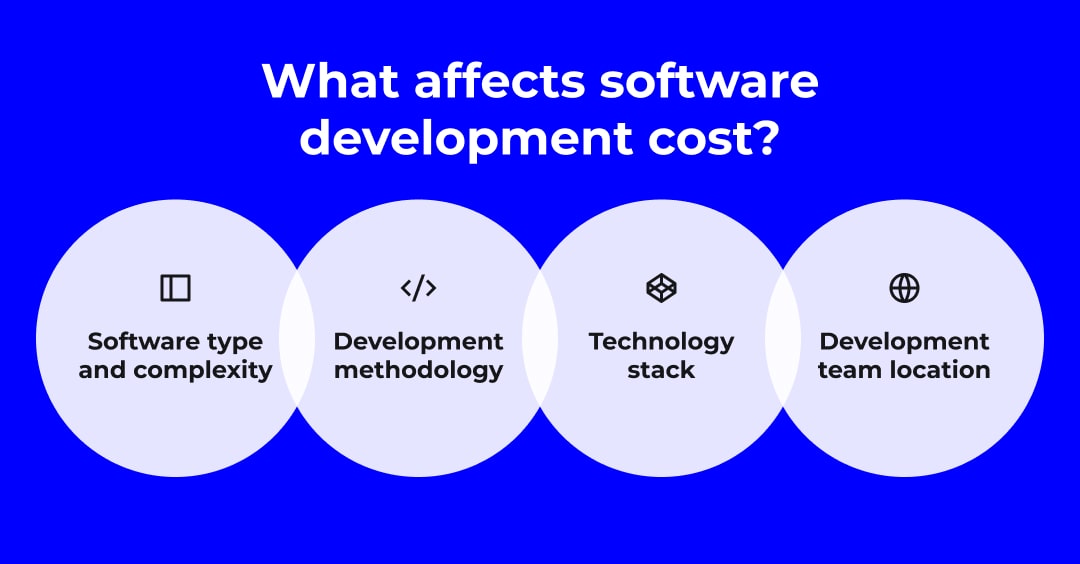
What does software development cost involve?
Several factors impact software development costs, from project scope to technology choices. Knowing what drives these expenses helps you plan efficiently and avoid overspending.
Software Type and Complexity
The more advanced the features, the greater the cost. A basic application with limited functionality is far cheaper to develop than a multi-layered system requiring complex integrations, real-time data processing, and high-security measures.
For example, a calculator app takes minimal development effort. In comparison, an ERP system involves multiple interconnected components, user roles, and ongoing maintenance, driving up both time and costs.
If you’re working on a straightforward tool, no-code or low-code platforms can speed up development and reduce expenses. However, if scalability and customization are priorities, a traditional development approach is often the better long-term investment.
Costs also depend on platform requirements. Building for web, iOS, Android, and desktop demands additional effort, increasing both development time and budget.
Development Methodology
Your choice of development methodology directly impacts software development costs, efficiency, and flexibility. The right approach helps streamline workflows, reduce unnecessary expenses, and avoid costly rework. With advancements in AI, automation, and cloud-based development, some methodologies now significantly lower software development costs compared to traditional approaches.
Waterfall
A step-by-step approach where each phase (planning, design, coding, testing, deployment) must be completed before moving to the next. Best for short, well-defined projects where requirements won’t change. However, any mid-development adjustments can be costly and time-consuming. This is why many teams now favor Agile or AI-powered automation for cost control.
Agile
Agile breaks development into iterative sprints, allowing frequent feedback and real-time adjustments. It’s ideal for projects that evolve, but constant refinements and extended timelines can increase costs. AI-driven coding assistants and automated testing are now reducing Agile overhead, cutting the need for extensive QA teams while keeping development nimble.
Scrum
A structured Agile framework where teams work in time-boxed sprints, regularly reassessing priorities. Smaller teams and incremental releases help control costs, but daily standups and ongoing iterations add overhead. Many teams now integrate AI for sprint planning and automation to optimize workload distribution.
Kanban
Kanban focuses on visualizing tasks and reducing work in progress, making it effective for frequent updates and maintenance projects. It improves efficiency but requires disciplined prioritization to prevent bottlenecks. AI-powered workflow automation tools now enhance Kanban by optimizing task assignments without manual intervention.
Lean
Inspired by lean manufacturing, this method eliminates unnecessary steps and automates repetitive processes. Ideal for small teams on tight budgets, Lean reduces waste, but demands experienced engineers to maintain quality. No-code/low-code platforms are now an extension of Lean, cutting development for simpler applications.
DevOps
A mix of development and operations, DevOps automates deployment, monitoring, and updates, reducing maintenance costs and accelerating delivery. While it requires skilled DevOps engineers and infrastructure investment, serverless computing and cloud-native automation now eliminate the need for traditional backend maintenance, dramatically lowering costs.
The AI and Automation Shift
No-code/low-code platforms now replace traditional development for MVPs, while AI-driven debugging and testing cut QA expenses. As software development evolves, reducing costs is no longer about hiring fewer developers, but about using smarter technology.
Managing unexpected software costs is like diagnosing a medical issue: you need to find the root cause before it escalates. We implemented iterative reviews and financial feedback loops, reducing unanticipated expenses by 20%. AI-driven cost monitoring has been a game-changer, allowing real-time budget adjustments that prevent overruns before they happen.
Victor Santoro Founder & CEO at Profit Leap
Technology Stack: Balancing Cost, Scalability, and Future Growth
Your technology stack directly influences development expenses, from hiring costs to long-term maintenance. The right choices keep your project scalable and cost-efficient, while the wrong ones lead to overpriced talent, maintenance issues, and expensive migrations.
Skill Level and Software Developer Cost
The cost of hiring a software developer depends on the stack. Widely used languages like JavaScript, Python, and Java have a larger talent pool, keeping salaries competitive. Niche technologies, such as Rust or Solidity, drive up hiring costs because fewer specialists are available.
AI-generated code automates repetitive tasks, reducing development hours. But skilled engineers are still needed to refine, optimize, and manage AI-assisted coding, making high-level expertise more expensive.
For cross-platform projects, mobile app developer costs fluctuate depending on whether you build natively (Swift, Kotlin) or opt for a hybrid approach (React Native, Flutter).
Development Speed and Cost Optimization
Some stacks allow for faster deployment, while others require customization that progresses more slowly. Serverless computing eliminates backend maintenance costs. You pay only for the computing power used. This pay-as-you-go model is a game-changer for cost optimization in software development.
According to McKinsey, embedding FinOps principles into software engineering processes can enhance cost efficiency by managing cloud expenses more proactively, allowing businesses to optimize their infrastructure spending while maintaining development speed.
Scalability and Long-term Viability
Scalability should consider keeping costs predictable. Some stacks scale horizontally (by adding servers), others vertically (by upgrading hardware). Cloud-native architectures with auto-scaling help you pay only for actual usage.
For security-focused applications, blockchain development adds new cost layers due to specialized talent needs. However, decentralized systems reduce reliance on costly centralized databases.
Meanwhile, quantum computing is still niche but is already reshaping encryption, data processing, and high-complexity applications. While expensive today, it may soon impact enterprise software costs.
Maintenance and Hidden Costs
Every stack comes with hidden maintenance expenses. Some require constant updates (e.g., PHP-based systems), while others offer long-term stability with minimal patching. Choosing a low-maintenance stack reduces future technical debt.
AI-assisted debugging is now lowering testing costs, automating repetitive QA tasks, and catching bugs early, which means fewer costly post-release fixes.
A future-proof stack isn’t just about what works now; it’s about cutting costs and reducing risks over time.
Development Team Location
Where you hire affects the cost of software development. Local teams offer easier collaboration but come at a premium, while outsourcing can cut costs.
To minimize cost-per-hire in tech, many companies use a hybrid model that combines local leads with offshore developers. This balances expertise, cost efficiency, and flexibility without sacrificing quality. If you need fast scaling, outstaffing providers offer pre-vetted talent on flexible contracts, helping you avoid full-time hiring expenses.
Pricing Models for Development Projects
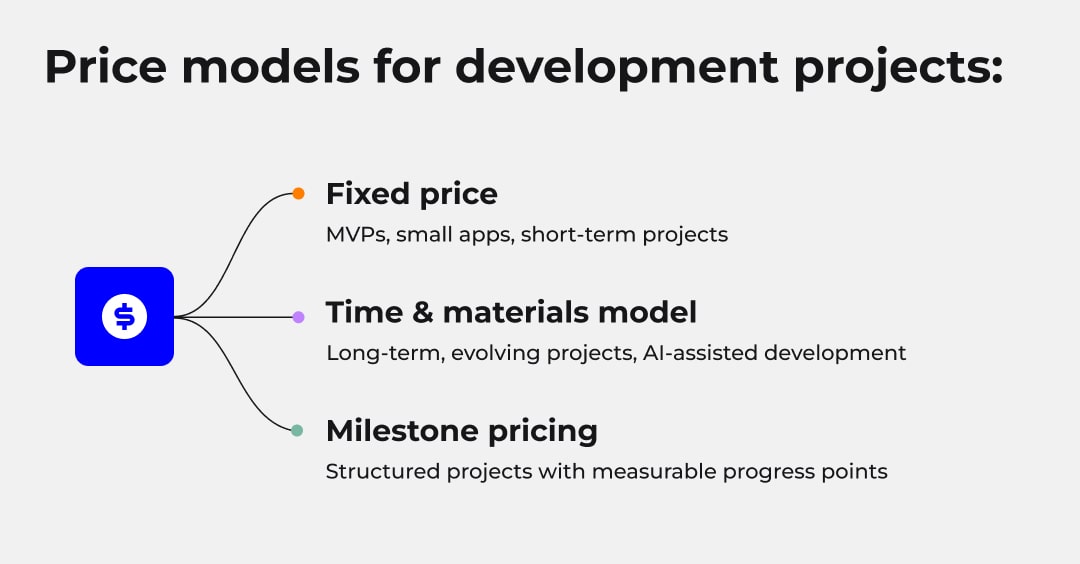
Different pricing models per project type
Your pricing model shapes project flexibility, risk, and cost control. Whether you’re working with an in-house team or outsourcing, the right approach can reduce software development costs while keeping projects on track.
Fixed-price Model: Predictability at a Cost
A fixed-price contract locks in costs upfront. This is ideal for well-defined projects with a clear scope, set deadlines, and minimal changes. However, any adjustments mid-project may require renegotiation.
While this model works well for traditional software development, rigid pricing structures often lead to inefficiencies. A hybrid model, where fixed pricing is used for core functionalities and flexible billing is applied for iterative enhancements, is becoming more practical.
Fixed price models work well for MVPs, small apps, and short-term projects with a fixed scope.
Time and Materials Model: Flexibility With Less Cost Control
With this model, you pay for actual work done, usually at an hourly rate plus materials. It works well for projects with evolving requirements, allowing for flexibility and continuous improvement. Still, it’s important to note that without strong oversight, budgets can fluctuate. To optimize onboarding costs, set clear time tracking, budget caps, and progress reviews.
As AI-driven development and low-code platforms reduce manual coding, this model is increasingly popular for fast-moving, AI-powered projects where new features are continuously refined. Note, it still requires careful scope management to avoid escalating costs.
The Time and Materials model is best suited for long-term projects, AI-assisted development, and initiatives with evolving requirements.
Software costs can spiral out of control like tax season surprises, so I break development into two-week sprints with cost checkpoints. Last month, this helped us catch a potential $30,000 overrun when cloud usage exceeded estimates, allowing us to adjust before it became a real problem.
Trevor Bailey Co-Founder at Taxfluence
Milestone Pricing Model
Here, payments are tied to specific deliverables rather than time spent, and payment is issued upon completion of a feature or stage. This offers better visibility into progress and motivates development teams to meet deadlines. This model can optimize costs in software development, but it may slow progress if milestones are too large or complex. It’s particularly effective for modular AI features, cloud-native applications, and serverless platforms. With the rise of AI-generated code, deliverables must be defined by functionality rather than by time spent.
The milestone pricing model is well-suited for structured projects with measurable progress points.
Dedicated Team Model
A dedicated team gives companies ongoing access to development talent without having to build a full in-house team. Instead of hiring every role internally, companies work with an external team that supports long-term development needs while allowing internal stakeholders to retain more control over the project.
Benefits include:
- Scalability: Adjust team size based on project needs.
- Cost management: Can reduce some hiring, payroll, and infrastructure overhead compared to building a full internal team.
- Project control: Collaborate directly with the team to align tasks with internal priorities.
If you work on complex, evolving projects, a dedicated team helps ensure consistent quality and predictable costs.
FAQ
What factors influence software development costs?
Software development costs depend on project complexity, tech stack, team location, and pricing model. High-skill expertise, AI integration, and advanced security features can drive up costs, while automation and efficient development methodologies can help keep them in check.
How can I reduce software development costs without compromising quality?
To reduce software development costs without compromising quality, optimize team structure by leveraging dedicated or remote developers, use open-source tools, and adopt Agile delivery frameworks for faster iterations. Automate testing, prioritize must-have features, and choose scalable infrastructure to avoid costly rewrites.
What are the best strategies for cost optimization in software development?
Invest in AI-assisted development, serverless infrastructure, and reusable code components. Use a hybrid team model, outsource selectively, and track expenses with cloud-based cost monitoring tools. Regular audits help eliminate waste and improve budget efficiency.