
How Much Does a Recruitment Agency Charge by Country and Why
The HR Services market is constantly growing, offering team scaling experts equipped with AI-powered tools. With tech recruiting services, it’s possible to accelerate hiring speed and close in-demand but hard-to-fill positions on a tech team.

The HR Services market is constantly growing, offering team scaling experts equipped with AI-powered tools. With tech recruiting services, it’s possible to accelerate hiring speed and close in-demand but hard-to-fill positions on a tech team.

Ann Kuss
Ann is a growth-oriented tech leader with more than 13 years of experience building and scaling remote teams for startups and global brands. She has helped companies expand internationally across 17 countries. A Kyiv-Mohyla Business School graduate and MIM Kyiv alumna, Ann is also an active mentor supporting the development of junior tech talent.
Table of Contents
- Recruitment Agency Fee Structure
- Factors Affecting Standard Recruiting Fees
- How Much Does a Recruitment Agency Charge by Country?
- What to Do If I Get Lost in a Recruitment Agency’s Pricing Policy?
- FAQ
The HR Services market is constantly growing, offering team scaling experts equipped with AI-powered tools. With tech recruiting services, it’s possible to accelerate hiring speed and close in-demand but hard-to-fill positions on a tech team.
But what about pricing? Optimizing hiring costs is important, especially for growing businesses with numerous investment opportunities. This is why it’s important for businesses to understand recruiting structures and fees in order to make the best hiring decisions.
Let’s take a look at how recruiters structure their fees to help you choose the best approach for scaling your own team.
Recruitment Agency Fee Structure
A recruitment agency’s fee structure is based on the terms of the agreement between the agency and the client. It’s important to clearly outline the recruiting fee structure and terms before commencing the recruitment process or recruiters may cost a lot, even if they are from countries where recruiting costs are considered to be low.
Worldwide, prices and payment deadlines will depend on the services provided. If you want to pay only for the relevant services and negotiate recruitment fee agreements, it’s necessary to compare the available service models.
Let’s walk through the standard types of recruiting fees, which are more important to consider than geography.
Just Recruitment
Contingency Recruitment
A client pays the agency only when a candidate is successfully hired.
Fee Structure: An average recruitment fee fluctuates between 15-30% of the candidate’s first-year salary.
Payment Timing: Paid after the newly hired candidate’s first working day.
Retained Recruitment
The agency is hired exclusively for a search, often for high-level or specialized positions.
Fee Structure: Usually, it’s 25-35% of the candidate’s first-year annual salary, paid in installments.
Initial Retainer Fee: One-third of the total fee is paid upfront.
Progress Payment: Another one-third is paid at a milestone, such as presenting a shortlist of candidates.
Final Payment: The remaining one-third is paid upon the successful hire.
Payment Timing: Structured in stages throughout the recruitment process.
Flat Fee Recruitment
The agency may charge a flat fee for the services, regardless of the candidate’s compensation. If you pay for the scope of real work, which can vary, it’s easier to measure the effectiveness of your investments.
Fee Structure: A fixed amount agreed upon before the search begins.
Payment Timing: Can be upfront, in stages, or upon successful hire, depending on the agreement.
Recruitment and Ongoing HR Ops
Temporary Staffing
The agency supplies specialists who are employed by the agency but work for the client.
Fee Structure: An hourly or monthly rate is charged, which includes the specialist’s pay plus a markup for the agency’s services.
Markup: Typically ranges from 25-75% above the worker’s hourly wage.
Payment Timing: Billed regularly, such as weekly or monthly, based on hours worked.
Temp-to-Perm Recruitment
A temporary worker has the opportunity to become a permanent employee.
Fee Structure: Combines temporary staffing fees with a conversion fee if the temp worker is hired permanently.
Conversion Fee: Often a percentage of the annual salary, adjusted by the length of the temp period.
Payment Timing: Ongoing for temporary staffing, with a one-time fee upon permanent hiring.
Contract Recruitment
An agency hires experienced contractors or freelancers, like AI Software Engineers or Data Scientists, for specific projects or for a set duration.
Fee Structure: Similar to temporary staffing, with an hourly or project-based rate that includes the agency’s markup.
Payment Timing: Billed regularly, based on time worked or project milestones.
Additional Terms of Cooperation You Might Need
A recruitment agency’s fee structure is not the only decision-making factor when you seek the right People partner to scale your team.
Guarantee Period
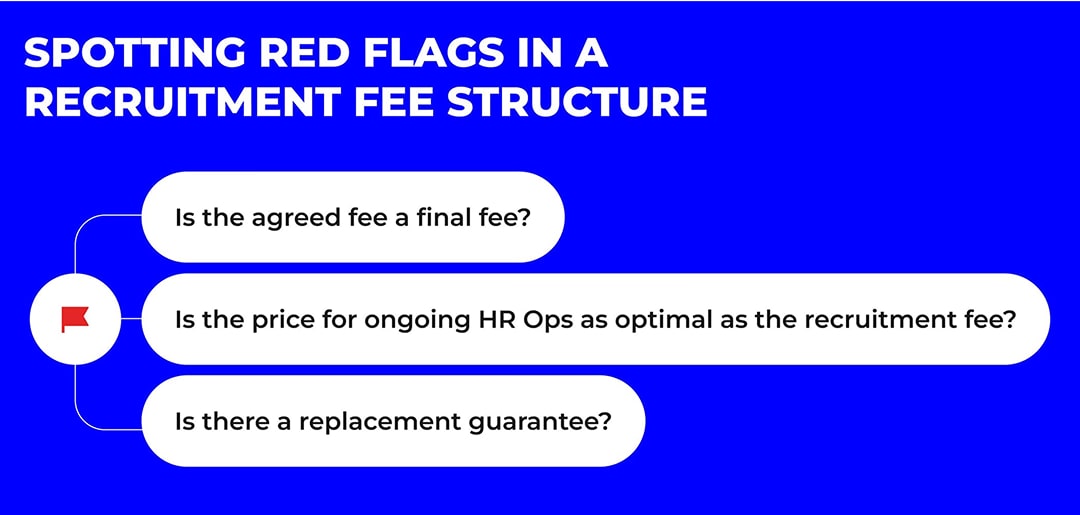
The cost of hiring a programmer can add up over time if you replace your hire, which is why some agencies offer a guarantee period. If the new hire leaves during this period, a replacement will be found at no additional cost or a portion of the fee will be refunded.
Exclusivity
Some agencies offer reduced fees in exchange for exclusive rights to the recruitment search. This could be a perfect option if you don’t have recruiters on your team and don’t mind fully outsourcing your recruiting.
Niche Expertise
If you need to hire candidates with niche expertise for important projects, consider working with recruiters who specialize in finding those roles.
Factors Affecting Standard Recruiting Fees
What is essential to know when navigating the HR services market in search of recruiters?
Location: Fees can vary by region, with metropolitan areas often having higher rates.
Market Conditions: Supply and demand for talent within a specific location impact recruitment agency fees. Competitive markets with high talent demand lead to higher fees. Countries with higher living expenses also see higher recruitment fee rates, as agencies factor in their operational costs.
Is it possible to find regions with both a lower cost of living and skilled jobseekers? Yes, it’s worth noting that an agency and hired specialists could be located in different regions, and a recruitment agency’s fee calculation reflects that.
Position Level: Executive searches generally have higher fees than lower-level positions. Let’s say the average recruitment fee for the needed service package is 15-25% of first-year compensations, with some countries falling slightly lower or higher. Then, positions requiring unique skills or extensive experience would command fees between 25-30%.
Industry Standards: Different industries may have established fee ranges based on typical salaries and recruitment practices. If you seek pros in the IT sector, a standard recruitment fee might be higher due to the difficulty of finding suitable candidates.
Agency Reputation: Well-known agencies might command higher fees due to their established track record.
When you understand the pricing factors, the question, ”How much does a recruitment agency charge by country?” takes on new depth.
How Much Does a Recruitment Agency Charge by Country?
Recruitment Pricing Comparison
| Country | Typical fees for hiring IT specialists | Decision-making factors |
United States |
Fees typically fall within the 15-25% range, with higher percentages for specialized roles
|
American recruiters place more emphasis on a candidate’s personality and fit with the company culture. They are generally very flexible and client-oriented.
|
United Kingdom |
Similar to the US, fees generally range from 15-25%, with potential adjustments for specific sectors or senior positions.
|
British recruiters focus more on skills and expertise. The UK recruitment sector is highly saturated, making it challenging for new agencies to build a client base and brand reputation.
|
Singapore |
Entry-level positions might see fees around 10-12%, while senior or specialized roles can reach 20-30%.
|
Cultural differences are less pronounced than in India, but agencies should still be aware of local norms and customs. It’s better to have a presence in Singapore to manage relationships.
|
India |
Fees typically range from 8.33-16.67% of the candidate’s annual CTC (Cost to Company), with variations based on seniority and agency structure.
|
Cultural differences may be present, especially around communication styles and work practices. Yet the region may offer lower fees and fast turnaround.
|
If your recruiters maintain a high-quality talent base, adhere to relevant hiring regulations, and offer a shortlist of culturally relevant candidates with skills tailored to your needs, their recruitment fees will likely fall at the higher end of the range. However, you can be sure that the result of their work will meet your expectations.
Keep in mind not only the cost spent on recruiters, but also the potential benefits they bring in the long run.
What to Do if I Get Lost in a Recruitment Agency’s Pricing Policy?
The pricing structure behind good recruitment services should not be complicated. If you don’t understand exactly what you are paying for, search for alternative firms.
While considering “How much does a recruitment agency charge by country?”, focus on finding quality, vetted technical recruitment and staffing services.
FAQ
What services are included in a recruiter’s fee?
The typical recruiter fee covers sourcing, screening, interviewing, and presenting candidates.
When do I pay the recruitment fee?
It depends on the company you choose to work with and the type of hire (hourly, fixed-term, permanent). Some recruiting specialists work on a pay-as-you-go subscription type plan, some charge fixed monthly fees, and others charge after the hire.
What happens if I make a hire myself after using the agency’s services for a candidate?
This is highly specific to the agency you’re working with and how far into the process you are (shortlisting candidates, initial interviews). It’s a good question to ask up front when retaining the agency, in case you find a perfect referral for your role from an outside source during the engagement.