
Metrics for the Recruitment Pipeline: What Are the Norms?
Recruiting is more than filling open positions. It is a detailed system that, when built properly, helps companies find top talent quickly and consistently. The difference between effective recruiting and simply filling positions lies in data-backed decision-making. The right metrics reveal bottlenecks, pinpoint areas for improvement, and help teams build a smoother, more effective recruitment pipeline

Recruiting is more than filling open positions. It is a detailed system that, when built properly, helps companies find top talent quickly and consistently. The difference between effective recruiting and simply filling positions lies in data-backed decision-making. The right metrics reveal bottlenecks, pinpoint areas for improvement, and help teams build a smoother, more effective recruitment pipeline

Ann Kuss
Ann is a growth-oriented tech leader with more than 13 years of experience building and scaling remote teams for startups and global brands. She has helped companies expand internationally across 17 countries. A Kyiv-Mohyla Business School graduate and MIM Kyiv alumna, Ann is also an active mentor supporting the development of junior tech talent.
Table of Contents
- What Are Recruitment Pipeline Metrics?
- What Are Normal Candidate Pipeline Metrics?
- Key Stages and Metrics of a Recruitment Pipeline Process
- Benefits of a Well-managed Recruitment Pipeline
- How to Optimize Your Recruitment Pipeline
- Common Pitfalls and How to Avoid Them
Recruiting is more than filling open positions. It is a detailed system that, when built properly, helps companies find top talent quickly and consistently. The difference between effective recruiting and simply filling positions lies in data-backed decision-making. The right metrics reveal bottlenecks, pinpoint areas for improvement, and help teams build a smoother, more effective recruitment pipeline
In this article, we’ll cover the main recruitment pipeline metrics and explain how these insights can help you refine your hiring strategy.
What Are Recruitment Pipeline Metrics?
Recruitment pipeline metrics are like a GPS for your hiring journey. Using them at each recruiting step lets you track progress and reach your final destination more quickly. Metrics allow you to evaluate your recruiting pipeline and improve the quality of your hires.
Pipeline efficiency can be measured through key metrics like pass-through rate, drop-off rate, and time to hire. For example, a high drop-off rate during interviews may signal unclear expectations or a flawed evaluation process.
Think of metrics as a recruiter’s toolbox. Each tool serves a different purpose, but together they contribute to a successful recruitment pipeline. By tracking and analyzing these metrics, you see how well your recruitment pipelines are performing.
The success of our recruitment pipeline hinges on key areas: conversion rates, candidate quality, time-to-hire, and retention. High conversion rates signal a strong pipeline, while retention highlights long-term success. By focusing on these metrics, we refine strategies to ensure efficient hiring and place high-quality candidates who drive organizational growth.
Amit Doshi Founder & CEO at MyTurn
What Are Normal Candidate Pipeline Metrics?
There is no one-size-fits-all benchmark for recruitment pipeline metrics. The right targets depend on the role, industry, and company size. However, industry benchmarks can provide a useful starting point for setting expectations and evaluating your hiring process.
General Benchmarks
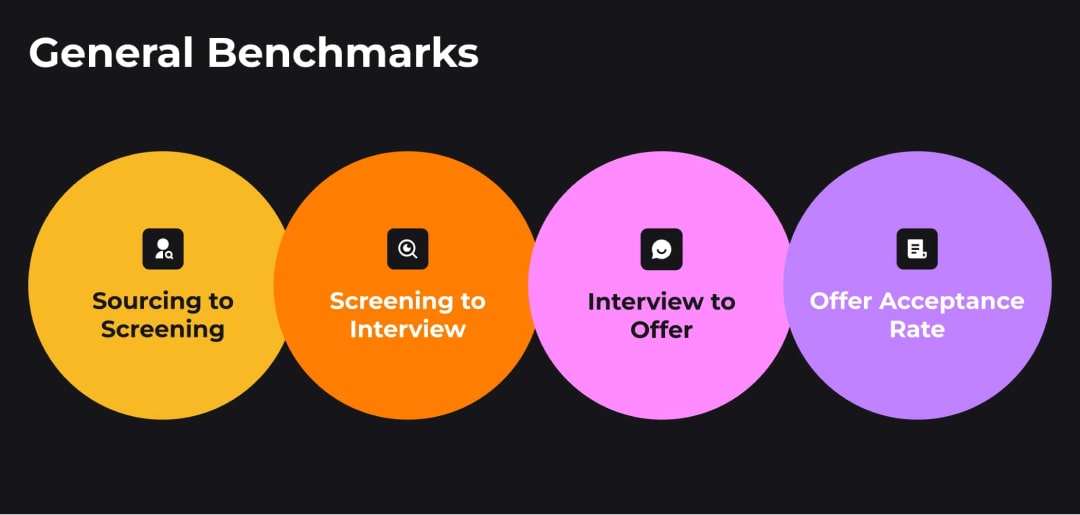
Recruitment pipelines often follow similar patterns across roles and industries. These benchmarks serve as a starting point to assess pipeline performance and identify areas for improvement:
- Sourcing to Screening: A portion of sourced candidates advance past screening, where resumes and profiles are reviewed to determine whether they are a strong enough fit for deeper evaluation.
- Screening to Interview: Screened candidates with the right qualifications and skills move on to interviews. Conversions at this stage vary by role complexity, seniority, and industry.
- Interview to Offer: A share of interviewed candidates receive offers. Highly specialized or niche roles may have lower offer rates because the requirements are more specific.
- Offer Acceptance Rate: High acceptance rates signal that expectations, compensation, and the candidate experience were aligned. Low acceptance rates may point to poor candidate experience, uncompetitive offer rates, poor communication, or unclear expectations.
Time-to-Hire versus Time-to-Fill
- Time-to-hire: This metric measures the time from when a candidate applies for a role to when they accept an offer. It reflects the speed and efficiency of the recruitment process once a candidate enters the pipeline.
- Time-to-fill: This metric measures the time from when a role is opened to when it is filled. It typically includes sourcing, screening, interviewing, offer negotiation, and sometimes onboarding-related steps.
According to Workable, average benchmarks for technology roles include:
Location | Time-to-Fill (Days) | Time-to-Hire (Days) |
Global | 68 | 33 |
US & Canada | 56 | 33 |
UK & Ireland | 56 | 28 |
Europe | 85 | 36 |
Australia | 46 | 28 |
Asia | 92 | 36 |
Rest of World | 64 | 32 |
These benchmarks help organizations tailor their recruitment strategies, ensuring efficient processes and improved candidate experiences.
Specialized Insights
While general benchmarks provide a useful starting point, different roles and industries follow distinct hiring patterns. Understanding these distinctions can help fine-tune your approach.
- C-level roles: Key metrics include quality of hire, time-to-fill, and offer acceptance. Conversion rates may be lower because the evaluation process is more selective, but acceptance rates tend to be higher as candidates are more carefully pre-qualified.
- Technical roles: Key metrics include time-to-hire and pass-through rates. These roles attract high application volumes but have lower conversion rates due to skill assessment requirements.
- Sales and Marketing roles: Key metrics include interview-to-offer rates, candidate satisfaction, and offer acceptance. Hiring teams may see higher conversion rates when candidates align well with the company’s culture and communication style.
Factors That Influence Recruitment Pipeline Metrics
Several factors can affect recruitment pipeline benchmarks:
- Industry: As mentioned above, technical roles often attract higher application volumes but lower pass-through rates because of specialized skill requirements and assessments.
- Company Size: Startups may have broader pipelines and lower pass-through rates, which often raise questions about how to hire developers efficiently while maintaining quality.
- Geography: Candidate availability, compensation expectations, and competition vary by market and location, affecting sourcing volume, pass-through rates, time to hire, and offer acceptance. In competitive regions, location-specific benchmarks can help teams set realistic expectations and improve conversion rates throughout the pipeline.
SHRM’s 2024 Talent Trends Report also mentions skills shortages and retention issues as key factors shaping the recruitment landscape. These insights highlight the importance of aligning strategies with current trends to maintain an efficient pipeline.
By comparing your metrics to relevant benchmarks, you can identify whether your recruitment pipeline is operating efficiently.
Key Stages and Metrics of a Recruitment Pipeline Process
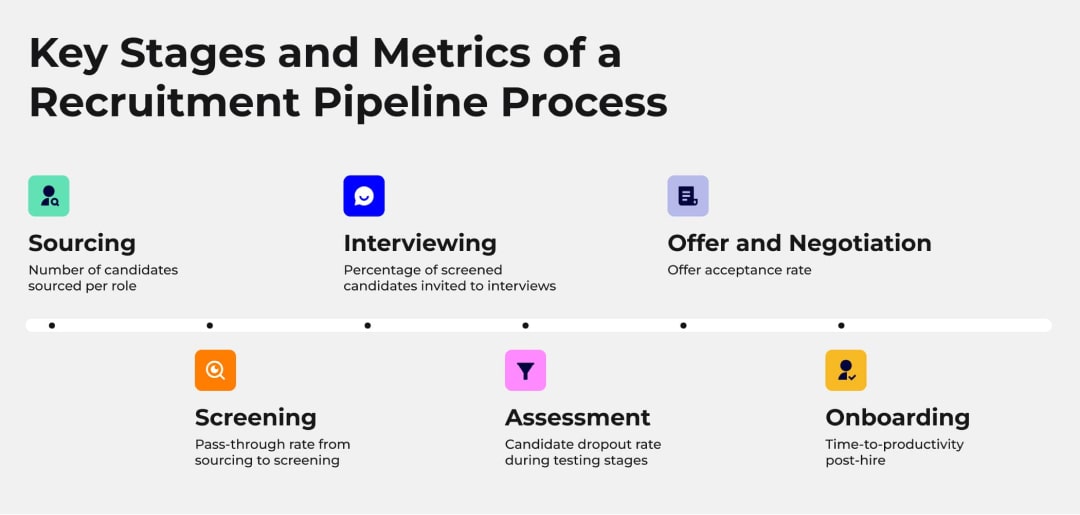
A recruitment pipeline is successful when each stage moves qualified candidates forward efficiently. The most common stages include:
Sourcing
At this stage, the talent search begins. Hiring teams use job boards, referrals, social media, and direct outreach to build a strong talent pipeline for current and future hiring needs. For specialized roles, such as Cybersecurity Engineer roles, leveraging IT recruitment services can help build a stronger pipeline.
Metric: Number of candidates sourced per role.
Screening
Screening helps identify candidates who align with the role’s requirements and narrows the pool to the most qualified individuals. This step often involves reviewing resumes and conducting initial interviews.
Metric: Pass-through rate from sourcing to screening.
Interviewing
Interviews help hiring teams evaluate how well candidates’ communication and working style align with the role. This stage often includes behavioral questions and role-specific discussions to identify candidates who should move forward.
Metric: Percentage of screened candidates invited to interviews.
Assessment
The assessment stage provides deeper insight into a candidate’s technical abilities. Hiring teams evaluate technical proficiency through skills tests and role-specific exercises. This stage helps confirm whether a candidate’s capabilities meet the position’s expectations.
Metric: Candidate dropout rate during testing stages.
Offer and Negotiation
At this stage, hiring teams present the offer and work through final details with the selected candidate. A high acceptance rate for offers suggests that the role, compensation, expectations, and candidate experience are aligned. A low acceptance rate may point to issues with compensation, role clarity, communication, or the candidate’s experience in earlier stages.
Metric: Offer acceptance rate.
Onboarding
Onboarding marks the beginning of a new hire’s journey with the company. Effective onboarding reduces early turnover and accelerates a new hire’s impact.
Metric: Time-to-productivity post-hire.
Each stage of the recruitment pipeline is an opportunity to refine your recruiting pipeline strategy. By tracking the right metrics at each step, teams can create a smoother, more effective process for both employers and candidates.
Benefits of a Well-managed Recruitment Pipeline
A structured recruitment pipeline benefits both employers and candidates:
Aspect | For Employers | For Candidates |
Time Efficiency | Reduced time-to-hire ensures roles are filled quickly. | Faster hiring decisions reduce uncertainty. |
Quality of Hires | Aligns candidates with technical and cultural needs. | Highlights unique strengths through a fair process. |
Cost Savings | Efficient recruitment pipeline management minimizes expenses. | Streamlined processes save candidates' time and effort. |
Diversity and Inclusion | Streamlined processes save candidates' time and effort. | Transparent pipelines build trust and encourage diversity. |
Reputation Building | Positive candidate experiences enhance the employer brand. | Clear communication fosters goodwill and trust. |
How to Optimize Your Recruitment Pipeline
A recruitment pipeline is only as effective as the effort you put into refining it. Small, strategic changes can save time, money, and resources.
The following actions can make your pipeline more efficient and impactful:
Leverage Technology
Technology is the backbone of an optimized recruitment pipeline. Applicant tracking systems (ATS) and AI-powered platforms can streamline sourcing, automate screening, centralize candidate data, and help candidates move smoothly through each stage.
- Use an ATS to centralize and organize candidate data.
- Leverage AI for tasks like resume parsing and candidate pipeline management, ensuring that qualified candidates are identified and engaged efficiently.
Define Clear Stages
Ambiguity at any stage can slow down the pipeline. A well-designed recruiting pipeline template can help establish clear criteria for advancing candidates and ensure everyone involved understands expectations.
- Create a standardized checklist for each stage.
- Involve hiring managers early to align on role expectations and evaluation requirements.
Improve Communication
Silence during the hiring process can signal disorganization and weaken candidate trust. Regular updates at each stage help keep candidates engaged and reduce drop-off rates.
- Automate follow-up emails for application status updates.
- Adhere to established timelines.
Measure Key Metrics
Metrics are the compass guiding your pipeline management. Track critical KPIs like time-to-hire, pass-through rates, and offer acceptance rates to pinpoint inefficiencies.
- Use dashboards to visualize pipeline performance.
- Regularly review data and adjust strategies accordingly.
Focus on Candidate Experience
A positive pipeline experience prioritizes transparency, respect, and seamless interactions.
- Personalize communication to show candidates they are valued.
- Offer timely feedback, including to applicants who are not selected.
By implementing these optimizations, recruitment pipelines can become strategic assets that help secure top talent faster while strengthening your company’s reputation.
Common Pitfalls and How to Avoid Them
Even the most structured recruitment pipeline can face challenges. By identifying common issues early, you can take action to keep the process efficient and aligned with hiring goals.
Overloading the Pipeline With Unqualified Candidates
Casting too wide a net can waste time. Focus on targeted sourcing to attract candidates who meet role-specific criteria. Use AI tools and refined job descriptions to filter early.
Neglecting Internal Candidates
Overlooking internal talent can hurt morale and slow down hiring. Create clear pathways for employees to learn about and apply for new roles.
Ignoring Metrics
Without proper metrics, it becomes difficult to manage an efficient hiring process. Consistently monitor KPIs to make data-driven decisions and improve pipeline performance.
Avoiding these pitfalls ensures your recruiting pipeline remains efficient, fair, and appealing to talent.
Key Takeaways
A well-structured recruitment pipeline is a powerful tool for connecting with top talent while meeting your company’s needs. By tracking key metrics and benchmarking against industry norms, teams can hire faster, improve diversity, and achieve higher offer acceptance rates.
Small adjustments in communication, sourcing strategies, or metrics analysis can deliver measurable value. Consider strategies like IT staff augmentation to address talent gaps and streamline hiring.
FAQ
What’s the difference between a recruitment pipeline and a talent pipeline?
A recruitment pipeline focuses on moving active candidates through the hiring stages for a specific role. A talent pipeline is a curated pool of pre-qualified candidates who may not be part of an active hiring process but could be considered for future opportunities.
What recruitment benchmarks are useful for pipeline evaluation?
Useful recruitment benchmarks for pipeline evaluation include:
- Sourcing to screening rate, which shows whether your sourcing strategy is attracting candidates who meet the role’s basic requirements.
- Screening to interview rate, which reflects how many qualified candidates are strong enough to move into deeper evaluation.
- Interview to offer rate, which helps assess if interviews identify candidates who match the role’s expectations.
- Offer acceptance rate, which indicates whether compensation, experience, and candidate expectations are aligned and competitive.
- Time to hire, which reflects the efficiency of the recruitment process.
- Time to fill, which shows the efficiency of the entire recruitment process from opening to accepted offer
Together, these metrics show whether a recruitment pipeline is attracting qualified candidates, moving them through each stage efficiently, and converting the right candidates into accepted offers.