
Software Developer Skills on Everyone’s Radar in 2026
As technical needs evolve, so do the skills companies look for in software developers. This guide highlights the software developer skills expected to remain in demand in 2026, including the roles, capabilities, and technical areas businesses are prioritizing as they scale.

As technical needs evolve, so do the skills companies look for in software developers. This guide highlights the software developer skills expected to remain in demand in 2026, including the roles, capabilities, and technical areas businesses are prioritizing as they scale.

Ann Kuss
Ann is a growth-oriented tech leader with more than 13 years of experience building and scaling remote teams for startups and global brands. She has helped companies expand internationally across 17 countries. A Kyiv-Mohyla Business School graduate and MIM Kyiv alumna, Ann is also an active mentor supporting the development of junior tech talent.
Table of Contents
- Software Developer Skills in Need: Top Positions and Specializations
- Beyond Software Developer Hard Skills: Future Trends
- Conclusion
- FAQ
As technical needs evolve, so do the skills companies look for in software developers. This guide highlights the software developer skills expected to remain in demand in 2026, including the roles, capabilities, and technical areas businesses are prioritizing as they scale.
Software Developer Skills in Need: Top Positions and Specializations
In 2026, businesses are prioritizing software developer skills that support AI integration, data analytics, personalized digital experiences, and cybersecurity. Generative AI is no longer a speculative advantage; it is a hallmark of how businesses stay competitive.
The challenge now is execution. Many organizations understand AI’s potential but still need developers who can work AI into daily operations, not for posterity but in ways that add measurable value.
As companies move from AI exploration to implementation, demand is growing for developers who can combine technical knowledge with practical judgment.
AI and ML expertise remains front and center. Developers who can scale intelligent systems — especially with generative AI and NLP — are in high demand. Add cloud-native fluency and secure coding practices, and you have a developer who’s not just valuable, but essential. Companies serious about hiring top talent must move fast, offer growth, and create a culture where developers thrive
Rob Reeves CEO and President, Redfish Technology
Top Positions in Demand With Software Engineering Skills
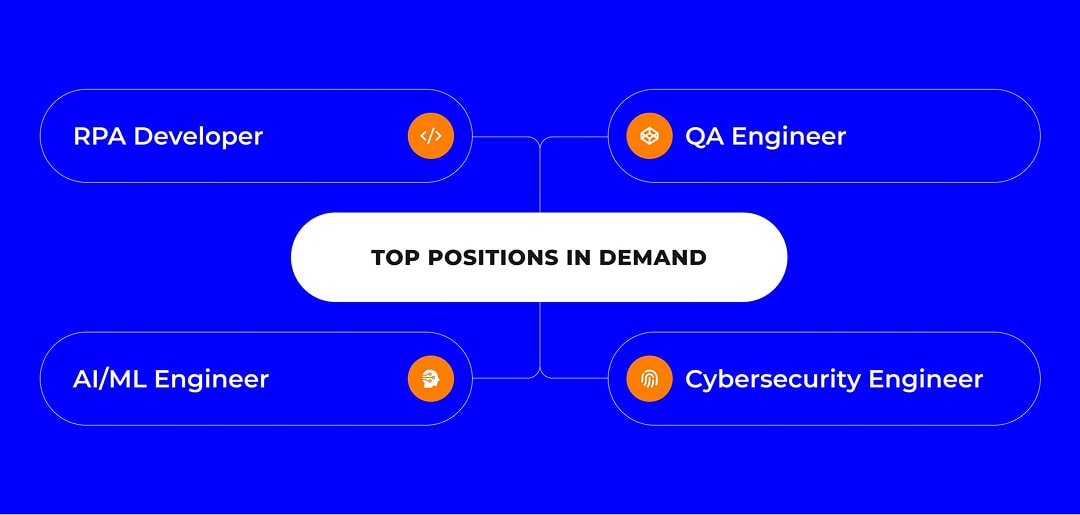
Top positions businesses seek
The following are some of the most sought-after specialized technical roles.
AI and ML Engineer
Developers specializing in AI and ML create algorithms that process and generate large volumes of raw data. Software engineering skills required for this position include data management, fine-tuning and training models, embedding models into existing IT software, and integrating them with other applications.
As more and more industries embrace AI implementation, software development teams requiring AI engineers can be found almost everywhere. The healthcare, automobile, IT outsourcing, and financial sectors are all interested in these specialists. Given the competition for these specialists, companies should plan hiring needs early and build a clear roadmap for the AI capabilities they want to support.
Robotic Process Automation Developer
Automation has become a cost-effective way to drive process improvement, primarily by increasing operational efficiency. Robotic process automation developers help build and deploy bots that automate rule-based tasks across business systems.
The core skills for RPA developers include process mapping, bot development, scripting, workflow configuration, and testing automated processes. Demand for RPA developers spans manufacturing, banking, insurance, healthcare, and customer operations, where teams often need to streamline repetitive procedures.
QA Engineer
As AI development expands, the need for QA engineers grows in tandem to guarantee system stability.
Key QA-related software developer skills include experience with test automation tools, testing frameworks, bug tracking, and programming languages such as Python, Ruby, or JavaScript. QA engineers should also understand Agile and DevOps practices, especially when working with teams that release software frequently.
While QA talent may be more widely available than some niche engineering roles, companies should still look for candidates with the right mix of automation experience, product judgment, and collaboration skills.
Cybersecurity/Information Security Engineer
Cybersecurity is one area where demand outpaces the availability of qualified professionals, as companies increasingly handle more sensitive data across integrated systems.
Skilled cybersecurity engineers understand modern security principles and master tools such as firewalls, VPNs, vulnerability scanners, and endpoint protection platforms to help protect businesses from cyber threats.
Since skilled cybersecurity developers can be difficult to find, companies should plan ahead when sourcing talent and avoid waiting until an incident to fill critical security gaps.
Top In-demand Software Developers Skills
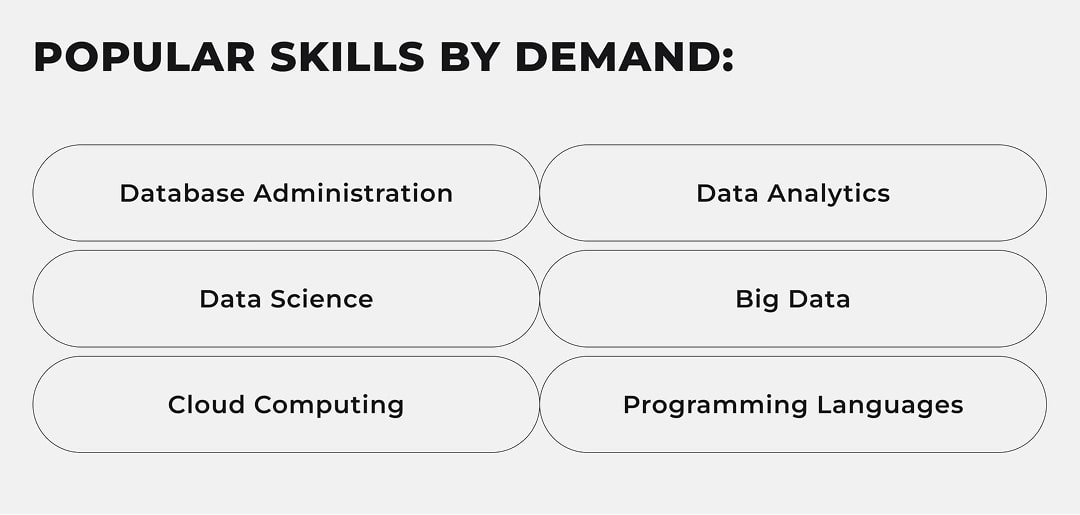
Skills needed for actual projects
Hiring is increasingly shifting toward skills-based evaluation rather than traditional degree-based acceptance. Harvard Business Review has noted that some major employers have reduced or eliminated degree requirements from job descriptions, reflecting a broader focus on demonstrated capabilities rather than credentials.
Clearly defining a role is only one part of building an effective team. Companies also need to understand which software developer skills align with their project requirements and long-term product goals. This is especially important because many high-demand skills overlap across roles, from AI and data analytics to cloud computing and cybersecurity.
The following skills are expected to remain important for software developers in 2026.
Database Administration
The core of smart business operations remains data. The more sophisticated software solutions you seek, the more databases you will need to manage. With mastery in database administration, you expect software developers to manage datasets, design, and implement the needed applications. As the scale of datasets continues to increase, so does the demand for good database management skills.
Data Analytics
Data analytics helps software developers understand how users interact with products. Data reveals where systems have issues and where improvements can deliver the greatest business value. Developers with analytics skills use data to inform feature development and build solutions that better align with user and business needs.
Data Science
Data science is one of the most important skills for software developers. Combining data analysis with statistics, this skill is especially sought after for developing more complex solutions and machine learning models. With data science skills, developers can create more efficient automated solutions and intelligent systems.
Big Data
Big data skills help developers work with large, complex datasets and the frameworks used to process them. By analyzing large data sets, developers can uncover user and system needs and build more informed software solutions. These insights can guide feature development, support data-informed design decisions, and enable real-time data processing applications.
Cloud Computing
As more applications become cloud-based, cloud computing remains a leading software development skill. Businesses are increasingly seeking developers with experience with platforms like Google Cloud, AWS, and Azure. Cloud expertise is valuable not only for building cloud-native applications but also for modernization. Moving to cloud-based infrastructure can make it easier for traditional systems to integrate with AI capabilities, scalable services, and modern security protocols.
Programming Languages
Python remained one of the most widely used development languages in 2025, especially for teams building AI-driven features, automation workflows, and data pipelines. JavaScript and TypeScript also remain core to frontend-heavy and full-stack projects.
At the same time, Go and Rust continue to gain attention for infrastructure-heavy roles where performance and low-latency matter. For companies building scalable platforms or high-load applications, experience with these languages is a highly valuable skill for software developers.
Beyond Software Developer Hard Skills: Future Trends
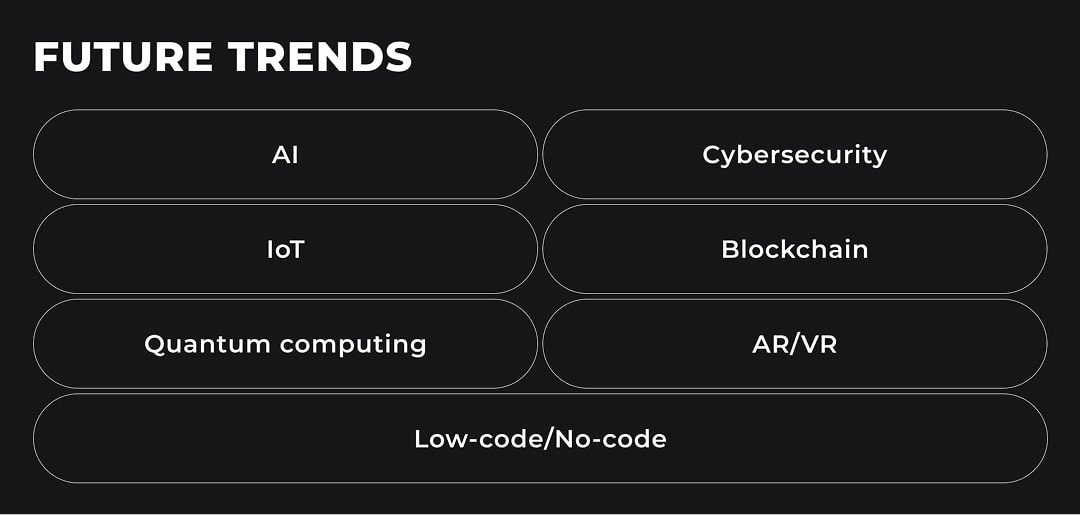
Software developer areas of specialization in demand for future projects
AI, cybersecurity, cloud computing, and data skills are already shaping software development hiring. Looking ahead, companies are also prioritizing developers who can work effectively with AI-assisted coding tools, edge computing environments, and blockchain-enabled systems.
AI-assisted development is changing what teams expect from software engineers. Companies are not only looking for developers who know React, Python, or other core technologies; they also want professionals who can collaborate responsibly with AI tools to enhance and expedite common development tasks.
Infrastructure needs are also evolving. Demand is growing for engineers who can build edge computing systems, especially in industries such as logistics, manufacturing, and connected devices. Blockchain development is also shifting from cryptocurrency-focused use cases towards security and decentralized system design.
Developers who can create AI-powered applications, understand cloud-native architecture, and embed security by design are defining 2025’s hiring trends. AI skills aren’t standalone anymore — they’re expected to work hand in hand with secure, scalable infrastructure. Companies that prioritize learning, security-first thinking, and developer growth will stay ahead
Steve Fleurant CEO, Clair Services
Conclusion
Software development continues to evolve, and so do the expectations placed on development teams. In 2026, businesses are investing in results-driven development.
Hiring managers are looking for developers who can train and integrate models, evaluate AI-generated outputs, strengthen security, build scalable cloud-native applications, and connect technical work to business outcomes. The most valuable software developer skills are becoming more interdisciplinary, practical, and closely tied to how companies build, modernize, and compete.
FAQ
What are the most in-demand software developer skills today?
The most in-demand software developer skills include AI, machine learning, cloud computing, cybersecurity, data analytics, automation, and proficiency in widely used programming languages such as Python, JavaScript, TypeScript, Go, and Rust. Employers are prioritizing developers who can connect AI, data analytics, and technical decisions to valuable business outcomes.
Why are AI and machine learning considered top software developer skills?
AI and machine learning are considered top software developer skills because they help teams quickly analyze data to build optimized solutions faster and more efficiently. Developers with AI and ML expertise can help train and fine-tune models and identify where automated systems may produce inaccurate or unreliable results.
What software development expertise is recommended for every software developer?
The most important software development expertise depends on the role, tech stack, and business need. Still, many developer roles benefit from strong fundamentals in programming, debugging, version control, system design, security awareness, and collaboration. As development becomes more AI-assisted and cloud-connected, developers also need to understand how their code performs, integrates with other systems, and supports scalable, secure applications.