
Software Engineer Performance Review: Process, Metrics, and Examples
Regular performance reviews help engineering leaders understand how developers are contributing to code quality, project delivery, collaboration, and long-term team goals. When structured well, they also create space for professional growth and clearer alignment between individual work and business priorities. Ninety-two percent of specialists want frequent,consistent feedback from their team leads.

Regular performance reviews help engineering leaders understand how developers are contributing to code quality, project delivery, collaboration, and long-term team goals. When structured well, they also create space for professional growth and clearer alignment between individual work and business priorities. Ninety-two percent of specialists want frequent,consistent feedback from their team leads.

Ann Kuss
Ann is a growth-oriented tech leader with more than 13 years of experience building and scaling remote teams for startups and global brands. She has helped companies expand internationally across 17 countries. A Kyiv-Mohyla Business School graduate and MIM Kyiv alumna, Ann is also an active mentor supporting the development of junior tech talent.
Table of Contents
- Popular Performance Management Frameworks
- Performance Review Calibration
- Developer Performance Review Management Training
- Benefits of Performance Evaluation for Business
- Software Engineer Performance Review Example
- The HR of It All
- FAQ
Regular performance reviews help engineering leaders understand how developers are contributing to code quality, project delivery, collaboration, and long-term team goals. When structured well, they also create space for professional growth and clearer alignment between individual work and business priorities. Ninety-two percent of specialists want frequent,consistent feedback from their team leads.
That means companies should treat performance management as an ongoing practice and establish consistent best practices for software developer performance reviews.
Popular Performance Management Frameworks
Setting clear goals will ensure professional growth
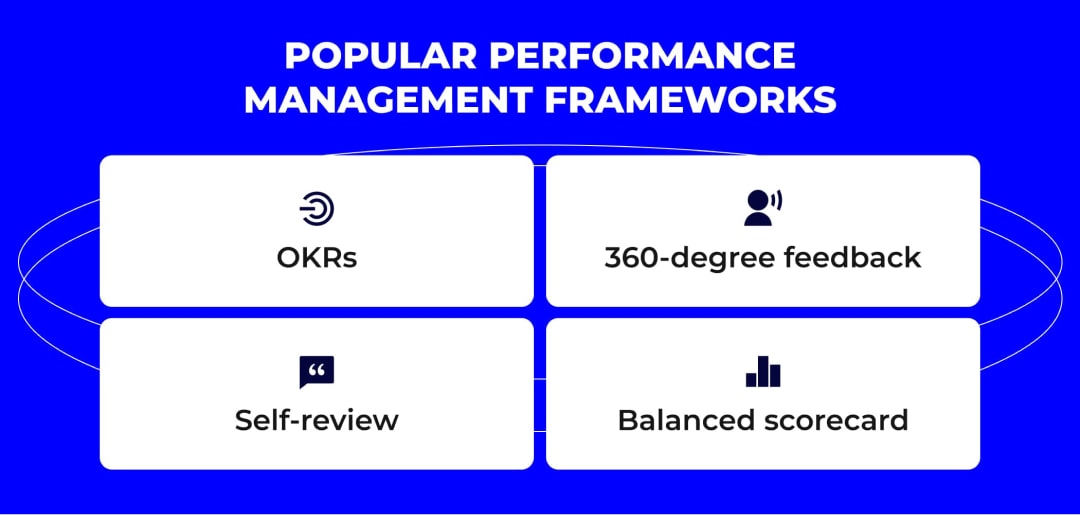
IT companies often use a combination of approaches and review types to guide, assess, and improve developers’ performance. Here are the most effective ones.
OKRs
Objectives and Key Results (OKRs) is a popular goal-setting framework, used by many tech companies. Introduced by Intel in the 1970s, it’s still a useful management tool today. OKRs are often used as part of a continuous performance management approach. The framework focuses on setting specific, measurable, and time-bound team goals and regularly reviewing progress toward them.
In recent years, OKRs have been further refined by incorporating AI-powered tools to track performance. Platforms like BetterWorks or WorkBoard enable automated progress tracking. They offer insights into productivity bottlenecks and alignment issues and suggest real-time adjustments.
Continuous Performance Management aims to help team members to understand what is expected of them. It provides ongoing support, assisting with goals and identifying areas for improvement.
Core Elements of OKRs
Objectives: Clear, specific, and measurable goals that an individual or a team should aim to achieve. They should align with the company’s strategic goals and be challenging yet attainable.
Key Results: The KPIs or specific metrics used to gauge progress toward objectives and determine success. Key results should be quantifiable, data-driven, and should reflect the impact of the objectives.
Time-bound: Objectives and key results should have a specific timeframe for completion. This keeps focus on delivering results in a timely manner and monitoring progress.
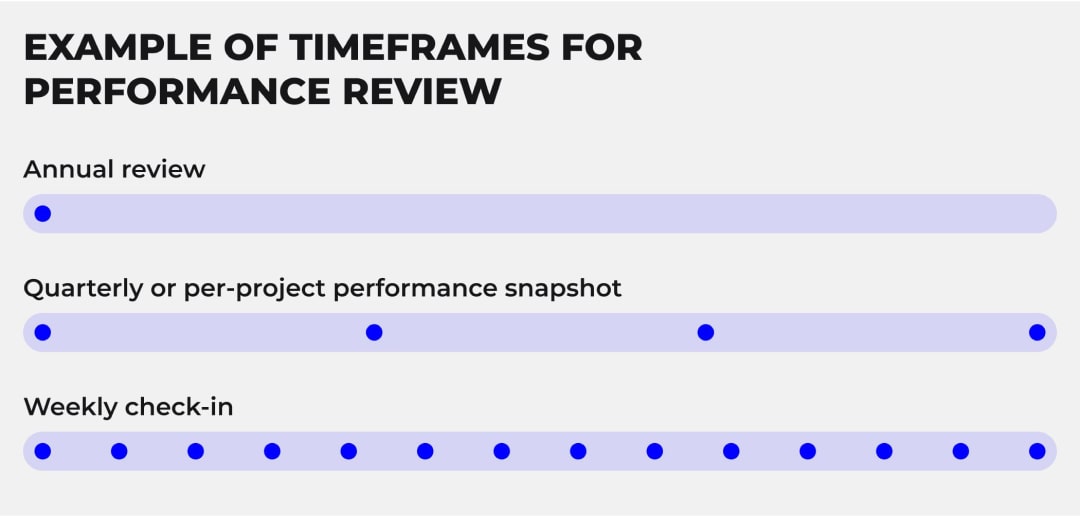
Regular Check-ins: Typically monthly or quarterly, regular check-ins help keep progress on track and provide opportunities for feedback and course correction as needed.
Feedback and Adjustments: Provide feedback based on progress toward objectives. In addition to supporting individuals and teams, feedback cycles can reveal when goals or key results need adjustment to stay aligned with desired outcomes.
360-degree Feedback
Implemented by the military, the 360-degree feedback approach evolved from the Multisource Feedback framework (MSF), which lacked input from direct reports. The 360-degree approach provides a more comprehensive view of a team member’s performance and potential.
To reinforce suggestions, some organizations are integrating AI sentiment analysis into their feedback processes. By analyzing textual feedback for tone and intent, these tools can identify areas of friction and surface constructive recommendations that might otherwise be overlooked in subjective surveys.
Core Elements of 360-degree Feedback
Survey Instrument: A standardized survey questionnaire is used to collect feedback from various sources. The survey may include questions about skills, behaviors, or competencies and may also request open-ended feedback.
Feedback Collection: Feedback is collected from managers, peers, direct reports, and customers. Responses should be confidential and anonymous to encourage honest and open discourse.
Feedback Report: Collected feedback is compiled into a report that provides a comprehensive view of the individual’s strengths and areas for improvement. The report may also include graphical representations of the data, such as bar charts or radar charts, to help a developer understand the results.
Feedback Discussion: The developer meets with their manager to review the report. This creates an open forum for asking questions and gaining a deeper understanding of the feedback.
Development Plan: The developer and manager will devise a detailed training or coaching plan to drive improvement.
The 360-degree feedback approach is used by 85% of Fortune 500 companies.
Self-review
Self-review allows team members to reflect on and assess their own performance. It helps identify areas of strength and areas for improvement.
The process typically includes a standard assessment where developers evaluate their work against specific responsibilities, goals, and competencies. Software engineer self-evaluation examples can help developers structure their reflections, document achievements, and provide concrete examples of their impact.
Self-reviews can support engagement by giving developers ownership of their work and a structured way to showcase its impact. They should be paired with manager feedback to create a more balanced and objective assessment.
Balanced Scorecard
The Balanced Scorecard approach was introduced by Harvard professors Robert Kaplan and David Norton in the early 1990s. The framework helps organizations evaluate performance from multiple perspectives rather than relying on a single metric or outcome.
Core Elements of the Balanced Scorecard Method
Perspectives: The model consists of four perspectives: financial, customer, internal processes, and learning and growth. The four perspectives provide a comprehensive view of an individual or team’s performance and its impact on the company’s overall success.
Objectives and Key Results: Within each perspective, teams can define specific objectives and key results to measure progress and success. These objectives should align with the company’s broader strategy and be clear, measurable, and attainable.
Performance Metrics: Specific performance metrics are established for each objective and the key result. The metrics should be quantifiable and data-driven, reflecting the objectives’ impact.
Performance Tracking: Regular tracking of performance against the objectives and key results is important to ensure progress and identify areas for improvement.
Feedback and Adjustments: Managers should provide performance-based feedback and adjust goals and objectives as needed to ensure success.
Performance Review Calibration
Adjusting performance reviews helps to reduce subjectivity and bias in performance evaluations. It increases transparency and fairness, and improves the accuracy of performance assessments. More accurate performance assessments can ultimately lead to improved team performance and satisfaction.
Developer Performance Review Management Training
Companies train managers to use performance evaluation tools effectively. They take a step further in providing constructive feedback and setting up fair and objective evaluations.
Aligning Individual Evaluations With Organizational Goals
Individual evaluations should connect each team member’s performance to the company’s goals and objectives. Including evaluation guidelines in the employee handbook can help ensure consistency and alignment across the organization.
Conducting Calibration Sessions
In these sessions, managers come together to review and discuss their evaluations and make any necessary adjustments to ensure consistency and fairness across the organization.
Benefits of Performance Evaluation for Business
Why have developerʼs performance reviews in place?
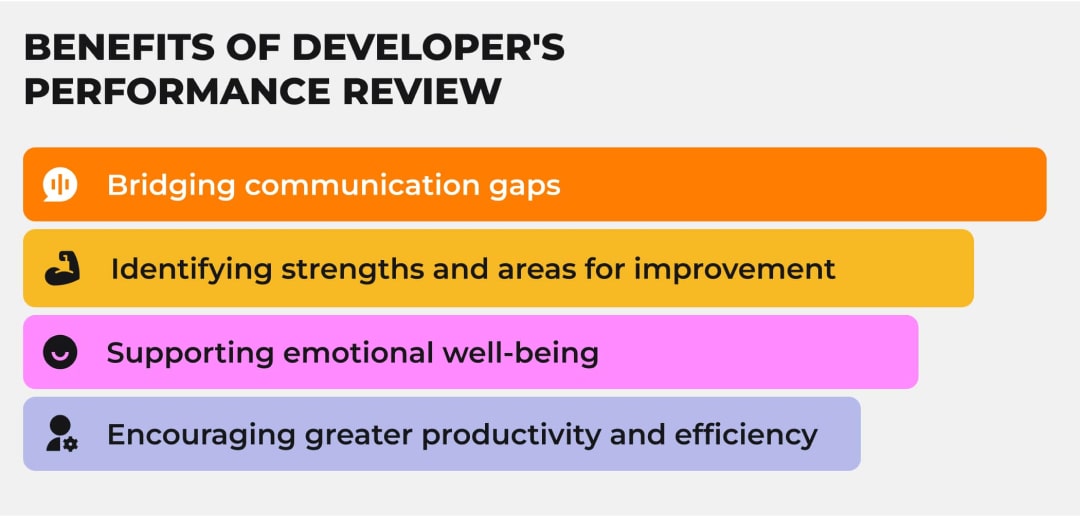
Regular performance reviews help to identify areas for improvement through developer feedback and coaching. This can lead to improved code quality and better user experience.
Additionally, integrating skill-gap analysis tools into reviews ensures teams are better equipped to tackle future challenges, such as adopting new programming languages or frameworks.
Software developer performance reviews provide a space for developers to discuss their goals and align them with the project’s objectives. This helps ensure developers are working towards advancement and not planning to quit software engineering.
Performance reviews provide a forum for open and honest communication between developers and their managers. This builds trust and improves the overall relationship among the team members. They become accountable for their performance, which leads to increased motivation and a greater sense of ownership over their work.
Reviews also give data and insights into the strengths and improvement areas of individual developers. They provide data for project planning and ensure that the right people are assigned to the right tasks.
Such insights support team scaling and streamline fast hiring processes by identifying specific skill gaps that need to be filled quickly. This data is valuable when organizations are scaling tech teams.
Performance Review for Developers Metrics
The following criteria are commonly used to evaluate a software engineer’s performance.
Code Quality
Code quality can be gauged through code review metrics. Common indicators include the number of code defects, the frequency of code review feedback, and the speed of code review completion.
Project Completion Rate
This metric evaluates a software engineer’s ability to complete work on time and meet project requirements. Teams can track completed tasks, on-time delivery rates, and progress against agreed deadlines.
Customer Satisfaction
This metric evaluates customer or user satisfaction with a software engineer’s work. Teams can measure it through user surveys, customer feedback, support requests, bug reports, or product usage signals.
Technical Skills
This metric evaluates a software engineer’s technical knowledge and their ability to apply that knowledge in day-to-day work. Teams can assess technical skills through code reviews, technical assessments, architecture discussions, and skill-building exercises.
Collaboration and Communication
This metric evaluates a software engineer’s ability to work effectively with others. Teams can assess collaboration and communication through peer feedback, responsiveness, documentation quality, and the ability to clearly explain technical decisions to various stakeholders.
Continuous Learning and Development
This metric evaluates a developer’s commitment to continuous learning and professional growth. Teams can assess it by reviewing participation in training, knowledge sharing, and efforts to develop new technical or leadership skills.
Productivity
This metric evaluates a software engineer’s ability to deliver meaningful work efficiently. Teams can assess productivity by reviewing completed tasks, turnaround time, and progress against sprint or project goals. These metrics should be used as part of a broader performance evaluation rather than as standalone judgments.
Strong performance reviews also consider qualitative factors, such as problem-solving, ownership, collaboration, communication, and the quality of the engineer’s contributions.
Software Engineer Performance Review Example
Timeframes for review
Performance review templates can help managers structure feedback consistently while leaving room for role-specific goals, technical strengths, and growth opportunities. For a more detailed review framework, see Toptal’s guide to conducting a software engineer performance review.
The HR of It All
Software developer performance reviews are most effective when HR leaders and technical managers work together. Tech leads can evaluate code quality, delivery, technical decision-making, and teamwork within the engineering team. HR teams can help standardize review criteria, document outcomes, and ensure reviews are conducted consistently across the organization.
When performance appraisals are seen as tools for growth and improvement rather than judgment, employees feel more valued and motivated. It’s about creating a supportive environment that fosters development and recognizes hard work.
Bradford Glaser President & CEO, HRDQ
FAQ
How to define developer productivity?
Developer productivity measures how effectively a developer or engineering team delivers valuable work within a given time frame. It includes output, but it should also account for code quality, delivery consistency, collaboration, issue resolution, and the ability to meet project requirements without creating unnecessary rework.
What improves developer productivity?
Developer productivity depends on more than individual output. Clear goals, open communication, developer satisfaction, and access to the right tools and resources all help create an environment where engineers can consistently do their best work.
What are the typical components of a software developer’s performance review?
A software developer’s performance review typically includes clear goals, structured feedback, and performance metrics such as code quality, delivery, collaboration, technical skills, and continuous learning. It may also include self-reviews, peer or 360-degree feedback, regular check-ins, calibration sessions, and action plans for improvement. When combined, these components give managers and developers a more complete view of performance, growth opportunities, and alignment with team goals.