Just ask any recent applicant: the tech job market is evolving fast. Across the economy, employment in technology fields fell by roughly 214,000 jobs in April 2025, according to CompTIA’s Tech Jobs Report, based on the U.S. Bureau of Labor Statistics (BLS) data. With the market becoming more competitive and the rise of AI rapidly reshaping tech roles, employers are prioritizing clear, concise, and compelling communication, especially from applicants who can demonstrate both technical skills and strategic fit.
For job seekers, this means even more opportunities to stand out with the right strategy.
Despite the rise of AI and new hiring technologies, the tried-and-true cover letter remains one of the most powerful tools for making a memorable impression. This short, one-page document helps you go beyond your resume and explain why you’re the right engineer, developer, or tech professional for both the role and the company.
Though concise, a cover letter can be challenging to write well. If you’re wondering how to write a cover letter for a job in today’s fast-changing tech industry, the following expert tips will help. We’ll cover everything from how to make a cover letter that highlights your skills to how to write a good cover letter that resonates with tech recruiters.
A strong tech cover letter complements your resume by translating your engineering skills, certifications, or frameworks into value—contextualizing projects you've delivered, systems you've scaled, or tools you've built, and why they mattered. It provides critical information that may be missing, allowing you to explain career trajectory changes, location flexibility, and resume gaps that could be disqualifying without more context. It highlights your relevance to the role and company, and it serves as a tool to demonstrate your enthusiasm and strategic alignment.
According to the Harvard Business Review, that additional context is especially important in an era when resumes must follow a very specific formula to pass Applicant Tracking Systems (ATS)—software that helps companies streamline their hiring process by parsing, scoring, and ranking resumes.
The generic format of the modern resume doesn’t always convey personal characteristics like creativity, critical thinking, and resilience, especially in the tech industry, where the resume necessarily focuses on hard skills, such as Python, SQL, and Java. A cover letter gives engineers, developers and other tech candidates an opportunity to prove they’re more than just code contributors—they're solution-oriented thinkers.
“The best cover letters don’t just show what you’ve done—they show how you drive impact. They help tech candidates stand out by connecting the dots between experience and results.”
— Marisa Goldberg, Senior Director of Recruiting at Toptal
Madeline Mann, a job search strategist and author of Reverse the Search: How to Turn Job Seeking Into Job Shopping, estimates that about 50% of recruiters and hiring managers read cover letters.
It can be tempting to see that stat and forgo a cover letter altogether. But when you know how to write a cover letter for a job effectively, it becomes a powerful differentiator. While more applicants are indeed skipping the task, Mann believes that approach is misguided since a cover letter ideally informs recruiters why you are applying for the job. In her experience, cover letters are especially impactful at startups that are looking for candidates who are as passionate as they are talented and where cultural fit is crucial.
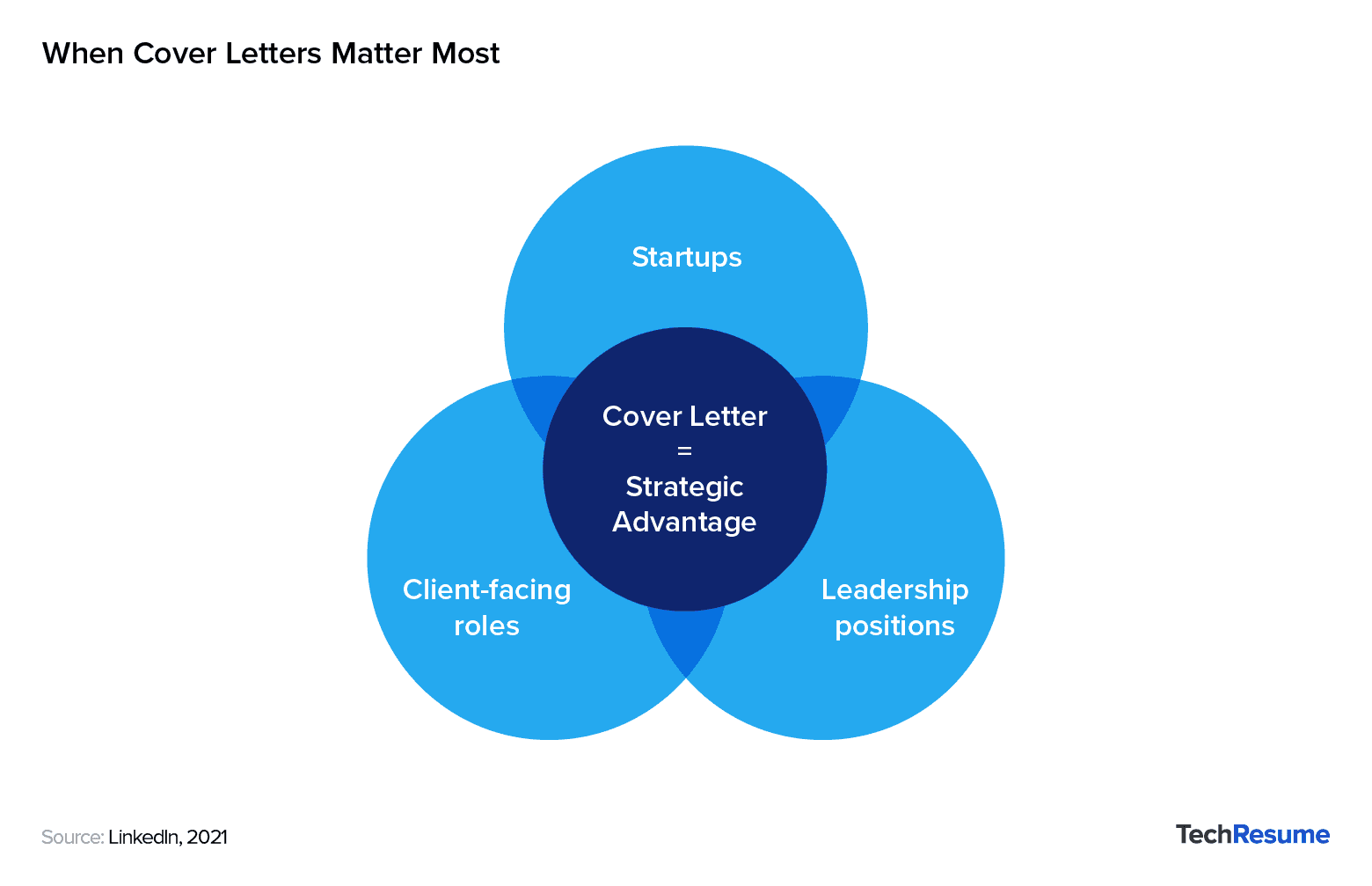
Cover letters are also essential for candidates who are seeking senior, specialized, or client-facing roles—such as in product management, technical consulting, or enterprise architecture—because they’re an opportunity to demonstrate the soft skills often required in those technical positions, including problem-solving, leadership, and adaptability. Most importantly, a well-written cover letter conveys good communication—and that’s the top skill employers are seeking right now, based on an analysis of 2 million job postings by Aura Intelligence, a workforce analytics platform.
Those soft skills are increasingly important for tech jobs as AI begins to perform basic tasks and hard skills become obsolete every few years, given technology’s rapid advancement. More than two-thirds of US executives say they plan to prioritize hiring candidates with soft skills this year, particularly transferable skills that allow them to move nimbly across roles, according to LinkedIn’s Global Talent Trends report.
Cover letters aren’t always required, but applicants should still submit one whenever possible unless the job listing specifically states that cover letters are not accepted. In competitive fields, knowing how to make a cover letter that’s customized and relevant can provide a strategic edge. While most companies continue to accept or encourage them, there are exceptions. Amazon, for instance, does not allow cover letters as part of its application process. Cover letters are always recommended for roles requiring clear communication, relationship-building, or strategic thinking.
In competitive fields, submitting a cover letter can provide a strategic edge, and it can certainly be a differentiator in tech and consulting. Google doesn’t require cover letters, but that’s because the company is looking to get an immediate sense of a candidate’s work ethic, according to Inc. Submitting a cover letter for a tech resume can give you a valuable advantage, particularly particularly in roles where strong communication, product intuition, and the ability to articulate technical tradeoffs matter—especially in agile environments. Applicants who take the time to send a cover letter are more likely to be the highly driven, self-motivated employees Google wants to hire.
Hiring managers don’t just want to know what makes you a good data engineer. They want to know what makes you a good machine learning engineer, back-end developer, or DevOps lead for their company. That’s why it’s important to tailor your cover letter, and why advice on how to write a good cover letter always includes personalization.
Beyond changing the basic information (greeting, job, and company name), you also want to include how you align with their industry, architecture, or engineering challenges. Check out the company’s “About Us” page, or take a look at its social media feeds, to get a feel for the language you should use. While the cover letter is an opportunity to align yourself with the company’s culture, be sure to research this in advance and have real examples to support your alignment.
“When a cover letter shows a clear connection to our work—why this role, why us—it signals preparation, intent, and strong alignment. That instantly elevates a candidate.”
— Marisa Goldberg, Senior Director of Recruiting at Toptal
Of course, you may not need to rewrite the entire letter for every job, especially if you are applying for a very specific type of role. Use modular templates to copy paragraphs that may work for multiple applications, and identify key phrases you can tweak for each letter.
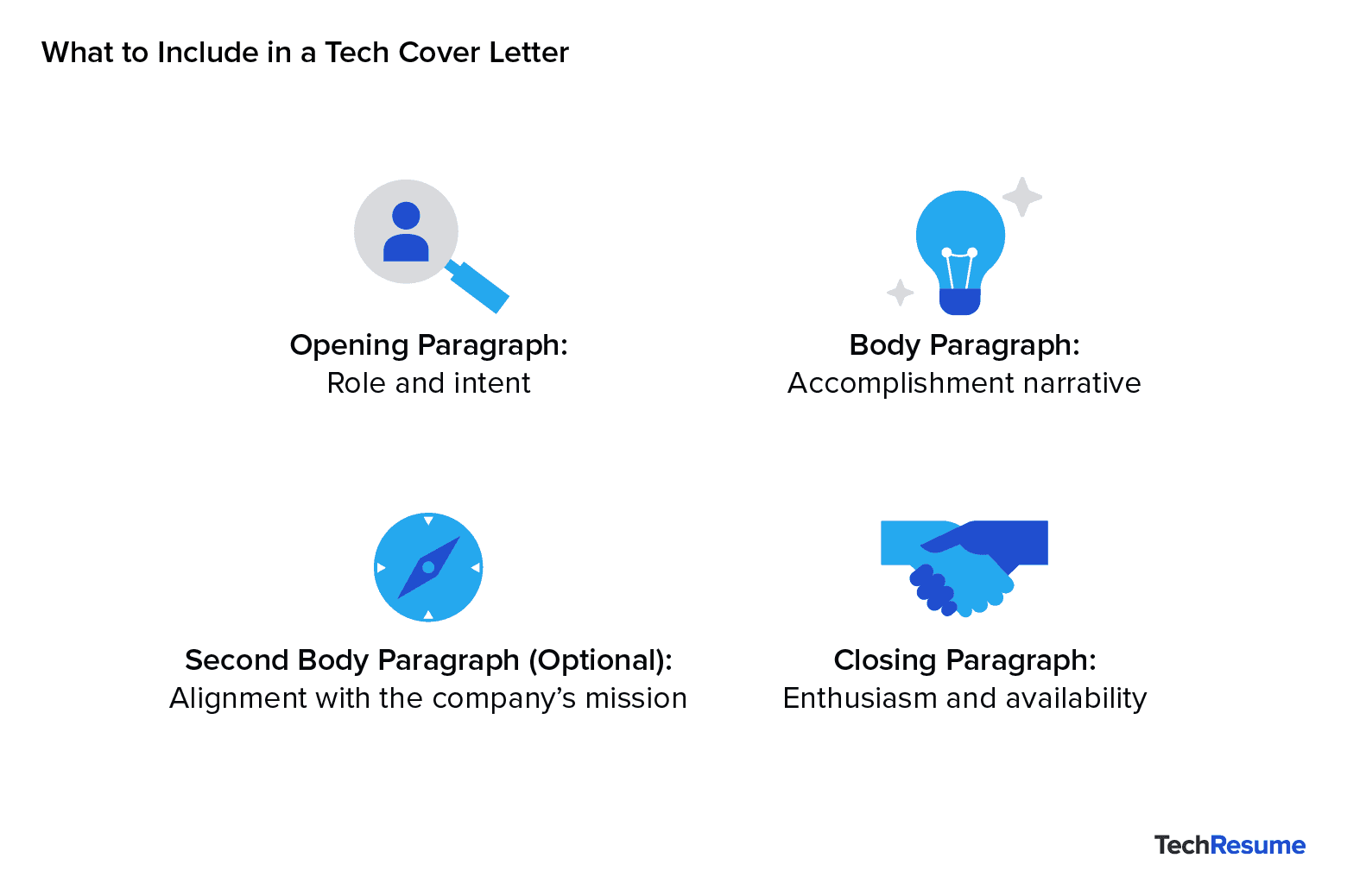
Think of cover letters like an elevator pitch. You’re explaining not just what you built, but why you built it—and how it solved a problem. You have a very short opportunity to sway your audience, so every paragraph counts. The best cover letter format contains the following:
- Opening paragraph: State the role and your intent. Highlight a relevant skill or accomplishment that connects to the job description.
- Body paragraph: Share a brief narrative of an accomplishment, such as reducing server load by 30% or improving product onboarding time, tying it to the needs of the company. This is a great opportunity to demonstrate soft skills such as adaptability and problem-solving.
- Second body paragraph (optional): Share how you align with the company’s mission, product, tech stack, values, or goals. Although this paragraph is optional, it can help you land an interview, since it demonstrates that you’ve done your research.
- Closing paragraph: Express enthusiasm and availability. Reinforce your fit and interest.
Pro Tip: Keep tone confident, focused, and authentic. Avoid overly generic statements like, "I am a quick learner.” Use purposeful language to highlight strengths such as “systems-level thinking,” “deep user empathy,” or “ability to drive technical alignment across teams.”
The best cover letters use a clean, professional format. And yes, format is part of knowing how to write a cover letter recruiters actually read. Keep the following cover letter writing tips in mind:
- Include your full name and optional contact details (email, phone number, LinkedIn, GitHub) in the header at the top, ideally styled as a single line to match the visual consistency of your resume.
- Use a PDF format unless otherwise stated.
- Use an easy-to-read font, such as Calibri, Georgia, Tahoma, or Verdana.
- Align all text to the left (no centering or justifying).
- Use single spacing with an extra space between paragraphs.
- Keep margins at 1 inch on all sides.
- Name the file clearly: e.g., Firstname_Lastname_CoverLetter.pdf
Pro Tip: Match the font and visual style of your resume for a cohesive application package.
Tech recruiters spend less than a minute reviewing applications. That’s why a concise, high-impact cover letter—around 250–400 words, or three to four paragraphs—is ideal. Keep it to one page and make every sentence count. Shorter letters demonstrate your ability to prioritize, communicate clearly, and respect the reader’s time.
Employers don’t always provide the hiring manager’s name, especially on online forms, but you can demonstrate initiative by tracking down the information. (Use the company website or LinkedIn.) If you still aren’t sure after researching, use “Dear [Company Name] Recruiting Team” or “Dear Hiring Team.” This salutation should be the initial sentence of your cover letter.
Applicants are increasingly turning to AI-powered tools like ChatGPT to help craft a compelling cover letter, but don’t assume an AI-written product is perfect. Even if AI helps generate your draft, your final version should reflect your technical depth and voice. No matter what, you’ll want to make sure your cover letter avoids the following all-too-common errors:
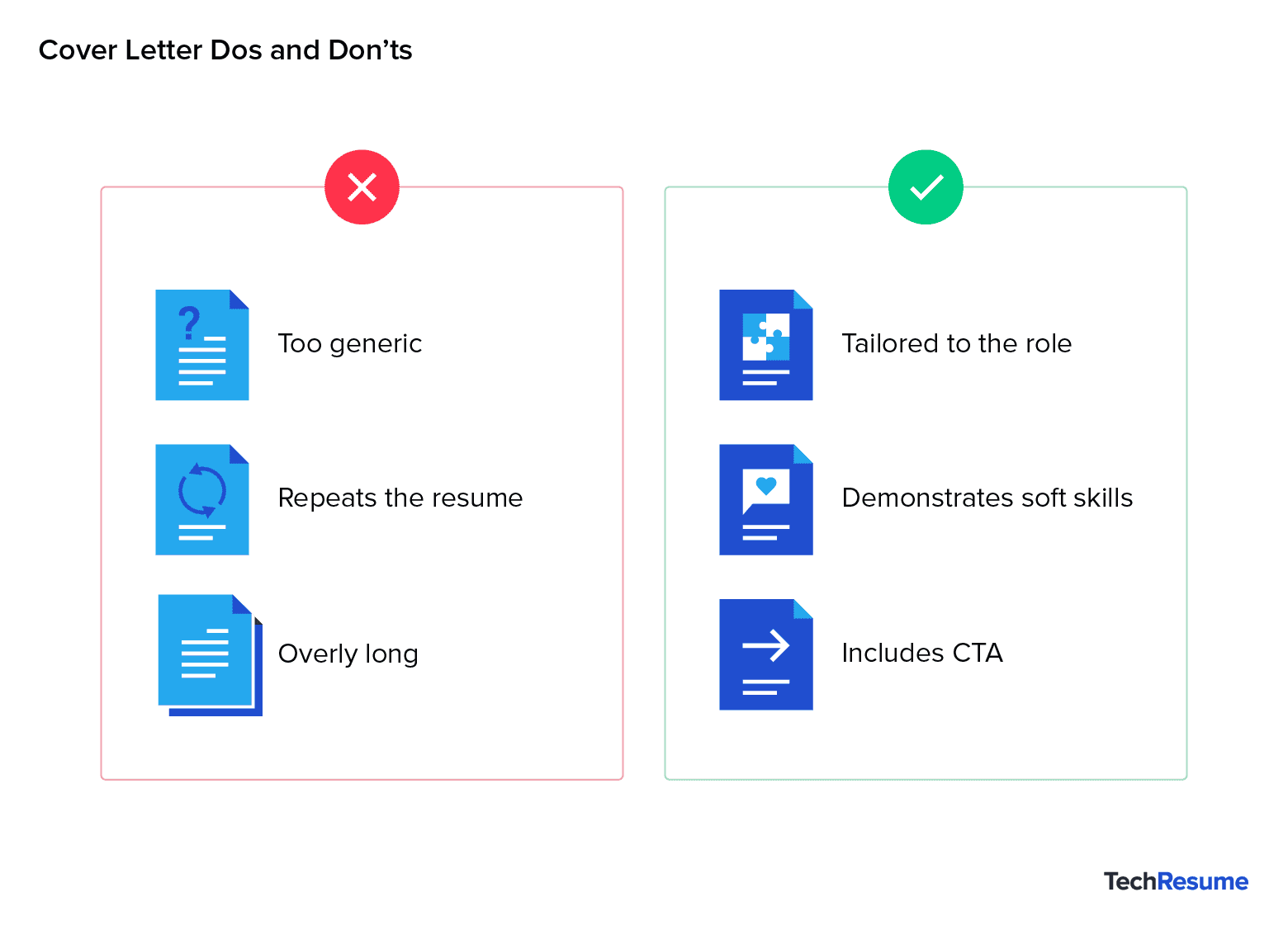
- Writing a generic letter not tailored to the role.
- Repeating the resume.
- Writing a letter that’s too long.
- Using language that’s overly formal or too casual.
- Using filler words or buzzwords without substance.
- Showing a lack of enthusiasm for the company or role.
- Skipping proofreading—typos and grammar errors reduce credibility.
- Failing to include a call to action.
Pro Tip: “I am available for an interview at your convenience and would greatly appreciate the chance to discuss my qualifications in more detail” is an effective CTA.
A well-written cover letter can make a powerful impression and help you stand out in a sea of applicants. Think of it as a tool to personalize your pitch, demonstrate your alignment with a company’s product vision, and show how your experience translates into technical and business impact.
While it’s crucial to tailor your letter for each role, it doesn’t have to be onerous. For efficiency, use a consistent, flexible format, while emphasizing what makes you unique—and uniquely suited for the job. When paired with a powerful resume, a compelling cover letter can convince a recruiter to call you in for that coveted interview and get you one step closer to getting hired.
Pro Tip: Don’t underestimate the power of tone—confidence, authenticity, and clarity go a long way. Even complex technical ideas should be explained simply and strategically.