Resume Examples
Nurse Practitioner
Start Your Resume Now
Use our AI resume writer to craft a professional resume that helps you land a job.
Nurse Practitioner
Start Your Resume Now
Use our AI resume writer to craft a professional resume that helps you land a job.
What Makes a Strong Nurse Practitioner Resume?
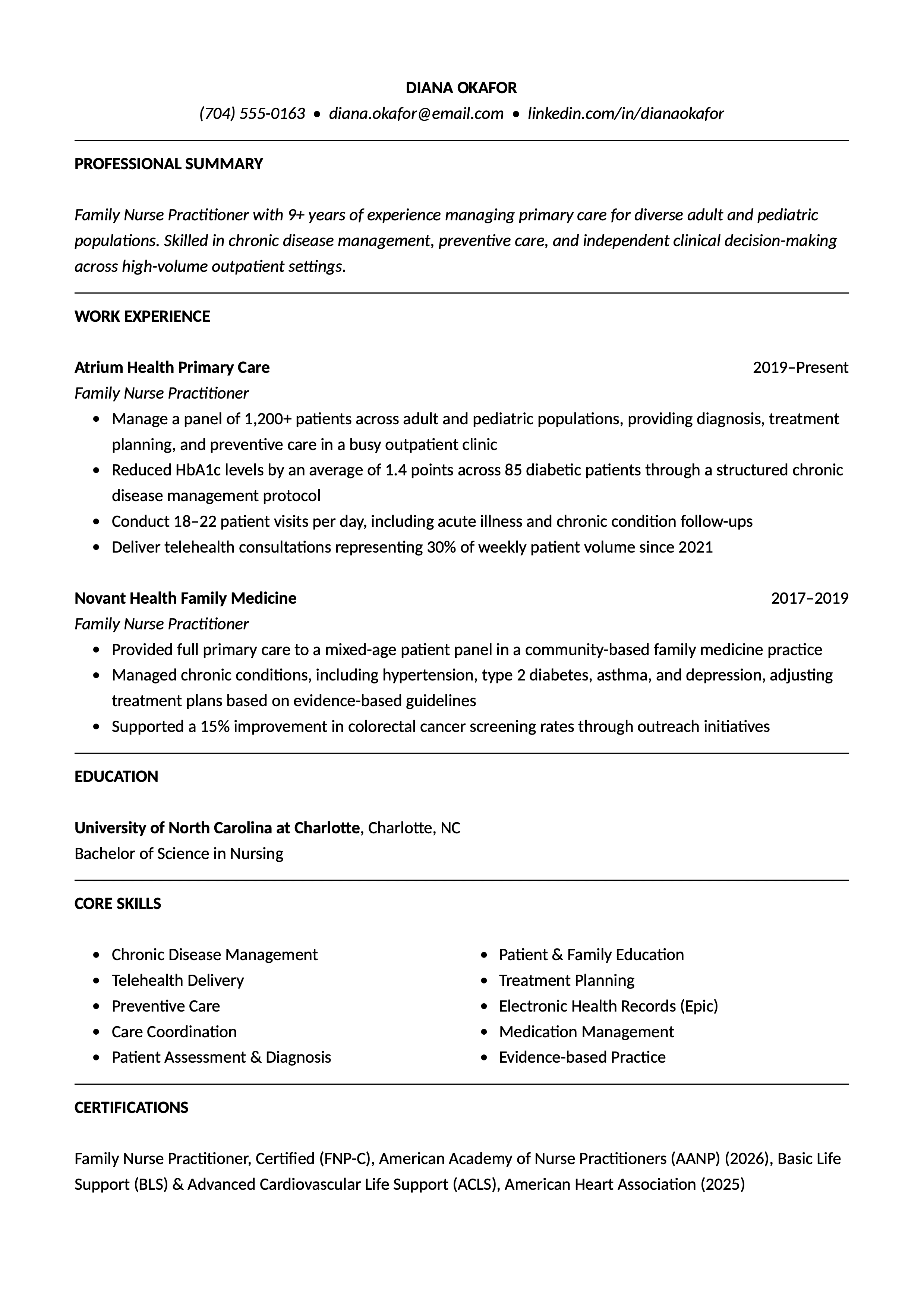
A strong nurse practitioner resume clearly shows your clinical expertise, advanced practice responsibilities, and patient care impact. Employers want to quickly understand your specialty area, certifications, and experience managing patient care independently or within interdisciplinary healthcare teams.
Your resume should highlight advanced clinical skills, patient assessment experience, diagnostic responsibilities, treatment planning, and healthcare documentation relevant to your specialty. This may include family practice, acute care, psychiatric mental health, pediatrics, women's health, or gerontology. Include important credentials, licenses, and certifications commonly required for advanced practice roles, along with experience using healthcare systems, telehealth platforms, or evidence-based treatment approaches when relevant.
Strong resumes focus on measurable clinical outcomes instead of only listing responsibilities. For example, you might mention patient volume, reduced wait times, improved care coordination, chronic disease management outcomes, or quality improvement initiatives. Clear examples of clinical decision-making, patient communication, and collaborative care often make advanced practice experience easier for hiring managers and healthcare organizations to evaluate.
Professional Summary for Nurse Practitioners
For most advanced practice roles, a professional summary is more effective than a traditional resume objective. Resume objectives are generally considered outdated because they focus on career goals, while modern summary sections highlight clinical expertise, specialty areas, certifications, and patient care experience.
A strong summary statement helps employers quickly understand your clinical background, prescribing experience, patient population focus, and healthcare setting. For example, family nurse practitioners may highlight preventive care, chronic disease management, and patient education, while psychiatric or acute care nurse practitioners may focus more on treatment planning, crisis intervention, diagnostics, or interdisciplinary collaboration. Mentioning certifications, telehealth experience, electronic medical records systems, or patient volume can also strengthen your opening statement.
Early-career nurse practitioners can use the summary section to emphasize clinical rotations, supervised practice experience, specialty training, or prior registered nursing experience relevant to the role.
Skills Section for Nurse Practitioners
A nurse practitioner resume should include a mix of advanced clinical skills, patient care competencies, and healthcare systems knowledge relevant to the role. Employers often review the skills section first to quickly understand your specialty area, prescribing experience, certifications, and clinical background.
The strongest skills sections focus on practical hard skills instead of broad or generic terms. Depending on your specialty, this may include patient assessment, diagnostics, treatment planning, chronic disease management, telehealth, medication management, or preventive care. Family nurse practitioners, psychiatric mental health nurse practitioners, pediatric nurse practitioners, and acute care nurse practitioners may all emphasize different technical skills, healthcare procedures, and patient populations.
It's also important to support your core competencies with real clinical experience throughout the resume. Hiring managers are usually more interested in how you applied your nurse practitioner skills in patient care settings than in a long list of keywords alone.
- Patient Assessment
- Treatment Planning
- Chronic Disease Management
- Preventive Care
- Telehealth
- Medication Management
- Care Coordination
- Diagnostic Interpretation
- Electronic Medical Records
- Evidence-based Practice
Resume Keywords for Nurse Practitioner Roles
The keywords on a nurse practitioner resume should match the clinical responsibilities, certifications, patient populations, and healthcare terminology used in the job description while still accurately reflecting your real experience. Many healthcare employers use applicant tracking systems to organize applications, so relevant resume keywords can help your background align more clearly with the role.
Strong resume keywords often include specialty areas, diagnostic responsibilities, treatment planning, patient care coordination, and healthcare documentation terms commonly mentioned in nurse practitioner job postings. Family practice roles may focus more on preventive care and chronic disease management, while psychiatric, acute care, or pediatric positions may prioritize behavioral health, medication management, emergency response, or specialty patient populations.
Instead of adding keywords only for visibility, use them naturally throughout your clinical experience, certifications, and skills sections. The strongest resumes connect healthcare terminology to patient outcomes, clinical decision-making, and real advanced practice experience.
- Primary Care
- Patient Assessment
- Chronic Disease Management
- Medication Management
- Treatment Planning
- Behavioral Health
- Preventive Care
- Care Coordination
- Clinical Documentation
- Evidence-based Practice
ATS Optimization for Nurse Practitioner Resumes
Many healthcare employers use applicant tracking systems (ATS) to organize and filter applications before they reach recruiters or hiring managers. A clean, ATS-friendly resume format helps these systems parse your experience correctly and makes your qualifications easier to review.
Use a simple single-column resume layout with clear section headings for certifications, clinical experience, education, and skills. Avoid graphics, tables, icons, or heavily designed templates that may create formatting issues in systems like Workday, Greenhouse, or iCIMS.
It's also important to use terminology that matches the job description, especially for specialty areas, patient populations, certifications, and treatment responsibilities. For nurse practitioner roles, employers often look for keywords related to patient assessment, treatment planning, chronic disease management, preventive care, behavioral health, or care coordination. Including these terms naturally throughout your work experience can improve both ATS compatibility and resume clarity.
Design & Formatting
Nurse practitioner resumes usually work best with a clean, structured resume format that makes clinical experience and credentials easy to scan quickly. Hiring managers often review resumes under time constraints, so readability and organization are usually more important than visual design elements.
Use a professional resume layout with consistent spacing, clear section headings, and readable fonts like Calibri, Arial, Helvetica, or Inter. A single-column format is generally the safest choice because it improves readability and helps applicant tracking systems parse information more accurately. Most nurse practitioner resumes should also keep certifications, licensure, and clinical specialties easy to identify near the top of the page.
Your formatting should help employers quickly review patient care experience, treatment responsibilities, specialty populations, clinical procedures, and measurable healthcare outcomes. Avoid overly decorative templates, complex graphics, or dense paragraphs that make important information harder to find.
Common Mistakes in Nurse Practitioner Resumes
- Listing nursing responsibilities without highlighting independent clinical decision-making, diagnosis, treatment planning, or patient management responsibilities.
- Omitting certifications, prescriptive authority, or licensure details; place credentials and specialty certifications prominently near the top.
- Using generic nursing language instead of emphasizing specialty areas like family practice, acute care, pediatrics, or mental health.
- Listing clinical skills without measurable outcomes; instead, include examples like patient volume, chronic disease management, or preventive care improvements.
- Including outdated procedures or irrelevant bedside nursing tasks that no longer reflect your current nurse practitioner scope of practice.
Frequently Asked Questions
A nurse practitioner resume should usually be one to two pages long. Early-career NPs can often keep their resume to one page, while experienced practitioners with multiple specialties, certifications, or leadership experience may need two pages. Focus on relevant clinical experience, patient populations, certifications, and measurable healthcare outcomes instead of listing every past responsibility.