Resume Examples
Registered Nurse
Nurse Practitioner
ICU Nurse
Start Your Resume Now
Use our AI resume writer to craft a professional resume that helps you land a job.
Registered Nurse
Nurse Practitioner
ICU Nurse
Start Your Resume Now
Use our AI resume writer to craft a professional resume that helps you land a job.
What Makes a Strong Registered Nurse Resume?
A strong registered nurse resume shows clinical expertise, active licensure, and measurable patient care results in a format recruiters can scan quickly. Include essentials such as RN licensure status, specialty certifications like Basic Life Support (BLS), Advanced Cardiovascular Life Support (ACLS), or Pediatric Advanced Life Support (PALS), and experience across patient populations or care settings. Highlight healthcare-specific tools and workflows, including Oracle Health, medication administration, care planning, and interdisciplinary collaboration.
Support responsibilities with outcomes where possible. Instead of listing duties, include examples such as reducing fall incidents, improving discharge education compliance, or supporting infection prevention initiatives. Strong resumes balance technical competence, documentation accuracy, and patient-centered care while showing progression in responsibility and clinical scope.
Professional Summary for Registered Nurses
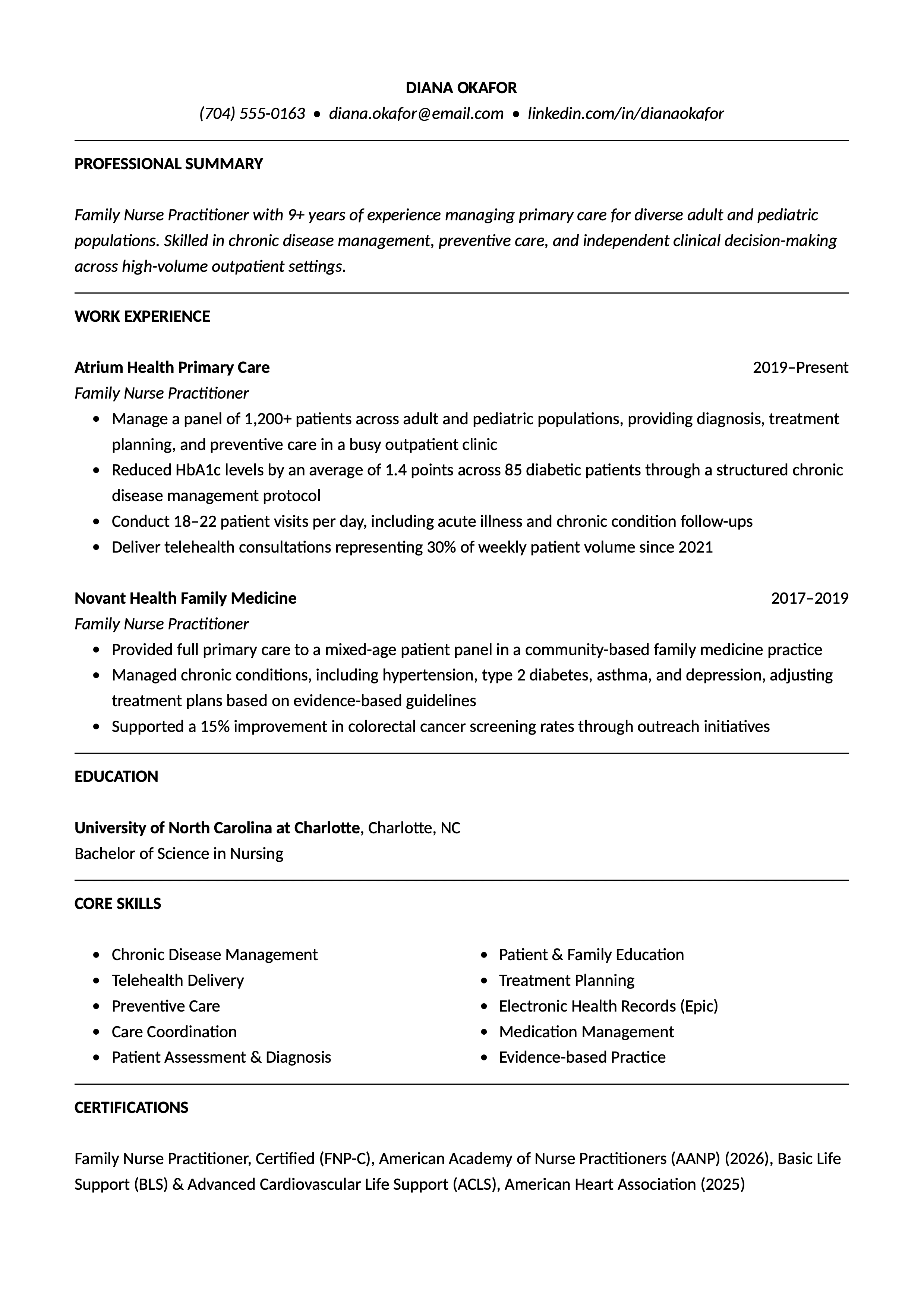
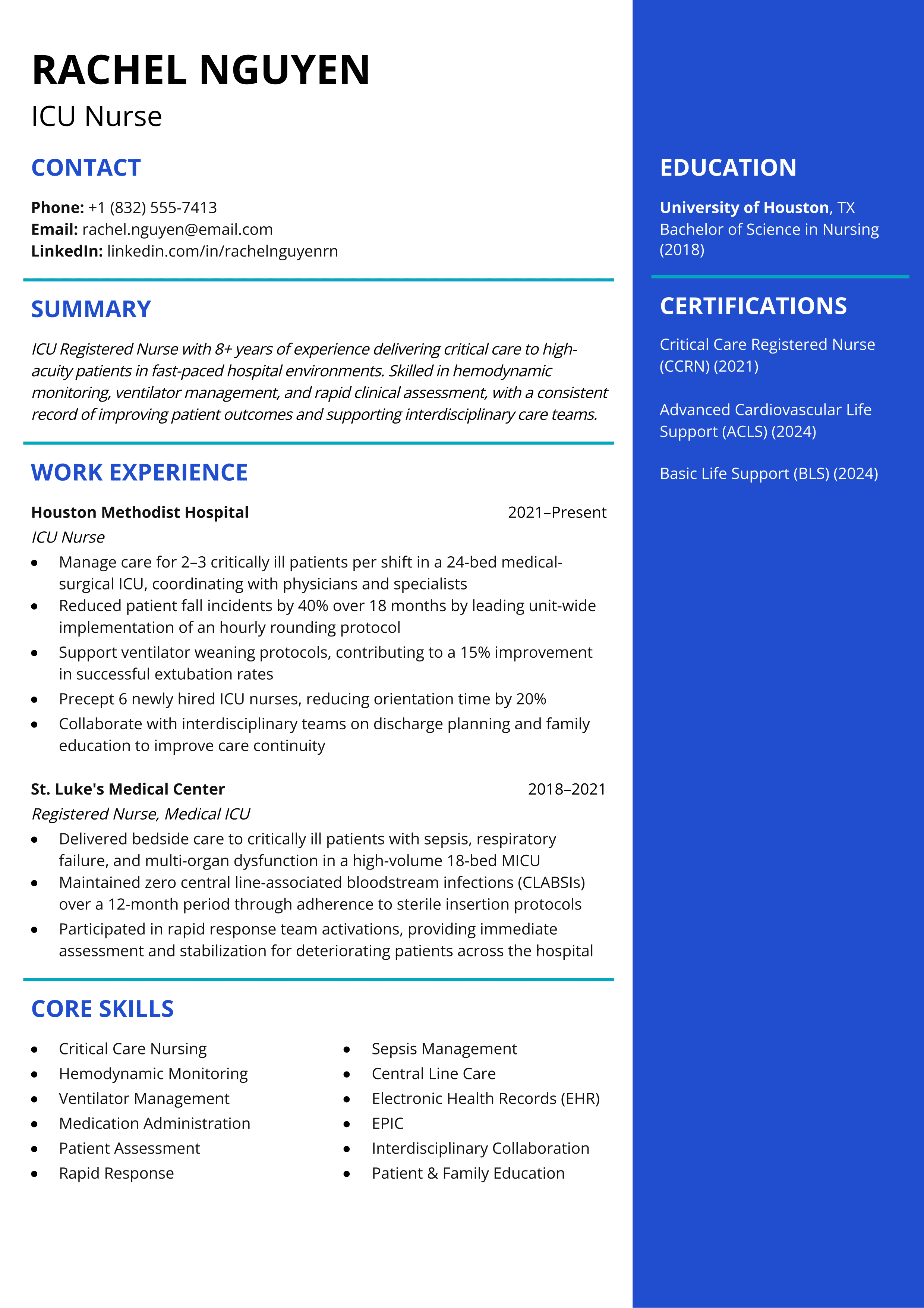
Experienced registered nurses should use a professional summary that mentions their specialty area, years of experience, certifications, and measurable outcomes. A strong summary might reference ICU, oncology, emergency, or medical-surgical experience, as well as metrics such as patient satisfaction scores or reduced readmission rates.
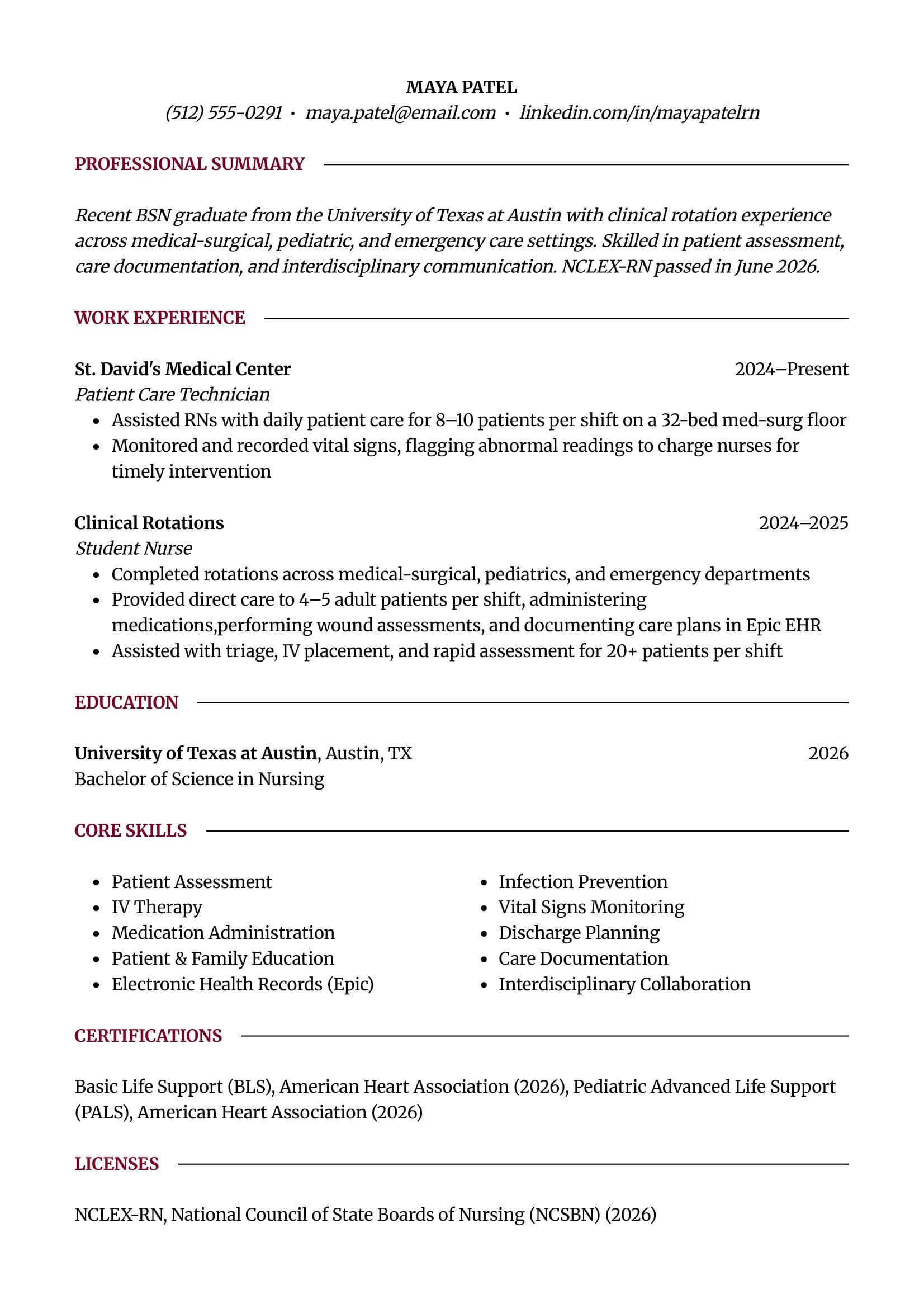
New graduates can use a resume summary focused on clinical rotations, National Council Licensure Examination (NCLEX-RN) status, education level, and transferable skills. Your summary should quickly establish your clinical focus, highest credential, and value to the care team so recruiters can assess fit within seconds.
Skills for a Registered Nurse Resume
The skills section should combine hard skills, soft skills, and nurse-specific core competencies relevant to the target role. Prioritize clinical capabilities such as patient assessment, medication administration, IV therapy, care coordination, and infection prevention alongside communication and patient education.
Include technical skills that recruiters commonly search for, including Epic, Cerner, telehealth platforms, barcode medication administration (BCMA), and electronic health record (EHR) documentation. Strengthen your skills section by adding evidence of leadership through charge nurse responsibilities, preceptor experience, committee participation, or quality improvement initiatives.
- Patient Assessment
- Medication Administration
- Electronic Health Records
- IV Therapy
- Care Coordination
- Infection Prevention
- Patient Education
- Telehealth Delivery
- Discharge Planning
- Vital Signs Monitoring
Resume Keywords for a Registered Nurse Resume
The strongest resume keywords reflect how registered nurses actually work, and not just include generic healthcare terms. Focus on the language employers use to describe patient care, clinical responsibilities, specialties, and outcomes.
Include terms tied to your environment and scope of practice, such as telemetry, discharge planning, patient education, care coordination, or evidence-based practice. Add context that shows scale and impact where possible, such as patient volume, acuity level, or quality improvement participation. Keywords should support real experience rather than appear as a standalone list.
- Registered Nurse (RN)
- Patient Assessment
- Clinical Documentation
- Care Coordination
- Evidence-based Practice
- Medication Administration
- Patient Education
- Discharge Planning
- Quality Improvement
- Interdisciplinary Collaboration
ATS Optimization for Registered Nurses
An ATS-friendly resume uses clear section headings and includes terminology pulled directly from registered nurse job descriptions. Use keyword optimization naturally by referencing examples such as ICU, med-surg, telemetry, Epic, Cerner, patient-centered care, and evidence-based practice.
Include standard section titles such as Licenses, Certifications, Experience, Skills, and Education. Keep formatting simple and place credentials where they are easy to identify. List certifications and software exactly as employers write them and match specialty language to the posting when relevant. Avoid tables, graphics, icons, and text embedded in images, as they can interfere with parsing.
Design & Style Guidelines for Registered Nurse Resumes
Registered nurse resumes should feel clear, organized, and focused. Recruiters often review applications quickly, so credentials and experience should be easy to locate.
Use a reverse chronological layout with clear section headings and consistent spacing. Simple, professional fonts such as Calibri, Helvetica, Arial, or Inter work well. Keep margins balanced and avoid visual elements that can distract from your content. Newer nurses can usually stay within one page, while experienced nurses with certifications, leadership experience, or specialty practice may use two pages, as long as every section adds value.
Common Mistakes in Registered Nurse Resumes
- Repeating job descriptions instead of showing your contribution by including outcomes, patient populations, or workflow improvements.
- Mixing Registered Nurse (RN) and Licensed Practical Nurse (LPN) responsibilities instead of clearly defining your license level and clinical responsibilities.
- Leaving out facility context; make sure to mention hospital type, bed capacity, or specialty unit when relevant.
- Sending identical resumes across specialties without adjusting procedures, certifications, and clinical emphasis for each role.
- Omitting patient ratios or acuity details rather than specifying workload indicators that help recruiters understand the scope of your work.
Frequently Asked Questions
A registered nurse resume is usually one page early in your career and up to two pages for experienced nurses. Additional length should reflect meaningful experience such as specialty practice, certifications, leadership responsibilities, or measurable clinical impact.