
How to Start an AI Business: Assembling a Strong Tech Squad
AI is reshaping industries with its ability to analyze vast datasets, automate tasks, and make predictions that were once impossible. AI offers unique solutions that traditional methods can’t provide. According to Forbes, 60% of businesses, from healthcare to finance, believe AI can help them serve customers better and improve company productivity. With the opportunities AI offers, knowing how to start an AI business can help new startups thrive.

AI is reshaping industries with its ability to analyze vast datasets, automate tasks, and make predictions that were once impossible. AI offers unique solutions that traditional methods can’t provide. According to Forbes, 60% of businesses, from healthcare to finance, believe AI can help them serve customers better and improve company productivity. With the opportunities AI offers, knowing how to start an AI business can help new startups thrive.

Ann Kuss
Ann is a growth-oriented tech leader with more than 13 years of experience building and scaling remote teams for startups and global brands. She has helped companies expand internationally across 17 countries. A Kyiv-Mohyla Business School graduate and MIM Kyiv alumna, Ann is also an active mentor supporting the development of junior tech talent.
Table of Contents
- How to Create an AI Startup: 5 Steps
- How to Identify Key Roles for AI Startup Companies
- How to Gather a Professional, Collaborative, and Diverse AI Team
- How to Maintain a Forward-looking Approach
- FAQ
AI is reshaping industries with its ability to analyze vast datasets, automate tasks, and make predictions that were once impossible. AI offers unique solutions that traditional methods can’t provide. According to Forbes, 60% of businesses, from healthcare to finance, believe AI can help them serve customers better and improve company productivity. With the opportunities AI offers, knowing how to start an AI business can help new startups thrive.
For those looking to enter this field, creating a solid business plan is essential for thriving in a competitive AI landscape. Let’s elaborate on how to start an AI company and carve out your market niche to stay ahead of the competition.
How to Create an AI Startup: 5 Steps
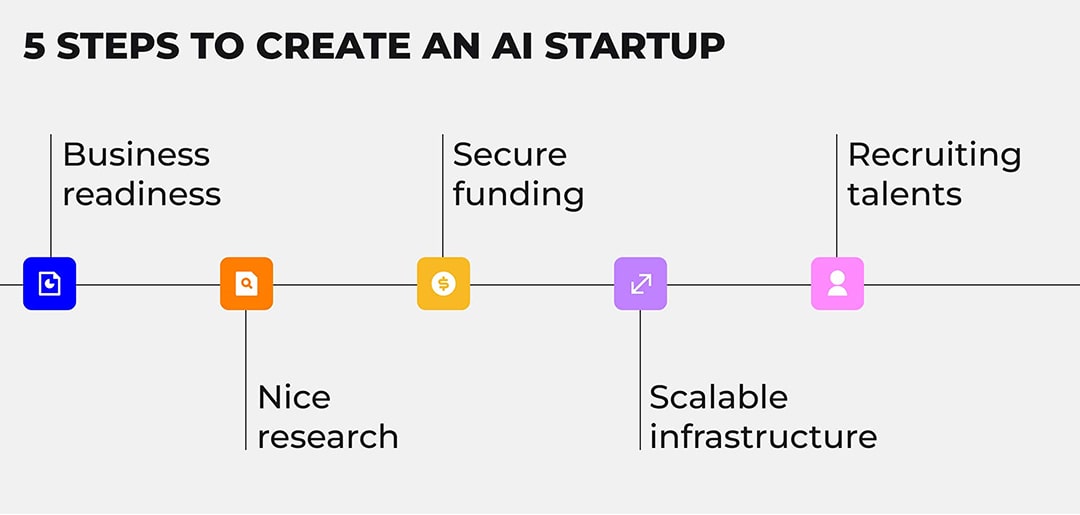
Here is the foundation of a smart artificial intelligence business plan.
Step 1: Evaluate AI Readiness for Your Business
Start by assessing your business’s AI readiness. This can be done by auditing resources, reviewing data quality, and evaluating internal expertise. You’ll be able to identify any gaps and allocate resources effectively. Determine if you have access to high-quality datasets relevant to your solution.
Additionally, check if your team is familiar with AI development tools and methodologies, and if any infrastructure is needed to support further development. This will help you understand if you can scale with the resources you have, or if you’ll need to find additional specialists. With a clear understanding of your readiness, set realistic timelines and proactively mitigate challenges.
Step 2: Research Before Starting an AI Company
Before launching an AI business, define your strategy. Gartner suggests starting with the business output and working backward. Identify the specific challenges or opportunities AI can address within your industry. This step sets the foundation for the tech stack, data sources, and roles you’ll need on your team.
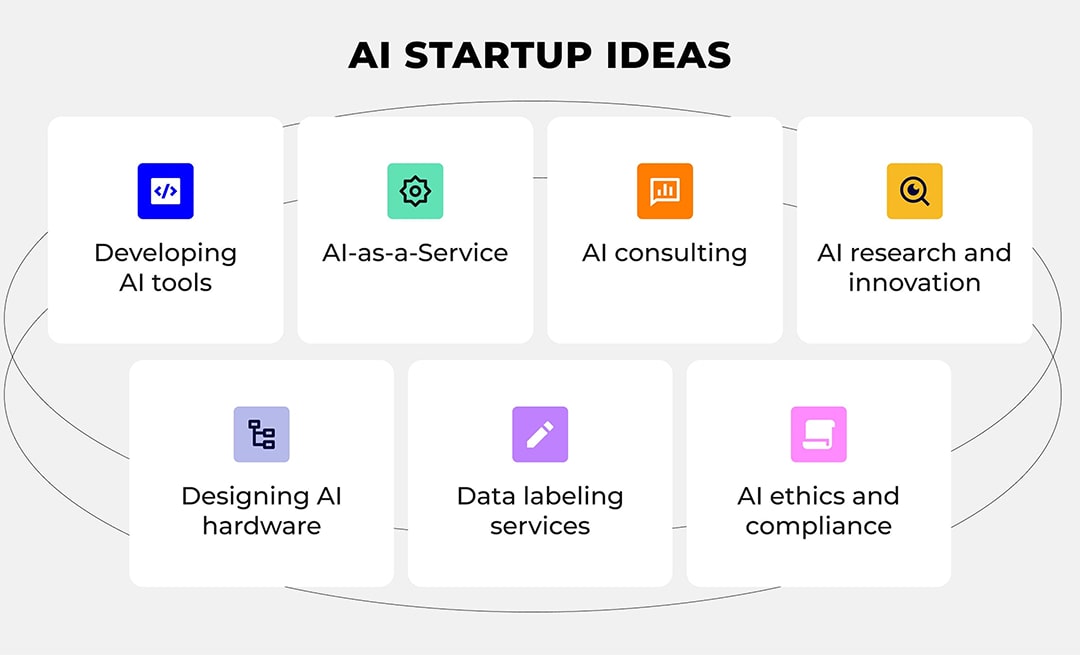
Here are some popular AI startup models to choose from:
- Develop AI toolsfor specific needs, like better medical image analysis to detect diseases early or solutions that help banks spot fraud in transactions.
- Offer AI as a Service (AIaaS) with ready-made APIs. Customizable, user-friendly services, like Microsoft Azure AI or Google Cloud AI, can support image and video analysis, natural language processing, and decision-making.
- Start an AI consulting business by providing expertise to other businesses.
- Provide data labeling services for training AI models. Precise data makes better AI. More and more businesses worldwide use AI, so demand for Data Annotators is growing.
- Advance AI through research and innovation.
- Design and manufacture specialized AI hardware.
- Create courses or platforms for AI skill development.
- Address AI ethics, fairness, and regulatory compliance.
Step 3: Secure Funding
AI startup companies can start building without significant upfront costs by using open-source AI frameworks, libraries, and tools such as TensorFlow, PyTorch, and Scikit-learn.
AI startups typically seek money from grants, research funds, and AI competitions. To grow faster, they attract investors like venture capital firms, angel investors, corporate venture arms, and crowdfunding platforms.
Regardless of your funding sources, to become a tech unicorn you’ll need to:
- Create a good pitch deck that shows your startup’s idea, team, and future plans.
- Customize your pitch to match what investors want, highlighting the ROI they can expect.
- Build a prototype or an MVP to show how your AI works.
- Partner with industry peers and customers to share the experience and grow together.
Step 4: Build a Scalable Infrastructure
Scaling an AI startup effectively hinges on establishing a robust infrastructure from the outset. Growing AI companies benefit greatly from a cloud-based setup, as platforms like AWS, Google Cloud, or Azure offer flexible, scalable resources. With cloud platforms, you can manage services for data storage, compute power, and AI-specific tools. This type of set-up will also save you from large capital investments in physical infrastructure.
Beyond cloud resources, you should consider integrating data management and model tracking tools. For example, MLflow or Databricks can help streamline data workflows and track experiments. If you plan for scalability in advance, it will minimize your technical debt and your teams will be ready to handle increasing data loads and user demands when your business expands.
Step 5: Recruit Top Talent
A successful artificial intelligence startup requires more than just a brilliant idea. Startup AI companies need skilled teams to bring those ideas to life. Due to high demand, AI engineer salary expectations have risen, so you’ll need to offer competitive compensation to attract top-tier talent.
The global talent market offers fewer AI experts than businesses require, so you’ll need to put in some effort to hire AI developers who match your needs. Here are some proven methods for starting an AI company with the right specialists on board.
Networking
Attend AI conferences, workshops, and meetups to communicate with potential team members. Partner with universities and research institutions to access emerging talent in the field of AI. You can also find AI developers’ profiles on online platforms.
AI for Recruitment
Ironically, AI can help you find AI talent. Modern AI-driven tools allow you to analyze plenty of big data in tech recruitment, so you can identify potential candidates who will be successful within your team in the long run.
Outstaffing
In addition to talent shortages, starting an artificial intelligence startup can be time-consuming and resource-intensive. You can partner with outstaffing companies to flexibly scale your tech team when needed.
This approach can help you access the expertise you require without distracting from your core operations. HR professionals from outstaffing agencies can gather your project requirements and shortlist suitable candidates for you to interview.
Building an AI startup team requires a blend of technical expertise, adaptability, and strong problem-solving skills. Bringing together people with diverse backgrounds encourages fresh perspectives, while fostering a sense of ownership and purpose helps keep teams engaged and motivated.
Runbo Li Co-founder & CEO at Magic Hour
How to Identify Key Roles for AI Startup Companies
Let’s explore the essential roles to consider when starting an AI company.
Begin building your team with at least one person from each of these three Archetypes: idealists, business leaders, and engineers.
As your startup grows, the number of people (and departments) belonging to each of the archetypes should grow too.
1. Idealists
This is who shapes the “face” of an AI startup.
Founder
The visionary individual or individuals who conceptualize the startup and drive its mission.
IT Marketers
These specialists are responsible for promoting your startup and creating a positive brand image with potential clients.
AI Ethicists
As AI becomes more pervasive, ethical considerations become increasingly important. AI ethicists help your team make responsible decisions and avoid biases in AI systems.
2. Business Leaders
They are responsible for the venture’s commercial results.
Product Developers
Someone who can turn ideas into tangible products.
Salespeople
Essential for generating revenue and securing customers.
AI Project Managers
Project managers ensure that AI projects stay on track, on time, within budget, and in accordance with business goals.
3. Engineers
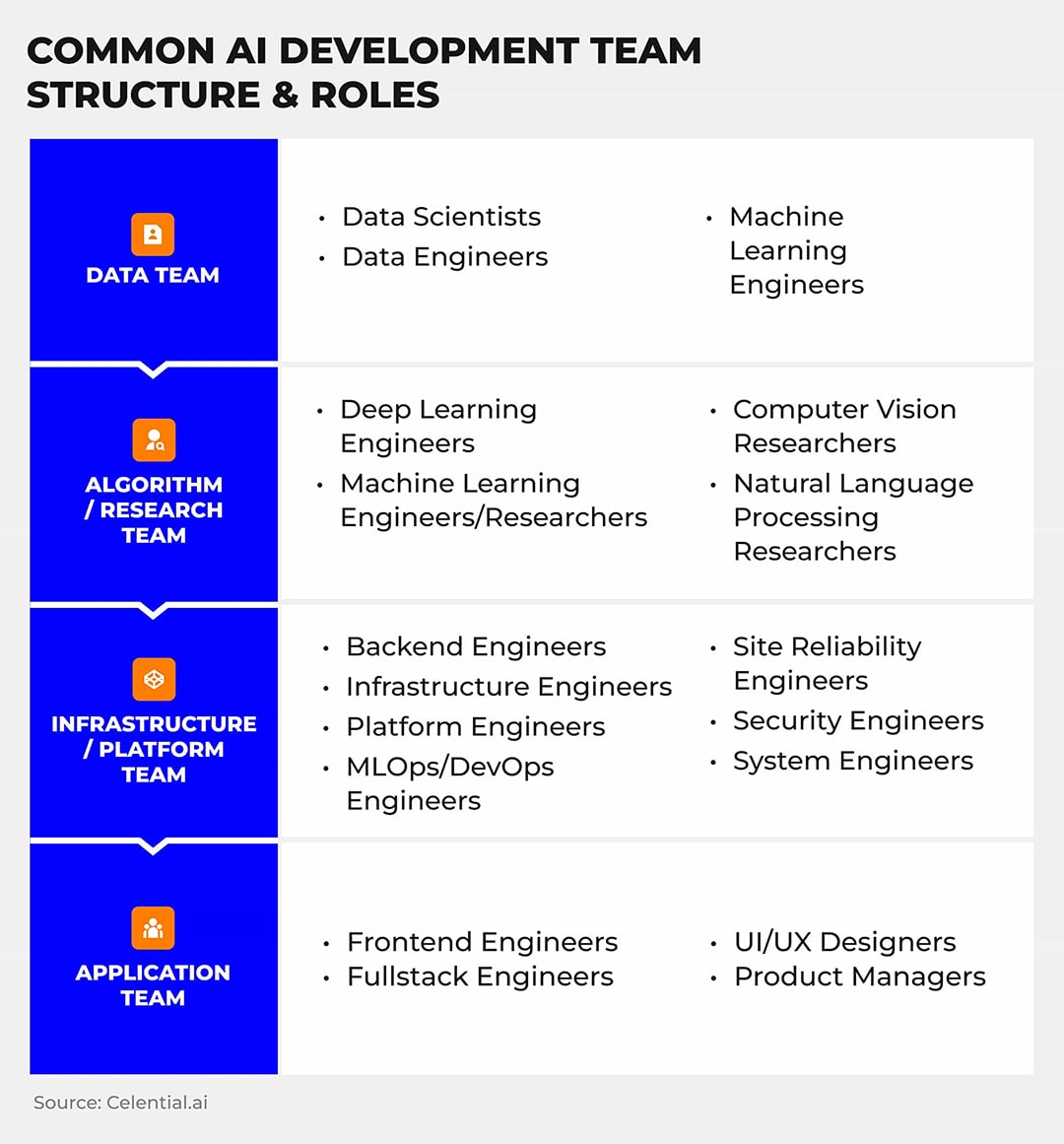
It’s not possible to start an AI company without engineers. Without a tech team, all other specialists involved in the AI startup would have nothing to invest in, promote, or benefit from. The IT team structure can vary depending on your startup model. Here’s a list of the most in-demand specialists:
Data Scientists
Data Scientists build machine learning models, analyze data trends, and refine algorithms.
Data Analysts
Data analysts are essential for extracting valuable insights from data.
Machine Learning Engineers
Machine learning engineers create software that leverages data science by developing machine learning models and deploying them in production systems.
Prompt Engineers
Prompt engineers make AI systems more human-like. They create prompts that improve AI algorithms.
Data Engineers
Data engineers create the infrastructure needed to collect, store, and manage data. They make data accessible and usable for AI applications.
Domain Experts
Domain experts possess industry-specific knowledge that helps AI teams understand the context and nuances of guiding AI systems.
How to Gather a Professional, Collaborative, and Diverse AI Team
We’d start by examining hard skills.
- A degree in computer science, machine learning, or a related field from a reputable institution shows that candidates have foundational knowledge.
- The best specialists have worked on relevant AI projects within their industries. They can share portfolios, code samples (for engineers), and references from previous managers or clients.
- Certifications in AI tools, such as TensorFlow or PyTorch, confirm a developer’s specific expertise.
- Research papers or open-source work in AI reveal a candidate’s in-depth interest in this niche.
- In tech interviews, good specialists fluently explain AI concepts and practical AI solutions.
With a diverse AI startup team, it is easier to offer unrivaled (feature-rich and bug-free) solutions to the market. With this in mind, consider various backgrounds and skill sets when starting an AI company.
To level up cross-functional communication between data scientists, engineers, and domain experts:
- Look for candidates with a similar approach to business ethics.
- Make them aware of each other’s duties.
- Organize memorable team-building activities.
How to Maintain a Forward-looking Approach
Set Clear Goals and Metrics
This is how to create an AI startup that delivers commercial results and brings your AI initiatives to life while remaining aligned with key growth metrics. Using OKR examples for software engineers can be a practical way to align the team with goals, such as improving algorithm accuracy or optimizing deployment times.
- Determine a Customer Acquisition Cost (CAC) and Lifetime Value (CLTV). A high CLTV relative to CAC suggests a profitable customer acquisition strategy.
- Analyze the startup’s Revenue Growth over time.
- Measure Churn Rate, which shows how many customers stop using the product or service within a certain time frame. A high Churn Rate suggests the need to improve customer satisfaction.
- Track DAU and MAU (daily and monthly active users).
- Understand the startup’s long-term goals, whether it aims for an IPO, acquisition, or other exit strategies.
To keep your AI team involved, you or your project manager can discuss those metrics with them. We’d also recommend discussing the startup’s goals and the milestones it has reached, such as partnerships, new investors, awards, or notable customer acquisitions.
With any AI startup, be ready to balance your ambition with your budget. Here are some metrics that can help you prepare your company’s budget for the necessary changes in your AI company team structure:
- Evaluate Burn Rate. It’s how quickly the startup is using its cash reserves.
- Assess your Runway, answering how long the startup can operate on its cash reserves without additional funding.
- Calculate the difference between revenue and the cost of goods sold (COGS). A healthy gross margin indicates the startup can cover operating expenses and invest in growth.
Consider Starting an Artificial Intelligence Startup With an International Team
The global talent market can offer a wider range of unique skill sets and diverse hourly rates. For example, you can find experienced AI developers for hire in Eastern Europe.
Some countries require a business to establish a legal entity there in order to hire locals directly. This results in additional tax burdens and other legalities that are unsuitable for startups on a tight budget. A simpler route is to work with an outstaffing services provider who can help you hire vetted global talent with industry experience that matches your specific requirements.
Embrace Agility and Invest in Continuous Learning
Market conditions and users’ preferences are unstable. That’s why sticking to an agile team structure in software development can benefit AI projects. Regularly assess your team’s progress and make necessary adjustments to optimize your AI solutions based on real-world usage and changing needs. Collect and analyze customer feedback, reviews, and Net Promoter Scores (NPS) to help with the assessment.
Ask about continuous learning during interviews and engage specialists who are willing to stay up to date with the latest research in AI.
As you can see, starting an AI startup is a multi-faceted process that requires careful planning, top talent recruitment, and innovative ideas. To position your AI startup for success in a competitive landscape, building the ideal team must be ongoing:
- Stay responsive to market change and upgrade your team with pros well-versed in the latest trends;
- Plan a professional strategy to retain top talent, which is key to long-term success in AI.
FAQ
Is AI a good business to start?
Yes, artificial intelligence (AI) is rapidly expanding, and the market is expected to reach more than $826 billion by 2030. AI’s ability to automate, predict, and personalize unlocks vast opportunities across industries, making it a scalable path for startups.
Can I create my own AI?
Yes, you can create your own AI model without writing code. Many platforms, like Google’s AutoML and Microsoft’s Azure AI, offer tools for building AI models using simple, no-code interfaces, making AI accessible to non-programmers.
Why do most AI startups fail?
Most AI startups fail due to a lack of focus and poor product-market fit, often driven by a misunderstanding of customer needs. Additionally, monetization issues, inadequate key performance indicators, and gaps in team experience and diversity create challenges that many startups struggle to overcome, ultimately hindering long-term success.