Find out how long your resume should be, whether one page is still a good choice, and if two pages or more actually make sense for your experience level.

AUTHOR
Inge Miscevic
Principal Career Coach
Inge Miscevic is a Principal Career Coach at Toptal Resume with over a decade of experience reviewing and improving thousands of resumes across industries. In her work with clients, she focuses on clear resume structure, effective formatting, and content that presents real experience in a way recruiters can quickly understand.
For most candidates, a resume should be one page. Two pages can make sense with 10 or more years of relevant experience, though a long career on its own isn't a reason to add a second page. The deciding factor is how much of that experience is directly relevant to the job you're applying for.
One page is still a good target for most resumes, particularly if you have a shorter work history. But there’s no need to squeeze all your relevant experience onto one page just to meet this limit. Cornell University’s Graduate School reaches the same conclusion, describing resumes for non-academic positions as one- or two-page summaries and recommending keeping them concise, with enough white space to make them easy to scan. That’s different from an academic CV, which can be longer and includes more detailed information about research, teaching, publications, and other academic work.
Use this table that recommends resume length by career stage as a starting point:
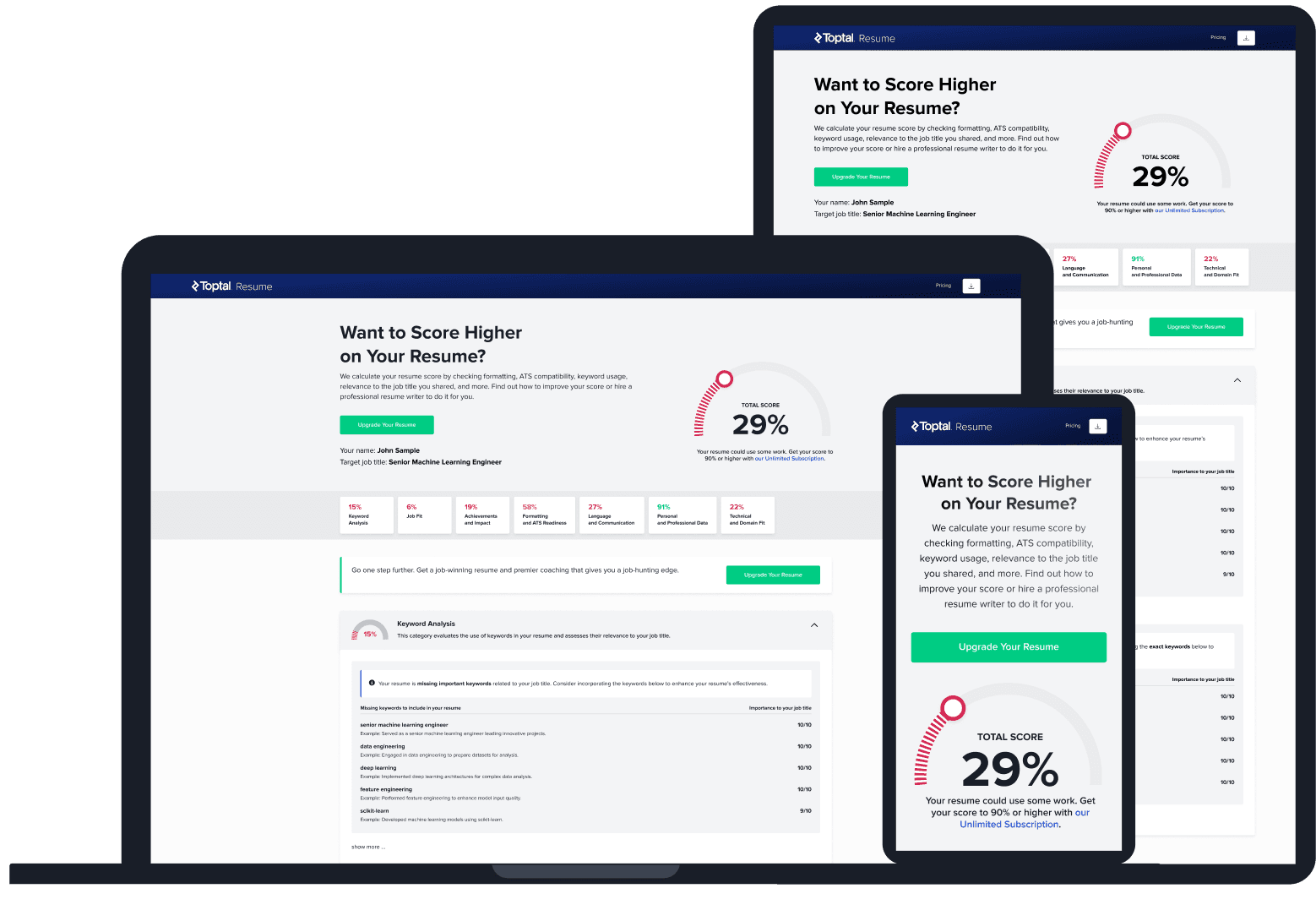
Upload your resume and tell us your target job title. Our system will analyze it the way a recruiter and ATS would—scoring it across core hiring dimensions and giving you personalized, role-specific feedback you can implement right away.
Read Next
Resume Tips
Executive Resume: What Makes It Different and How to Write One
Executive resumes aren't longer versions of standard resumes. They're built around business impact at scale, a different audience, and strategic language throughout.
By Borislav Stojkov
Principal Resume Writer
Borislav Stojkov is a Principal Resume Writer at Toptal Resume. His professional track record includes personally reviewing and rewriting more than 2,000 resumes for professionals across industries. In his direct work with clients and the development of AI-based resume-writing services, he focuses on ATS-optimized structure, modern template design, and recruiter-aligned writing and formatting standards.
Resume Tips
Career Change Resume: How to Reframe Unrelated Experience
The most common career change resume problem isn't irrelevant experience. It's describing relevant experience in the wrong language.
By Borislav Stojkov
Principal Resume Writer
Borislav Stojkov is a Principal Resume Writer at Toptal Resume. His professional track record includes personally reviewing and rewriting more than 2,000 resumes for professionals across industries. In his direct work with clients and the development of AI-based resume-writing services, he focuses on ATS-optimized structure, modern template design, and recruiter-aligned writing and formatting standards.
Resume Tips
Teacher Resume, Cover Letter, and Letter of Interest: A Complete Toolkit for Educators
A practical guide to the three career documents teachers need, with examples and role-specific tips for every teaching level and specialty.
By Borislav Stojkov
Principal Resume Writer
Borislav Stojkov is a Principal Resume Writer at Toptal Resume. His professional track record includes personally reviewing and rewriting more than 2,000 resumes for professionals across industries. In his direct work with clients and the development of AI-based resume-writing services, he focuses on ATS-optimized structure, modern template design, and recruiter-aligned writing and formatting standards.
| Career Stage | Recommended Length | Why |
|---|---|---|
| Entry-level (0–3 years) | One page | Limited experience is easiest to scan on a single page. |
| Mid-career (4–10 years) | One page, sometimes two | Enough experience to fill a page without padding. |
| Senior/executive (10+ years) | Two pages | More space can help show leadership, scope, and significant results. |
| Academic/research | Multiple pages | Publications, research, grants, and teaching history might take up more space. |
These are meant to be guidelines, and not strict page limits. If everything that matters fits comfortably on one page, there’s no reason to add another. If you’ve cut irrelevant experience and your resume still needs two pages to show the qualifications that matter for the job, use two pages.
Cornell College’s Berry Career Institute mentions a similar approach for students, recommending that most college students keep their resume to one page while also suggesting that they maintain a longer master resume containing all of their experience. The point is to edit that larger record down for each application rather than trying to fit everything into the version you send.
That same idea works for other career stages as well. Your resume should be long enough to make your case, but short enough that the relevant information doesn’t get buried.
Yes, a two-page resume can be a good choice when you have enough relevant experience to justify it. This is more common as your career progresses, but seniority isn’t the only reason to use two pages.
You might need two pages if you have:
What you don’t need is a second page just to be able to include every job you’ve ever held. Older positions can usually be shortened, and unrelated experience can often be removed. Long lists of responsibilities are not as useful as a few strong, highly relevant achievements. Youth Central, a Victorian Government career service, similarly advises against padding a resume and notes that a well-presented one-page resume can be more effective than a longer resume filled with unnecessary information.
Page two should give the reader something useful. If your second page includes mostly older roles, repeated skills, or responsibilities that don’t add much to your application, that’s a sign to cut more content.
There’s also no need to make the first page so crowded that it becomes hard to read. If reducing your resume to one page means tiny text, narrow margins, or seven lines of information without necessary white spaces, you’ve taken the rule too far just to avoid adding a second page.
“Recruiters aren’t counting your pages. They’re looking for the information that’s relevant to the role, and they have limited time to find it. Make sure everything on your resume earns its place.”
— Borislav Stojkov, Principal Resume Writer at Toptal
If your resume is two pages and you’d prefer to get it down to one, start with the content. Don’t start by changing the font size to 9 points to fit everything. Formatting can be adjusted for fine-tuning after the content has been reviewed.
Look at every section and ask whether it helps explain why you’re qualified for this particular job. You probably don’t need:
This can be uncomfortable when you’ve spent years building your career, but a resume shouldn’t be a record of everything you’ve done. Think of it as a selection of the experience that’s useful for the job you’re applying for.
Your most recent roles usually deserve the most attention. If you’re applying for a senior marketing position, for example, your recent marketing leadership experience matters more than a job you held 7 years ago that has no connection to what you do now.
That doesn’t mean older experience has to disappear completely. It just doesn’t need the same amount of detail. You might use five bullets for your current position, three for the role before that, and one or two lines for an older position.
A resume can get long very quickly if you turn every job into a list of responsibilities. Instead of: “Managed a team of 15 sales representatives and oversaw regional sales operations.” you might write: “Led a 15-person sales team across three regions, increasing annual revenue from $8.2M to $11.6M.” The second bullet gives the reader more to work with, and it doesn’t take much more space.
This is one of the easiest ways to shorten a resume. If your summary says you’re skilled in process improvement, your skills section lists process improvement, and four job descriptions mention it again, you probably don’t need all of those references. Keep the strongest evidence and remove the rest.
The same applies to phrases like “responsible for,” “worked with,” and “helped with.” They often take up space without adding much information.
Once the content is under control, look at the layout. You can usually make small adjustments to margins, spacing, headings, and font size without making the resume difficult to read. Just don’t use formatting tricks to squeeze a two-page resume into one page when the content clearly needs more room.
A good one-page resume should still have some breathing room. If you want a starting point built for this resume length, Toptal's one-page resume template can save you some of that editing work.
Two pages can make sense when you’ve built up enough relevant experience that cutting the resume further would leave out information a recruiter actually needs.
This often happens with senior and executive candidates. You may have multiple leadership roles, large teams, major initiatives, or results that need a little more explanation, but don’t assume that 10+ years of experience automatically means you need two pages.
A senior candidate with 12+ years of experience and a focused career history might have an excellent one-page resume. Another candidate with 5+ years of experience might have enough directly relevant projects and accomplishments to need two pages. The number of years is a useful guideline, but it shouldn’t be used as a formula for every resume.
Academic applications are a different situation. If you’re applying for an academic or research position, you might need a CV rather than a standard resume. A CV can be several pages long because it usually includes publications, research, grants, teaching experience, conference presentations, awards, and other work that’s relevant in an academic setting.
Trying to squeeze all of that into one or two pages usually isn’t the point. If you’re unsure which document you need, see the Recruitment.com’s CV vs. resume guide for a closer look at how the two differ.
Once you’ve settled on the resume length and content, take a step back and read it through as if you were the person hiring for the role. Ask yourself the following questions:
If the resume is clear, relevant, and easy to read, you’re probably close. Once you’ve got the content where you want it, you can use the Toptal Resume Builder to build and format your resume. Then run it through the Toptal ATS Resume Checker as a final check.