A letter of interest and a cover letter are not the same thing, and using one when the other is expected can hurt your application.


AUTHOR
Borislav Stojkov
Principal Resume Writer
Borislav Stojkov is a Principal Resume Writer at Toptal Resume. His professional track record includes personally reviewing and rewriting more than 2,000 resumes for professionals across industries. In his direct work with clients and the development of AI-based resume-writing services, he focuses on ATS-optimized structure, modern template design, and recruiter-aligned writing and formatting standards.
While a cover letter is written as a response to a job opening that already exists, a letter of interest is an outreach to a company without an open role. Cover letters address specific requirements, and letters of interest are sent proactively to start a conversation. Choosing between the two is not a matter of preference, and it depends on the context. This guide will help you understand the difference and learn how to write a strong letter of interest.
Simply put, a letter of interest is a document you send to a company you admire and want to work for when no position is advertised. It's also known as a letter of intent, expression of interest, or prospecting letter. It might sound like a long shot at first, but many job seekers have experienced situations where a position is filled before it's ever publicly posted.
A hidden job market exists, and a letter of interest can be a useful tool for accessing it through direct, proactive outreach and networking. Unlike a cover letter, it doesn't focus on a specific position, but on a general fit, culture, mission, and direction of the company you're targeting. Its tone can be slightly more conversational than that of a cover letter because you're trying to start a relationship with them rather than respond to a formal invitation.
Upload your resume and tell us your target job title. Our system will analyze it the way a recruiter and ATS would—scoring it across core hiring dimensions and giving you personalized, role-specific feedback you can implement right away.
Read Next
Resume Tips
Chronological vs. Functional vs. Combination Resume: Which Format Should You Use?
Learn the differences between chronological, functional, and combination resumes, and which format fits your background best.
By Inge Miscevic
Principal Career Coach
Inge Miscevic is a Principal Career Coach at Toptal Resume with over a decade of experience reviewing and improving thousands of resumes across industries. In her work with clients, she focuses on clear resume structure, effective formatting, and content that presents real experience in a way recruiters can quickly understand.
Tools & Services
Best Resume Builder in 2026: How the Top Resume Builders Compare
Compare the best resume builders of 2026, learn what sets Toptal Resume apart, and find the right tool for your price, features, and career goals.
By Inge Miscevic
Principal Career Coach
Inge Miscevic is a Principal Career Coach at Toptal Resume with over a decade of experience reviewing and improving thousands of resumes across industries. In her work with clients, she focuses on clear resume structure, effective formatting, and content that presents real experience in a way recruiters can quickly understand.
Resume Tips
The Registered Nurse Resume: What Hospitals Actually Screen For
Learn what hospital recruiters actually screen for on a registered nurse resume, from licensure and specialty experience to quantified patient outcomes.
By Inge Miscevic
Principal Career Coach
Inge Miscevic is a Principal Career Coach at Toptal Resume with over a decade of experience reviewing and improving thousands of resumes across industries. In her work with clients, she focuses on clear resume structure, effective formatting, and content that presents real experience in a way recruiters can quickly understand.
A cover letter is a targeted document that candidates often send with a resume when applying for a job posting. Its goal is to respond to the specific needs defined in a job description by mirroring its language and addressing the listed requirements. They often have a similar structure, with an opening section, body of the letter, and closing, but they serve different strategic purposes, and the context of the conversation is not the same.
The tone of a cover letter is more formal: three to four short paragraphs that mention a specific product, role, or team detail, along with an accomplishment relevant to the role and an anecdote or relatable detail. If you need AI-assisted help drafting a cover letter for your job application, Toptal Resume's cover letter generator walks you through the process and tailors it to your resume and job description.
The table below can help you understand the difference between a cover letter and a letter of interest and decide on what's the right choice for your specific situation.
| Aspect | Letter of Interest | Cover Letter |
|---|---|---|
| Trigger | Sent proactively, without an open posting | Sent in response to a specific job posting |
| Purpose | Introduces a candidate and expresses their interest in the organization | Explains a candidate’s fit for a specific role in a company |
| Structure | More general structure, highlighting transferable skills and admiration for the company | Tailored to address a role’s defined requirements |
| Common mistake | Being too vague about the desired role or department | Not referencing the role requirements |
Most importantly, a letter of interest isn't simply a cover letter that is sent when there's no job opening, and it requires a fundamentally different approach.
In this section, you'll learn how to write an effective letter of interest in five specific steps.
Step 1: Research the company
Your letter of interest shouldn't look like it could have been sent to any company. Before you start writing, get familiar with their vision and cultural values, recent activities or initiatives, or a product launched. Connecting with their background will instantly set your letter of interest apart from the many others they receive.
Step 2: Open with a connection to their work
Once you've completed the initial research from step 1, continue by explaining why you're reaching out to that specific organization. For example, you can say that you've been following the expansion of their business into a new market and express your interest in any opportunities at their company. That connection means genuine interest that sets you apart from generic outreach.
Step 3: Make your value proposition
This is the central part of your letter of interest, and it should explain how you could contribute to their team. You shouldn't target a specific role (which might not even exist), so focus on your area of expertise and the type of work you do best, and back it with a relevant achievement or a big win from your work experience. The key is to find a balance between being specific and flexible.
Step 4: Express genuine enthusiasm
In this section, the tone can be somewhat warmer than in a typical cover letter. You would like to start a relationship with them, so showing admiration for their work is completely appropriate. That said, keep it specific instead of expressing general enthusiasm.
Step 5: End with a low-pressure ask
Of course, you want them to take the next step and continue the conversation, but you shouldn't ask for a job. Be confident and say that you'd welcome the opportunity to explore further whether there might be a fit. Don't forget to include your contact details and attach your resume.
The two examples below illustrate two very common scenarios in which a job seeker could use an effective letter of interest. In the first letter of interest sample, a marketing professional reaches out to a company they admire when there's no job opening for the desired position. In the second example, a teacher writes to a school district speculatively before the hiring season.
Example 1: Marketing Professional (General Letter of Interest)
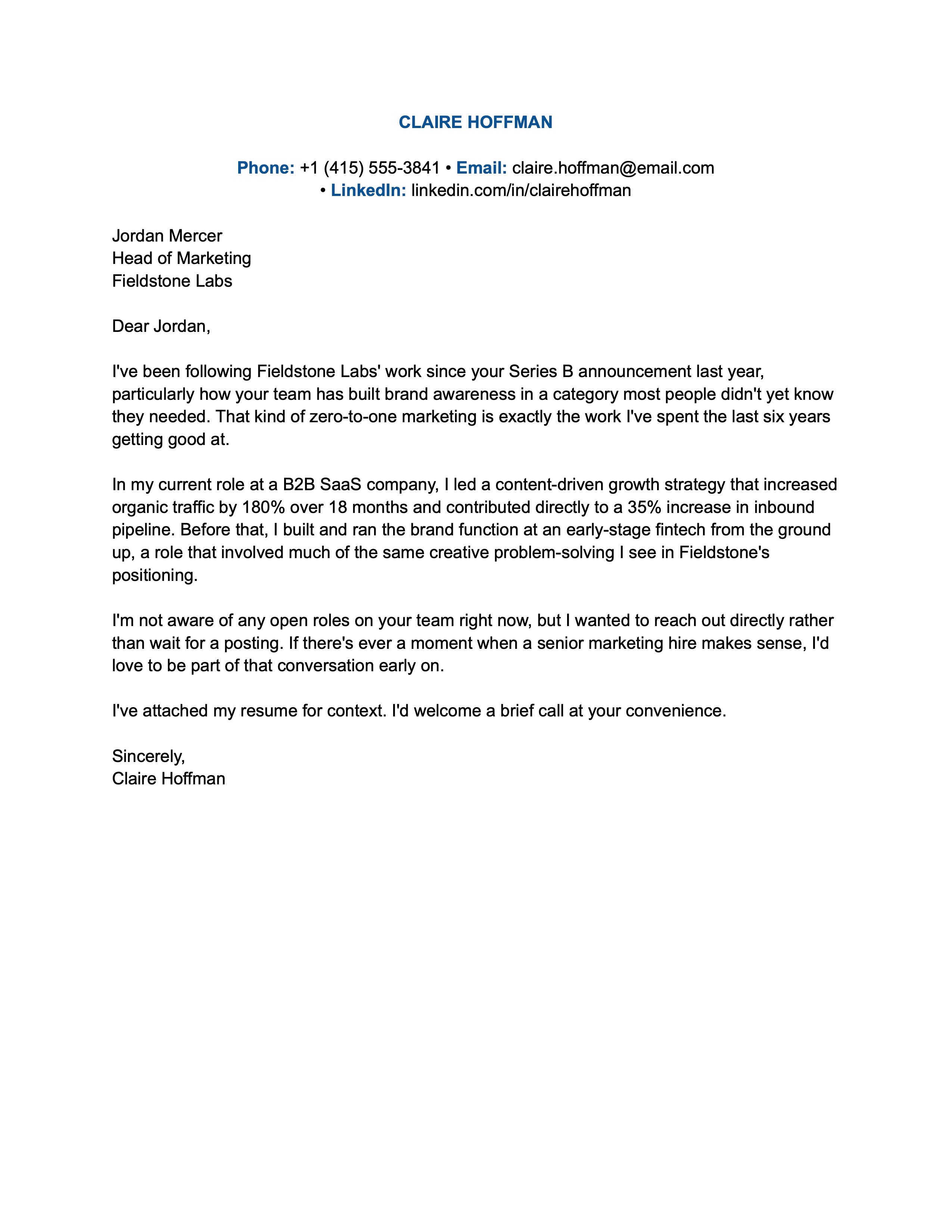
The letter of interest example in the image below describes a marketing professional reaching out to a tech company in the growth stage. There's no job posting, and her goal is to start a conversation with the company she's been following.

Here's what works in this example:
Example 2: Teacher (Letter of Interest to a School District)
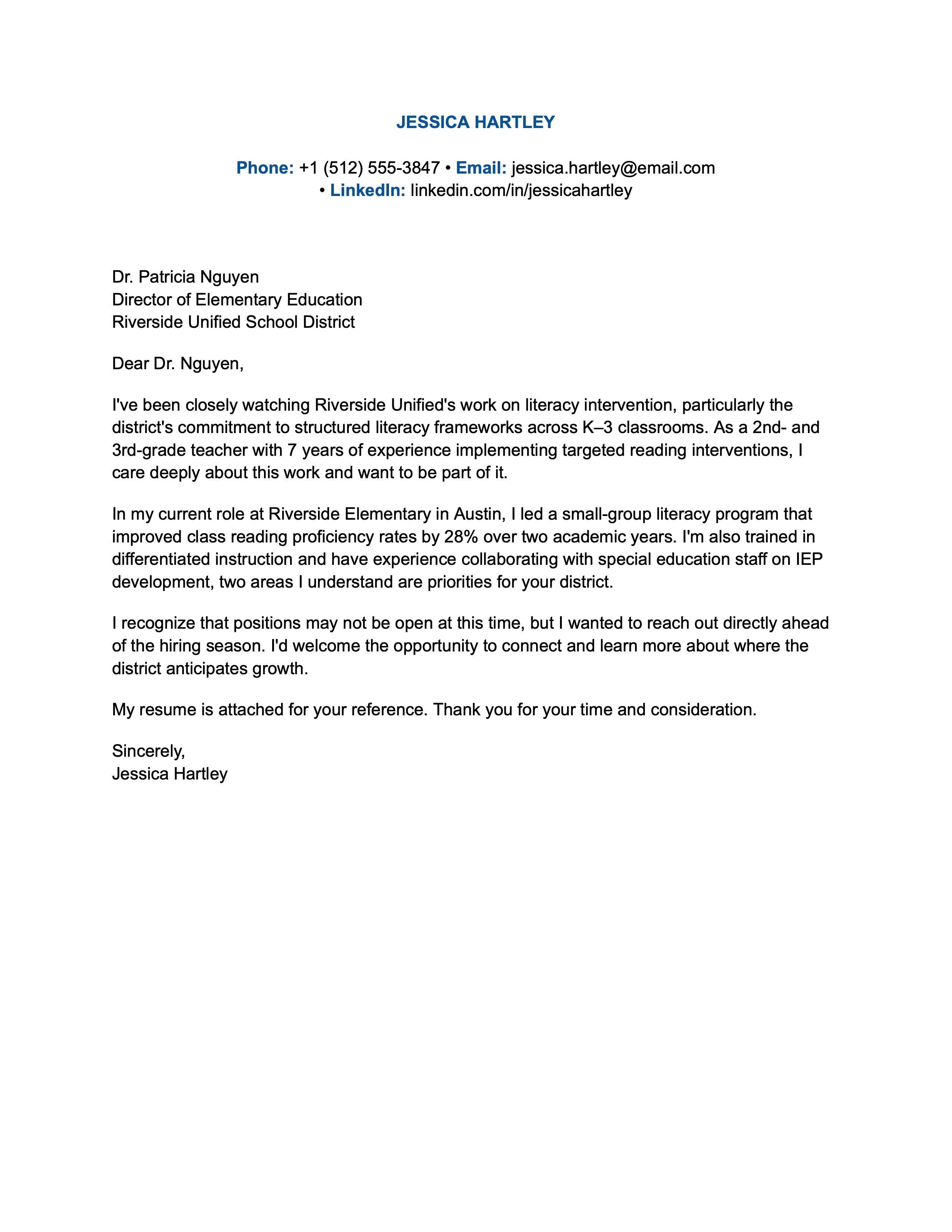
The second example, shown in the image below, is written by an experienced elementary school teacher who is reaching out to a school district. This proactive outreach is a common practice, and qualified candidates like Jessica can be considered.

Particularly strong details in this example:
Whether you're writing a letter of interest to a company you've been targeting or a cover letter for a specific posting, the structural principles are the same, and you can use our gallery of cover letter templates to get started. Additionally, Toptal Resume's AI resume builder can help you polish the resume you're attaching with tailored writing suggestions.