Entry-level Resume: How to Write a Resume With Little or No Experience
An entry-level resume with no work experience isn’t empty: it’s built from projects, coursework, volunteering, and other evidence that proves you’re ready.

AUTHOR
Borislav Stojkov
Principal Resume Writer
Borislav Stojkov is a Principal Resume Writer at Toptal Resume. His professional track record includes personally reviewing and rewriting more than 2,000 resumes for professionals across industries. In his direct work with clients and the development of AI-based resume-writing services, he focuses on ATS-optimized structure, modern template design, and recruiter-aligned writing and formatting standards.
If you don't have any paid work history, the job of your resume is to prove that you're a good fit for the job using any experience you might have. A resume for students with no experience will always focus on education, coursework, skills, and any kind of practical work, including internships, personal projects, volunteering, or extracurricular leadership. This guide will explain how to frame and quantify those elements to strengthen your application for an entry-level position.
What Counts as Experience When You Have None
When figuring out how to make a resume with no experience, first ask yourself whether you really don’t have any. There are different practical things you’ve done either during education or independently that can be translated into an effective presentation of your skills and achievements. All first resume examples focus on the following:
- Internships: They are real experiences and should be treated like any paid job entry, with the organization name, role title, and bullet points describing your results.
- School and academic projects: Any project where you’ve demonstrated your skills to achieve some results can be used as strong evidence of your competence.
- Volunteering: Similar to internships in terms of format, but list only job-relevant aspects of your volunteering engagements.
- Part-time and seasonal jobs: Even if they seem unrelated to your target job, find all transferable skills and frame the bullet points around them.
- Extracurricular leadership: Many of them, e.g., club officer or event organizer, mean real responsibilities that can be tied to many professional jobs.
- Personal projects or freelance gigs: As with academic projects, focus on what you delivered, framing them as self-employment with real clients.
- Competitions and hackathons: Name your role and achievements, as these can be particularly valuable for tech entry-level resumes.
To sum up, writing your first resume is not about the titles you’ve had, but about transferable skills and achievements from your earlier experience. If you need help to build your entry-level resume, Toptal’s AI resume builder provides tailored suggestions for your target role based on your past experience.
First Resume: How to Order the Sections
An entry-level resume template is a little different from standard resumes, and the resume format for students with no experience isn't identical to that of an experienced professional. The section order typically changes to emphasize your education, projects, and skills, which, in these cases, assume the role of the work experience section in standard resumes. The table below summarizes what changes and why.
| Element | Standard Resume | Entry-level Resume |
|---|---|---|
| Section order | Professional summary, work experience, education, skills | Optional summary or objective, education, projects (and/or any unpaid work), skills |
| Opening section | Professional summary | Optional short summary/objective that can be skipped entirely |
| Work experience | Paid jobs only | Internships, projects, volunteering, or any part-time work |
| Bullet points | Achievements based on business impact | Achievements with any credible quantified results |
| Education | Institution and degree title | Relevant coursework, GPA (if strong), expected graduation date |
| Skills | Tailored skills list based on the work experience | Tailored skills list based on transferable hard and soft skills |
| Length | One to two pages | One page only |
| Format | Reverse-chronological resume format for most cases | Reverse-chronological or combination (hybrid) resume format |
Objective or Summary? Clear Rules for Entry-level Resumes
The resume objective vs. resume summary debate is particularly important to resolve when writing an entry-level resume. There are many aspects to consider, but the answer is clear: Whenever there's enough evidence of your relevant background for the target job, writing a short professional summary is the best choice. Summarizing your hands-on experience definitely outperforms saying what you're looking for.
Resume objectives can be useful when an applicant has no relevant experience (no projects, no internships, no extracurricular leadership, etc.), and mentioning a few transferable, relevant skills alongside the personal objective can help paint a clearer picture. That said, always connect what you know with what the employer is looking for.
As stated above, an entry-level resume template always means having a one-page resume. If having any kind of summary requires losing or shortening any relevant experience section, omit it entirely. Your skills and achievements are already easy to scan at a glance on a one-pager, and the summary doesn't add much value, or can even be redundant.
How to Write a Resume With No Experience: A Step-by-step Method
The step-by-step guide for writing a no-experience resume below is based on evidence from years of writing and reviewing a wide range of entry-level resume examples for students with no experience or recent graduates entering the job market. Following these seven specific steps will help you make a good resume for your first job:
- Analyze the job description. Identify the most important job requirements, which are those most frequently mentioned by the employer.
- Gather your evidence. Think carefully about which skills and achievements from your experience are (even loosely) related to the selected requirements.
- Use the substitutes to create your work experience. Treat all of them as job entries, whether it's volunteering, internships, or projects. List your title, the organizations, and describe with achievement bullets.
- Quantify everything you can. See the before/after section below to learn how exactly to do this.
- Move the education section up. It's a good practice to place it right after the summary (if you have one) and to include relevant coursework, GPA if strong, and any academic honors.
- Create a tailored skills section. List the most relevant skills, but stay honest and represent your experience accurately.
- Keep it one page. A two-page entry-level resume is never a good idea: If needed, make the bullets shorter or remove the summary entirely.
How to Quantify Things That Were Not Jobs
The table below shows how any kind of experience can be quantified by listing "before and after" bullet points written as effective first job resume samples.
| Experience Type | Before (Unquantified) | After (Quantified) |
|---|---|---|
| Class project | "Completed a supply chain case study” | "Analyzed a retailer's distribution model and proposed a 15% delivery cost reduction” |
| Volunteering | "Volunteered at Chicago Food Bank" | "Coordinated food distribution serving 400+ community members, tracking inventory in Excel" |
| Extracurricular activities | "Member of the University Business Club" | "Managed scheduling, vendor coordination, and budgets for 14 events per semester" |
| Unrelated part-time job | "Worked as a barista at a local coffee shop" | "Delivered customer service for 80+ daily transactions in a high-volume environment, maintaining consistent quality during peak hours" |
| Personal tech project | "Built a web application using React and Node.js" | "Designed a mobile-responsive web app using the RAWG API with advanced search features, increasing user engagement by ~30% and reducing page load times" |
| Freelance gigs | "Did graphic design work for small businesses" | "Completed logo and brand identity projects for three local businesses, delivering final assets within agreed timelines and receiving repeat commissions" |
As you can see, the pattern is the same for all of them, and every well-performing first resume example uses the same formula: scope of your work + your method (skills) + results. If you do this part right, the title becomes less central.
One-page Resume Format: What to Cut First
Entry-level resumes are always one page long, and there's no exception to that rule when it comes to defining the resume format for students with no experience. The one-page rule isn't simply a convention with no practical reason behind it: Recruiters spend seconds on resumes regardless of career level, and it's hard to imagine they will invest more time and effort in an entry-level resume. Additionally, candidates without directly relevant experience need to make their case clear at a glance, without requiring the reader to infer it from deep analysis.
What to cut first
- Leave off the least relevant and least related experience that is less likely to strengthen your application.
- Make bullet points more concise by making them one line long.
- Remove education details that don't help you, such as a weak GPA.
- Don't list your high school if you already have college experience (ongoing studies or obtained a degree).
- Skip the summary/objective if its content is already clearly visible elsewhere.
What not to cut
- Always keep bullet points that include quantified achievements.
- List all certifications relevant to your target job.
- Keep relevant coursework in your education section if it aligns with the field in the job description.
- Don't cut the skills section, which links you directly to the job requirements.
To learn more about resume length, see our full guide on how long a resume should be.
ATS Basics for Entry-level Candidates
Many job portals and employers use applicant tracking systems (ATS) in their hiring processes. That means that a software scans and evaluates your resume before it reaches a human reader. Having an ATS-friendly resume is important so the machine scanners can read and organize the information in it correctly. To make your entry-level resume ATS-compatible, follow these general rules:
- Use a simple resume format and layout. Avoid overly complex designs with multiple columns, graphics, tables, text boxes, and so on.
- Use standard section headings. Don't invent alternatives to universally used headings, such as "Work Experience," "Education," or "Professional Summary."
- Use the job posting's language. ATS systems look for specific skills and requirements for the job, so try to mirror their language as much as possible.
If you want to make sure that your resume is ATS-friendly, Toptal Resume's ATS resume checker provides you with a thorough analysis of different aspects of your resume, compared to your target job. For a more detailed comparison of resume tools that use ATS-friendly templates for entry-level resumes, see our guide on the best resume builders for college students.
Teenager Resume With No Work Experience
If you're a high school teenager writing a resume for your first job, you should focus on slightly different things compared to college student resumes. Naturally, you don't have any academic coursework to list, so you can use your extracurricular activities, volunteer work, school clubs, or even babysitting or lawn care to make your case. It's important to present such experience as a valuable asset for your skills and work ethic.
Your education details are also very important, even at this level, and you can list your GPA, relevant classes, honors, clubs, or sports. Don't forget to describe any seasonal or part-time jobs and skills, such as computer skills (even basic), customer communication, and time management.
As with any first-job resume example, always submit a one-page resume. Don't worry that you have to come up with a lot of content to compensate for your lack of experience, as you're writing a resume for a high school student, and recruiters don't expect to see extensive resumes with multiple pages.
Entry-level Tech, IT, and Project Manager Resumes
Different entry-level resumes focus on different things depending on the role you're targeting for your first job. Below, you can find the elements you should highlight for some of the most common entry-level positions, with links to the resume writing guides for each of them.
Entry-level Software Engineer Resume
The foundation of most strong entry-level software engineer resume examples is the Projects section. Your evidence base can include the apps you built as personal or academic projects, and the skills to list in their dedicated section that are particularly important for today's market include familiarity with AWS, cloud, and AI tools. Don't forget to add your GitHub link in the contact information section.
Entry-level IT Resume
Valuable additions to your entry-level IT resume are certifications, such as CompTIA A+, Google IT Support, or Microsoft Fundamentals. If you have any experience with help desks, support, and troubleshooting (including volunteer IT work or school tech support), make sure to describe it with quantified bullet points in the work experience section. For more detailed advice, see our full guide on IT resume examples.
Entry-level Project Manager Resume
Project manager roles always require prior experience, and you should be very careful if that's not the case with you. All your coordination, scheduling, or team leadership skills from club or volunteer roles should be presented as truly relevant hands-on experience. When it comes to technical skills and certifications, a strong asset of all entry-level project manager resume examples is tools like Asana, Jira, or Trello, and having a credential like the Google Project Management Certificate would be ideal.
Entry-level Engineering Resume
Similar to other tech entry-level resumes, the strongest evidence of your relevant experience is found in your academic projects, lab work, capstone projects, and, above all, in any internships you've completed. Technical skills for any example of an engineering resume should be specific: mention software names, tools, and methodologies in the work experience descriptions and in the skills section.
First Resume Examples: Entry-level Samples for Students and Graduates
The two entry-level resume examples in the images below illustrate two of the most common scenarios for first-job resumes: the first is for a career starter with no degree who is still in school, and the second is for a recent computer science graduate.
Example 1: Entry-level Business Operations Resume Example (No Degree, College Junior)
This first job resume sample shows that Jordan's studies are still in progress, and he is targeting an internship or an entry-level job in business operations. His work experience includes the Campus Events Coordinator role, a project for his operations management course, and a volunteer role at a food bank.
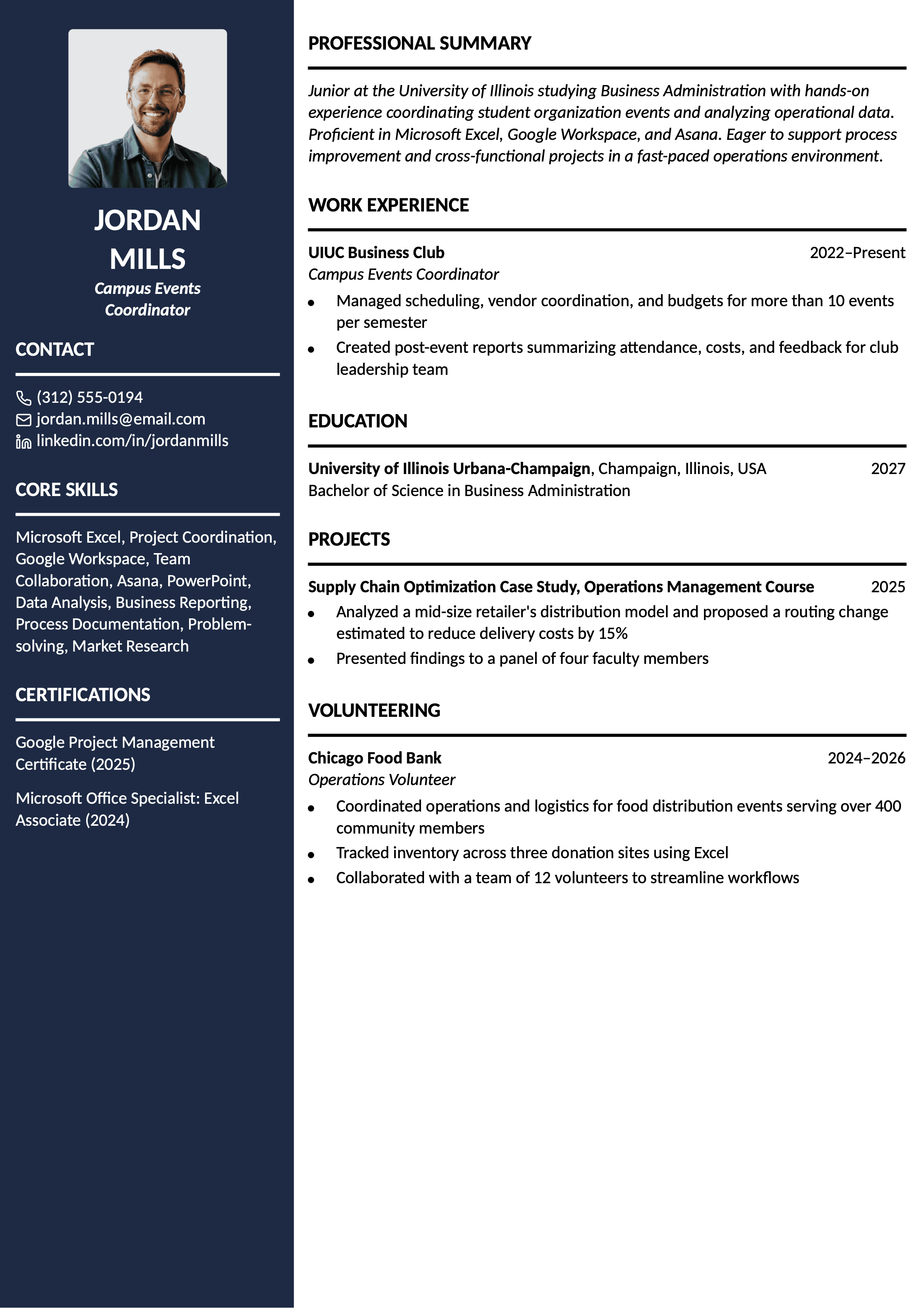
Note that all the bullet points describe very specific, quantified achievements: 10 events, 400 community members, the cost reduction in the case study, and so on. Also, the skills required for the target roles are highly visible in the sidebar of this entry-level resume template.
Example 2: Entry-level Software Engineer Resume Example (Recent Computer Science Graduate)
As you can see in the image below, the applicant is a recent computer science graduate with concrete experience from his projects. All three projects have quantifiable metrics: improved response times by 15%, 30% increase in user engagement, and so on.
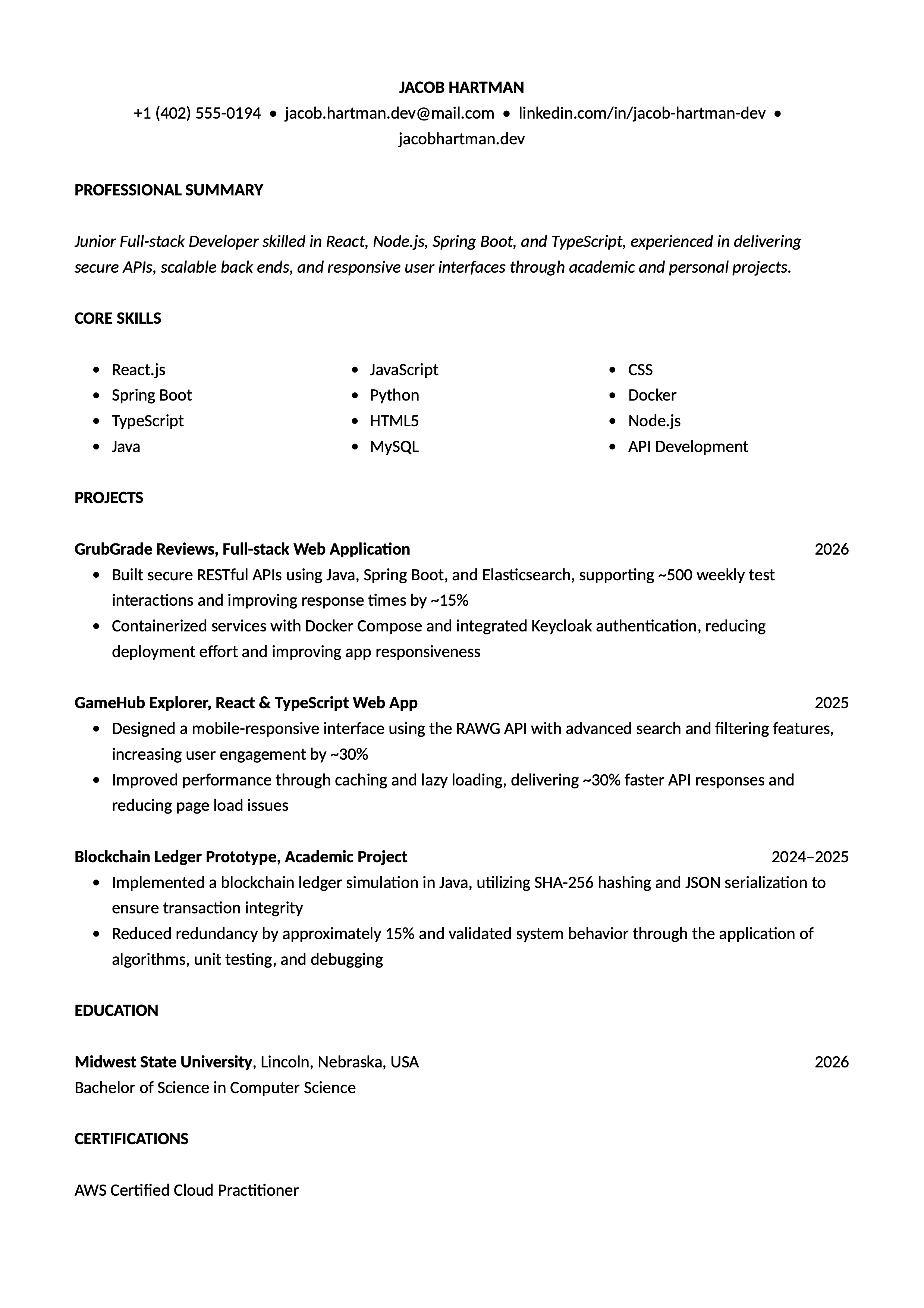
This entry-level resume template places the skills section right after the professional summary, which is particularly well-suited for tech roles, and his AWS Certified Cloud Practitioner certification supports it.
You can download this example for free and use it as an entry-level resume template.
Entry-level Cover Letter Example
The purpose of an entry-level cover letter is to connect what you have to what the company needs. You don't need to sound apologetic if you have no experience or limited experience, but rather show what you bring to the table. Let's take a closer look at the cover letter example shown in the image below for the same job seeker as the entry-level resume example in the previous section.
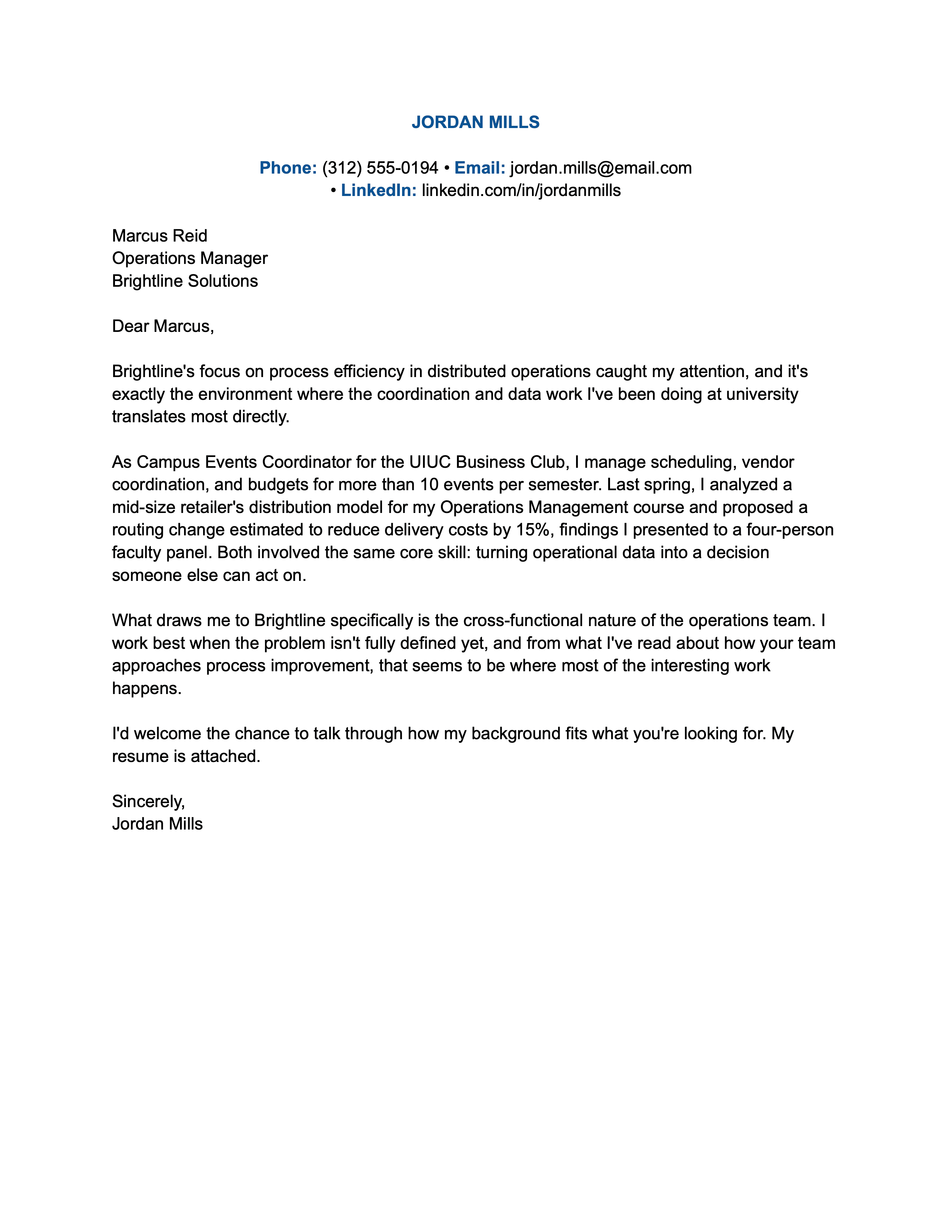
Jordan is applying for a business operations job at the company Brightline Solutions. The letter doesn't start with a generic "I'm applying for," but with a specific detail about the company, its focus area, which shows that he's done some research. In the second paragraph, he highlights his college experience achievements (10+ events, a 15% cost reduction estimate, and a four-person panel). Of course, there's no need to repeat every detail from your resume, and to mention only a few of your most impressive achievements and skills. The closing is confident and forward-looking, stating, "I'd welcome the chance to talk through how my background fits what you're looking for."
If you'd like AI-powered assistance with writing the cover letter for your first job, Toptal Resume's cover letter generator creates content tailored to your career level, background, and target job.
Build Your Entry-level Resume
If you need help writing your first job resume or want to update the entry-level resume you already have, Toptal's resume builder offers AI-assisted guidance adapted to your career level and experience, with tailored content suggestions and expertly designed resume templates.
FAQ
ATS Resume Score Checker
for Professional Roles
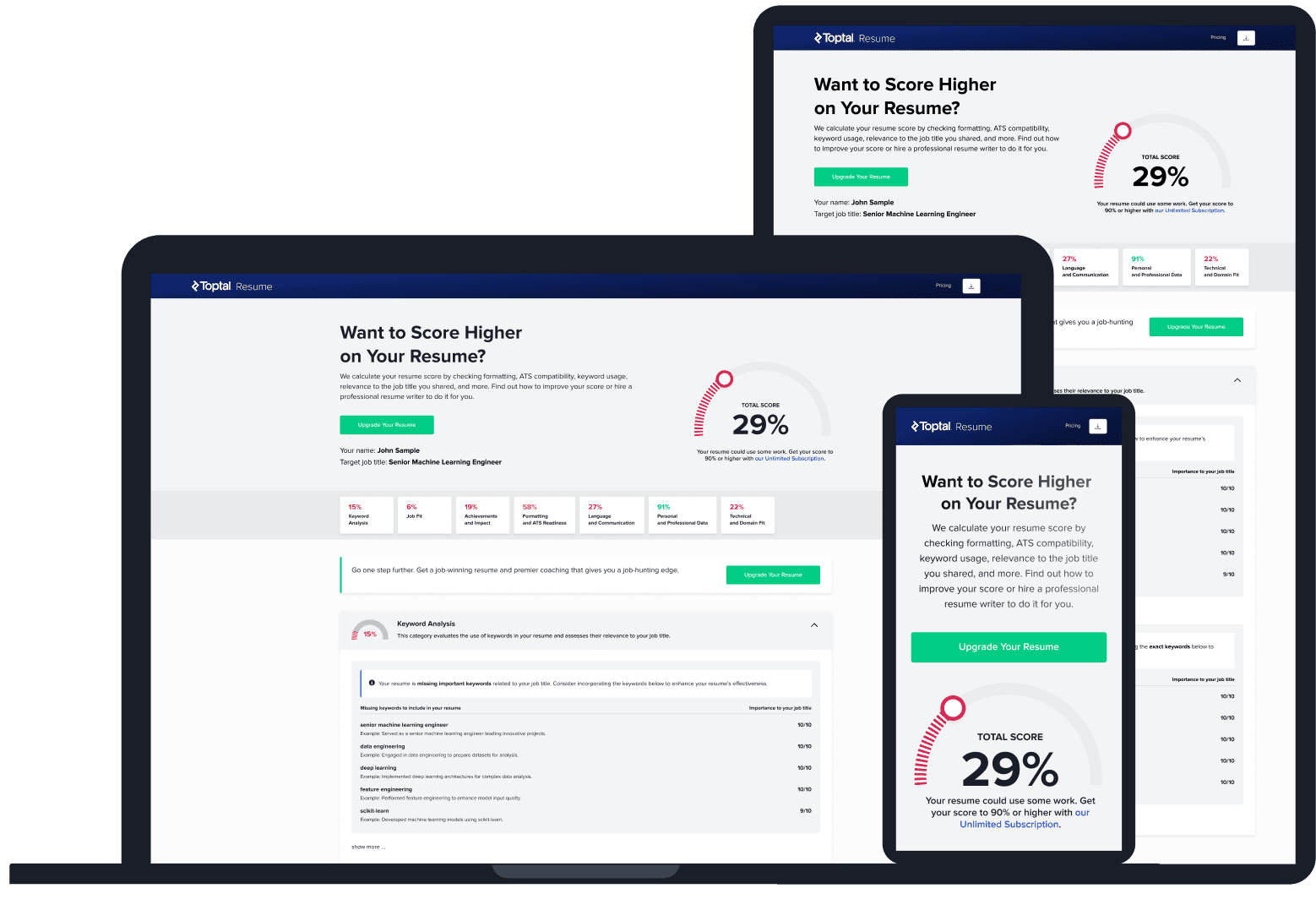
Upload your resume and tell us your target job title. Our system will analyze it the way a recruiter and ATS would—scoring it across core hiring dimensions and giving you personalized, role-specific feedback you can implement right away.
Read Next
Resume Tips
Resume Templates That Work: Formats, Examples, and How to Choose
The right resume template depends on your goals and experience, not your design preference. Here’s how to choose one that works for both ATS systems and human reviewers.

By Borislav Stojkov
Principal Resume Writer
Borislav Stojkov is a Principal Resume Writer at Toptal Resume. His professional track record includes personally reviewing and rewriting more than 2,000 resumes for professionals across industries. In his direct work with clients and the development of AI-based resume-writing services, he focuses on ATS-optimized structure, modern template design, and recruiter-aligned writing and formatting standards.
Resume Tips
Follow-up Email After Applying for a Job: Templates and Tips
A follow-up email after applying should be sent once, at the right time, and with something worth saying. Here’s how to do it without hurting your chances.
By Borislav Stojkov
Principal Resume Writer
Borislav Stojkov is a Principal Resume Writer at Toptal Resume. His professional track record includes personally reviewing and rewriting more than 2,000 resumes for professionals across industries. In his direct work with clients and the development of AI-based resume-writing services, he focuses on ATS-optimized structure, modern template design, and recruiter-aligned writing and formatting standards.
Resume Tips
Hard Skills vs. Soft Skills: What They Are and Where They Go on Your Resume
Hard skills go in your dedicated skills section. Soft skills go in your experience bullets. Here’s why that distinction matters and how to apply it.
By Borislav Stojkov
Principal Resume Writer
Borislav Stojkov is a Principal Resume Writer at Toptal Resume. His professional track record includes personally reviewing and rewriting more than 2,000 resumes for professionals across industries. In his direct work with clients and the development of AI-based resume-writing services, he focuses on ATS-optimized structure, modern template design, and recruiter-aligned writing and formatting standards.