

Most continuous deployment (CD) systems test code before rolling it out—but there’s a better way. Learn how to use Kubernetes to build an easily extendable event-driven CD pipeline that is optimized for reliable test results.
Read MoreTRUSTED BY LEADING BRANDS


Our Services
Streamline your deployment processes with Toptal's DevOps Services. Our comprehensive services are designed to optimize operations, streamline workflows, and drive faster delivery of innovative solutions.
Looking for guidance about the perfect DevOps solution for your needs?
Get a Free Consultation NowOur DevOps team leverages experience at leading companies to work with you on developing and deploying tailored solutions that meet your business needs and unique industry demands, providing you with sustainable results and long-term success.

 Cloud Services Practice Lead
TJ is the Cloud Services Practice Lead at Toptal, dedicated to helping companies overcome challenges in their cloud transformation journey. With more than 13 years of experience in the hosting and cloud services industry, TJ is a passionate technology leader.TJ is the Cloud Services Practice Lead at Toptal, dedicated to helping companies overcome challenges in their cloud transformation journey. With more than 13 years of experience in the hosting and cloud services industry, TJ is a passionate technology leader.
Previously Managed Client











Practice Lead
TJ is the Cloud Services Practice Lead at Toptal, dedicated to helping companies overcome challenges in their cloud transformation journey. With more than 13 years of experience in the hosting and cloud services industry, TJ is a passionate technology leader.
Previously Managed Client

Technology Experience
13+ Years

Delivery Manager
Rachael serves as a Delivery Manager at Toptal with a focus on leading diverse global teams in developing innovative solutions for our clients. She works across multiple disciplines, including technology, marketing, and management consulting. Rachael specializes in managing people and client relationships, process optimization, and driving teams toward optimal business outcomes.
Previously Managed Client

Experience
9+ Years


26+ Years
of Experience
Fabrice is a DevOps engineer with extensive experience in AWS, Kubernetes, and Terraform. He is highly focused on automation using CI/CD and infrastructure as code, always opting for the simplest solutions to complex problems. Fabrice has worked with clients such as Cisco, Topps, MyDocSafe, Armedia, HMRC, and UK Home Office, as well as medium-sized companies and startups. His greatest joy comes from seeing his work being utilized in production and making a positive impact on his clients' businesses.
Previously at


7+ Years
of Experience
David is an information technology professional with experience in diverse areas such as Azure Kubernetes technical advisory, enterprise solutions architecture, site reliability, and systems administration. He has worked in various industries such as financial services, manufacturing, and healthcare. David is progressive, process-oriented, and customer-obsessed.
Previously at


10+ Years
of Experience
Aditi is a senior DevOps engineer with 10+ years of experience building and automating cloud infrastructure on AWS and Azure for numerous clients. She has helped integrate open-source tools such as Jenkins, Git, Docker, ELK stack, Argo CD, and Helm. Aditi is eager to work hands-on with the latest technologies and help clients simplify their tasks and achieve their goals.
Previously at


11+ Years
of Experience
Emiliano is a cloud engineer with more than 11 years of experience with Amazon Web Services architecture. He helps customers with cloud migration and adoption, designs cloud-native solutions, and migrates existing workloads to containerized infrastructure. Emiliano is an expert at creating reproducible infrastructure, reducing infrastructure costs, improving infrastructure security availability and performance, and automating the software delivery process.
Previously at


10+ Years
of Experience
Gaya is a cybersecurity expert who loves finding cracks in company security and creating powerful solutions to fill them. With numerous global CTF (capture the flag) competitions under her belt, Gaya excels in vulnerability management, cloud security, incident response, security awareness, and security risk management (PCI/DSS, ISO 27001, CMMC). Gaya is well versed with Qualys, Rapid7, Nessus, Splunk, Carbon Black, SentinelOne, Azure Sentinel, Azure cloud tools, and those in Kali Linux.
Previously at


14+ Years
of Experience
Javier loves challenges and new technologies. He has a strong background in C++, Python, and the vast cloud DevOps experience, and is AWS certified. He has worked with large companies such as Intel and Amadeus, and for several startups and research-based companies. Javier is currently based in France and can communicate in Spanish, English, and French.
Previously at











11+ Years
of Experience
Jenniffer is an engineer and project manager with more than 11 years of experience in the IT field, focusing on technical project management and DevOps adoption. She has a passion for helping customers achieve their goals. During her many years of experience, Jenniffer has worked as a project manager, program manager, and, most recently, as a technical project manager. She has extensive knowledge of how technology works and what makes a product successful.
Previously at


13+ Years
of Experience
David is a principal cloud architect with more than 13 years of experience helping customers design and architect cloud solutions on Azure.
Previously at


8+ Years
of Experience
Vishnu is an open-source contributor and researcher with substantial experience in the public cloud and DevOps. He helps companies in their digital transformation journey by moving workloads to the cloud, adopting DevOps culture by implementing the right DevOps tools, and educating developers through workshops.
Previously at


5+ Years
Engineering Experience
Paweł is a seasoned DevOps engineer and cloud architect with 5+ years of experience designing, automating, and managing cloud environments for high-profile clients. Specialized in AWS and Azure, he holds multiple certifications that highlight his expertise.
Previously at


10+ Years
of Experience
Vadim has more than ten years of experience as a cloud architect and DevOps engineer and a background in full-stack Java web development. His expertise includes infrastructure, optimization, deployment, CI/CD pipelines, migrations, and security.
Previously at


10+ Years
of Experience
Deepak is a cloud architect, specialist, consultant, SRE, and observability engineer with over a decade of intense professional experience. He has architected and built multiple platform-agnostic infrastructures from scratch for modern cloud systems. Deepak has a proven track record of hands-on operations in high-scale environments and is proficient in cost optimization, IaC, automation, cloud security, migrations, deployment pipelines, and observability.
Previously at


15+ Years
of Experience
Olcay is a data engineer with a PhD in computer science and 15+ years of professional experience with extensive projects. He is a data warehouse (DWH) expert and a developer who focuses on productivity using robotics. He also has superior communication, decision-making, and organizational expertise backed by a master’s degree in business management. Olcay is an excellent team player and leader who undertakes challenging jobs with his outstanding analytical and problem-solving skills.
Previously at


9+ Years
of Experience
Emmanuel is a cloud security engineer with experience in systems auditing, application security, and secure cloud deployment. He has delivered sensitive technology projects across the East African region and globally in the public and private sectors. Emmanuel’s experience is backed by three Microsoft Azure and two AWS certifications. He is a Certified Ethical Hacker (CEH). Emmanuel holds a Master of Science in Information Technology from Carnegie Mellon and a Bachelor of Science from United States International University-Africa.
Previously at


22+ Years
of Experience
Subbu is a subject matter expert in information security and has more than 22 years of information technology experience. He has assisted large enterprise customers in the banking, telecommunication, and e-commerce sectors with security transformation, DevSecOps, security architecture, and implementations. Subbu’s security expertise includes AWS, GCP, IAM, enterprise security, data protection, and application security and compliance.
Previously at

Looking for guidance about the perfect DevOps solution for your needs?
Looking for guidance about the perfect DevOps solution for your needs?
UNRIVALED EXPERTISE
Having previously worked with these leading global companies, our talent brings valuable insights and expertise to deliver world-class outcomes.









Discover the cutting-edge benefits our clients enjoy globally from the Toptal network.
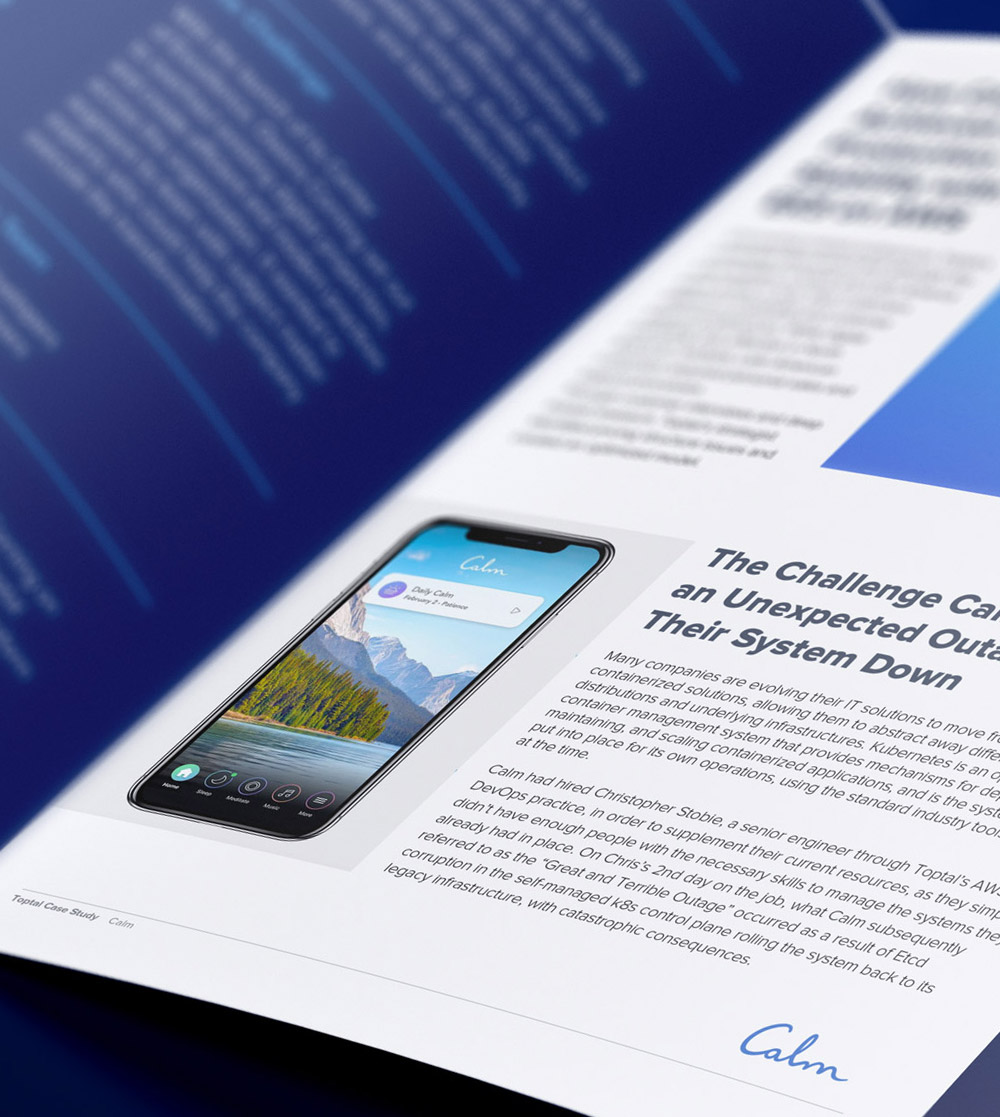
Challenge: The company behind the leading meditation app found itself in a decidedly non-calming situation when an outage had catastrophic consequences.
Impact: Calm benefited from improved stability, reliable networking, and elimination of costly outages. In the months since, the company has been able to easily absorb significant revenue growth without performance issues.
Mark Marcantano
Technical Program Manager at Calm



Newsweek and Statista’s rankings were based on an independent survey of more than 2,400 decision-makers at Fortune 500s.

| 1 |  |
|---|---|
| 2 |  |
| 3 |  |
| 11 |  |
| 12 |  |
| 33 |  |
|---|---|
| 39 |  |
| 66 |  |
| 80 |  |
| 101 |  |
Highest ranked across all industries
Other Professional Services
Methodology for the Rankings
How likely the respondent is to recommend the selected company to others.
Measures the convenience of interaction with the company and efficiency of processes.
Measures the company’s cost-effectiveness and quality relative to price.
Measures whether the company consistently meets or exceeds expectations in quality and timeliness of deliverables.
Measures the company’s ability to consistently fulfill commitments and maintain customer trust.
OUR THOUGHT LEADERSHIP
Read the latest articles and resources to keep you current on emerging trends in digital innovation, DevOps, cloud, software containers, and more.
Most continuous deployment (CD) systems test code before rolling it out—but there’s a better way. Learn how to use Kubernetes to build an easily extendable event-driven CD pipeline that is optimized for reliable test results.
Read MoreJohnmicah Potter is a senior platform and DevOps engineer with 18 years of experience building and scaling web applications across frontend, backend, infrastructure, and cloud environments. He specializes in performance engineering, automation, and containerized systems. Johnmicah brings a pragmatic, hands-on perspective to modern software delivery, helping teams balance speed, reliability, and operational risk in DevOps-driven architectures.
DevOps Related Offerings
Achieve end-to-end success by completing your operational stack with services that ensure every aspect of your business is optimized.
DevOps brings structure to modern software delivery by providing streamlined workflows, automation, and real-time visibility. Rather than treating delivery as a handoff between teams, DevOps introduces a continuous cycle that encourages shared responsibility and better system reliability.
Without a strong connection between development and operations, software delivery falters as outdated systems cause sluggish rollouts, inconsistent environments, and unpredictable outcomes. Development teams that lack a DevOps foundation often rely on manual workflows, increasing the likelihood of mistakes, slowing iteration, and making it harder to respond to incidents or pinpoint process gaps. Over time, these issues compound, affecting both team morale and customer experience.
Establishing a DevOps practice involves aligning goals across departments, identifying inefficiencies, and creating a roadmap for continuous delivery. Automation plays a central role here. It streamlines repetitive tasks, standardizes environments, and enables faster, more reliable software releases. Deliberate, upfront planning helps reduce the risk of adopting fragmented toolchains or implementing short-term fixes that fail under pressure.
Bringing in experienced DevOps professionals to navigate this process is critical. They offer the architectural insight and technical expertise needed to build automated systems that are stable yet flexible. A DevOps services company will lay the groundwork for reliable deployments, greater agility, and smoother collaboration across the product lifecycle.
A successful DevOps transformation relies on partnering with experts who understand the technology and the organizational dynamics required. The ideal DevOps services company combines technical skills with the ability to work cross-functionally across departments. Being able to onboard quickly and gain the trust of your internal teams is essential.
The right DevOps partner can manage the entire lifecycle, from delivery pipeline automation and environment provisioning to system observability and security integration. A reliable company should demonstrate hands-on experience with leading platforms, such as GitLab, Jenkins, Terraform, and Kubernetes, and will tailor the stack to fit your technical infrastructure. Beyond tooling, look for partners who unify diverse roles, including platform engineers, cloud architects, and automation specialists, into a cohesive unit.
The best partners ensure your team is equipped to operate and scale the system independently over time by ensuring documentation and knowledge-sharing practices are key to their process.
When you invest in DevOps services, you’re not just paying for software or tools—you’re paying for the time, expertise, and support needed to design, implement, and maintain a more efficient deployment and development process. Before hiring a DevOps partner, it’s important to understand how their pricing structures account for initial planning, implementation phases, and ongoing maintenance or support. Pricing models commonly fall into three categories:
Other cost factors include the size and composition of the DevOps team, the complexity of your environment, and service-level expectations.
Keep in mind that investments in automation and monitoring often reduce operational overhead and lead to savings that offset upfront expenses. Effective DevOps practices can also decrease downtime, accelerate release cycles, and enhance compliance—all of which contribute to meaningful long-term returns.
Behind every successful DevOps implementation is a combination of proven processes, automation tools, and collaboration frameworks. These elements work together to support continuous improvement, integration, and delivery throughout the software lifecycle.
A typical DevOps lifecycle links every stage of delivery into a seamless, collaborative system. Each phase plays a distinct role in enabling fast, stable releases:
A full DevOps implementation calls for a structured rollout that begins with strategic alignment. This includes setting clear goals, selecting pilot teams or projects, introducing automation frameworks, and managing organizational change across teams. Long-term success depends on thoughtful, sustainable adoption.
CI/CD pipelines form the backbone of delivery. By automating testing and deployments, they ensure releases are speedy, consistent, and less prone to error. Frequent, incremental updates make it easier to detect issues early.
Robust DevOps also relies on strong cross-functional coordination. Developers, IT operations, and QA teams must align on shared processes and tools to maintain smooth workflows. When teams work in silos, automation can fail and teams lose visibility into what’s happening across the pipeline.
The following best practices provide the guardrails that help teams deliver software more efficiently and reliably.
A powerful toolchain shapes workflows, streamlines collaboration, and enables automation across the development lifecycle. Choosing a cohesive set of tools lets each phase, from building to monitoring, flow smoothly. When selecting your DevOps toolchain, the main principles include:
Using Infrastructure as Code (IaC) and automation transforms how teams provision, configure, and maintain environments. By managing infrastructure changes with the same rigor as application code, this approach reduces errors, accelerates deployments, and simplifies scaling. A few key practices support this model.
First, unified codebases—using declarative templates stored in a single repository—ensure consistent coordination across compute, storage, and networking resources in both cloud and on-premises environments.
Second, environment standardization helps maintain identical definitions across development, staging, and production, preventing drift and making maintenance easier.
Third, automated operations reduce manual workload and increase reliability by handling tasks like scaling, backups, and patching. Finally, incorporating infrastructure testing through version control, peer reviews, and automated test pipelines ensures changes are stable and errors are caught early.
Gaining real-time visibility into system performance and behavior is essential for reliable, efficient operations. Observability goes beyond traditional monitoring to offer comprehensive insights into complex systems through metrics, logs, and traces. Best practices here include:
Instead of treating security as a separate function, DevSecOps embeds it directly into development workflows—helping teams catch vulnerabilities and compliance issues early, before they reach production. This shift requires several best practices.
First, integrated security checks should be built into development using static and dynamic code analysis tools. By automating these scans as part of the CI/CD pipeline, teams can ensure consistent coverage across every release.
Second, secrets management and policy enforcement are critical. Credentials, API keys, and tokens should be stored in vault-based tools, with access controls enforced programmatically to reduce the risk of leaks or unauthorized access.
Third, apply automated compliance validation by continuously monitoring system configurations for alignment with regulatory standards and automatically logging audit data to simplify reporting. In addition, role-based access controls help limit user permissions across tools and environments, while maintaining audit trails for accountability and incident response.
Finally, use a Software Bill of Materials (SBOM) to track all open-source components and dependencies in your stack, giving teams better visibility into potential security vulnerabilities and licensing requirements.
By connecting development and operations more closely, DevOps drives faster, more reliable software delivery. When implemented well, it fosters collaboration, shortens release cycles, and enables teams to better respond to shifting market conditions or evolving user needs. But adopting DevOps at scale also presents challenges that must be carefully managed. Here’s a breakdown of the advantages and potential drawbacks:
Benefits and Outcomes | Challenges |
|---|---|
|
|
DevOps practices facilitate digital innovation and operational excellence across diverse sectors. They also help organizations meet industry-specific demands and evolving customer expectations.
For fintech organizations, DevOps enables fast, secure delivery of banking tools and payment systems while maintaining rigorous compliance with regulatory standards. E-commerce companies depend on DevOps to release new features frequently, optimize performance during high-traffic events, and enable seamless customer experiences across devices.
In healthcare, where uptime and security are non-negotiable, DevOps supports updates to patient management platforms, telehealth systems, and clinical software without compromising data privacy. Media and SaaS platforms benefit from scalable architectures and agile deployment cycles, allowing them to deliver content globally and manage user bases with minimal downtime. And enterprise organizations apply DevOps to modernize legacy environments, unify siloed teams, and introduce automation at scale.
DevOps is a strategic imperative that enables the agility and resilience organizations need to stay competitive. It brings development and operations together into a cohesive, high-performing system that makes teams faster and more adaptive.
But transitioning to DevOps can be challenging without the right support. Hiring a seasoned partner to guide this transformation can accelerate the cultural and operational shifts needed while minimizing risk and streamlining processes.
Investing in experienced professionals and proven practices provides technical improvements, cross-functional alignment, and process clarity. Over time, this investment delivers outsized returns through improved reliability, increased efficiency, and greater innovation. It’s not just about moving faster—by embracing DevOps, leaders position their teams to meet future challenges with confidence.
DevOps services accelerate software release cycles and improve deployment reliability by integrating development and operations workflows, automating delivery processes, and implementing continuous integration/continuous delivery (CI/CD) pipelines. These services streamline engineering operations and enable higher-quality product releases through improved cross-team collaboration and rapid, user-informed iteration. Well-executed DevOps initiatives deliver lasting value by supporting scalable delivery and fueling continuous innovation.
The cost of professional DevOps services depends on the complexity of the work, the level of expertise required, and the length of the engagement. Whether you’re addressing an immediate challenge or laying the groundwork for future expansion, your investment typically reflects the project scope, delivery model, and how the work aligns with broader business objectives.
Toptal’s approach differs from a conventional DevOps services company by offering flexible, high-caliber talent tailored to your specific needs. You can engage a single DevOps engineer or assemble a cross-functional team, using delivery models that integrate seamlessly into your workflows and scale with your business. With built-in project oversight and access to proven experts, Toptal provides a results-driven DevOps solution that prioritizes performance and adaptability.
Toptal’s DevOPs solutions are designed for integration across disciplines and delivery phases—from strategy and execution to optimization and scaling. Your Toptal team can bring together specialists across engineering, design, marketing, management, and more. This interdisciplinary alignment ensures cohesive, end-to-end delivery that drives measurable business results.
Looking for guidance about the perfect DevOps solution for your needs?
Get a Free Consultation Now


