

Hire App Developers
Hire the Top 3% of Freelance Mobile App Developer
Hire mobile app developers, programmers, and engineers on demand. Top companies and startups choose mobile app developers from Toptal for cross-platform development, native iOS and Android apps, UI/UX design, mobile performance, and more.
Hire a Top App Developer Now
No-Risk Trial, Pay Only If Satisfied.





Hire Freelance App Developers

Moon Alzoubi
Freelance App Developer
Verified Expert in Engineering
UTC-06:00
United States
Toptal Member Since March 17, 2025
Moon is an accomplished SharePoint and Power Platform developer and architect with 14 years of expertise in development and design within the US oil and gas sector and government-owned enterprises. His portfolio includes a diverse range of projects of varying scales, from inception to implementation, focusing on pivotal solutions primarily tailored for SharePoint and Microsoft 365 environments. Moon is keen on embracing fresh platforms and challenges in his professional journey.
Show More
Muzammil Husnain
Freelance App Developer
Verified Expert in Engineering
UTC-06:00
United States
Toptal Member Since May 30, 2023
Muzammil is a skilled and responsible developer who excels in crafting complex applications and brings a wealth of experience. His expertise spans diverse technical and business domains, honed over eight years. He values effective communication, organization, and collaboration and thrives in team environments. Muzammil embraces challenges and utilizes his creativity to discover innovative solutions and tackle challenges head-on.
Show More
Ahmed Elkady
Freelance App Developer
Verified Expert in Engineering
UTC-05:00
Canada
Toptal Member Since January 13, 2021
Ahmed has been a passionate iOS developer since his internship days in 2014 while studying computer engineering at the University of Waterloo. He has done six internships, most notably at Compass in New York and LinkedIn in San Francisco. After graduating, Ahmed worked at an edtech company called Top Hat for three years, then moved on to Coffee Meets Bagel for two and a half years. He holds a master's degree in computer science from the University of Illinois.
Show More
Scott Fennell
Freelance App Developer
Verified Expert in Engineering
UTC-05:00
United States
Toptal Member Since February 20, 2017
Scott has written hundreds of custom web apps and WordPress plugins, with a current focus on Next.js and React. He specializes in 3rd-party API integrations, including Mailchimp, Cloudflare, and Shopify. He is experienced in leading technology teams, is a seasoned public speaker, and has presented at WordCamp Portland and the Google campus in Seattle. He has been published on A List Apart and CSS-Tricks many times. Scott is also a former infantry officer in the US Army.
Show More
Bruce Rodrigues
Freelance App Developer
Verified Expert in Engineering
UTC-03:00
Brazil
Toptal Member Since May 28, 2021
Bruce is a senior full-stack developer with almost a decade of experience. He is an expert in React and Java but has extensive experience with Ruby on Rails, Node.js, and Python. Having worked as a scrum master and project manager for three years, he is keen on agile processes and unit testing. Bruce is very critical of code and has a good eye for UI/UX, thanks to years of collaborating with designers and helping them develop components and user interfaces.
Show More
Nikolay Derkach
Freelance App Developer
Verified Expert in Engineering
UTC-03:00
Canada
Toptal Member Since December 16, 2013
Nikolay is a product-focused iOS expert with a background in security. He has worked extensively on building iOS apps, helping clients with product strategy, and advising on UX design. His passion is to work with startups to help them bring the first iteration of their product to market.
Show More
Joel Frank
Freelance App Developer
Verified Expert in Engineering
UTC+00:00
Portugal
Toptal Member Since December 26, 2019
With a PhD in computer science and over 18 years of experience creating mobile applications, Joel has a passion for creating flawless user interfaces and applications that exceed expectations. In addition, his knowledge of databases and back-end requirements gives him a deep understanding of an application's complete architecture.
Show More
Patrik Vaberer
Freelance App Developer
Verified Expert in Engineering
UTC+01:00
Slovakia
Toptal Member Since March 31, 2016
Patrik is a freelance iOS developer with extensive experience in startups. His latest projects have been top-notch apps for US startups Johnson & Johnson and Telepass done in Swift. Patrik delivers top quality, pays attention to details, and is the type of person who gets things done.
Show More
Bilal Sammour
Freelance App Developer
Verified Expert in Engineering
UTC+03:00
Jordan
Toptal Member Since May 19, 2021
Bilal is a top 3% seasoned mobile and desktop app engineer with 15 years of experience and numerous international awards. He excels in Flutter, React Native, Android, and Xamarin and has developed over 10 high-quality apps. Bilal has managed many teams and contributed significantly to startups, organizations, and leading companies. He is recognized as a top-notch app developer and a valuable asset for organizations seeking exceptional proficiency.
Show More
Sam Watkins
Freelance App Developer
Verified Expert in Engineering
UTC+10:00
Australia
Toptal Member Since February 25, 2021
Sam is an expert programmer with 25 years of experience. He's a good communicator, enthusiastic, innovative, and meticulous in his attention to detail. Sam practices "Simplicity, Clarity, Generality" to rapidly create quality software. His research interests include LLMs, latent diffusion, e-learning, collaboration, maths, and graph-based programming. Sam programs in Python, JavaScript, Go, C, and Perl, and creates web apps with Python, Node.js, PostgreSQL, HTML5, CSS, and Svelte.
Show More
Riaan van der Linde
Freelance App Developer
Verified Expert in Engineering
UTC+12:00
New Zealand
Toptal Member Since July 5, 2016
Riaan is a skilled developer that takes pride in his work. With over ten years of development experience over a wide range of languages, he has worked on multiple successful projects globally. He takes ownership of his projects and makes sure that everything is done to the best standard before handing it over to clients. He is also very transparent when it comes to communication with the client.
Show MoreDiscover More App Developers in the Toptal Network
Start HiringA Hiring Guide
Guide to Hiring a Great App Developer
Mobile app developers are full-stack engineers who build and maintain applications across various devices, from working on back-end data collection and mobile application architecture to implementing user interfaces. This guide to hiring mobile app developers provides tips on defining project requirements, creating job descriptions, and selecting interview questions so you can identify the best candidate.
Read Hiring GuideMobile App Hiring Resources
Toptal in the press
... allows corporations to quickly assemble teams that have the right skills for specific projects.

Despite accelerating demand for coders, Toptal prides itself on almost Ivy League-level vetting.

Our clients


Creating an app for the game


Leading a digital transformation


Building a cross-platform app to be used worldwide


Drilling into real-time data creates an industry game changer
Testimonials
How to Hire Mobile App Developers Through Toptal
1
Talk to One of Our Client Advisors
A Toptal client advisor will work with you to understand your goals, technical needs, and team dynamics.
2
Work With Hand-selected Talent
Within days, we’ll introduce you to the right dedicated mobile app developers for your project. Average time to match is under 24 hours.
3
The Right Fit, Guaranteed
Work with your new app programmer for a trial period (pay only if satisfied), ensuring they’re the right fit before starting the engagement.
EXCEPTIONAL TALENT
How We Source the Top 3% of App Developers
Our name “Toptal” comes from Top Talent—meaning we constantly strive to find and work with the best from around the world. Our rigorous screening process identifies experts in their domains who have passion and drive.
Of the thousands of applications Toptal sees each month, typically fewer than 3% are accepted.
Toptal Mobile App Development Case Studies
Discover how our mobile app developers help the world’s top companies drive innovation at scale.
CASE STUDY
React Native app for global media company
CASE STUDY
Fintech Mobile App for Top 5 Financial Firm
CASE STUDY
Android and iOS apps for automotive manufacturer
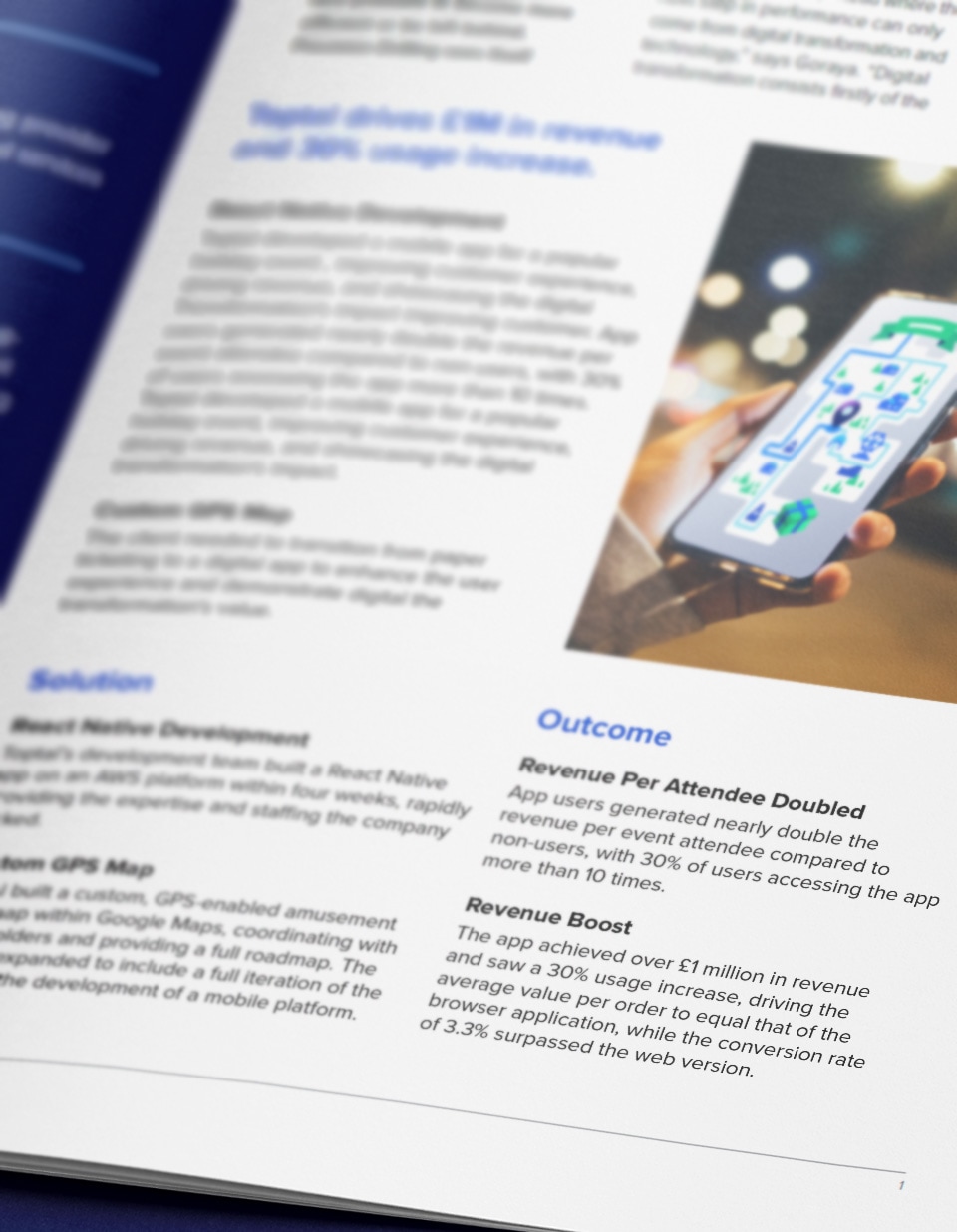
Toptal drives £1M in revenue and 30% usage increase with a React Native holiday event app for global media company.
Challenge: The client needed to transition from paper ticketing to a digital app to enhance the user experience and demonstrate digital transformation’s value.
Solution: Toptal built a custom React Native app on an AWS platform, featuring a GPS-enabled amusement park map within Google Maps. The team seamlessly coordinated with stakeholders and delivered a comprehensive roadmap. The initial four-week project expanded to a full iteration of the app and the development of a mobile platform.
Impact: App users generated nearly double the revenue per event attendee compared to non-users, with 30% of users accessing the app more than 10 times. The app achieved over £1 million in revenue and saw a 30% usage increase, driving the average value per order to equal that of the browser application, while the conversion rate of 3.3% surpassed the web version.
RELATED CAPABILITIES
- Software Development
- Mobile App
- React Native
- Delivery Management
- AWS
- App Product Management
Not only did Toptal provide development expertise, but through our Product Manager, we were able to guide the solution as if it were our own.
Bryan Henderson
Senior Client Partner, Media & Entertainment
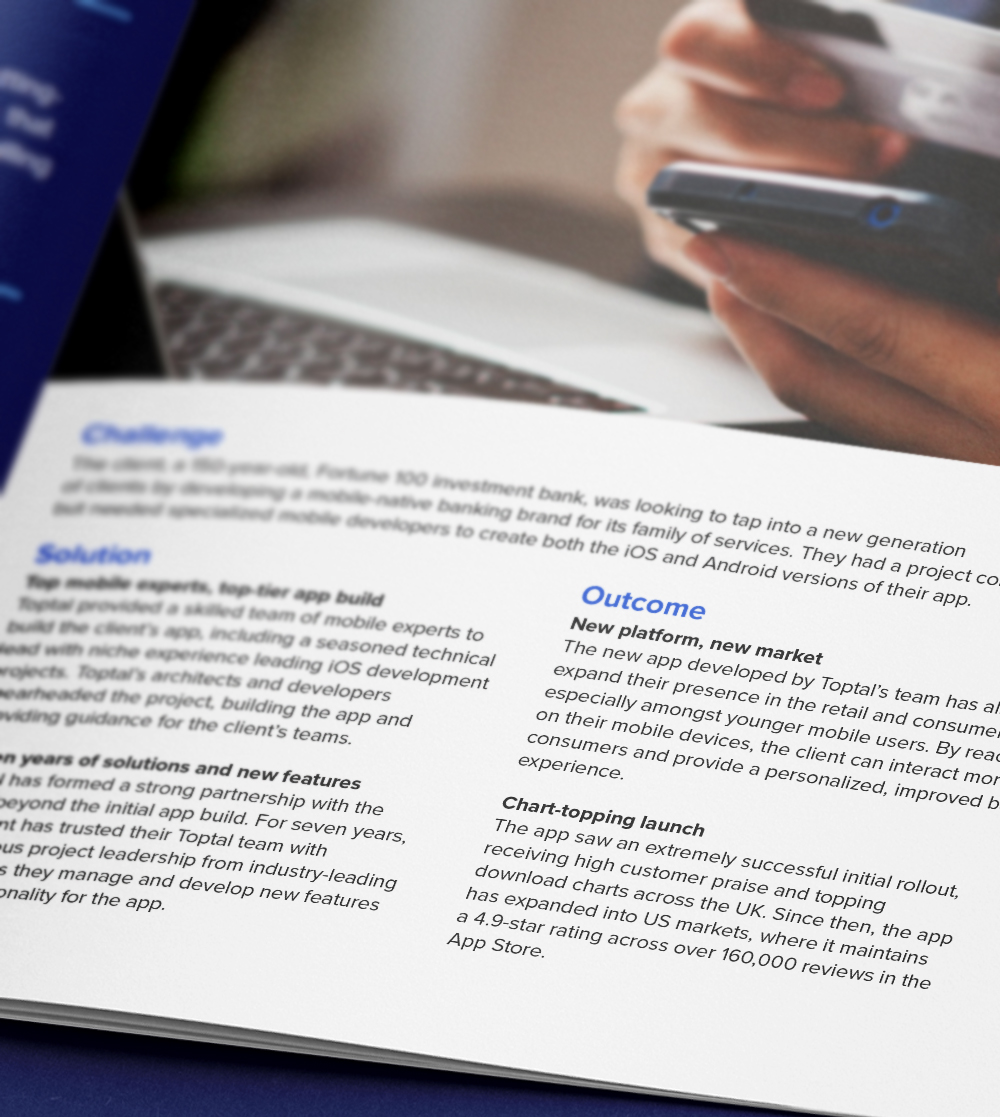
Top-five global financial services firm partners with Toptal to reach new market with fintech mobile app development.
Challenge: The client, a 150-year-old, Fortune 100 investment bank, was looking to tap into a new generation of clients by developing a mobile-native banking brand for its family of services. They had a project concept, but needed specialized mobile developers to create both the iOS and Android versions of their app.
Solution: Toptal provided a skilled team of iOS and Android experts to build the client’s app, including a seasoned technical lead. Toptal’s architects and developers spearheaded the project, building the app and providing guidance for the client’s teams.
Impact: The new app developed by Toptal’s team has
allowed the client to expand their presence in the
retail and consumer banking sector, especially
amongst younger mobile users. The app saw an extremely successful initial rollout, receiving high customer praise and topping download charts across the UK. Since then, the app has expanded into US markets, where it maintains a 4.9-star rating across over 160,000 reviews in the App Store.
RELATED CAPABILITIES
- iOS
- Android
- Mobile App
Toptal’s developers and software architects have played a pivotal role in building our app from the ground up. Their commitment to excellence and continuous delivery of new functionality aligns perfectly with our vision for our app, ensuring its ongoing success.
Managing Director, Consumer & Wealth Management
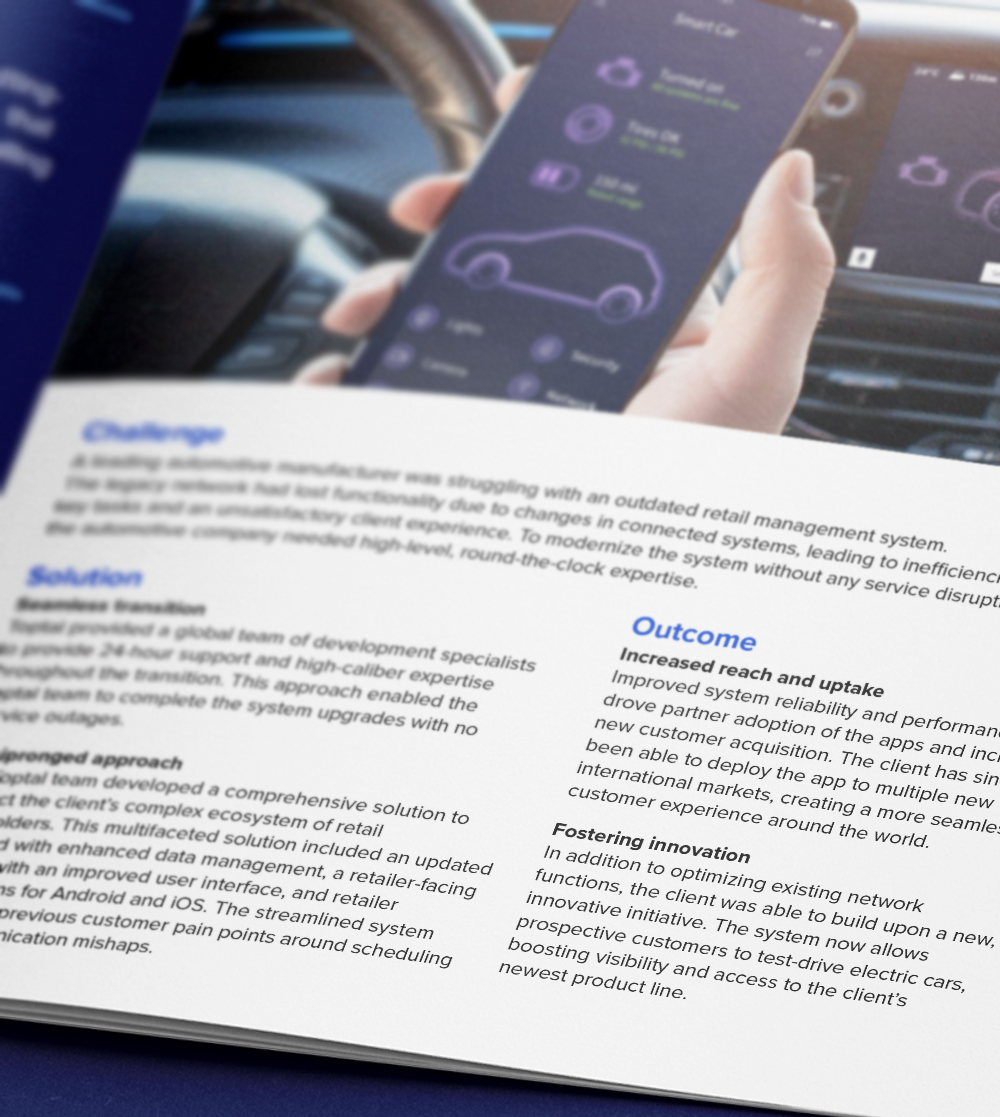
Toptal helps Fortune 500 auto brand improve CX with mobile app and legacy system overhaul
Challenge: A leading automotive manufacturer was struggling with an outdated retail management system. The legacy network had lost functionality due to changes in connected systems, leading to inefficiencies in key tasks and an unsatisfactory client experience.
Solution: The Toptal team developed a comprehensive solution to connect the client’s complex ecosystem of retail stakeholders. This multifaceted solution included an updated back end with enhanced data management, a retailer-facing website with an improved user interface, and retailer applications for Android and iOS.
Impact: Improved system reliability and performance drove partner adoption of the apps and increased new customer acquisition. The client has since been able to deploy the app to multiple new international markets, creating a more seamless customer experience around the world.
RELATED CAPABILITIES
- Mobile App
- iOS
- Android
- Software Development
- Node.js
The most gratifying aspect was realizing the significant contribution I made and seeing it appreciated. It was fulfilling to see how my expertise and ideas could shape a large-scale product.
Asi Farran
Senior Full-stack Developer
Capabilities of Mobile App Developers
Harness the skills of our expert mobile app developers to create intuitive, user-friendly interfaces that ensure exceptional performance and meet the needs of today’s smartphone users.
Custom Mobile App Development
To provide a seamless user experience, custom mobile apps need to perform well and load quickly across different devices and screen sizes. Toptal developers apply their expertise in iOS and Android programming languages, CSS frameworks, and responsive design principles to deliver exceptional outcomes.
Cross-platform App Development
Building mobile apps with cross-platform frameworks accelerates development cycles and helps support a consistent user experience on Android and iOS devices. With experience in React Native, Flutter, and .NET Maui, Toptal developers create apps with fluid, dynamic layouts that leverage the underlying hardware’s full capabilities.
Native App Development for Android and iOS
Native iOS and Android programming languages allow developers to leverage platform-specific APIs and frameworks for increased customization. Toptal developers employ Swift for iOS, and Kotlin and Java for Android, to optimize performance and implement features with greater capabilities than those of cross-platform development tools.
User Interface (UI) and User Experience (UX) Design
Intuitive and visually appealing interfaces ensure that mobile apps provide an engaging user experience. Toptal developers are skilled at coding gesture-based interactions, navigation structures, and layouts that meet user expectations and adhere to both accessibility and platform-specific guidelines.
Mobile App Testing and Quality Assurance
Automated and manual testing are integral to the development of secure, bug-free mobile apps. By performing repetitive, large-scale tests for functionality and performance, and manual tests to address outlying usability issues, Toptal mobile app developers verify that apps behave optimally, even when delivered at scale.
Back-end Integration and API Development
Integrating back-end services and APIs requires the deployment of efficient communication protocols. Toptal developers have extensive experience using architectural styles and query languages like REST APIs and GraphQL to engineer enterprise-grade solutions for secure and reliable data flow between mobile apps and server-side components.
App Store and Google Play Optimization
Preparing apps for deployment on Apple’s App Store and Google Play requires adherence to design standards, privacy policies, and functionality requirements. Toptal developers verify that apps meet compliance requirements and conduct testing and optimization analysis to improve their functionality and visibility.
Mobile Security and Data Protection
Mobile security is more important than ever, and Toptal mobile app developers are committed to applying best practices for data encryption, multi-factor authentication, and secure API exchange. Their expertise extends to performing vulnerability assessments to guard against unauthorized access and data leaks.
Performance Optimization
Optimizing mobile apps for speed and responsiveness enhances their functionality and user appeal. Toptal developers implement data fetching and caching strategies, compress images and code strings, and use lightweight frameworks and lazy loading techniques to reduce load times and support a seamless user experience.
Integration With Third-party Services
Connecting mobile apps to third-party services can enable in-app purchases, social sharing, and analytics. Toptal developers are experienced at using software development kits (SDKs) and configuring API endpoints to provide secure integrations that offer access to a wide range of additional capabilities.
Trusted by 25,000+ Clients Worldwide
Find the Right Talent for Every Project
Accelerate your project with versatile, expert talent. From short-term solutions to long-term collaboration, Toptal delivers impactful results.
Senior App Developers
Senior app developers bring deep technical expertise and advanced problem-solving skills to address your most complex challenges. Toptal’s rigorous vetting process provides access to professionals who combine robust technical experience with proven leadership.
Dedicated App Developers
Dedicated app developers focus exclusively on your projects, leverage advanced mobile app expertise, and align with your long-term objectives to enable seamless integration and deliver high-quality outcomes.
Offshore App Developers
Offshore app developers combine exceptional expertise with competitive rates, making them ideal for scaling projects efficiently. Operating across multiple time zones, they provide global coverage and 24/7 support for time-sensitive requests.
Remote App Developers
Remote app developers offer top-tier expertise worldwide, removing location barriers to connect you with the best talent for your projects. They integrate seamlessly with distributed or hybrid teams, enabling flexible collaboration from anywhere.
FAQs
The cost associated with hiring an app developer depends on various factors, including preferred talent location, complexity and size of the project you’re hiring for, seniority, engagement commitment (hourly, part-time, or full-time), and more. In the US, for example, Glassdoor’s reported average total annual pay for app developers is $88,000 as of August 2024. With Toptal, you can speak with an expert talent matcher who will help you understand the cost of talent with the right skills and seniority level for your needs. To get started, schedule a call with us — it’s free, and there’s no obligation to hire with Toptal.
There are several advantages to hiring a an app developer for your company. First and foremost, hiring app developers gives your company a competitive edge by allowing you to connect with a larger audience via mobile devices. Apps enhance client engagement and retention due to the predominance of mobile devices. Mobile apps can also customize consumer experiences and streamline company procedures; you may incorporate customer service, inventory management, and payment methods into your app. And a mobile app can gather insightful user data and feedback to enhance your product offerings. Overall, employing Mobile App developers will help expand your company and enhance consumer satisfaction, inevitably resulting in more sales and profitability.
When choosing a an app developer online, experience, technical proficiencies, and soft skills are the primary indicators to inform how successful a developer will be on your team. First, the developer’s background should showcase a portfolio of successful apps relevant to your project goals, including positive references. You may request examples of their work and inquire about their problem-solving and debugging strategies. Second, the developer’s technical abilities must be strong and correlate to the development tools, platforms, and programming languages needed for your project; you’ll want to hire someone committed to remaining current with the newest trends and technologies in mobile app development. Finally, an app developer needs excellent communication and teamwork abilities; it is a green flag if a candidate has a track record of collaborating across product, design, and quality assurance teams.
Yes, Mobile App developers are in high demand due to the prevalence of mobile device use; mobile apps are necessary for businesses that want to stay relevant and improve user experience. The global mobile app market was valued at $228.98 billion as of 2023 and is projected to more than double through 2030. App giants like Apple, Alphabet (Google’s parent company), and Microsoft dominate the list of the most profitable companies worldwide, but companies of any size can benefit from investing in the lucrative market of mobile apps.
Typically, you can hire app developers with Toptal in about 48 hours. For larger teams of talent or full end-to-end project delivery, timelines may vary. Our talent matchers are highly skilled in the same fields they’re matching in—they’re not recruiters or HR reps. They’ll work with you to understand your goals, technical needs, and team dynamics, and match you with ideal candidates from our vetted global talent network.
Once you select your app programmer, you’ll have a no-risk trial period to ensure they’re the perfect fit. Our matching process has a 98% trial-to-hire rate, so you can rest assured that you’re getting the best fit every time.
Considering your unique requirements and objectives is vital when choosing between a cross-platform and native mobile app. Cross-platform apps employ a single codebase to develop apps for many platforms using frameworks like React Native, Flutter, and Xamarin. Native apps use separate codebases for different platforms, whether targeting Android development (Java and Kotlin), iOS development (Swift and Objective-C), or both. In general, simple programs that don’t need regular hardware contact or high-performance capabilities can be developed more quickly and cheaply through cross-platform development. However, a native mobile app best suits more complex, high-performance apps that interact with hardware or other native apps frequently.
To hire the right app coder, it’s important to evaluate a candidate’s experience, technical skills, and communication skills. You’ll also want to consider the fit with your particular industry, company, and project. Toptal’s rigorous screening process ensures that every member of our network has excellent experience and skills, and our team will match you with the perfect app developers for your project.
At Toptal, we thoroughly screen our application developers to ensure we only match you with the highest caliber of talent. Of the more than 200,000 people who apply to join the Toptal network each year, fewer than 3% make the cut.
In addition to screening for industry-leading expertise, we also assess candidates’ language and interpersonal skills to ensure that you have a smooth working relationship.
When you hire dedicated mobile app developers with Toptal, you’ll always work with world-class, custom-matched app developers ready to help you achieve your goals.
You can hire app programmers on an hourly, part-time, or full-time basis. Toptal can also manage the project end-to-end based on your specific requirements as part of our Consulting and Services offerings. Whether you hire a app developer for a full- or part-time position, you’ll have the control and flexibility to scale your team up or down as your needs evolve. Our app developers can fully integrate into your existing team for a seamless working experience.
We make sure that each engagement between you and your app developer begins with a trial period of up to two weeks. This means that you have time to confirm the engagement will be successful. If you’re completely satisfied with the results, we’ll bill you for the time and continue the engagement for as long as you’d like. If you’re not completely satisfied, you won’t be billed. From there, we can either part ways, or we can provide you with another app developer who may be a better fit and with whom we will begin a second, no-risk trial.
Explore Related Toptal Services
Looking for an end-to-end business solution? Browse Toptal's portfolio of services.
How to Hire Mobile App Developers

Verified Expert in Engineering
7 Years of Experience
Ahmad is a full-stack mobile and web developer who has built multiple apps that have been released to the Apple and Google Play app stores. He specializes in cross-platform development with React Native and Flutter, and has worked at various companies around the world. Ahmad’s city-based social mobile app placed second in a hackathon organized by the municipality of Izmir in Turkey.
Expertise
Mobile App Developers: A Business Essential With Skyrocketing Demand
The global mobile app market is projected to exceed $626 billion by 2030, underscoring its explosive growth and influence. Industry giants like Apple, Alphabet, and Microsoft (leaders with substantial mobile investments) continue to dominate the ranks of the world’s most profitable companies. Meanwhile, businesses of all sizes increasingly depend on skilled developers to swiftly launch new applications, enhance features, and ensure seamless maintenance of existing services.

Choosing a qualified specialist in the current market is challenging. More businesses are adopting mobile-first strategies, driving competition for skilled app engineers. According to the Stack Overflow Developer Survey, salaries for mobile developers increased by over 27% between 2024 and 2025, underscoring the difficulties faced by businesses seeking to hire a mobile application developer. In addition to this competition, verifying an applicant’s skillset can be difficult, especially if the hiring manager or recruiter is not a subject matter expert.
In addition to answering the question, “What does an app developer do?” this hiring guide examines crucial attributes to look for in iOS, Android, or cross-platform app development, offers helpful pointers for crafting compelling job descriptions, and even includes sample interview questions. This article explores how to hire app builders who are a good fit for your team and will help your product succeed.
What Attributes Distinguish Quality Mobile Application Developers From Others?
The success of a mobile app project often hinges on the quality of the software developers behind it, as they play a critical role in bringing your idea to life through technical expertise and innovative solutions. When evaluating top candidates, it’s essential to consider a wide range of qualifications, including general technical abilities, soft skills, and platform-specific expertise, such as proficiency in cross-platform development frameworks.
General App Developer Skills: Technical Abilities and Soft Skills
First, all mobile application developers must have technical abilities and soft skills since they work across the entire software development stack, including the back- and front-end, and must collaborate with many other teams.
The required technical abilities depend on an app’s platform and coding languages. However, there are a few standard proficiencies you should look for in all candidates: An understanding of back-end programming, UI/UX design and implementation, and app architecture is crucial for any mobile application developer. They should be strongly versed in at least one mobile development language or framework (i.e., Java, Kotlin, Swift, Objective-C, JavaScript, React Native, Flutter, or Xamarin).
If targeting multiple device types is one of your main project requirements, candidates familiar with responsive app design (those prepared to implement an app across various screen sizes and devices, including phones, tablets, and even televisions) may best meet your goals.
Soft skills must complement technical abilities because mobile application developers work with many partners, including quality assurance engineers, designers, product managers, and other development teams. At smaller companies or during times of transition, an app developer may have to wear different hats, sometimes leading a product’s design, roadmap, and testing. Look for candidates who can articulate technical concepts, facilitate smoother collaboration with stakeholders, align project goals with business requirements, and ensure the final product resonates with its target audience.
Languages for Android Developers: Java and Kotlin
When hiring Android engineers, you may choose between various programming backgrounds. Many are familiar with Java, while others know Kotlin. Often, developers will have experience with both languages.
Java is a general-purpose language released in 1996. Java suits complex applications with big codebases because of its durability, adaptability, and platform independence. Veteran developers with many years in the field have likely worked as Java developers; Java experts may have a few extra years of experience compared to Kotlin developers and may be better versed in general or back-end concepts.
However, many Java experts are also staying up to date with Google’s preferred language for apps: Kotlin, an Android-specific language released in 2016. Kotlin is developer-friendly, making writing code easier and more effective. If you are creating an Android app from scratch, you should likely hire experienced developers of Kotlin.
Both languages have distinct merits and are used in a wide range of ways. Moreover, they are fully compatible (programmers can use Kotlin and Java in the same project), and you may want candidates skilled in both.
Languages for iOS Developers: Swift and Objective-C
iOS development may involve Swift or Objective-C programming. While some engineers may only know one language or the other, many high-quality iOS developers know both (in particular, many Objective-C developers have learned Swift). It is also possible to use Objective-C and Swift in the same project, as they are fully compatible.
Objective-C, an object-oriented language available since the 1980s, has been the default language for iOS development since the first iPhone SDK release in 2008. Though Apple released Swift in 2014 to replace Objective-C, Objective-C is still relevant: Objective-C developers are a good fit in cases where you need to support old OS versions, legacy applications, large or old codebases, or C/C++ library integration.
Swift is a quick, secure, and continually expanding language intended to speed up and simplify the creation of iOS apps. Look for skilled Swift developers if your project’s priorities include improving performance, development speed, app memory, or project scalability.
Frameworks for Cross-platform Development: React Native, .NET MAUI, and Flutter
Cross-platform applications are mobile apps designed to run on multiple operating systems, such as iOS and Android. They offer a cost-effective way to streamline app development across different mobile platforms. Developers use specialized frameworks to write a single codebase that can be deployed across various platforms, making this approach efficient and lowering the cost of development.
If different platform versions of your application have few differences and can share code, hiring cross-platform developers can have various upsides, including:
- Reduced development time.
- Development cost savings and fewer expended resources.
- Easier app maintenance and code reusability.
However, cross-platform solutions are only ideal for some projects. Native apps are often the better choice when hardware-specific features or complex graphics are required, as cross-platform development approaches can sometimes compromise performance and diminish the user experience. Additionally, some developers prefer to focus their expertise exclusively on either iOS or Android.
If you determine that a cross-platform professional is the right fit for your project, they should be proficient in one of three widely used frameworks:
- React Native: Released in 2015 by Meta, React Native can emulate native design patterns and is commonly used by many startups and large companies.
- .NET MAUI: .NET MAUI is a robust framework that enables developers to create native applications for Android, iOS, macOS, and Windows using a single codebase, making it ideal for cross-platform projects. It leverages the rich ecosystem of .NET, providing developers with powerful tools, libraries, and APIs, which ensures high performance and native look and feel across all platforms. It is the spiritual successor of Xamarin.
- Flutter: A newer framework released by Google in 2017, Flutter can build platform-friendly designs quickly and is catching on among talented developers due to its many advantages.
The decision among .NET MAUI, Flutter, and React should be guided by your project’s specific priorities, such as performance requirements, native design fidelity, and the strength of community support.
How Can You Identify the Ideal App Developer for You?
When assembling an app developer team, it’s essential to consider a combination of skills tailored to your project’s unique needs. A strong team brings together a range of skills, from technical expertise in specific mobile platforms to creative problem-solving capabilities that result in custom solutions. Staying ahead of industry trends is also vital, as it ensures your app remains competitive and relevant in a rapidly evolving market. By implementing a thorough screening process, you can identify candidates with the right combinations of skills, providing a cost-effective way to build an app that aligns with your technical requirements and business goals. Whether working on low-cost projects or high-scale enterprise solutions, a well-rounded team can collaborate effectively with stakeholders, including the sales team, to deliver a product that drives success.
It is vital to consider your unique use case and the experience level required when searching for an app developer for hire. For instance, if you have an e-commerce app idea, your engineer should have experience creating apps with solid security features, integrating payment systems, and optimizing for in-app purchases. If you are building a social media app, you’ll want a developer who has experience with complicated social features like messaging, commenting, and liking.
The first step is to specify your problem statement and the resulting skills gap to fill. This is crucial to communicating your project requirements to applicants. Consider the scope, price, and schedule of your project, as well as the technical expertise required or any specific technology constraints. Do you need a dedicated mobile developer, or would you be better suited with a generalist software developer? You should also consider the level of expertise required to accomplish your goals, especially if you are tackling a complex project.
Considering Mobile App Schedules, Timelines and Costs
The length of a project can vary significantly depending on the size and complexity of the app, the functionality required, and the platform used. A more complicated application with specialized features and integrations may take months or even years to complete, significantly impacting the cost of development compared to a simple app with basic capabilities.
A project’s timeline can also influence whether you hire a contractor, freelancer, dedicated developer, or full-time engineer, as well as the hourly rates you can expect to pay. Factors such as your budget, schedule, development costs, project specifications, and personal preferences will shape this decision, particularly if you’re collaborating with a software development company or hiring independent developers. Regardless of the approach, it is critical to thoroughly evaluate applicants, verify their qualifications, and establish clear expectations from the outset.
Understanding development costs is essential for effective budget planning. The average cost of building an app depends on its complexity, features, and whether it requires additional development phases such as updates or scaling. Working with an outsourcing partner can be a cost-effective way to access top-tier expertise and streamline the development process. Whether your project involves building a native app or utilizing cross-platform app development, maintaining clear communication with your app development team is vital to managing expenses efficiently and ensuring project success.
Identifying the Level of Expertise
Some engineers have been around since the first iPhone was launched, while others are just beginning their journey in the field, highlighting the importance of effectively discerning their level of expertise.
- Junior developers or entry-level developers often have fewer than two years of experience and require further training and direction to advance their careers. These entry-level developers can generally complete well-defined tasks with clear solutions but may struggle with more open-ended problems.
- Mid-level developers typically have two to five years of hands-on experience. They can handle more complex jobs independently, including translating business requirements into technical solutions and aligning them with industry trends. At this point in their careers, developers typically have enough knowledge to make informed decisions but may still need guidance from senior colleagues on questions of architecture and scalability.
- Senior developers typically have over five years of experience in their field, a deep understanding of app development best practices, and the ability to effectively manage a team of mobile app programmers. Their extensive hands-on experience ensures they can confidently meet a wide range of business needs.
Multiple factors come into play when deciding the level of expertise your app requires, including project budget, development cost, size, and deadlines. A junior developer may be a good fit if you are working on a small project or have a limited budget, but for more complex projects where minimizing development time is critical, hiring a senior developer may be the better choice. Experienced engineers can best ensure the entire project is finished on time and meets high-quality industry standards. A highly talented tech lead who can help with project management throughout the development process over time may be worth investing in if you are building a long-term app development team.
Working With Freelance Developers Through Hiring Platforms
Remote developers are an increasingly popular choice for businesses seeking to expand their talent pool beyond local boundaries. This is especially true within the freelancing industry, where businesses can hire developers for app projects that require flexibility and a wealth of experience to meet diverse needs.
Before selecting a hiring platform for mobile app development, thoroughly assess your project’s specific needs, including the required technical expertise, budget constraints, and timelines. Once these requirements are clarified, evaluate the reputation of potential hiring platforms. Seek platforms with proven track records, successful candidate placements, and positive client testimonials to ensure reliability and quality.
A competitor gap analysis can further enhance this process. Toptal stands out by offering a comprehensive solution through rigorous vetting processes, ensuring that clients receive exceptional services from highly qualified developers. Our developers undergo multiple assessments covering technical skills, coding expertise, problem-solving abilities, and communication skills so that only the most qualified candidates join our network. This comprehensive vetting approach ensures access to top-tier remote developers and sets the stage for informed hiring decisions.
Remember, when hiring for a mobile app development project, identifying key qualities in candidates is critical to success. Look for combinations of skills that align with your project’s goals, such as solid design skills paired with technical expertise in a specific mobile platform like iOS development. The ability to deliver custom solutions while maintaining seamless communication across teams ensures your app meets both user expectations and business objectives.
Hire Dedicated App Developers
For companies pursuing long-term mobile or web app projects, hiring dedicated app developers can improve delivery speed, product consistency, and code quality. This model ensures that engineers remain focused on your application’s goals, architecture, and user experience over time. It also reduces onboarding overhead and enables faster adaptation to evolving requirements.
How to Write an App Developer Job Description for Your Project
A well-written job description will attract and filter the best mobile app developers for your role. It should include:
- The necessary qualifications, including education, training, experience level, and any desirable credentials. Effective communication and familiarity with the agile development methodology can be crucial, as these skills promote collaboration and good project management.
- Any distinctive features of the business or project that would be attractive to potential applicants.
- The duties and expectations that will come with this role. Specify the hourly rates and whether it is an in-house or a freelance app developer position.
- If the role allows remote developers, specifying the time zone compatibility will also be beneficial, ensuring your team can work in real time without significant delays.
Mobile application developer postings may take different forms depending on whether you are searching for a specific mobile operating system developer or building a dedicated team. Though you should tailor requirements to the app’s platform, any mobile developer should have extensive experience with back-end systems, app architecture, user interfaces (UIs), and programming languages.
You may use a general job description template or a specialized Android or iOS template to iterate on and refine your ideal posting.
What Are the Most Important App Developer Interview Questions?
Asking the correct questions and carefully assessing a candidate’s answers will help you determine their technical skills and cultural fit. Mobile development covers a wide range of areas of expertise, and you must carefully approach the interview process to hire candidates based on your use case.
You may start your interview with some general mobile app interview questions to ensure that a candidate understands core concepts such as mobile data use, design approaches (e.g., localization and internationalization), and common pitfalls. However, you should tailor your interview based on your custom considerations, such as app architecture, whether or not you also plan to target web delivery, and your desired app platform (iOS, Android, or cross-platform).
Architecture is an integral part of any mobile app development service. Unless candidates are interviewing for a junior role, they should be familiar with common mobile architectures, such as clean architecture, Model-View-View Model (MVVM), and functional and reactive programming.
What is the MVVM design pattern, and when would you use it?
Regardless of whether they are creating an Android or iOS app, developers should be familiar with the MVVM pattern. MVVM separates application layers (e.g., separating views from business logic), resulting in code that is easier to maintain, test, and reuse. The MVVM design pattern is a suitable architecture for many small or medium applications.
What are the advantages of native apps over hybrid apps?
Many businesses target app delivery across mobile and computer devices. When this is the case, it may be unclear whether a native or hybrid app offers the best approach, and you might want a developer to advise you on your overall app development strategy. Most candidates should be familiar with the differences between native and hybrid apps, and capable of discussing the pros and cons of each app type. The main benefits of native apps are better performance, more reliable access to device hardware, and greater security. The candidate should be able to explain how native apps can provide a seamless user experience by taking advantage of platform-specific features and delivering faster load times. On the other hand, an applicant might recommend building a hybrid app when working with a small team or needing to prioritize development speed.
What is Android data binding?
If you already know that you will focus on a native app for a specific platform or use a certain hybrid or cross-platform framework, you should focus your questions on your technology of choice. For example, when hiring for Android, you might ask about data binding because it can be challenging to debug and execute correctly. A skilled developer will be familiar with the Data Binding Library, a package that enables programmers to connect UI elements in layouts to data sources in the architecture of their apps. With data binding, developers can reduce boilerplate code, increase performance, and simplify UI code maintenance. However, since data binding adds logic to UI files, it can make debugging and testing tricky, and not all developers support this approach. Candidates should be able to describe the core functionalities, advantages, and drawbacks of data binding and how to use it when developing an app.
Companies searching for Android or iOS talent may find these resources useful:
- 20 Essential Android Interview Questions and Answers
- 14 Essential iOS Interview Questions and Answers
If you are targeting cross-platform or hybrid apps, ask questions specific to the frameworks you are working with. For example, a business building a cross-platform application with React Native may choose questions from a React Native interview questions guide.
Why Do Companies Hire App Developers?
App development for simple or complex projects requires a strategic approach to ensure success while managing challenges effectively. Establishing a solid foundation with a thorough screening process is a cost-effective way to identify developers with the expertise needed. Equally important is fostering effective communication between your team and developers, ensuring clarity, alignment with project goals, and seamless execution from start to finish.
Bringing an app idea to life often requires more than creativity; it demands the right technical expertise and careful planning to avoid the hidden costs that can derail a project. When you hire a developer to make an app, it’s crucial to ensure they have the skills to transform your concept into a cutting-edge, functional product while staying within budget. A thoughtful hiring and project management approach can help minimize unforeseen expenses and ensure your app meets user expectations and business objectives.
The app development process spans a wide range of platforms, skills, and business needs. Experienced app developers use various tools and technologies, collaborate across disciplines (e.g., design, quality assurance, and product), and optimize development time by efficiently translating a project’s requirements and goals into tangible product features.
After an app’s launch, a mobile application developer offers ongoing support, such as coding app updates and integrating the newest hardware and operating systems. They can also advise on app store optimization and troubleshooting to ensure people find and use the app.
Modern businesses depend heavily on mobile apps, and a well-designed app can give a company a considerable competitive advantage by delivering exceptional services that meet user expectations. With the aid of an app developer, your company can grow income, better engage clients, and connect more effectively with its target audience.
We have discussed a variety of subjects regarding the entire process of hiring app developers, from relevant technical proficiencies to crafting a job description to interview questions. By following the strategies outlined in this guide, you can confidently navigate the hiring process and secure top-tier app development talent. Whether your goal is to launch a groundbreaking new app or enhance an existing one, finding the right developer will ensure your vision translates into a successful, user-friendly product that drives growth and engagement.
The technical content presented in this article was reviewed by Mukhammad Ali Toshboev.
Featured Toptal Mobile App Publications


Top App Developers Are in High Demand.