


E-commerce is a crowded sector. Build a better product strategy and increase your chances of success with these expert insights.
Read MoreTRUSTED BY LEADING BRANDS


Our Services
Toptal’s E-commerce Website Development Services help businesses create intuitive online shopping experiences that drive conversions. From custom storefront development to platform migration and performance optimization, we deliver scalable, secure, and high-performing e-commerce solutions tailored to your business needs.
Looking for guidance about the perfect e-commerce website development service for your needs?
Get a Free Consultation NowOur e-commerce website development experts, with experience at leading companies, develop and deploy tailored solutions to meet your business needs and unique industry demands for sustainable results and long-term success.

 CEO, Technology Services
As Toptal’s CEO of Technology Services, Robert leads strategy and operations across our technical services portfolio, spanning AI, automation, and operations. He previously served as Deloitte’s Managing Director & Chief Commercial Officer, transforming its Cloud Operate and Engineering business into a multibillion-dollar operation. He held senior roles at IBM, Velocity, co-founded Corio, and was CIO for two Fortune 500 companies.As Toptal’s CEO of Technology Services, Robert leads strategy and operations across our technical services portfolio, spanning AI, automation, and operations. He previously served as Deloitte’s Managing Director & Chief Commercial Officer, transforming its Cloud Operate and Engineering business into a multibillion-dollar operation. He held senior roles at IBM, Velocity, co-founded Corio, and was CIO for two Fortune 500 companies.
Previously At











CEO, Technology Services
As Toptal’s CEO of Technology Services, Robert leads strategy and operations across our technical services portfolio, spanning AI, automation, and operations. He previously served as Deloitte’s Managing Director & Chief Commercial Officer, transforming its Cloud Operate and Engineering business into a multibillion-dollar operation. He held senior roles at IBM, Velocity, co-founded Corio, and was CIO for two Fortune 500 companies.
Previously at

Technology Experience
35+ Years

Delivery Manager
Rachael serves as a Delivery Manager at Toptal with a focus on leading diverse global teams in developing innovative solutions for our clients. She works across multiple disciplines, including technology, marketing, and management consulting. Rachael specializes in managing people and client relationships, process optimization, and driving teams toward optimal business outcomes.
Previously Managed Client

Experience
9+ Years


24+ Years
of Experience
A passionate and driven team player with more than 17 years of online experience, Simone is committed to creating exceptional digital customer journeys. She has experience in e-commerce, online gaming, and the domain sector. Having worked at small companies with significant digital footprints and Fortune 500 companies, Simone offers expertise as a digital product manager and holds certifications as an Agile Scrum Product Owner (SPO) and an Agile Scrum Master (SCM).
Previously at


23+ Years
of Experience
Bogdan has more than 24 years of hands-on experience with enterprise-level systems, delivering numerous large-scale projects for leading organizations in e-commerce, telecommunications, banking, energy, pharmaceuticals, and the public sector. As a solutions architect, Bogdan can drive a solution from concept to production or provide end-to-end proofs of concept (POCs) or minimum viable products (MVPs) related to solution architecture, design, development, and release pipelines.
Previously at


27+ Years
of Experience
Dan has been a technology expert for more than 27 years, collaborating with large firms such as Oracle and Accenture, as well as startups. He also had the opportunity to develop his own business. His recent focus has been on e-commerce, full-stack web development, and Elasticsearch. Throughout his career, Dan has architected and delivered large-scale solutions to clients while remaining hands-on with technology.
Previously at


11+ Years
of Experience
Paula is an award-winning UX/UI designer, advisor, and illustrator with more than 11 years of hands-on experience in making complex interfaces delightful and user friendly. She has made a significant impact in large corporations, such as Amazon, Zillow, Google, as well as startups. Her mission is to create efficient, beautiful, innovative, and high-quality experiences for the greater good of society.
Previously at


22+ Years
of Experience
Subbu is a subject matter expert in information security and has more than 22 years of information technology experience. He has assisted large enterprise customers in the banking, telecommunication, and e-commerce sectors with security transformation, DevSecOps, security architecture, and implementations. Subbu’s security expertise includes AWS, GCP, IAM, enterprise security, data protection, and application security and compliance.
Previously at


12+ Years
of Experience
Kevin is a senior digital marketing professional with a background in the tier-1 consumer electronics category and agency experiences in consumer retail, wireless and internet communications, retail finance, and SaaS. He has a deep technical knowledge of all major digital marketing tactics. His specialties are designing end-to-end digital marketing campaigns that connect with customers at all relevant touch points and generating business results that look at incremental customers or revenue.
Previously at











9+ Years
of Experience
With a degree in understanding how people think (aka neuroscience) and a passion for crafting experiences that sell, Alex’s background isn’t traditional. You’ll find Alex’s work at the intersection of design and commerce, helping his clients convert leads into sales.
Previously at


6+ Years
of Experience
Laurynas has over six years of professional experience developing web and mobile applications with modern and efficient technologies. He is proficient in a diversified tech stack, including C#, .NET, Node.js, Python, TypeScript, JavaScript, React, and Angular. Laurynas has worked across the financial, eCommerce, video games, and software industries and is willing to embrace new challenges.
Previously at


14+ Years
of Experience
Matias is a certified Magento developer who primarily works with Magento (1 and 2) at the moment. He's worked with clients from Europe, the US, and Australia. Matias specializes in data management and has worked with large catalogs from different sources.
Previously at


24+ Years
of Experience
Kaustav is a hands-on, goal-oriented, versatile technology professional with more than two decades of experience, primarily in open-source digital technologies such as blockchain, IoT, microservices, cloud services, distributed architecture, R&D, design, and development. He has a proven track record of delivering consistent business results, and he loves to take on technical challenges, learn about new technology innovations, and deliver successful products worldwide.
Previously at


7+ Years
of Experience
Adeel is a seasoned software development engineer in test (SDET) with 7+ years of experience designing and implementing comprehensive automated test solutions with Aidin, Spekit, ApexChat, The Children's Place, and NIFT ePay. His primary expertise spans Cypress, Playwright, Selenium, Jenkins, Docker, and CircleCI across diverse industries, including e-commerce, e-health, chat platforms, and fintech. Adeel thrives in a remote, collaborative, and technically challenging environment.
Previously at


22+ Years
of Experience
Dory is an innovative software engineer with 22+ years of success, building customer-centric technology products and solutions. He built systems powering a $100 million advertising business for one client and improved performance by 15X for another. Dory has hired and trained teams and turned MVPs into full products. He has experience across a broad ecosystem of software, tools, and platforms, including Python, AWS, JavaScript, and React, to drive effective end-to-end execution of projects.
Previously at


11+ Years
of Experience
Asmahane is a product design manager with more than 11 years of experience working across Dubai, Jordan, London, Lebanon, and Cyprus. She specializes in leading end-to-end design processes and crafting innovative, user-centered solutions for web applications, mobile applications, websites, and software as a service (SaaS). Her portfolio includes work with Avolta, Shell, Jinius by Bank of Cyprus, Cognizant, Orange Telecom, and more. Asmahane has delivered high-quality designs in technology, fintech, telecommunications, artificial intelligence (AI), travel, and e-commerce industries.
Previously at


7+ Years
of Experience
Franklin is a marketing professional with marketing, communications, and Agile project management certificates. He has led the creation and implementation of multiple digital marketing campaigns in e-commerce, SaaS, health, consumer goods, finance, real estate, government, and advocacy organizations. Franklin excels in developing inspired and innovative marketing communications messaging to acquire qualified leads with a firm intent to generate income and improve brand awareness.
Previously at


14+ Years
of Experience
Erica is an agile project manager and product owner with more than 14 years of experience. She has worked on a multitude of different topics and products. Erica is a quick learner with strong networking, communication, and organizational skills, and she loves working with international teams.
Previously at

Looking for guidance about the perfect e-commerce website development service for your needs?
Looking for guidance about the perfect e-commerce website development service for your needs?
UNRIVALED EXPERTISE
Having previously worked with these leading global companies, our talent brings valuable insights and expertise to deliver world-class outcomes.









Discover the cutting-edge benefits our clients enjoy with the global Toptal network.
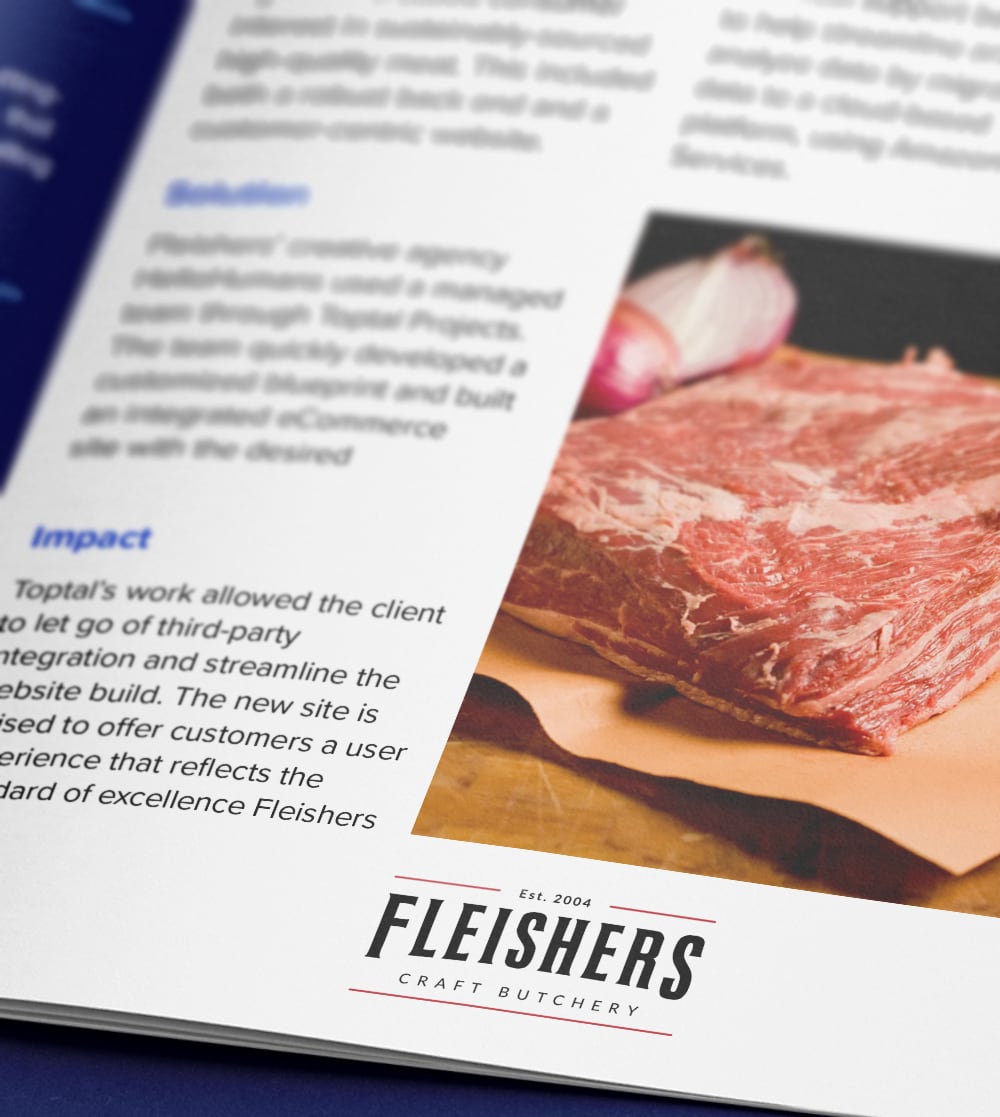
Challenge: Fleishers Craft Butchery sought to update their operations in light of increased consumer interest in sustainably-sourced high-quality meat. The demand necessitated both a robust back-end and a customer-centric website.
Solution: Fleishers’ creative agency HelloHumans opted for a managed team through Toptal Projects to take on the work. The team quickly developed a customized blueprint and built an integrated e-commerce site with the desired back-end features.
Impact: Toptal’s work allowed the client to forego third-party integration and streamline the website build. The new site is poised to offer customers a user experience that reflects the standard of excellence Fleishers is known for.
Bryan Dalessandro
Founder of HelloHumans


Newsweek and Statista’s rankings were based on an independent survey of more than 2,400 decision-makers at Fortune 500s.

| 1 |  |
|---|---|
| 2 |  |
| 3 |  |
| 11 |  |
| 12 |  |
| 33 |  |
|---|---|
| 39 |  |
| 66 |  |
| 80 |  |
| 101 |  |
Highest ranked across all industries
Other Professional Services
Methodology for the Rankings
How likely the respondent is to recommend the selected company to others.
Measures the convenience of interaction with the company and efficiency of processes.
Measures the company’s cost-effectiveness and quality relative to price.
Measures whether the company consistently meets or exceeds expectations in quality and timeliness of deliverables.
Measures the company’s ability to consistently fulfill commitments and maintain customer trust.
OUR THOUGHT LEADERSHIP
Stay ahead with expert insights into e-commerce website development, platform selection, UX best practices, SEO strategies, and conversion rate optimization.
E-commerce is a crowded sector. Build a better product strategy and increase your chances of success with these expert insights.
Read MoreE-COMMERCE WEBSITE DEVELOPMENT RELATED OFFERINGS
Pair Toptal’s E-commerce Website Development Services with related competencies to effectively tackle your business challenges.
E-commerce has evolved from a simple sales channel into a core business discipline that blends technology, design, data, and strategy. Modern development services now underpin everything from marketing and payments to shipping, analytics, and growth. In this environment, one-size-fits-all platforms fall short; brands increasingly rely on custom e-commerce solutions that deliver differentiation and long-term customer engagement.
Meanwhile, technologies such as AI personalisation, AR product visualisation, intelligent search, headless architecture, and voice commerce are rapidly raising expectations. The next phase of digital retail will centre on hyper-personalized, immersive discovery and effortless checkout across devices. Custom e-commerce solutions allow these innovations to be embedded in a way that feels native, scalable, and aligned with business strategy—giving brands the foundation they need to grow and compete in a constantly evolving market.
The e-commerce industry has continued to grow at a steady pace, driven by consumer expectations, improved digital infrastructure, and the shift to mobile-first behavior. What was once a new and emerging channel has become a mature, established ecosystem supported by platforms, tools, and experiences that can handle businesses of all sizes.
Global sales growth trends and SaaS adoption metrics
Global e-commerce revenue continues to surge. This sustained growth is largely due to:
As this growth continues, every business that wants to sell online needs software to run its store. Small and mid-sized businesses often use simple, ready-made software because it’s easy to set up and start selling. Large companies often use more advanced, customizable systems because they need more control, faster performance, and the ability to handle heavy traffic.
Expanding mobile commerce and cross-border opportunities
Mobile commerce (m-commerce) now accounts for the majority of online transactions worldwide. As a result, mobile optimization is no longer optional—it’s central to e-commerce success. Regardless of device or location, consumers expect:
Simultaneously, cross-border e-commerce continues to rise. Brands are removing longstanding friction from international expansion and tapping into global audiences through automated tax calculators, multi-currency payment gateways, international shipping integrations, and real-time translation tools.
Evolving user expectations around personalization and delivery speed
Shoppers expect a highly tailored experience every time they interact with a business. Dynamic recommendations, personalized search results, pricing that adapts to their behavior, and promotions that consider their stage in the journey - that’s just what it takes to stay competitive in the digital world.
At the same time, delivery expectations have become increasingly stringent: customers now expect rapid fulfillment, detailed tracking, and flexible delivery windows. This demand has prompted retailers to integrate their logistics systems more closely with their e-commerce platforms, aligning warehousing, inventory, shipping, and customer service to create a more predictable and transparent experience.
The Impact of COVID-19 on the E-commerce Industry
The pandemic was a turning point for online retail, one that permanently changed how people discover and buy products. What began as a necessity soon became an expectation, reshaping e-commerce into the default way to shop. Key takeaways from this time include:
The e-commerce platform landscape has matured into a diverse ecosystem designed to support businesses at different scales and levels of complexity. Choosing the right platform is a strategic decision that shapes how a brand:
As expectations rise, businesses are increasingly seeking platforms that strike a balance between ease of use and the flexibility to support long-term innovation. This has driven a shift toward platform specialization.
Shopify stands out as an accessible yet powerful platform designed for simplicity, speed, and scalability. Its hosted infrastructure removes the burden of server management, while its extensive app marketplace provides ready-to-install extensions for marketing, analytics, fulfillment, and more. From emerging DTC brands to established Shopify Plus enterprises, businesses value its intuitive interface, rapid deployment capabilities, and robust multi-channel integrations.
Adobe Commerce (formerly Magento) remains the platform of choice for large retailers that require in-depth customization capabilities - including features such as complex catalogues, multi-store management, and B2B functionalities. Its APIs are highly flexible, its architecture is modular, and it integrates seamlessly with Adobe Experience Cloud, making it the perfect platform to create highly personalized and automated experiences. And because it’s so extensible, it’s ideal for businesses with significant operations and ambitious marketing goals.
WooCommerce is a dominant force in content-driven commerce, thanks to its seamless integration with WordPress. As an open-source solution, it offers full customization and access to a vast ecosystem of plugins. Brands that prioritize editorial content, SEO flexibility, and complete design control often choose WooCommerce to combine storytelling and commerce within a familiar CMS environment.
BigCommerce blends the ease of use of a SaaS platform with the power of enterprise-grade customization. It has open APIs, built-in support for headless configurations, and integrates natively with Amazon, eBay, and social media platforms—which empowers fast-growing merchants to reach more people without taxing their infrastructure. It’s highly stable and flexible, making it an excellent fit for mid-market and enterprise businesses that want to grow across multiple channels.
Drupal Commerce integrates a powerful commerce engine directly into the Drupal CMS, making it an ideal choice for organizations that require robust content management alongside transactional capabilities. Its strong security standards, modularity, and multilingual support make it especially appealing to government agencies, NGOs, universities, and global enterprises with complex compliance needs.
As brands increasingly demand flexibility beyond traditional monolithic systems, headless commerce, composable architectures, and low-code tools are gaining traction. These emerging solutions decouple the front-end from the back-end, enabling faster iteration and seamless omnichannel experiences across web, mobile apps, in-store interfaces, and IoT devices.
Shift4Shop has a fully hosted environment for optimal SEO, PCI compliance, and secure payment processing. Entrepreneurs and small retailers love its built-in marketing tools, simple product management, and clean templating system—features which allow them to optimize their stores without needing deep technical expertise.
A successful e-commerce build begins long before development starts. The planning phase lays the strategic foundation for the entire initiative, ensuring that the final platform not only looks good but also:
Precise alignment around goals, audiences, technical requirements, and operational realities is what transforms an online store into a sustainable growth engine.
The process begins with gaining a clear picture of your market and audience—how customers search, discover, evaluate, and purchase online. These insights shape core decisions about navigation, product taxonomy, and checkout flow. Letting UX and CRO principles guide this stage helps create a smoother experience, remove friction, and support real business results.
Effective planning reduces risk, accelerates delivery, and ensures that the platform is built on validated customer and business insights rather than assumptions.
Market and audience research to inform UX and functionality
Understanding your audience is the cornerstone of a successful e-commerce experience. Before design or development begins, teams should examine customer demographics, shopping motivations, friction points, and behavioral patterns to inform their approach.
Tools such as heatmaps, user surveys, and analytics platforms reveal how customers navigate product pages, search for items, and move through checkout flows. These insights inform everything from navigation structure to product filtering logic, ensuring the experience aligns with real user needs rather than internal preferences.
Branding, content, and MVP planning
Having a strong brand identity helps maintain consistency in how you display your products to the tone of your messaging. Before you even start building anything, you should have a clear idea of:
This way, you can make sure the platform feels like you and reflects your values.
When it comes to building something, MVP (Minimum Viable Product) planning is important. Instead of trying to launch with every single feature you can think of, you focus on what will have the biggest impact on your customers and cut back on waste. This approach gets your project out the door faster and lets you measure the impact of your early iterations.
Competitive benchmarking and differentiation strategies
Evaluating competitors helps establish performance baselines and identify industry norms around features, user experience, and design. But true differentiation requires going beyond simple parity. Brands can distinguish themselves through immersive product visualization, compelling storytelling, personalized recommendations, streamlined checkout flows, and other experience-driven enhancements that elevate customer satisfaction and brand credibility.
The right development partner shapes not only the technical execution of your platform, but its long-term adaptability and performance. Selecting a partner who aligns with your strategic goals, industry context, and operational needs dramatically increases the likelihood of a successful outcome.
Evaluate experience, portfolio, and platform focus.
A strong partner should demonstrate expertise on the platform your business relies on—whether Shopify Plus, Magento/Adobe Commerce, WooCommerce, BigCommerce, or a headless framework. Reviewing case studies, client testimonials, and technical capabilities helps determine whether the partner can effectively handle the complexity of your requirements and deliver a high-performing, scalable solution.
Assess communication practices and development methodologies.
Clear communication is crucial. A partner should set clear timelines, deliverables, sprints, and feedback loops to keep expectations aligned. Agile or hybrid methods support steady iteration, reducing risk and improving quality. Their approach to revisions, stakeholder alignment, QA, and deployment signals how smooth the project will run. Partners who include long-term support and maintenance in their process ensure greater stability and lower post-launch risk.
Confirm technical depth in integrations and scalability.
Modern e-commerce platforms rely on a web of interconnected systems, ranging from payment gateways and CRMs to ERPs, inventory management tools, subscription engines, and analytics pipelines. A qualified development partner understands these integration points and can architect solutions that support growth, stability, and long-term adaptability.
Budgeting for an e-commerce development project is often more complex than businesses initially expect. Costs vary widely based on scope, technology choices, and the level of customization required. Understanding how pricing models work helps organizations plan more confidently and avoid unexpected overruns.
Several key factors can affect the overall cost of your e-commerce project. Understanding these cost drivers helps align expectations, improve planning, and prevent overspending:
Behind every high-performing e-commerce platform lies a structured process for discovery and deployment. Each stage is designed to minimize risk and ensure everyone is on the same page, and the platform is built to handle growth as your user and customer base expands.
A successful e-commerce build typically unfolds across several interconnected phases. While each development team may adapt the process, the underlying structure remains consistent—anchored in alignment, iteration, and data-driven refinement.
Discovery and requirement alignment
The initiative begins with deep discovery. Product owners, strategists, designers, and developers collaborate to define business objectives, user behaviors, technical constraints, and system requirements. This phase includes auditing existing digital infrastructure, mapping user journeys, identifying catalog and fulfillment logic, and determining KPIs.
Design, prototyping, and architecture planning
With requirements clarified, UX designers create wireframes and prototypes that test navigation, product flow, and conversion pathways. These prototypes validate assumptions before development begins, reducing rework later. At the same time, technical architects plan the underlying structure, including data models, API configurations, integration methods, and hosting environments.
Development, testing, deployment, and optimization cycles
With an emphasis on delivering functional components across the front-end, back-end, and integration layers, development proceeds in iterative sprints. Pipelines for continuous integration (CI) automate code validation and lower deployment risks.
In order to guarantee stability across devices and conditions, quality assurance conducts functional, regression, load, and security testing.
Following launch, development moves into continuous optimization, which involves improving user journeys, optimizing performance, and examining behavior data to promote higher conversions and sustained growth.
For small to mid-sized businesses that value speed to market over modularity, monolithic architecture is ideal because it offers centralized management and simplicity. Scaling, however, necessitates redeploying the entire program, which can impede experimentation and slow updates.
Functionalities (like cart, catalog, checkout, and payments) are divided into independently deployable services by microservices architecture. This increases orchestration complexity but permits parallel development, quicker scaling, and flexibility in integration.
Dynamic omnichannel experiences are made possible by headless commerce, which separates the front-end and back-end systems. It supports quick UX experimentation and new interfaces like voice or augmented reality by granting brands total creative freedom across devices and touchpoints.
Building a modern e-commerce platform requires more than meeting baseline functionality. Following technical and user-focused best practices ensures that the website remains fast, secure, discoverable, and capable of supporting growing business demands.
Your technology stack influences everything from development efficiency to site performance and security. A future-ready stack should be flexible, stable, and designed for growth.
Match stack to scalability, performance, and security needs
Frameworks should be chosen not only for present functionality but for their ability to support future expansion. High-traffic environments may require asynchronous back-end technologies, distributed caching, and strong database optimization.
Security considerations—such as PCI compliance, encrypted communications, and GDPR readiness—must guide framework and infrastructure choices.
This is also the stage where decisions about advanced technologies in e-commerce must be made. AI-driven personalization, augmented reality for product visualization, intelligent search engines, automation tools, and emerging technologies like IoT and blockchain are no longer peripheral enhancements—they now shape how modern customers evaluate products and navigate the buying journey.
The software stack must therefore support these capabilities natively or through flexible APIs. For example, a headless front end may be required to deliver AI-powered recommendations across multiple touchpoints. At the same time, a composable architecture may be better suited for integrating AR or real-time inventory intelligence.
Here are the core components that bring this architecture to life:
SEO and accessibility are crucial components of a discoverable and inclusive e-commerce experience. SEO within marketing services has evolved into a highly technical discipline, relying on clean data structures, rapid performance, and adaptable content systems.
Optimize metadata, content hierarchy, and schema markup
Rich results powered by structured data (product schema, reviews, breadcrumbs) boost visibility. Clean URLs, canonical tags, XML sitemaps, and logical heading structures support efficient crawling and indexing.
Implement WCAG accessibility standards for inclusive design
Accessible design ensures that all users, including those using assistive technologies, can interact with your website. WCAG 2.1 AA compliance includes keyboard navigation, ARIA labels, color contrast standards, and descriptive alt text.
Accessibility expands reach, reduces legal risk, and improves overall user experience.
Security is foundational to customer trust. E-commerce systems must protect sensitive information and adhere to global regulatory standards. The following steps are essential to building and sustaining a secure e-commerce environment:
Scaling requires more than added infrastructure—it demands modular architecture and continuous monitoring. Keep the following steps in mind:
E-commerce development delivers clear, measurable advantages in reach, efficiency, and brand growth—but achieving these outcomes requires navigating significant technical and operational challenges that accompany modern digital infrastructure.
Benefits and Outcomes | Challenges |
|
|
E-commerce development today extends far beyond building an online storefront. Modern platforms serve as operational command centers, powering sales, fulfillment, customer engagement, partner integrations, and data-driven decision-making. When executed strategically, E-commerce Development Services transform digital commerce from a transactional touchpoint into a scalable ecosystem supporting every stage of the customer and business lifecycle.
In addition to increasing the value of each customer interaction and lowering internal friction, well-architected systems provide the infrastructure that companies need to enter new markets, channels, and product categories. The end product is more than just a useful website—it’s a potent tool for boosting sales, improving customer loyalty, and building long-term brand equity.
Sales enablement, retention, and brand building
An established e-commerce system uses customer intelligence and automation to increase revenue. Teams can manage customer journeys from first visit to repeat purchase and personalize offers through integrated analytics and CRM tools. Features like dynamic pricing, loyalty programs, and AI-driven recommendations strengthen brand credibility.
Key functions:
Internal workflows, partner networks, and customer lifecycle support
Modern e-commerce solutions serve as centralized operational platforms. They synchronize internal tools—such as ERP, inventory, fulfillment, and analytics—to create end-to-end visibility across departments. Real-time dashboards inform production, shipping, and support decisions, while integration with partner APIs (including those of manufacturers, distributors, and logistics providers) ensures seamless collaboration. Lifecycle automation further strengthens retention: triggered emails, automated service updates, and contextual content keep customers engaged long after the initial purchase.
Migration and Upgrade Services
An often overlooked business application of e-commerce development is the need for modernization. Many companies still rely on legacy stores and monolithic systems that limit performance and make it difficult to adopt new features or channels. Moving to scalable platforms such as Shopify Plus, Magento 2, BigCommerce, or headless frameworks improves stability and speed while reducing technical constraints.
Key parts of a proper migration:
Investing in E-commerce Development Services is ultimately a decision to build a digital infrastructure capable of supporting long-term growth. In a landscape where customer expectations shift rapidly and competition intensifies, professionally engineered platforms provide the stability, flexibility, and performance necessary to stay ahead. A well-developed e-commerce site becomes far more than a point of sale—it becomes the operational and experiential foundation of the business.
Elevate digital presence and customer experience
A professionally built e-commerce platform enhances every aspect of your digital presence. Thoughtfully crafted UX, fast performance, and modern design work together to create a memorable first impression and a frictionless shopping journey. These elements reinforce credibility from the moment a customer lands on the site or e-commerce store, helping to build trust and encourage conversions. A consistent, well-executed experience doesn’t just generate sales; it cultivates loyalty and strengthens brand equity.
Enable long-term scalability through expert-driven architecture
Scalable architecture is crucial for any business seeking to expand. Expert developers design systems that can support new products, additional storefronts, increased traffic, and develop global audiences without compromising performance. With modular codebases, cloud-native foundations, and continuous integration pipelines, the platform becomes adaptable rather than fragile. This strategic approach enables the business to evolve quickly, launch new features efficiently, and maintain a competitive edge in a rapidly changing digital environment.
Strengthen data, performance, and brand trust
Trust is one of the most valuable currencies in digital commerce. Professional development practices safeguard sensitive data, maintain strong security standards, and ensure the platform runs smoothly around the clock. Continuous performance monitoring, structured testing frameworks, and reliable analytics provide visibility across every aspect of the customer journey. These insights empower teams to refine experiences, optimize marketing efforts, and make informed decisions that support sustainable growth.
Looking for guidance about the perfect e-commerce website development service for your needs?
Get a Free Consultation Now