

Hire Virtual Reality Developers
Hire the Top 3% of Freelance Virtual Reality (VR) Developers
Hire virtual reality (VR) developers, engineers, and programmers on demand. Top companies and startups choose virtual reality developers from Toptal for immersive environment creation, 3D game mechanics, real-time rendering, Unity and Unreal Engine development, and more.
Hire a Top Virtual Reality Developer Now
No-Risk Trial, Pay Only If Satisfied.









Hire Freelance Virtual Reality Developers

Manuela Kajkara
Freelance Virtual Reality Developer
Verified Expert in Engineering
Croatia
Toptal Member Since December 30, 2020
Manuela is a software engineer, specializing in the development of AR and VR experiences and applications for mobile devices and headsets. With her focus on details and an eye for design, she delivers high-quality products that exceed clients' expectations. Manuela has five years of experience and a master's degree in software engineering.
Show More
Vladimir Mitrovic
Freelance Virtual Reality Developer
Verified Expert in Engineering
Serbia
Toptal Member Since November 1, 2015
Vladimir has been a professional developer for 11 years. Most recently, he's focused on augmented reality, computational design, and computer graphics. He has architected complex software systems, designed UX, led teams, and spoken at conferences. Vladimir values simplicity and efficiency and loves working on interactive products, no matter the platform.
Show More
Dennis Ippel
Freelance Virtual Reality Developer
Verified Expert in Engineering
Netherlands
Toptal Member Since May 26, 2014
A creative technology expert with 15+ years experience, Dennis has worked for over eight years for top ad agencies and production companies in London, UK. He makes high-end websites, digital installations and mobile apps, and he specializes in 3D, VR, and AR. He has worked for clients such as Nike, Ferrari, Fiat, Mini, EA, Disney, Unilever, and Intel, and he is the creator and lead developer of Rajawali, an open-source 3D framework for Android.
Show More
Richard Terrell
Freelance Virtual Reality Developer
Verified Expert in Engineering
United States
Toptal Member Since August 26, 2021
Rick is an entrepreneurial leader with a background in gaming and immersive technologies. Rick has experience leading and developing defense simulations, video games, and theme park attractions in larger corporate environments and is always interested in new industries. Over the last several years, Rick's also worked in startups as a leader and primary technologist—covering code, architecture, design, and maintenance.
Show More
Vineet Nalawade
Freelance Virtual Reality Developer
Verified Expert in Engineering
India
Toptal Member Since October 30, 2023
Vineet is a seasoned engine developer with 7+ years of experience, specializing in Unity and Unreal Engine. He has led teams in various augmented reality (AR), virtual reality (VR), and WebGL projects, successfully creating applications for iPhone, Android, Meta Quest, and Microsoft HoloLens 2. Passionate about merging tech with real-world impact, Vineet is eager to embrace new challenges, working hand-in-hand with clients to innovate with purpose.
Show More
Adrien Jacquin
Freelance Virtual Reality Developer
Verified Expert in Engineering
France
Toptal Member Since March 16, 2021
Adrien is a software engineer specialized in virtual reality. He is a passionate developer ready to solve problems and overcome every challenge. He has experience in different environments, from Airbus and medtech startups to a cancer research lab. His strength is being adaptable to any setting while listening closely to the client's needs to fulfill them efficiently.
Show More
Diego Montoya
Freelance Virtual Reality Developer
Verified Expert in Engineering
Germany
Toptal Member Since October 26, 2020
Diego is an engineer and creative technologist with 10 years of experience in AR/VR and other spatial computing fields. After five years in an AR/VR startup from Munich, he co-founded VRdirect and served as its CTO. He has done groundbreaking AR/VR work for Audi, Porshe, BMW, Hyperloop, Henry Schein, the Cologne Cathedral and many agencies. With a passion for emergent technologies, Diego excels at pushing the limits of 3D interactivity through creativity, ingenuity, and drive.
Show More
Khanh Ha
Freelance Virtual Reality Developer
Verified Expert in Engineering
Vietnam
Toptal Member Since January 7, 2020
Khanh Ha is a software engineer veteran with a track record of industry-level projects in the fields of computer vision, deep learning, machine learning, 3D geometry, and computer graphics technologies. He also specializes in digital human technologies, from 3D avatar estimation to motion capture.
Show More
Darin Erat Sleiter
Freelance Virtual Reality Developer
Verified Expert in Engineering
Australia
Toptal Member Since October 11, 2016
Darin is a data scientist and engineer with a PhD in physics from Stanford. He's passionate about data and machine learning and has worked on data science projects across numerous industries and applications. Darin's co-founded an AI company and led a team of data scientists to build a product that uses machine learning and optimization techniques to reduce energy consumption in data centers. He's eagerly waiting for quantum computers.
Show More
Ibraheem saleh
Freelance Virtual Reality Developer
Verified Expert in Engineering
Australia
Toptal Member Since June 11, 2021
Ibraheem is a passionate developer with a keen acumen for learning who solves unique and engaging tech problems, making great projects come to life. He has developed an escape room in a bus, a VR roller coaster, and an AR presentation tool for auto shows, just to name a few. He has proven experience in everything from programming languages and environments, mechatronics, computer animation, VFX, and CAD modeling to CFD and FEA analysis and even some welding and fabrication.
Show More
Jason RT Bond
Freelance Virtual Reality Developer
Verified Expert in Engineering
Canada
Toptal Member Since May 13, 2017
Jason has over a decade of experience in video games, virtual/augmented reality and 3D assets. He is an expert in the Unity Engine and can work with a wide variety of platforms (web, mobile, PC/Mac, game consoles). He prefers a multi-disciplinary approach—having a background in both game design and coding, as well as experience in audiovisual content creation pipelines.
Show MoreDiscover More Virtual Reality Developers in the Toptal Network
Start HiringA Hiring Guide
Guide to Hiring a Great Virtual Reality Developer
Virtual reality is going mainstream, resulting in a lot of demand for VR talent and even more hype. This leaves a veritable flood of VR developer resumes to wade through. How can you know which ones are right for your project? We recently interviewed hiring executives from some of the most successful VR production houses and distilled their wisdom down into this handy hiring guide.
Read Hiring GuideToptal in the press
... allows corporations to quickly assemble teams that have the right skills for specific projects.

Despite accelerating demand for coders, Toptal prides itself on almost Ivy League-level vetting.

Our clients


Creating an app for the game


Leading a digital transformation


Building a cross-platform app to be used worldwide


Drilling into real-time data creates an industry game changer
Testimonials
How to Hire VR Developers Through Toptal
1
Talk to One of Our Client Advisors
A Toptal client advisor will work with you to understand your goals, technical needs, and team dynamics.
2
Work With Hand-selected Talent
Within days, we’ll introduce you to the right VR engineer for your project. Average time to match is under 24 hours.
3
The Right Fit, Guaranteed
Work with your new virtual reality engineer for a trial period (pay only if satisfied), ensuring they’re the right fit before starting the engagement.
EXCEPTIONAL TALENT
How We Source the Top 3% of Virtual Reality Developers
Our name “Toptal” comes from Top Talent—meaning we constantly strive to find and work with the best from around the world. Our rigorous screening process identifies experts in their domains who have passion and drive.
Of the thousands of applications Toptal sees each month, typically fewer than 3% are accepted.
Toptal Virtual Reality Case Studies
Discover how our virtual reality (VR) developers help the world’s top companies drive innovation at scale.
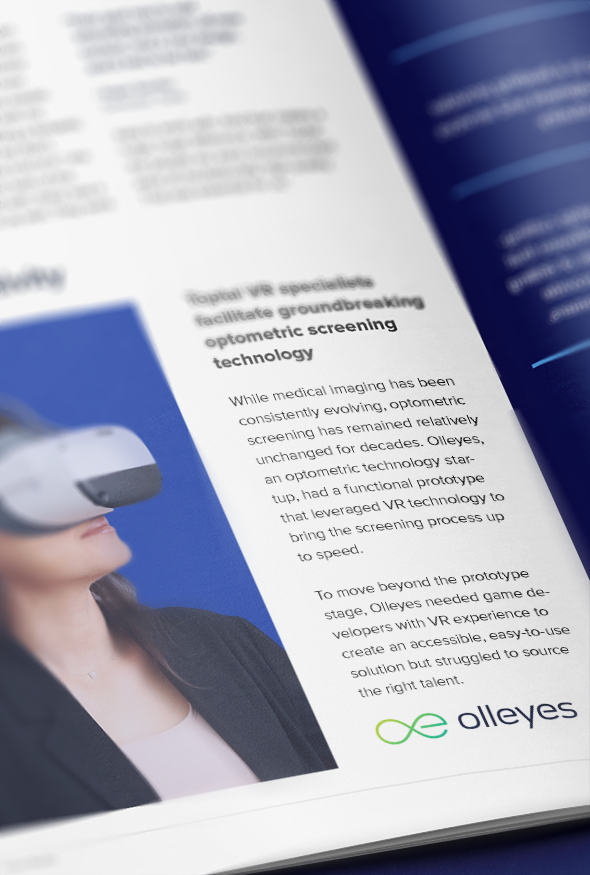
Toptal VR engineers and game developers facilitate groundbreaking optometric screening technology.
Challenge: While medical imaging has been consistently evolving, optometric screening has remained relatively unchanged for decades. Olleyes, an optometric technology startup, had a functional prototype that leveraged VR technology to bring the optometric screening process up to speed.
Solution: Toptal engineers revamped the original software for ease of use and optimized it to run smoothly on the limited battery capacity allowed by VR platforms. Toptal’s game developers then utilized Unity and Unreal to create a user-friendly, animated interface, making the product accessible even for pediatric and geriatric patients.
Impact: Olleyes saved an estimated 50% on development costs compared to outsourcing to multiple firms. The technology Toptal developed at Olleyes has made eye screening faster and more accessible for patients across the country, and Olleyes now holds several major contracts with national distributors.
RELATED CAPABILITIES
- Virtual Reality
- Unreal Engine
- Unity
- UX Design
- Animation
Toptal has been my secret weapon because it’s a menu of high-quality talent that’s just unprecedented.
Freddy Morgenstern
Co-founder and CTO, Olleyes

Capabilities of Virtual Reality Developers
Virtual reality (VR) developers specialize in crafting immersive, interactive digital experiences that blend 3D environments with real-time responsiveness. They use advanced tools like Unity and Unreal Engine to develop complex behaviors and integrate hardware such as headsets, sensors, and motion controllers. With deep expertise in performance optimization and cross-platform development, they deliver high-fidelity VR solutions across industries, including gaming, healthcare, education, and training.
VR Environment Design
High-impact VR depends on spatial awareness and environmental storytelling. Our developers craft responsive 3D worlds that optimize scale and interaction flow to help users feel engaged and intuitively connected within virtual spaces.
Game Engine Development for VR
Game engines power the interactivity and realism at the heart of VR. Toptal VR experts use Unity and Unreal Engine to script dynamic behaviors, simulate physics, and optimize rendering pipelines to deliver interactive environments that respond fluidly to user input and motion.
Motion Controls and User Interactions
Natural interaction is critical for immersive VR experiences and requires more than button inputs. Our VR specialists implement motion tracking and gesture recognition to enable seamless user engagement within virtual environments.
Hardware and SDK Integration
Successful VR applications depend on smooth communication between software and hardware. Our developers integrate headsets, sensors, and platform-specific software development kits (SDKs)—such as Meta XR and Vive Wave—to ensure consistent performance and input fidelity across VR devices.
VR Performance Optimization
High frame rates and low latency are critical to preventing VR motion sickness and preserving immersion. Our development specialists optimize assets, reduce system load, and fine-tune rendering processes to ensure smooth, comfortable experiences across diverse hardware configurations.
Cross-platform VR Application Development
Consistent VR experiences require adaptability across headsets and operating systems. Toptal VR programmers build scalable applications that function seamlessly on standalone devices, tethered PCs, and mobile-based platforms to expand audience reach without compromising performance or interaction quality.
Quality Assurance and Testing
Testing VR applications demands specialized QA workflows to ensure stable user experiences across complex, spatially interactive scenarios. Toptal developers conduct in-headset testing, validate spatial interactions, and troubleshoot real-time performance issues to uncover edge cases that emerge only within fully simulated environments.
Clinical Simulation Design
Accuracy and realism are non-negotiable for VR-based medical training software. Our VR developers build high-fidelity clinical simulations using real-time platforms like Unity and Unreal Engine to enable safe, engaging environments for practicing procedures and enhancing patient care outcomes.
VR Training and Education Development
Virtual reality can transform how people learn and retain complex skills. Our specialists create interactive training and educational simulations in which learners engage with content in realistic, repeatable environments that improve real-world readiness through hands-on, experiential learning.
Staying Current with VR Innovations
VR evolves rapidly, requiring continuous upskilling. Toptal development experts stay updated through ongoing research, proactive experimentation with new toolkits, and early adoption of trends like eye tracking, hand presence, and mixed reality.
FAQs
Typically, you can hire virtual reality developers with Toptal in about 48 hours. For larger teams of talent or full end-to-end project delivery, timelines may vary. Our talent matchers are highly skilled in the same fields they’re matching in—they’re not recruiters or HR reps. They’ll work with you to understand your goals, technical needs, and team dynamics, and match you with ideal candidates from our vetted global talent network.
Once you select your virtual reality engineer, you’ll have a no-risk trial period to ensure they’re the perfect fit. Our matching process has a 98% trial-to-hire rate, so you can rest assured that you’re getting the best fit every time.
To hire the right VR programmer, it’s important to evaluate a candidate’s experience, technical skills, and communication skills. You’ll also want to consider the fit with your particular industry, company, and project. Toptal’s rigorous screening process ensures that every member of our network has excellent experience and skills, and our team will match you with the perfect virtual reality developers for your project.
At Toptal, we thoroughly screen our virtual reality developers to ensure we only match you with the highest caliber of talent. Of the more than 200,000 people who apply to join the Toptal network each year, fewer than 3% make the cut.
In addition to screening for industry-leading expertise, we also assess candidates’ language and interpersonal skills to ensure that you have a smooth working relationship.
When you hire VR engineers with Toptal, you’ll always work with world-class, custom-matched virtual reality developers ready to help you achieve your goals.
You can hire virtual reality engineers on an hourly, part-time, or full-time basis. Toptal can also manage the project end-to-end based on your specific requirements as part of our Consulting and Services offerings. Whether you hire a virtual reality developer for a full- or part-time position, you’ll have the control and flexibility to scale your team up or down as your needs evolve. Our virtual reality developers can fully integrate into your existing team for a seamless working experience.
We make sure that each engagement between you and your virtual reality developer begins with a trial period of up to two weeks. This means that you have time to confirm the engagement will be successful. If you’re completely satisfied with the results, we’ll bill you for the time and continue the engagement for as long as you’d like. If you’re not completely satisfied, you won’t be billed. From there, we can either part ways, or we can provide you with another virtual reality developer who may be a better fit and with whom we will begin a second, no-risk trial.
How to Hire a Great Virtual Reality Developer
Hiring high-quality virtual reality (VR) developers are critical to the success of your project. Selecting the right frameworks and tools is equally vital to ensuring a smooth development process. Despite the variety of websites offering freelance VR services, there are still challenges that come with getting the right person to fill this role on your team.
You may be a hiring manager for the development team at a large corporation, or a small business looking for a passionate VR developer. In any case, your interview process is an important method for evaluating the talent you seek.
Both art and programming are critical to any immersive virtual reality project. Depending on the culture of your company, art and programming roles may be very tightly defined with little overlap, or very fluid with less distinction between them. This article specifically covers programmers, rather than positions such as 3D modelers, texture artists, and animators.

VR solutions often rely on established frameworks and third-party engines. We took it upon ourselves to interview a few industry leaders to discuss the nuances of interviewing and hiring for virtual reality development. The developer that suits your project will be driven by what your VR company does, but there are common characteristics among all our sources for what they want from VR developers and how they choose to interview them.
Roles
Traditional VR engineering (whether game-related or not) is heavily influenced by the game development and app development communities. The roles within the team will often reflect this, but the culture of your company will ultimately decide how you delineate engineering roles within your team. In keeping with the language we encountered speaking to VR hiring managers, we’ve used terms such as “gameplay” and “game.” However, these roles are equally applicable to virtual reality applications that have nothing to do with gaming, such as interactive experiences, movies, and consumer spaces. Carefully evaluating your business needs can help you determine which roles are most essential for your team. VR engineering roles typically land in one of three categories:
1. Gameplay Engineers
A gameplay engineer is concerned with the ways in which a user interacts with a VR game and what they experience. They build the world of a game, but not the graphics. These engineers are key in crafting user interactions and ensuring your project management processes align with gameplay goals. In other words, these engineers build the game itself rather than the technology the experience runs on.
Gameplay engineers would be responsible for things such as how the characters within a game experience behave, how the user interacts with the environment in the virtual reality app world, and the navigation of the user within the world.
2. Engine Programmers (or “Core Engine Programmers”)
An engine programmer is almost the exact opposite of a gameplay engineer. These programmers work on the low-level technology that the experience runs on, particularly the 3D technology that renders the experience.
They also focus on ensuring that performance is acceptable. This is especially important in VR, as low frame rates can cause nausea.
In modern VR, it’s rare that an engine programmer would be responsible for building the engine that the experience runs on in its entirety. It’s far more likely that they would be responsible for low-level interactions with the third-party engine used to develop the game, such as Unity, Unreal, or CryEngine.
3. High-Level Scripting Engineers
Scripting engineers have a similar role to gameplay engineers. They work at a very high level in languages such as Lua or UnrealScript. This is in contrast to gameplay engineers, who work in the same low-level language in which the game is written, usually C++.
In some VR app development environments, particularly Unity, there is less distinction between a high level scripting engineer and a gameplay engineer. This is because gameplay code tends to be written in the higher-level languages supported by Unity, like JavaScript or C#.
Each of the roles described above have formal training. Unlike other software development and programming specializations, it’s rare nowadays that someone has these specific VR development skills without having gone to school for a programming or computer science degree.
Beyond formal training, there are several traits you should hope to see in your candidates as you interview virtual reality developers. If you choose to give your candidate a technical interview, we suggest taking three to four hours.
Collaborative Potential
Any virtual reality experience has a complex real-time system behind it with many moving parts. The developer who thinks collaboratively will be considerate of other team members and be conscious of the workflow and pipeline.
Communication is critical, whether you are working in a small company or a large distributed team. Collaborative team members work well independently but are also not afraid to ask relevant questions and share insights that move development along efficiently.
Problem Solving
There are several ways to asses problem-solving acumen. As with other technical interviews, posing technical problems during the interview process is a good means to evaluate problem-solving skills. They’re a good tool for drawing out the interviewee’s thoughts on the subject matter. Help when necessary. Ask them to elaborate to glean more details about their thought process.
Some technical problems are universal, applying to any programming role. Others might be more specific to virtual worlds such as camera calculations, rendering problems, and character AI techniques. Additionally, you as an interviewer should evaluate how they think about performance as well as the correctness of the solution to the problem.
3D Math Skills
Some level of 3D math is needed for anyone involved in building a VR experience. That said, the exact level will depend on their role within your team.
Core engine programmers will require in-depth, sophisticated knowledge of all aspects of 3D math. This includes vector and matrix mathematics, and the mathematics of rendering, physics, and shaders.
On the other hand, gameplay and scripting engineers only require basic knowledge of how to use 3D vectors and transformations.
This section of your interview should be tailored to challenge their 3D math skills to a level suitable for the role to which they are applying. The questions should attempt to reveal their underlying knowledge of the principles involved, rather than expecting rote knowledge of 3D operations.
One example might be that they should be able to tell the difference between a cross product and a dot product and how to use them, but not necessarily know the exact sequence of operations to perform a cross product.
Speed
Remember, each frame of your virtual reality experience must run in 16.6 milliseconds, or nausea can result.
Virtual reality, like so much of our experience today, is dependent upon efficiency: Does the code run fast?
In addition to solving problems in 3D space using applied 3D math, the solutions must be graceful. Being mathematically correct is not good enough if the solution is inefficient.
For example, a brute-force solution to a mathematical search problem is unlikely to be practical, even though it’s mathematically correct. If you are presented with a solution like this in an interview, try to prompt the interviewee to build on the baseline brute-force solution and turn it into a more efficient and elegant solution.
Optimization is the key to a pleasant user experience. Remember, each frame of your virtual reality experience must run in 16.6 milliseconds, or nausea can result. This requires all members of your team to understand performance and optimization.
There are two aspects of this. There is theoretical Big-O notation—which any computer science graduate should understand—whereby you can express the theoretical time and space complexity of an algorithm. But there is also more practical, experiential knowledge that relates code to real-world performance.
The former can be assessed while posing the technical problems discussed in the previous “problem solving” section. Does the interviewee understand the complexity of the solution they present, and how that will impact its theoretical performance?
The latter is particularly important for low-level engine programmers and can be assessed by asking about the low-level performance repercussions of the code they write. Do they understand the performance ramifications of various levels of caching, for example, or the performance characteristics of a CPU versus a GPU?
Desire
A person who is desirous of a position in the field will have examples of passion projects. As an interviewer, take the time to look at the quality of the source code they have posted on open source repositories like GitHub or work samples they have provided to you. Are these projects easily compiled and run?
Desire is often illustrated by enthusiasm and the candidate’s willingness to intrinsically sharpen their skills. Ask questions about their passion projects and the code they have written for them in a way that lets them reveal their desire for working in the field of virtual reality.
A demo reel is not necessarily expected from a programmer, but it’s appreciated. If you are presented with a demo reel, ask questions about the technical details of implementing what is shown in the demo reel.
As mentioned above, depending on the culture of your company, you may have less delineation between VR programming and artistic roles. For any roles with artistic components to them, a demo reel is crucial, so expect to have to do an in-depth evaluation of them for your interview process.
Overall Value
Aside from technical skills and passion, there are some other important aspects to consider in assessing a candidate’s likely overall value to your team.
While you are looking for new team members, you can keep this tidbit in mind: During our interviews, the most common role hired for was a game engineer. The most difficult role to fill was that of a core engine programmer. As you interview talent, it’s important to know their value within the wider technology ecosystem. This will affect the number of competing offers they are likely to receive.
However, regardless of the likelihood of competing offers, you should endeavor to make your interview process as swift as possible. Be efficient about expressing the results to both successful and unsuccessful interviewees.
Existing Skills and Learning Quickly
It might seem obvious that the most attractive candidate is one who has a combination of skills to fill gaps where needed. However, as an interviewer, it might also be helpful to think through whether or not your candidate is teachable. A willingness and demonstrated ability to learn on the job is as important as showing a mastered versatile skillset. Your needs and budget will guide you in this way about the best talent to hire.
Long-Term and Short-Term Approaches
Every team has a budget and schedule including long- and short-term goals. A core engine programmer can be very valuable to your team because they possess a versatile skill set. During the interview process, consider the long- and short-term goals your hire will be able to help shape and sustain.
Some engineers may be excellent at fighting fires, but not necessarily good at re-architecting your technology to meet your long-term goals.
One aim of your interview process should be to establish how the interviewee fits both within your team and schedule. Sometimes your long- and short-term goals may require different hiring decisions. Some engineers may be excellent at fighting fires—i.e., solving immediate problems and bugs that are stopping your virtual reality project from shipping—but not necessarily good at re-architecting your technology to meet your long-term goals.
Likewise, an engineer with a vision for the architecture of your virtual reality technology may not be best suited to jumping in and fixing the high-priority JIRA item that’s currently hindering the completion of a project. Your interviews should aim at distinguishing between these two roles within your project.
Not all developers are going to fit neatly into either category. In fact, some may be able to carry out both roles well. As an interviewer, you should be aware of which of these roles you are trying to fill.
To identify engineers who are good at fighting fires and solving immediate problems talk to them about cases like this in their work history. Drill down into the technical details of difficult problems they have solved in previous jobs. What was the timeline in which those problems were solved? How did they approach solving the problem, and what were their specific contributions to the solution?
For a more visionary, architect role, ask questions to get a feel for their vision for the system as a whole. During prior projects, did they lead the process of producing the system architecture? Are they excited to contribute to the wider design of the software? And finally, are they able to clearly communicate their insights with those working alongside them?
Creative Ability
“Creativity” in VR engineering can be defined in two ways with regards to the interview hiring process. One can be visually creative, e.g., with effects; there is also the marrying of math and art. Someone else can be design-wise creative, enhancing gameplay, tuning character movement timing, making jumping mechanics have the correct feel…the list goes on!
To gain insight into your interviewee’s creative ability, you will need to combine the specific areas we covered earlier: Problem solving, 3D math skills, and desire. Do the answers given reflect a creative outlook in the interviewee, or a more linear way of thinking?
Pushing the Envelope
Virtual reality is a cutting-edge media where the rules are still being written, unlike media such as film where many conventions have been established for nearly a century. A creative engineer in the VR field must be prepared to write the rules and conventions that future VR creators will follow.
During your interview, inquire about the engineer’s thoughts toward more accessible virtual reality experiences. Ask about their ideas about the sustainability of the field. Their answers should help you gauge how innovative you can expect them to be.
Leveling Up Your Team in the VR Era
Interviewing full-time or part-time VR developers (and AR developers) can be challenging, but with the right lens, you can find the talent you need to compliment your team and realize your vision. In order for the field of virtual reality to grow and thrive, we need to create accessible, high-quality experiences that work with affordable VR technology hardware and VR headsets like the Samsung Gear VR, Google Cardboard, or Oculus Rift.
Hunt for like-minded talent with a thirst for innovation, a heart for teamwork, and the ability to produce with minimal management oversight—there’s no other way to stay on the bleeding edge of the VR applications revolution!
We would like to thank Dave Alpert, CEO at Geopogo; Glen Egan, President and CEO of Sanzaru Games; and Alton Glass, Director and Owner of Glassrock Entertainment for their insights as we put together this article.
Featured Toptal Virtual Reality Publications



Top Virtual Reality Developers Are in High Demand.