High-skilled Job Report for Q1 2026


Erik is a data scientist, management consultant, and Toptal’s Chief Economist. He is a former senior analyst at NERA Economic Consulting and co-founded the global venture capital fund Firstrock Capital. Erik holds an MBA with distinction from Harvard.
Previously At

Table of contents
This is an overview of major findings. Download the full report for more insights.
Key Highlights
State of the High-skilled Work Market
Each quarter, Toptal analyzes job market data relevant to the Toptal Talent Network, which includes more than 20,000 highly vetted professionals in technology, design, finance, marketing, and strategic consulting. In addition to monitoring broader global data for quarter-over-quarter (QoQ) and year-over-year (YoY) trends, Toptal, the world’s largest remote workforce, has designed a unique scoring system, the Toptal Market Strength Score, which represents demand for experienced technology and professional services personnel.
Because Toptal and its talent network are fully distributed, we calculate primary scores specifically for the remote and hybrid work market, as well as secondary scores that apply to all work models, including remote, hybrid, and in-office roles.
The scores are based on new job postings, advertised compensation, and actual hiring.
Key findings from the Q1 report, released in April 2026, include the following:
- Demand for experienced remote and hybrid technology and professional services personnel rose 8.9% QoQ and 4.8% YoY.
- Broader job market data points to weaker demand for generalists and entry-level workers. Postings for all professions and all levels of experience in the US and most other large economies fell by an average of about 3% QoQ and 8% YoY, with the exception of Australia, which saw an increase of about 4% both QoQ and YoY.
- Volatility in the technology sector continues, with technology company layoffs increasing by about 140% both QoQ and YoY. This illustrates the divergent trends defining the current market: Even as some companies are reducing headcount broadly, employers are simultaneously competing for a narrower set of experienced, specialized professionals.
- The widespread adoption of AI is a major driver of the trends seen in this report. AI has accelerated a fundamental reshuffling across nearly every sector, prompting companies to reevaluate business models, product strategies, and the types of expertise they need.
- Increasing macroeconomic volatility is another contributor to the trends described in this report. The US labor market, a bellwether for global financial and economic health, is increasingly volatile, with job gains in January and March, but losses in February.
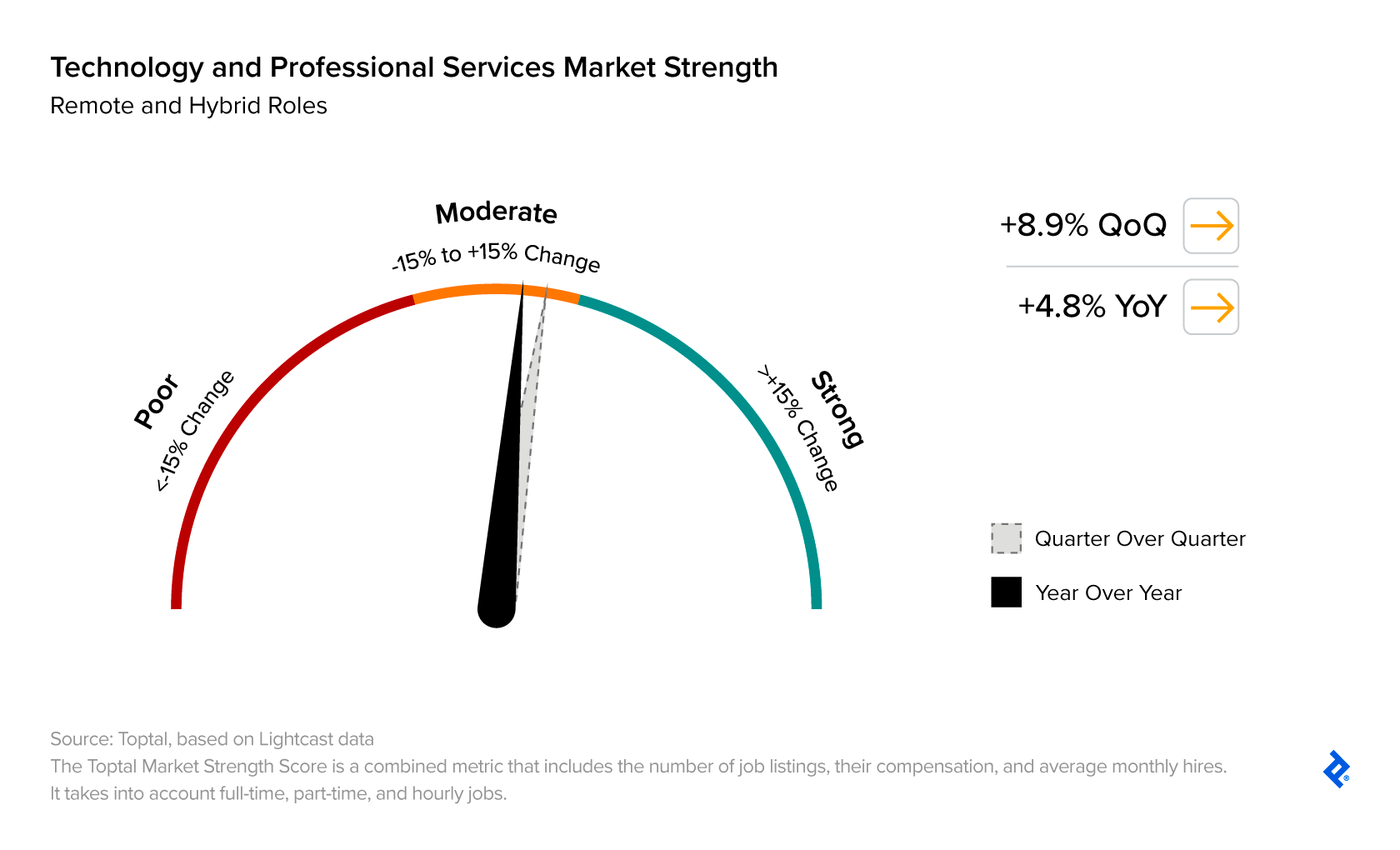
“The first quarter of the year brought genuine growth for skilled technology and professional talent as organizations moved from AI experimentation toward deployment,” says Erik Stettler, Toptal’s Chief Economist and the author of Toptal’s High-skilled Job Report for Q1 2026. “However, stated demand, as measured by new job postings and offered compensation, outpaced actual hiring. Companies are being extremely selective, expecting new hires to have AI fluency, business judgment, strong communication skills, and the ability to drive clear, rapid ROI. That selectivity is important to note because the broader economy is more fragile than some US labor market data suggests.”
Impact of AI
Technology Job Segment Rebounding Amid Continuing Declines in Broader Market
Global job postings across all professions and levels of experience remain lower than they were two years ago. However, postings for software engineers (a useful proxy for the broader technology sector) started to rebound as of the second quarter of 2025, even as the overall market continued on its downward trajectory.
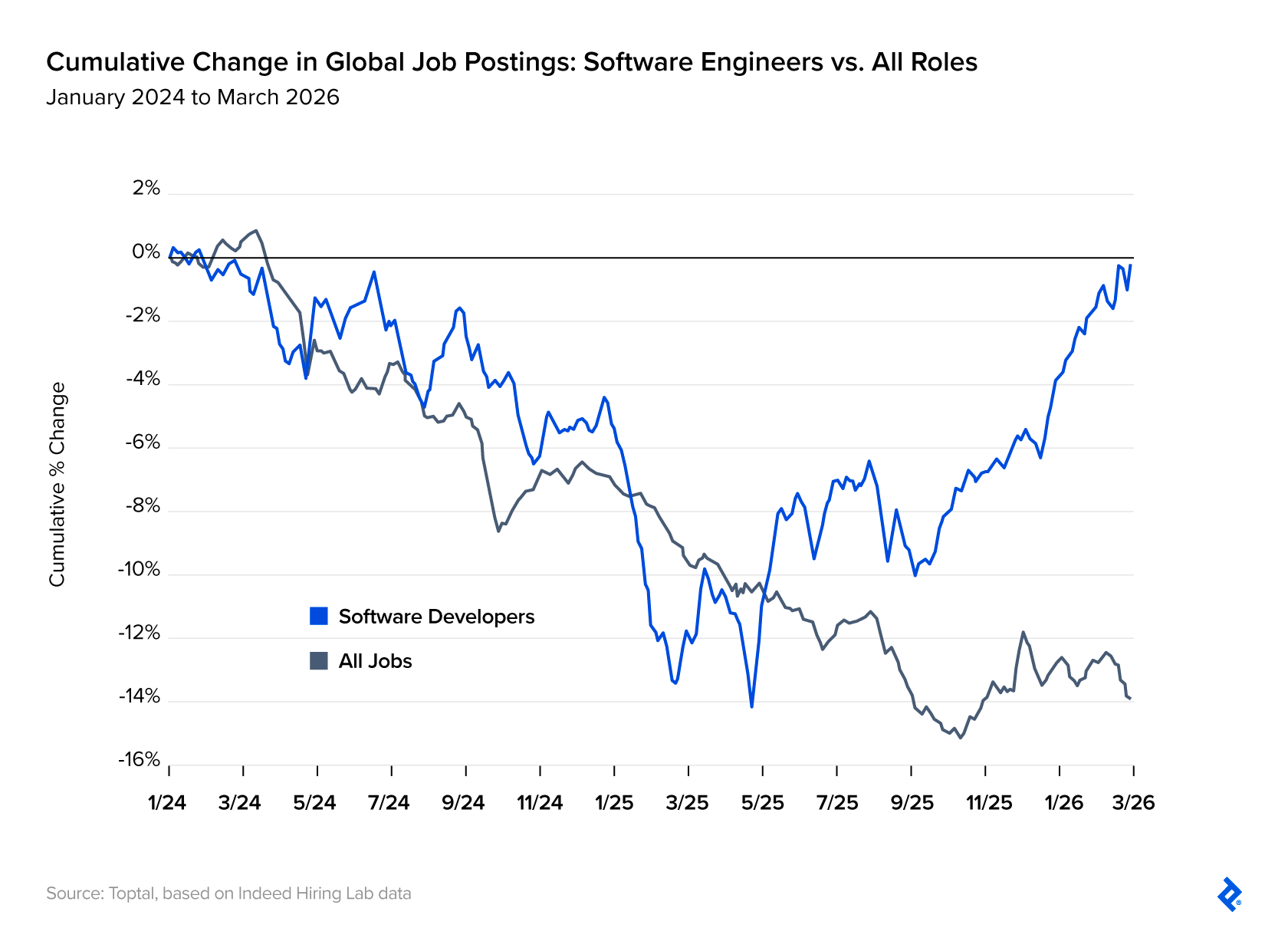
The widespread adoption of AI is prompting companies to embark on initiatives and investments that they wouldn’t otherwise, thereby increasing the need for technical talent. AI is a central force shaping many of the trends in the Q1 2026 labor market, as organizations reevaluate business models, product strategies, and workforce composition. These changes are creating higher demand for experienced talent in certain specializations, while more junior or generalist roles face declines.
Technology Layoffs
Layoffs at Technology Companies Rise Sharply Amid Structural Change
Layoffs at technology companies rose sharply in Q1, increasing 142% compared to Q4 2025. Layoffs also increased 140% YoY (Q1 2026 versus Q1 2025). Oracle’s dismissal of 30,000 workers on the last day of Q1 notably impacted these trends.
While this surge in layoffs may at first seem at odds with the aforementioned rebounding demand for software engineers, it’s important to keep in mind that tech company layoffs apply to all role types, seniority levels, and functions. Because layoff data captures workforce reductions broadly while demand data reflects targeted appetite for specific talent profiles, the two can move in opposite directions simultaneously.
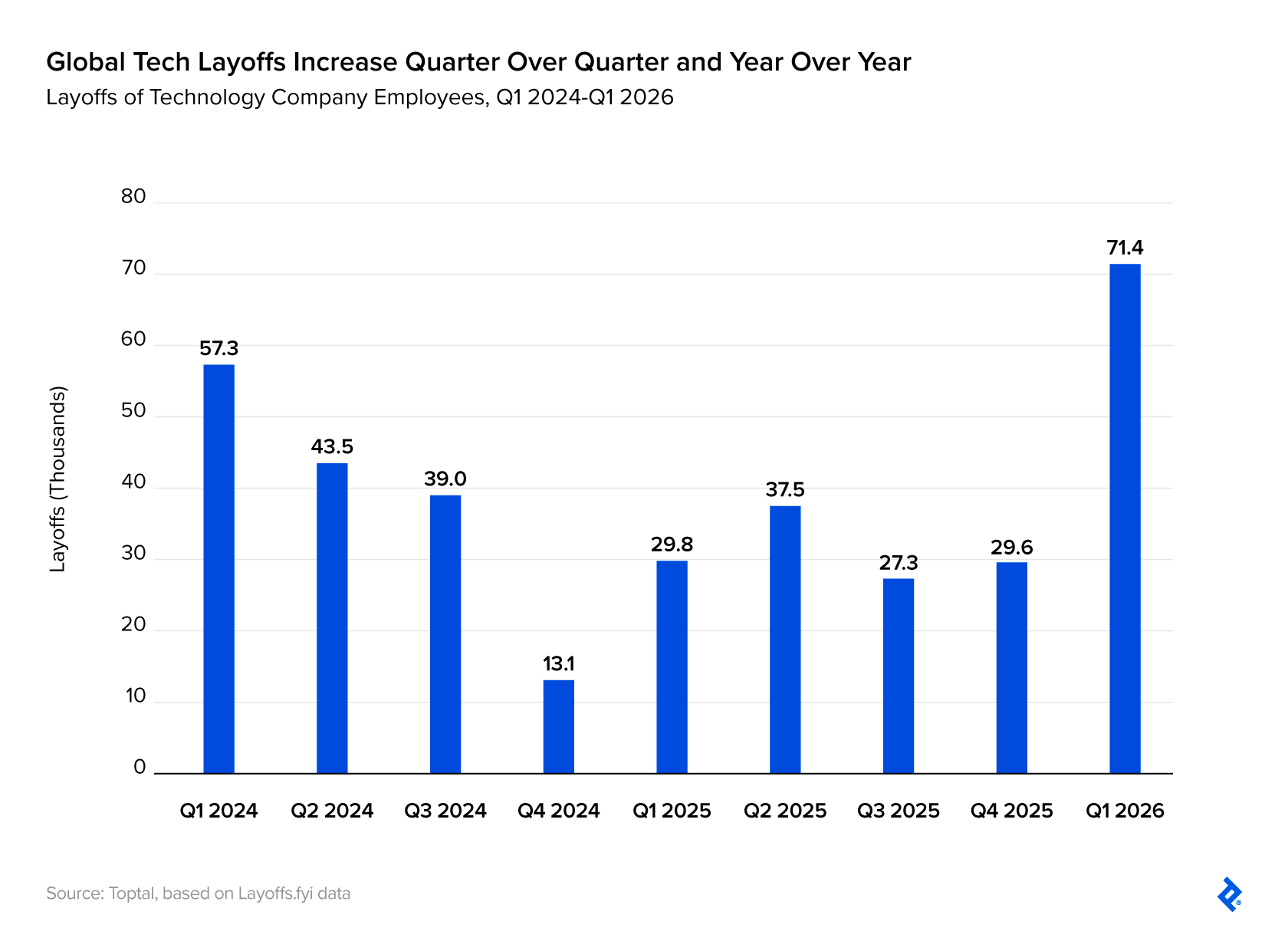
While increasing tech layoffs point to restructuring and volatility in both the technology and broader job markets, they do not, as of Q1 2026, reflect weakening demand for experienced professional services and technology talent.
Demand Overview
Toptal Market Strength Scores for 10 Key Areas of Expertise
Toptal Market Strength Scores are based on job listings, compensation, and hiring, as reported by Lightcast. Below is a table of the scores for remote and hybrid professionals with five or more years of experience in 10 areas of expertise.
A negative change of more than -15% equals a score of Poor, a change between -15% and +15% equals a score of Moderate, and a positive change greater than +15% equals a score of Strong.
Remote/Hybrid Job Market Segment | QoQ Market Strength Score (Q1 2026 versus Q4 2025) | YoY Market Strength Score (Q1 2026 versus Q1 2025) |
Data Science Experts | +12% | +14% |
Designers | +21% | +5% |
Developers | +7% | +1% |
Finance Consultants | +15% | +15% |
Information Security Experts | +20% | -15% |
Management Consultants | +7% | -6% |
Marketing Experts | +6% | +9% |
Product Managers | +15% | +46% |
Project Managers | +8% | -5% |
Sales Experts | +7% | +9% |
Detailed insights for each area of expertise are available in the full report.
International Job Market
Global Job Growth Remains Sluggish, With Australia as a Bright Spot
New job postings for all positions and levels of experience remained soft across the US and most other large economies with comparable data in Q1 2026.
The QoQ trends in new job postings across all professions and work models were as follows:
- Canada, France, Germany, Ireland, the UK, and the US saw declines ranging from 1.5% to 5.3%.
- Australia saw a 4.3% increase and was the only country that experienced QoQ growth.
- Job listings in the eurozone (all countries that use the euro currency) decreased 3.9% QoQ.
The YoY trends in new job postings across all professions and work models were as follows:
- Job postings in Canada, France, Germany, Ireland, the UK, and the US were down.
- Australia recorded a 4.4% YoY increase in job postings.
While demand for experienced technology and professional services talent has clearly rebounded from the Q4 2023 low point, the broader global job market has been slower to turn around.
Change in New Job Postings in Large Global Economies as of Q1 2026 | ||
Country | QoQ Change (Q1 2026 versus Q4 2025) | YoY Change (Q1 2026 versus Q1 2025) |
Australia | +4.3% | +4.4% |
Canada | -5.1% | -1.2% |
France | -5.3% | -20% |
Germany | -5.1% | -11.1% |
Ireland | -4.5% | -11% |
United Kingdom | -5.2% | -11.8% |
United States | -1.5% | -5.3% |
US Job Market Forecast
Projections for Job Growth in Q2 2026
Toptal’s US Job Market Forecast for Q2 2026 is built on a statistical model with predictive value for three key Bureau of Labor Statistics (BLS) employment indices: all US job openings, US professional services job openings, and US information services (i.e., technology) job openings. Our model also has predictive value for the market segment most relevant to Toptal: Remote and hybrid professional services and technology roles that require at least five years of experience. (We use Lightcast data for this projection, because it can be segmented more granularly than BLS information.)
The model is based on proprietary job-posting data from We Work Remotely, the world’s largest remote job board, and several macroeconomic indicators, including the U6 unemployment rate (which captures both unemployment and underemployment), high-yield credit spreads, hiring rates, and inflation-adjusted GDP. The resulting directional signals are then compared to Toptal’s own client demand data for remote and hybrid professionals.
Toptal’s predictive model suggests the following market signals for Q2 2026:
- Job growth for all US roles is projected to decline moderately. BLS data shows that job growth fell by about 12% per year over the last several years. Our model suggests job growth will decline in Q2, but at a smaller magnitude than the BLS average.
- Job growth for US professional services roles is projected to decline moderately. BLS data shows that professional services job growth also fell by about 12% per year for the last several years. Our model suggests job growth in Q2 is likely to continue on this trajectory.
- Job growth for US information services (technology) roles is projected to be effectively flat. BLS data shows that job growth in information services fell at about 22% per year over the last several years. In a departure from the BLS trends, the picture for technology-specific roles is more optimistic: According to our model, job growth for this segment in Q2 2026 will be effectively flat.
- Job growth for experienced remote and hybrid US professional services and technology roles is projected to increase moderately. Lightcast data shows that job growth in this segment rose at a rate of about 25% per year for the last several years. According to our model, job growth for this segment will continue to increase in Q2, but at a smaller magnitude than its historical average.
These signals should be understood as directional indicators, not full predictions. The final state of the US job market in Q2 2026 will depend on additional macroeconomic, policy, and sector-specific factors that are not captured in this analysis.
Methodology
Toptal’s Analysis of the Data
Toptal calculates QoQ and YoY market strength scores based on the change in new job postings, median advertised compensation, and actual hiring activity for technology and professional services personnel with at least five years of experience, as reported by Lightcast. Other trends are calculated based on data from Staffing Industry Analysts, Hacker News, LinkedIn, Indeed, and We Work Remotely, as noted throughout the report.
Please note: Some of the source data changes in real time and may shift slightly between early April 2026, when the calculations were done, and the time of publication. This is common with indices of this kind and typically does not materially affect the trends and major findings.
Some parts of the report have been redacted for public release. If you are interested in the unredacted version please reach out to insights@toptal.com.