High-skilled Job Report for Q4 2025


Erik is a data scientist, management consultant, and Toptal’s Chief Economist. He is a former senior analyst at NERA Economic Consulting and co-founded the global venture capital fund Firstrock Capital. Erik holds an MBA with distinction from Harvard.
Previously At

Table of contents
This is an overview of major findings. Download the full report for more insights.
Key Highlights
State of the High-skilled Work Market
Each quarter, Toptal analyzes job market data relevant to Toptal, the world’s largest fully remote workforce, and the Toptal Talent Network, which includes more than 20,000 highly vetted professionals in technology, design, finance, marketing, and strategic consulting. In addition to monitoring broader global data for quarter-over-quarter and year-over-year trends, Toptal has designed a unique scoring system, the Toptal Market Strength Score, which represents demand for experienced technology and professional services personnel.
Because Toptal and its talent network are fully distributed, we calculate primary scores specifically for the remote and hybrid work market, as well as secondary scores that apply to all work models, including remote, hybrid, and in-office roles.
The scores are based on new job postings, advertised compensation, and actual hiring.
Key findings from the Q4 report, released in January 2026, include the following:
-
Demand for experienced remote and hybrid technology and professional services personnel is strong, increasing 19.8% YoY (Q4 2025 versus Q4 2024). This is despite a slight QoQ decrease of 4%, reflecting an expected year-end slowdown. Full-year data provides additional context, showing a 10.9% increase for 2025 compared to 2024.
-
Demand for experienced remote and hybrid technology and professional services personnel slightly outpaced that of comparable in-office roles, despite highly publicized return-to-office mandates.
-
Highly skilled, senior-level technology and professional services personnel are faring better than generalists or entry-level workers, regardless of work model. Postings for all professions and levels of experience in the US and most other large economies fell by an average of nearly 10% YoY, with the exception of Canada, which increased by 2.4%.
-
AI is a major driver of the trends observed in this report, accelerating a fundamental reshuffling across nearly every sector and prompting companies to reevaluate their business models, product strategies, and the expertise they require.
“The talent market is undergoing a structural shift as organizations redefine how work gets done, finding a balance between AI and human judgment, and between remote flexibility and in-person collaboration,” says Erik Stettler, Toptal’s Chief Economist and the author of Toptal’s High-skilled Job Report for Q4 2025. “This transition is creating real friction between talent supply and demand, and some trends may seem contradictory, such as hiring growth alongside elevated layoffs, or higher demand for senior talent alongside limited pathways for new entrants. But these divergent trends reflect a common reality: Companies are still experimenting, validating ROI, and rebuilding teams around new technology and new ways of working. This turbulence has been challenging, but organizations that build optionality through disciplined experimentation and individuals who combine technical fluency with contextual judgment and strategic insight will be positioned to lead in the emerging equilibrium.”
Remote Work Trends
Demand for Experienced Remote and Hybrid Professionals Remains Strong
Despite large companies like JPMorgan Chase, Dell, and AT&T announcing full-time return-to-office mandates, demand for experienced remote and hybrid technology and professional services professionals remained robust, surging 19.8% YoY, for a Toptal Market Strength Score of Strong.
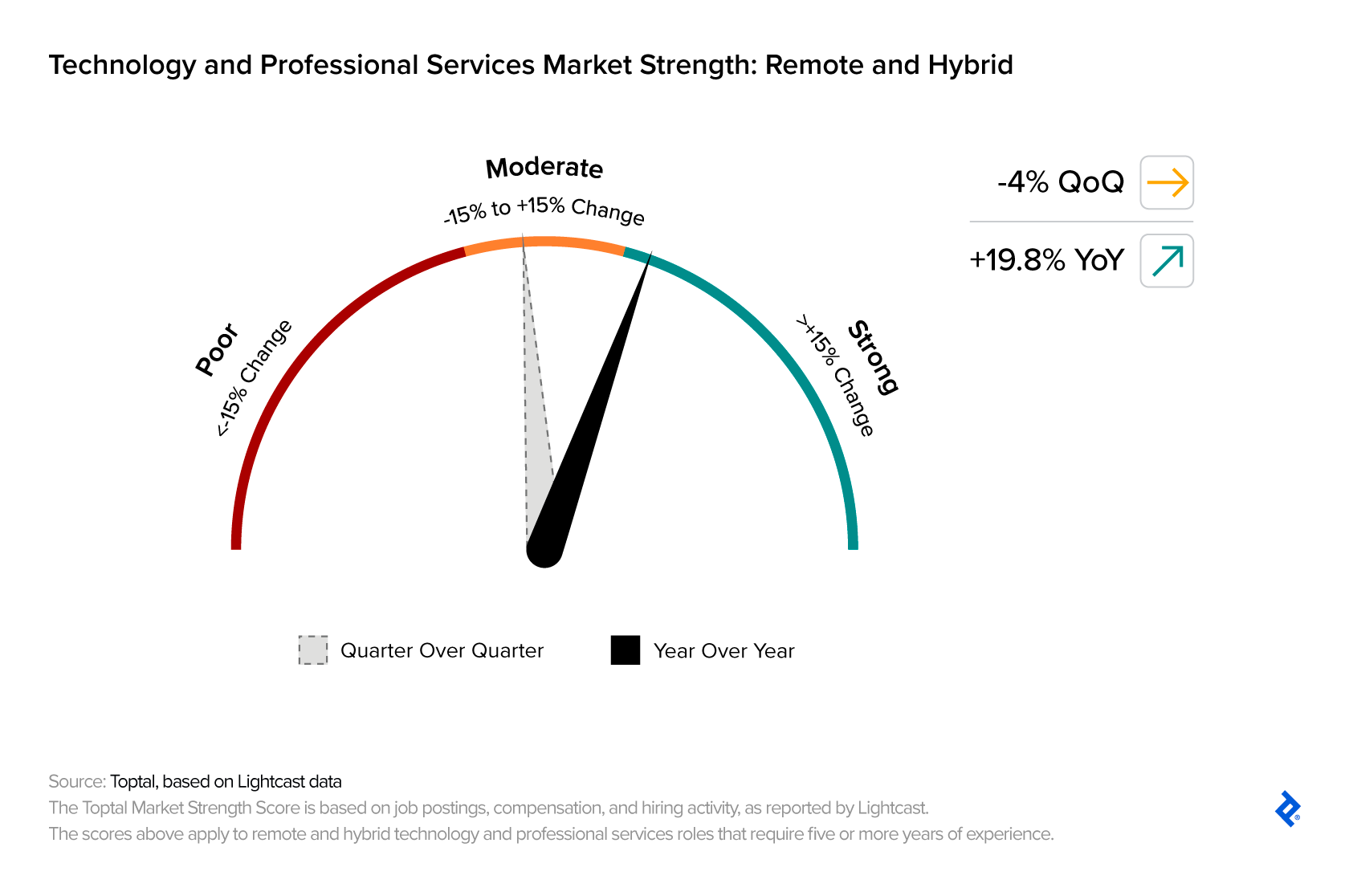
When looking at full-year data (as opposed to comparing quarters), there was a 10.9% increase in market strength for 2025 versus 2024.
The overall technology and professional services market, which includes all work models (remote, hybrid, and in-office), showed extremely similar trends, but slightly underperformed compared to the distributed job market.
Impact of AI
Demand for Data Science Professionals Increases
AI adoption continued to be a defining force in the Q4 2025 labor market, reshaping both demand patterns and the distribution of opportunity across experience levels.
Demand for data science experts, the professionals who provide the building blocks of AI through data collection, cleaning, analysis, and modeling, remained among the strongest of any field in our analysis, with a 32% YoY increase in market strength when comparing Q4 2025 to Q4 2024. When looking at full-year data (as opposed to comparing quarters), there was a 10.4% increase in market strength for 2025 versus 2024.
Similarly, developers, marketing experts, and product managers posted strong YoY market strength scores (all with growth of 30% or higher for Q4 2025 compared to Q4 2025), underscoring where organizations are investing as AI moves from experimentation to scaled deployment:
- Developers to build and integrate AI-powered systems into products and internal tools
- Data scientists and related specialists to enable organizations to design, train, and govern AI models
- Marketing experts to translate AI-driven insights into growth strategies, campaigns, and customer experiences
- Product managers to orchestrate cross-functional teams and ensure that AI initiatives deliver measurable business value
Demand Overview
Toptal Market Strength Scores for 10 Key Areas of Expertise
Toptal Market Strength Scores are based on job listings, compensation, and hiring, as reported by Lightcast. Below is a table of the scores for remote and hybrid professionals with five or more years of experience in 10 areas of expertise. The YoY scores compare data from Q4 2025 to data from Q4 2024.
A negative change of more than -15% equals a score of Poor, a change between -15% and +15% equals a score of Moderate, and a positive change greater than +15% equals a score of Strong.
QoQ Market Strength Score (Q4 2025 versus Q3 2025) | YoY Market Strength Score (Q4 2025 versus Q4 2024) | |
Data Science Experts | -11% | +32% |
Designers | -8% | -2% |
Developers | -6% | +30% |
Finance Consultants | -5% | +1% |
Information Security Experts | -14% | -2% |
Management Consultants | -7% | -2% |
Marketing Experts | +2% | +33% |
Product Managers | -3% | +30% |
Project Managers | -3% | +6% |
Sales Experts | -5% | +12% |
Detailed insights for each area of expertise are available in the full report.
Technology Layoffs
Tech Layoffs Remain Elevated Amid Structural Change
Tech layoff trends remain a critical early indicator of the health and direction of the broader high-skilled job market, particularly because the technology sector tends to adopt AI and other new technologies ahead of other industries. Based on Layoffs.fyi data, Toptal finds that:
- Global tech layoffs increased 3% QoQ in Q4 2025.
- Layoffs more than doubled YoY (Q4 2025 versus Q4 2024), but this is because Q4 2024 was an outlier and had the fewest layoffs of any quarter in the past two years by a significant margin. When looking at the full year, we see that the absolute number of workers laid off in all of 2025 was almost 20% lower than the number in 2024: 122,500 versus 152,900.
Despite the fact that fewer workers were laid off in 2025 than in 2024, layoffs remain significantly elevated versus a few years ago. Excluding the Q2 2020 spike, the period from Q1 2020 to Q1 2022 saw approximately 5,800 tech layoffs per quarter, just 20%, approximately, of Q4 2025’s total.
While some laid-off professionals are being absorbed by other sectors, many are still actively engaged in job searches, contributing to a deeper pool of experienced candidates and influencing compensation and negotiation dynamics across the high-skilled market.
International Job Market
Global Job Growth Remains Sluggish, With Canada as a Bright Spot
New job postings for all positions and levels of experience remained soft across the US and most other large economies with comparable data in Q4 2025.
The QoQ trends in new job postings across all professions and work models were as follows:
- Germany, Australia, Ireland, and France saw declines ranging from 0.6% to 3.5%.
- The UK, US, and Canada each posted single-digit increases: 1.5% for the UK, 2.1% for the US, and 5.8% for Canada.
- Job listings in the eurozone (all countries that use the euro currency) decreased 1.3% QoQ.
The YoY trends in new job postings across all professions and work models were as follows:
- Job postings in Australia, France, Germany, Ireland, the UK, and the US were down.
- Canada recorded a 2.4% YoY increase in job postings.
While demand for experienced technology and professional services talent has clearly rebounded from the Q4 2023 low point, especially in remote and hybrid roles, the broader global job market has been slower to turn around, particularly for junior and generalist positions.
Change in New Job Postings in Large Global Economies as of Q4 2025 | ||
Country | QoQ Change (Q4 2025 versus Q3 2025) | YoY Change (Q4 2025 versus Q4 2024) |
Australia | -1.7% | -4.2% |
Canada | +5.8% | +2.4% |
France | -3.5% | -16.6% |
Germany | -0.6% | -11.6% |
Ireland | -2.8% | -10.5% |
United Kingdom | +1.5% | -11% |
United States | +2.1% | -5.9% |
US Job Market Forecast
Remote and Hybrid Hiring as a Leading Indicator for Q1 2026
New to the Q4 2025 report is Toptal’s US Job Market Forecast for Q1 2026. The projection is built on a statistical model with predictive value for three key Bureau of Labor Statistics (BLS) employment indices: all US job openings, US professional services job openings, and US information services (i.e., technology) job openings.
The model is based on four years of job postings for remote and hybrid professionals on We Work Remotely, the world’s largest remote job board, to which Toptal has exclusive access. These patterns are then compared to Toptal’s own client demand data for remote and hybrid professionals over the same timeframe.
As of the end of 2025, Toptal’s model suggests:
- Job growth for all US roles is projected to decline moderately in Q1 2026. BLS data shows that job growth fell at a rate of about 11% per year for the last several years. Our model suggests job growth in Q1 is likely to continue on this trajectory.
-
Job growth for US professional services roles is projected to decline slightly in Q1 2026. BLS data shows that professional services job growth also fell at a rate of about 11% per year for the last several years. Our model suggests job growth for this segment will decline in Q1, but at a smaller magnitude than the BLS average.
- Job growth for US information services (technology) roles is projected to increase in Q1 2026. BLS data shows that information services job growth fell at a rate of about 21% per year for the last several years. But in a departure from the historical trends, and despite predicted declines in all professional services jobs combined, our model suggests technology job growth will be slightly positive in Q1 2026. Potential drivers for this rebound include companies moving beyond AI experimentation to large-scale implementation, professionals reskilling to better meet demand for AI talent, and the market making up lost ground after a period of sharp declines and restructuring.
These signals should be understood as directional indicators, not full predictions. The final state of the US job market in Q1 2026 will depend on additional macroeconomic, policy, and sector-specific factors that are not captured in this analysis.
Methodology
Toptal’s Analysis of the Data
Toptal calculates QoQ and YoY market strength scores based on the change in new job postings, median advertised compensation, and actual hiring activity for technology and professional services personnel with at least five years of experience, as reported by Lightcast. Other trends are calculated based on data from Staffing Industry Analysts, Hacker News, LinkedIn, Indeed, and We Work Remotely, as noted throughout the report.
Please note: Some of the source data changes in real time and may shift slightly between early January 2026, when the calculations were done, and the time of publication. This is common with indices of this kind and typically does not materially affect the trends and major findings.
Some parts of the report have been redacted for public release. If you are interested in the unredacted version please reach out to insights@toptal.com.