High-skilled Job Report for Q3 2025


Erik is a data scientist, management consultant, and Toptal’s Chief Economist. He is a former senior analyst at NERA Economic Consulting and co-founded the global venture capital fund Firstrock Capital. Erik holds an MBA with distinction from Harvard.
Previously At

Table of contents
This is an overview of major findings. Download the full report for more insights.
Key Highlights
High-skilled Job Report for Q3 2025
Each quarter, Toptal analyzes job market data relevant to Toptal, the world’s largest fully remote workforce, and the Toptal Talent Network, which includes more than 20,000 highly vetted professionals in technology, design, finance, marketing, and strategic consulting. In addition to monitoring broader global data for quarter-over-quarter and year-over-year trends, Toptal has designed a unique scoring system, the Toptal Market Strength Score, which represents specific demand for experienced remote and hybrid technology professional services personnel. The scores are based on new job postings, advertised compensation, and actual hiring. We also produce a monthly report with month-over-month analysis of the same trends.
Key findings from the Q3 report, released in November 2025, include the following:
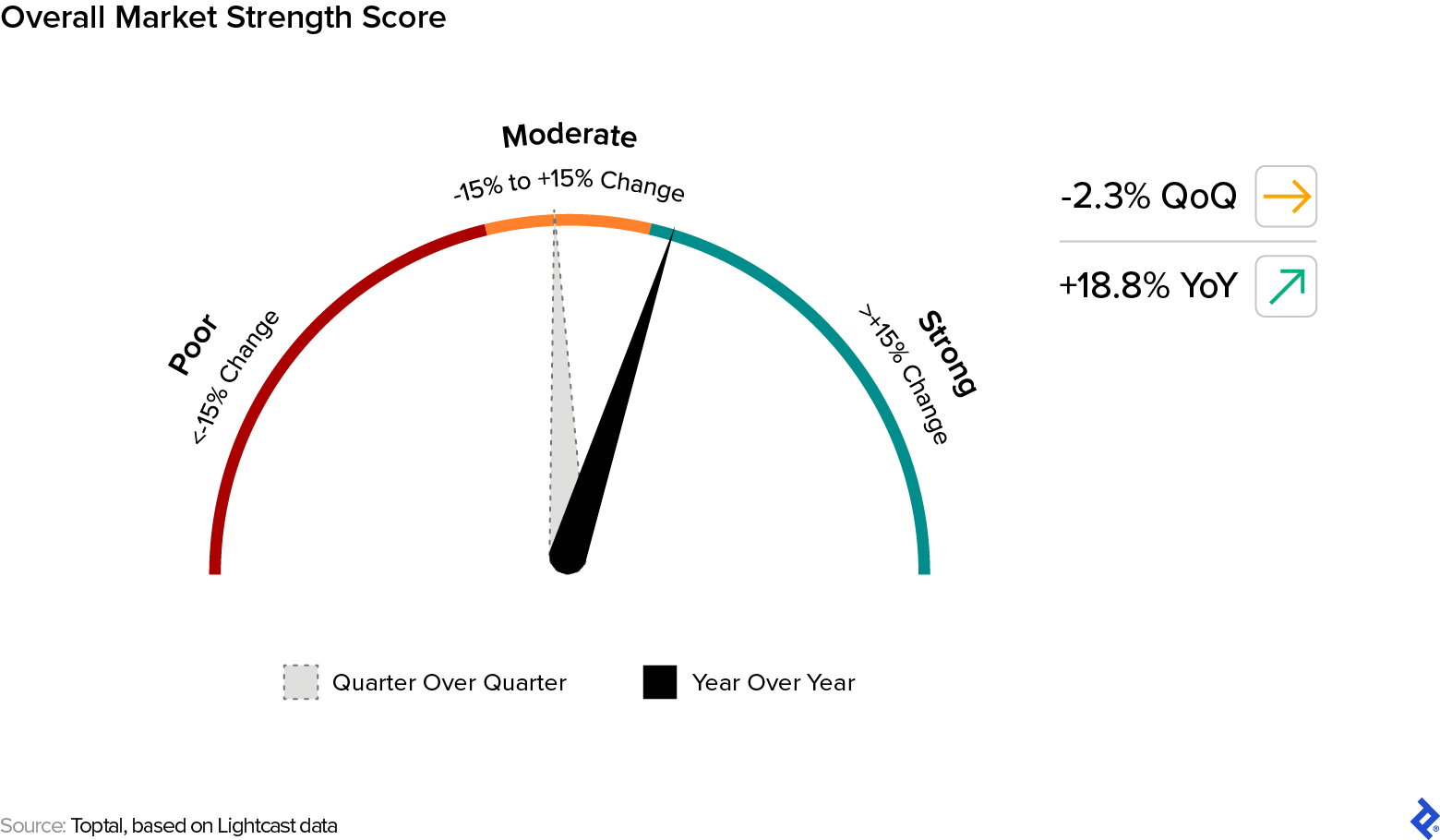
- Demand for remote or hybrid technology and professional services talent with five or more years of experience—as measured by new job postings, advertised compensation, and actual hiring— increased by 18.8% year over year, for a Toptal Market Strength Score of Strong.
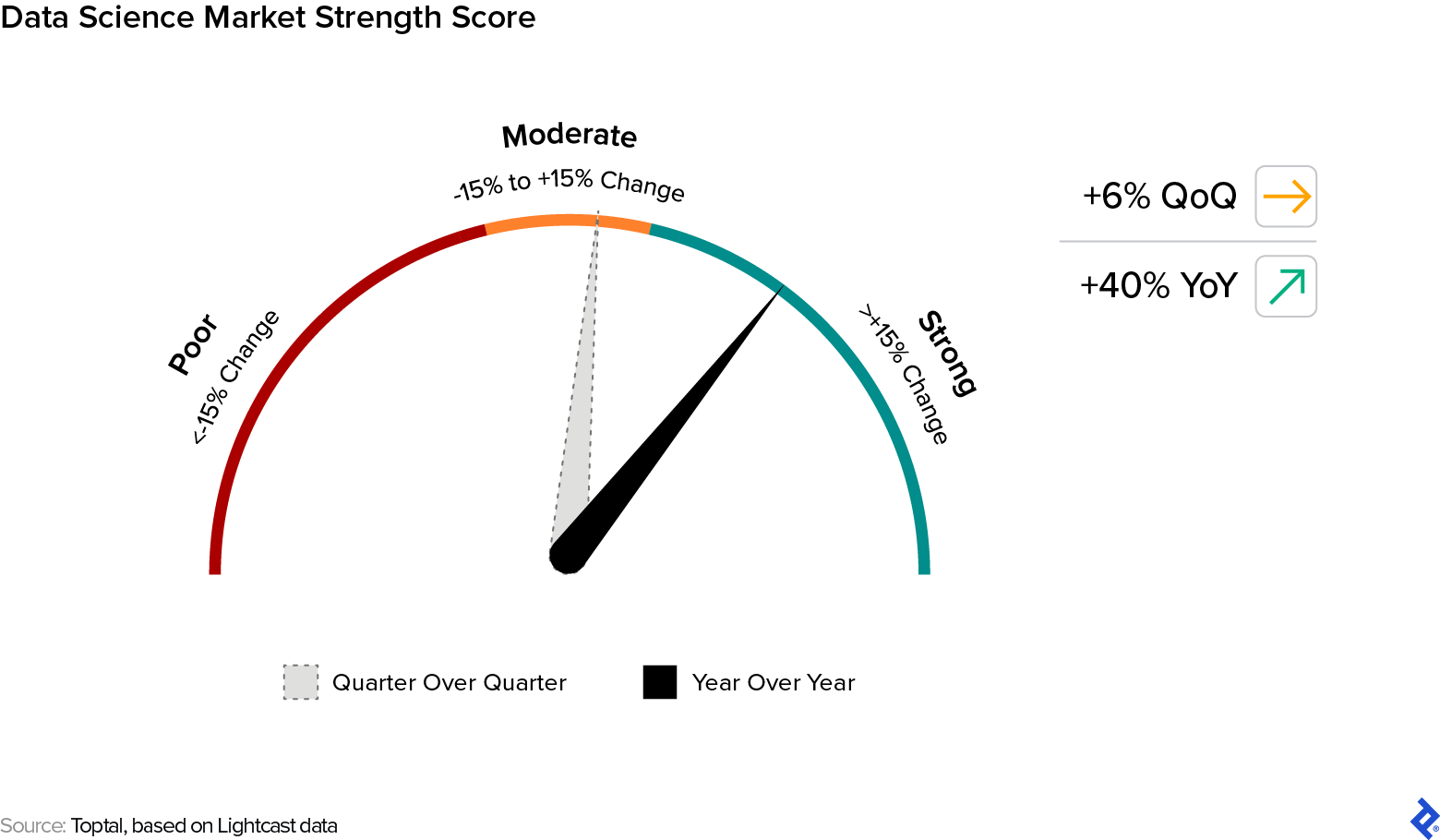
- Data science was the area of expertise that experienced the most growth: Demand surged 40% year over year, for a Toptal Market Strength Score of Strong. Demand for software developers and marketers also scored Strong, with year-over-year growth of 29% for developers and 20% for marketers.
- Demand for information security experts and management consultants was Moderate, declining 7% and 5% year over year, respectively.
- Global technology layoffs declined 28% quarter over quarter in Q3 2025, and remain below Q1’s layoff numbers. (As Toptal’s High-skilled Job Report for Q3 2025 went to press, news of Amazon’s likely layoff of up to 30,000 workers stands to reverse this downward trend.)
- Hiring for all levels of experience in the US technology, information, and media sector decreased 2.8% year-over-year, according to LinkedIn workforce data. At the same time, hiring for experienced remote and hybrid workers in Toptal’s areas of expertise increased by an average of 21%, according to Lightcast data.
- This volatility in the broader technology job market is likely due, in part, to the rapid adoption of AI that is causing technology companies to reevaluate their strategies and seek to fill highly specific roles. AI is negatively affecting junior positions far more than mid- and senior-level ones.
- The US and most other large global economies experienced a year-over-year decrease in new job postings for all professions and levels of experience combined, according to Indeed Hiring Lab data. While demand for experienced remote and hybrid technology and professional services talent has started to rebound from the market low in Q4 2023, the broader market has yet to begin its recovery.
“We are in a third, and more complex, act of the market saga since the onset of the COVID-19 pandemic,” says Erik Stettler, Toptal’s Chief Economist and the author of Toptal’s High-skilled Job Report for Q3 2025. “The current dynamic cannot be labeled simply as ‘up’ or ‘down’ and is best viewed through the lens of transition due to many interacting factors, including the adoption of AI, shifting supply chains, and reorganizing global trade. While this transition has generally manifested as a gradual, if uneven, recovery since early 2024, the most relevant takeaway is the changing market beneath the surface. The portion of technology-related job postings that are AI-related, for example, has doubled over the past two years—and the need for experienced, technology-related remote and hybrid talent is outpacing the general global job market.”
Remote Work Trends
Demand for Experienced Remote and Hybrid Professionals Is Strong
Despite large companies like JPMorgan Chase, Dell, and AT&T announcing full-time return-to-office mandates, the demand for experienced remote and hybrid technology and professional services personnel is on the rise. As of Q3 2025, demand—as measured by new job postings, median advertised compensation, and actual hiring activity—surged 18.8% year over year, for a Toptal Market Strength Score of Strong.
Impact of AI
Demand for Data Science Professionals Surges
Data science provides the building blocks of AI through the collection, cleaning, analysis, and modeling of data. As organizations increasingly build AI into their internal operations and external products and services, the demand for data engineers and machine learning experts continues to soar.
Demand for data science experts was the strongest of any area of expertise in this report, increasing 6% quarter over quarter—despite the typically slower summer months—and 40% year over year, for scores of Moderate and Strong.
This strong performance follows similar trends in Q2 and Q1 of 2025, when year-over-year data science expert demand was up 28% and 32%, respectively. In particular, demand is shifting toward data professionals who can connect technical fluency with business strategy and product insight, according to Toptal leaders.
“Companies are realizing that data is the foundation for the majority of their innovation, but are having difficulty identifying the best ways to use it,” says Brad DeFrank, Director of Delivery and AI Strategy at Toptal. “Given the ongoing strategy gap in AI, demand will likely favor adaptive professionals who can connect the dots between technical fluency, commercial savvy, and product thinking. Analytics in this landscape isn’t about dashboards, it’s about decisions.”
Demand Overview
Toptal Market Strength Scores for 10 Key Areas of Expertise
Toptal Market Strength Scores are based on job listings, compensation, and hiring for remote and hybrid roles in technology and professional services, as reported by Lightcast. A negative change of more than -15% equals a score of Poor, a change between -15% and +15% equals a score of Moderate, and a positive change greater than +15% equals a score of Strong.
QoQ Market Strength Score
| YoY Market Strength Score | |
Data Science Experts | +6% | +40% |
Designers | +11% | +8% |
Developers | -5% | +29% |
Finance Consultants | +3% | +12% |
Information Security Experts | -13% | -7% |
Management Consultants | -9% | -5% |
Marketing Experts | -6% | +20% |
Product Managers | -6% | +13% |
Project Managers | -11% | +3% |
Sales Experts | +4% | +13% |
Detailed insights for each area of expertise are available in the full report.
Technology Layoffs
Tech Layoffs Showed Momentary Stabilization, but Remain Elevated
Tech layoff trends are important to track since the technology sector generally adopts AI and other new technologies first, meaning what is happening in this sector may point to the future direction of other categories. Toptal calculated tech layoff trends based on data reported by Layoffs.fyi, and found that layoffs decreased 28% quarter over quarter—reversing Q2’s 33% increase and landing 4% below Q1.
The news of Amazon’s layoff of up to 30,000 workers has reversed this downward trend for Q4, and technology layoffs remain significantly elevated compared to five years ago. Excluding the Q2 2020 spike in layoffs prompted by the onset of the COVID-19 pandemic, the two-year period from Q1 of 2020 to Q1 of 2022 saw approximately 5,800 layoffs per quarter—just 22% of the total layoffs in Q3 of 2025.
International Job Market
Global Job Growth Is Sluggish, With One Exception
New job postings for all positions and all levels of experience fell in the US and most other large economies with comparable available data, both quarter over quarter and year over year.
The country with the strongest job growth by far, as measured by new openings posted, was Canada, with a 10.7% year-over-year increase in the number of open roles across all industries and seniority levels. The UK performed best quarter over quarter with an increase of 1.7%. France experienced the biggest declines in new jobs posted both quarter over quarter and year over year, with decreases of 6.3% and 16.4%, respectively. These job posting numbers include roles in all professional areas and at all seniority levels, as well as across all work models (remote, hybrid, and in-person).
Change in New Job Postings in Large Global Economies as of Q3 2025 | ||
Country | Quarter Over Quarter | Year Over Year |
Australia | +0.1% | -4.3% |
Canada | -1.6% | +10.7% |
France | -6.3% | -16.4% |
Germany | -1.0% | -11.8% |
Ireland | -3.2% | -9% |
United Kingdom | +1.7% | -12% |
United States | -2.6% | -9.2% |
Methodology
Toptal’s Analysis of the Data
Toptal calculates quarter-over-quarter and year-over-year market strength scores based on the change in new job postings, median advertised compensation, and actual hiring activity for technology and professional services personnel with at least five years of experience, as reported by Lightcast. Other trends are calculated based on data from Staffing Industry Analysts, Hacker News, LinkedIn, and Indeed, as noted throughout the report.
Given that Toptal itself is a fully distributed company, and the Toptal Talent Network is a remote workforce, we filter job posts, compensation, and hiring data for remote or hybrid positions whenever possible, and Toptal Market Strength Scores are specifically applicable to this flexible work market.
Please note: Some of the source data changes in real time and may shift slightly between early October 2025, when the calculations were done, and the time of publication. This is common with indices of this kind and typically does not materially affect the trends and major findings.
Some parts of the report have been redacted for public release. If you are interested in the unredacted version please reach out to insights@toptal.com.