
What Does a CFO Do? The Evolving Role and Responsibilities
The modern CFO is more than just the organization’s financial steward. They are a strategic partner who helps leaders navigate uncertainty and allocate capital with confidence.

The modern CFO is more than just the organization’s financial steward. They are a strategic partner who helps leaders navigate uncertainty and allocate capital with confidence.

Jan is a fractional CFO and chartered accountant who helps startups and growth-stage companies strengthen their financial operations. With expertise in financial modeling, budgeting and forecasting, cash-flow management, and investor reporting, his work equips founders with the financial insight they need to make confident decisions as their businesses scale.

Previous Role
Chief Financial OfficerThe chief financial officer (CFO) was once viewed primarily as the organizational scorekeeper. Their job was to maintain the books, manage financial controls, and then surface at the end of each month with the reports that told leadership how the business had performed. While those responsibilities remain foundational, they no longer fully define the role.
Modern CFOs increasingly operate as strategic partners to the CEO and executive team, shaping the direction of the business rather than simply tracking its results. According to a 2025 Deloitte survey of more than 1,300 CFOs and senior finance leaders, 57% of respondents ranked themselves among the top executives shaping enterprise strategy. The shift has been underway for more than a decade, but economic volatility and the pressure to make sound decisions around AI investment have only intensified it.
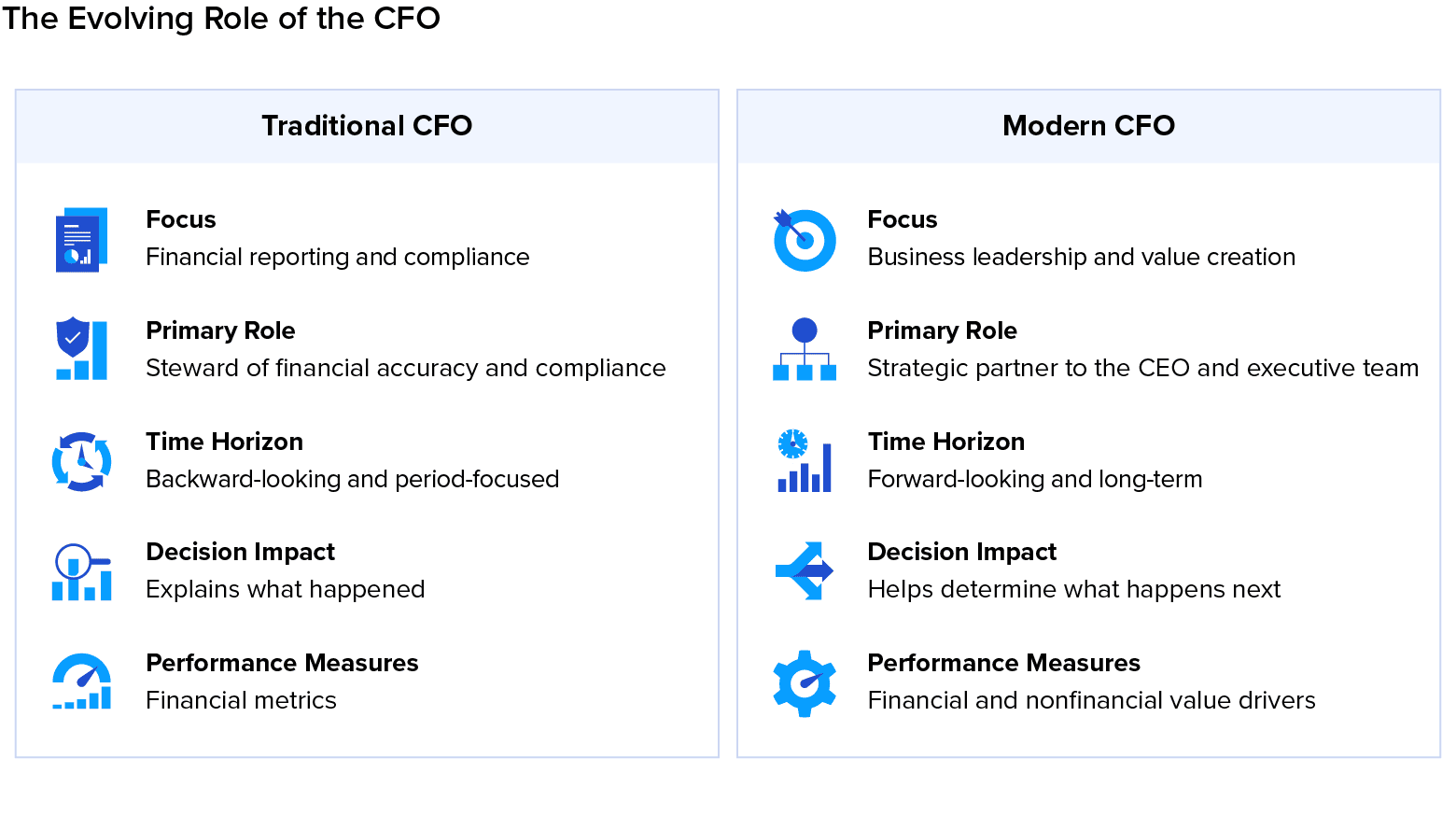
Having served as CFO across industries as diverse as healthcare, fintech, and agribusiness, I’ve seen this transformation play out in very different organizations and contexts. In this article, I’ll explore what modern finance leadership actually looks like in practice and what it will take to succeed in the role going forward.
What Does a CFO Do for a Company?
The CFO remains responsible for maintaining the integrity of financial information, overseeing accounting operations, managing risk, and safeguarding the organization’s balance sheet. These traditional CFO duties are as important as ever, but today’s finance leaders are also expected to help answer some of the most consequential questions any organization faces:
- Where should we invest, and what return can we realistically expect?
- How do we pursue growth without overextending the business?
- Which technologies are worth the investment?
- How do we manage risk in an environment defined by volatility and uncertainty?
- How do we measure and report on both financial and nonfinancial performance in ways that build long-term stakeholder trust?
These are not questions that sit neatly within a single function. While larger organizations often rely on financial controllers, treasury managers, and financial analysts to oversee specialized areas of finance, the CFO is uniquely positioned to connect financial insight with enterprise-wide strategy, helping leadership teams pursue growth ambitions while building long-term resilience.
That strategic function is valuable regardless of organization size. Early-stage companies and high-growth startups face many of the same fundamental questions as larger enterprises, often with less financial cushion and less room to course-correct if a major decision goes wrong. For founders and CEOs alike, experienced financial leadership can be the difference between a well-considered decision and a costly one, particularly when the stakes are highest and the margin for error is smallest.
The 4 Pillars of the Modern CFO Role
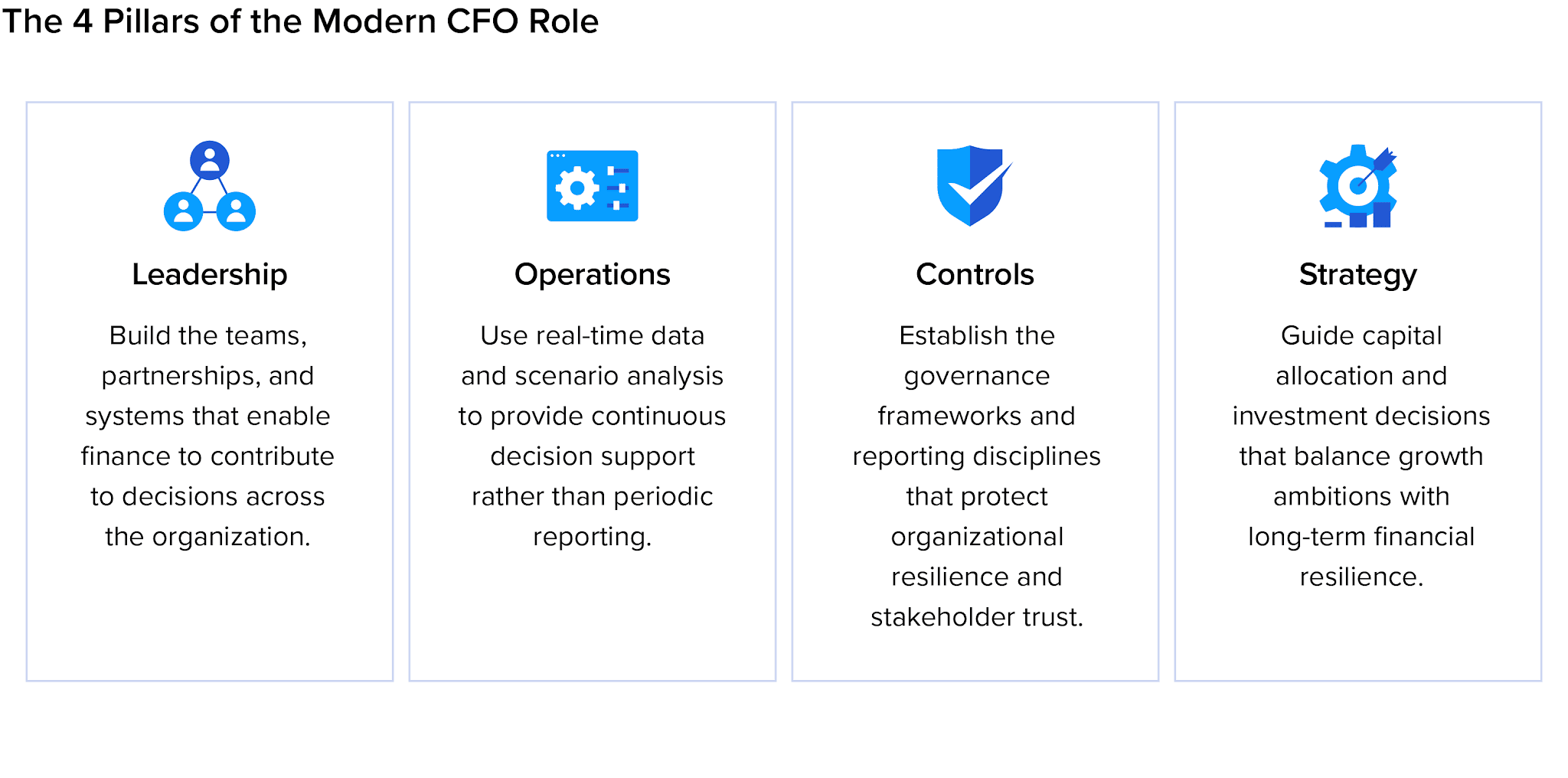
The modern CFO role is built around four core pillars: leadership, operations, controls, and strategy. These pillars are not new, but the expectations attached to each one have changed considerably as the role of CFO has expanded.
1. Leadership: Building Modern Finance Functions
The CFO’s leadership responsibility begins with a straightforward yet demanding question: Have I built a finance function capable of contributing to the decisions that matter most? That means assembling the right team, cultivating strong partnerships across the organization, and creating the processes and systems that allow finance to actively shape how the organization thinks and acts, even as the demands on the function continue to evolve.
Consider a healthcare services company preparing to make a significant technology investment. The business case looks compelling on the surface, but the underlying assumptions haven’t been rigorously tested. Whether finance simply validates the numbers or meaningfully shapes the decision depends almost entirely on what the CFO has built. Does the team have the analytical capabilities to stress-test revenue forecasts? Can it model the impact on cash flow, margins, and capital requirements? Does it have the cross-functional relationships to surface operational or regulatory risks that could affect the outcome?
Those are leadership questions as much as financial ones. CFOs must bring the same discipline to building their teams that they bring to allocating capital. They invest in people deliberately and anticipate the capabilities the organization will need before those needs become obvious.
The CFO’s leadership role: The most effective CFOs approach developing their people and teams with the same intentionality they bring to financial strategy, recognizing that the capabilities of the finance organization directly shape the quality of business decisions.
2. Operations: Driving Performance Through Financial Insight
The operational side of the CFO role centers on ensuring decision-makers across the organization have the right information when they need it. Finance teams have traditionally operated on monthly reporting cycles, producing financial reports after the fact and leaving leadership teams to act on information that was already weeks old.
That model is increasingly inadequate. As organizations generate ever-larger volumes of financial and operational data, finance leaders are expected to provide continuous decision support rather than periodic reporting. Modern reporting platforms give leadership teams real-time visibility into performance, translating financial data into visual dashboards and rolling forecasts that make it easier to identify emerging risks and adjust plans dynamically.
In practice, this requires close collaboration across the organization. Finance leaders work alongside operations, sales, and product teams to understand how day-to-day operational decisions affect profitability and where investment is needed to protect and grow market share. Cloud-based accounting platforms like Xero, along with the reporting and analytics tools that integrate with them, have made this kind of cross-functional financial intelligence more accessible, particularly for smaller organizations.
The shift matters because it redefines what finance is for. The traditional measure of a finance function was the accuracy and timeliness of its reporting. The modern measure is the quality of the decisions it informs. Every forecast, analysis, and report should ultimately help the organization make smarter choices.
The CFO’s operational role: Modern CFOs are transforming finance from a periodic reporting function into a source of real-time decision support, creating the systems and processes that allow finance to shape decisions as they are made rather than explain outcomes after the fact.
3. Controls: Protecting Organizational Resilience and Trust
Governance is not the most visible part of the CFO’s role, but it may be the most consequential. Financial policies and governance structures allow organizations to maintain financial stability and operate with confidence. While audit management, regulatory compliance, and accurate financial statements remain foundational CFO responsibilities, the role is increasingly expected to govern a much broader risk landscape.
Cybersecurity illustrates this shift well. A significant breach carries serious financial consequences, including regulatory penalties, operational disruption, and lasting reputational damage that can affect an organization’s standing with investors and partners. That makes cybersecurity a finance issue as much as a technology one, giving the CFO both a direct stake in reducing exposure and a genuine voice in how the organization prepares for and responds to incidents. The same logic extends to enterprise risks of all kinds, including those arising from AI governance failures or geopolitical disruption.
Effective risk management ultimately depends on governance. Organizations can model countless scenarios, but their ability to respond when conditions change depends on the frameworks they have built in advance. The benefits extend well beyond protection from downside financial risk. By establishing strong governance, the CFO improves forecast quality, supports better decision-making at the leadership level, and builds the kind of credibility with the organization’s investors and board of directors that is difficult to establish any other way.
The CFO’s governance role: The strongest CFOs establish governance frameworks and controls that make strategic ambition sustainable, giving organizations the resilience to navigate disruption and respond to emerging risks with confidence.
Why ESG Reporting Belongs in Finance
Sustainability reporting is one of the clearest ways in which the CFO’s governance responsibilities have expanded in recent years. As investors, regulators, and boards place greater emphasis on sustainability and long-term value creation, environmental, social, and governance (ESG) disclosure has become a meaningful part of the finance function’s remit. Finance teams are well positioned to lead these efforts because ESG disclosure demands the same rigor and accountability as traditional financial reporting, and finance functions already have the disciplines to deliver it.
The most material ESG considerations vary considerably by industry. For example, carbon emissions and environmental impact tend to dominate reporting priorities for manufacturing or energy companies, whereas healthcare organizations often place greater emphasis on workforce safety and equitable access to care. Geography adds another layer of complexity, with reporting expectations and regulatory requirements differing significantly across markets and jurisdictions.
Established frameworks such as those developed by the Global Reporting Initiative (GRI) and the International Sustainability Standards Board (ISSB) provide a consistent baseline in many markets. Elsewhere, particularly in emerging economies where disclosure requirements continue to develop, CFOs often have more discretion in determining what to measure and how to report it credibly.
Regardless of sector or jurisdiction, the underlying discipline is the same. CFOs who treat ESG as an extension of sound governance rather than a stand-alone compliance exercise will be better positioned to meet rising stakeholder expectations and evolving reporting standards.
4. Strategy: Allocating Capital for Long-term Value Creation
Capital allocation sits at the heart of the CFO’s strategic contribution. Every major investment decision represents a commitment of resources that could have been deployed elsewhere, and getting those decisions right is rarely straightforward. The CFO’s role is to ground investment strategy in rigorous financial modeling and to ensure assumptions are realistic rather than convenient, helping leadership teams make better decisions about investment priorities and capital structure.
A recent client engagement illustrates the point. An agricultural business was preparing to invest in a new equipment fleet when an emerging geopolitical conflict drove a sharp rise in fuel prices, introducing a significant variable into the capital budgeting analysis. Rather than relying on the original assumptions, we modeled several fuel-price scenarios to understand how the changing cost environment would affect long-term operating costs and expected returns. Our scenario modeling showed that, despite higher fuel prices, the investment would still generate substantial savings and improve margins. Armed with that insight, the client moved forward with confidence.
Disciplined modeling has only become more important as the capital environment has grown more demanding. Higher funding costs and greater investor scrutiny have raised the bar for investment decisions, requiring organizations to evaluate returns more rigorously and prioritize capital more selectively. CFOs meet that challenge by deploying capital more thoughtfully and maintaining the flexibility to act decisively when the right opportunities emerge.
The CFO’s strategy role: Successful CFOs bring rigorous financial analysis to major capital allocation decisions, so that leadership can evaluate opportunities with greater confidence. They clarify where to invest, when to wait, and whether the risks outweigh the potential return.
How Technology and AI Are Transforming the CFO Role
AI is forcing organizations to make some of the most complex and high-stakes technology investment decisions in a generation, and CFOs are increasingly integral to those conversations. Every major AI investment requires a credible business case, a realistic assessment of the value it will generate, and the governance structures to ensure it delivers. The same discipline applies to decisions about existing technology infrastructure, including the technical debt that many organizations have accumulated and must now address.
Within the finance function itself, AI adoption is becoming the norm. According to a 2025 KPMG study, 71% of organizations are already using AI within finance operations. The most immediate impact has been on routine work: time-consuming tasks like invoice processing and transaction allocation are increasingly automated, freeing finance teams to focus on data analysis and decision support. When combined with enterprise resource planning (ERP) systems and real-time reporting platforms, these technologies provide leadership teams with continuous visibility into performance rather than a monthly snapshot.
Why Data Governance Comes First
While the pace of AI adoption in finance is striking, adoption and value are not the same thing. I’ve found that the organizations getting the most from these tools are those that have invested in the harder, less visible work first: ensuring their internal data is clean and consistent and establishing clear rules for how technology outputs will inform decisions. Without that groundwork, even sophisticated AI systems can produce inconsistent financial analysis and undermine confidence in the insights they generate.
As AI capabilities continue to mature, the CFO’s relationship with technology will need to evolve accordingly. That does not mean taking a hands-on role in development or data science, but it does require developing enough fluency to ask the right questions and critically evaluate the outputs of generative AI tools. That kind of informed skepticism is as valuable as any technical expertise.
What Makes a Successful CFO Today?
CFOs cannot succeed without a strong command of accounting, reporting, and financial management. Yet technical expertise on its own says relatively little about whether a finance leader will operate effectively across the organization. Standout CFOs distinguish themselves through their ability to build trust, communicate with clarity, and shape strategic decision-making.
Cross-functional influence: Successful CFOs understand how value is created in their organization, which operational decisions drive growth, and where the greatest risks lie. That understanding allows them to contribute meaningfully to conversations about business strategy and operations that go well beyond traditional financial oversight. Building that kind of influence requires genuine curiosity about the business and strong cross-functional relationships.
Data literacy and digital fluency: Technology is reshaping how finance teams operate and how organizations make decisions, and CFOs need to understand it well enough to lead through those changes. That requires the judgment and technical fluency to scrutinize the underlying data and distinguish between tools that genuinely improve business decisions and those that merely speed up existing processes.
Communication and credibility: Few capabilities matter more for a CFO than the ability to translate complex financial information into clear, compelling insight. The strongest finance leaders help executives, boards, and operational leaders understand what the numbers mean and how they should inform the decisions the business needs to make. In an environment defined by uncertainty, clarity and context build lasting credibility.
What Successful CFOs Do Differently
- They ask hard questions about the assumptions behind the numbers.
- They earn the trust to influence critical business decisions across the organization.
- They can explain what the financials mean for the business in language that drives action.
- They develop a finance function that shapes how the organization thinks and acts.
- They have a clear point of view on how technology and data can improve how the business operates.
The Future of the CFO Role
The most valuable finance leaders in the years ahead will be those who can pair rigorous financial stewardship with sound strategic judgment. Those who entered the profession as scorekeepers and never updated their conception of the role will find it increasingly difficult to create value. The CFO who embraces a broader mandate as strategic partner and governance leader is the one organizations will rely on to make sound decisions in increasingly complex and uncertain environments.
That kind of strategic financial leadership is no longer reserved for the largest organizations. The rise of the fractional CFO is one of the more meaningful developments in the way financial leadership is delivered today, bringing enterprise-caliber strategic financial leadership to smaller and growing businesses. In my experience, many founders underestimate the value of that partnership or simply don’t realize it’s available to them.
Whatever form financial leadership takes, the CFO role will ultimately be defined by the clarity and conviction brought to difficult decisions and the ability to help organizations think more clearly, act more decisively, and invest more wisely.
Further Reading on the Toptal Blog:
Understanding the basics
A CFO leads an organization’s financial strategy, turning financial data into better business decisions. They oversee budgeting, forecasting, cash flow, reporting, and capital allocation while helping leaders evaluate risks, invest wisely, and plan for sustainable growth.
Typically, yes. The CFO usually reports to the CEO, although both are senior executives who work closely together on financial and strategic decision-making.
Most CFOs build experience across finance disciplines such as financial planning and analysis, controllership, and treasury before progressing into senior leadership roles. Experience in accounting firms or corporate finance teams can provide a path to the role.
Many CFOs hold a university degree and a professional accounting qualification, such as CPA certification or a credential from ACCA or CIMA. Increasingly, the role also demands strong leadership, communication, strategic, and technology skills.
Look beyond technical finance expertise. An effective CFO should be a strong leader, communicator, and strategic partner who understands how the business creates value and can turn financial insight into better decisions.

Cape Town, Western Cape, South Africa
Member since March 19, 2026
About the author
Jan is a fractional CFO and chartered accountant who helps startups and growth-stage companies strengthen their financial operations. With expertise in financial modeling, budgeting and forecasting, cash-flow management, and investor reporting, his work equips founders with the financial insight they need to make confident decisions as their businesses scale.