
Building Faster Prefix Search With the Trie Data Structure
Returning suggestions after every keystroke is expensive when a system stores millions of entries. Find out how the trie data structure narrows each search and the most effective ways to build a working implementation in Java.

Returning suggestions after every keystroke is expensive when a system stores millions of entries. Find out how the trie data structure narrows each search and the most effective ways to build a working implementation in Java.

Menderes is a software developer with nearly three decades of experience. A Java specialist, he’s held senior engineering roles at global enterprises including Amazon and Yahoo, where he built and optimized key features and platform services. Menderes earned a PhD in cognitive science from Middle East Technical University.
Expertise
Previous Role
Senior Software DeveloperPreviously At


Search and text interfaces have conditioned users to expect useful results before they’ve finished expressing what they want. A few characters typed into a search bar can produce a ranked set of queries, while predictive text uses a partially entered word to suggest its completion. Similar forms of prefix matching operate less visibly in spell checkers, dictionaries, routing tables, and other systems that must narrow a large collection of possible results with each new unit of input.
However familiar the experience has become, delivering it at speed is difficult when the system holds millions of stored words or queries. If it compares each new prefix against every stored entry, it must repeat the same large scan after every keystroke and surface suggestions immediately.
Conventional lookup structures work best when the complete search key is already known. Prefix-based systems have less information to work with because the search begins before the full key is known, which changes how the data needs to be organized, since words or queries with the same sequence need to be searchable together.
The trie data structure, also known as a prefix tree or digital tree, organizes keys according to the prefixes they share. Each character forms part of a path through the trie, so words with the same beginning follow the same branches until they diverge. Once a system has traversed the nodes associated with a prefix, it can find possible completions among the descendants of that point. The search is, therefore, dictated by the length of the input, not by the number of entries stored.
Drawing on nearly three decades as a Java developer, including at companies like Yahoo and Amazon, I explore what makes trie-based prefix search efficient, even on a large scale, and which retrieval problems benefit most from that design. I also examine how shared-prefix organization influences performance and memory use, giving other developers a clearer basis for deciding when a trie is the right structure.
Understanding the Trie Data Structure
A trie derives its efficiency from the way it represents the relationships between keys. Where many data structures store each word as a complete value, a trie divides it into a sequence of characters connected through nodes. Keys with the same opening characters use the same nodes, creating a shared route through the trie before branching at the point where the words differ. Understanding this structure explains how a trie can distinguish a complete word from a prefix and limit each search to a relevant path through the stored data.
How a Trie Organizes Data
A trie begins with an empty starting node, called the root, which connects to nodes representing the first characters of the stored keys. Each subsequent level represents the next character in the sequence. In a trie containing “wait” and “water,” for example, both follow the same path through the nodes for “w” and “a.” The paths then separate because the third character in each word is different. The trie stores their common beginning once and creates separate branches only where the words diverge.
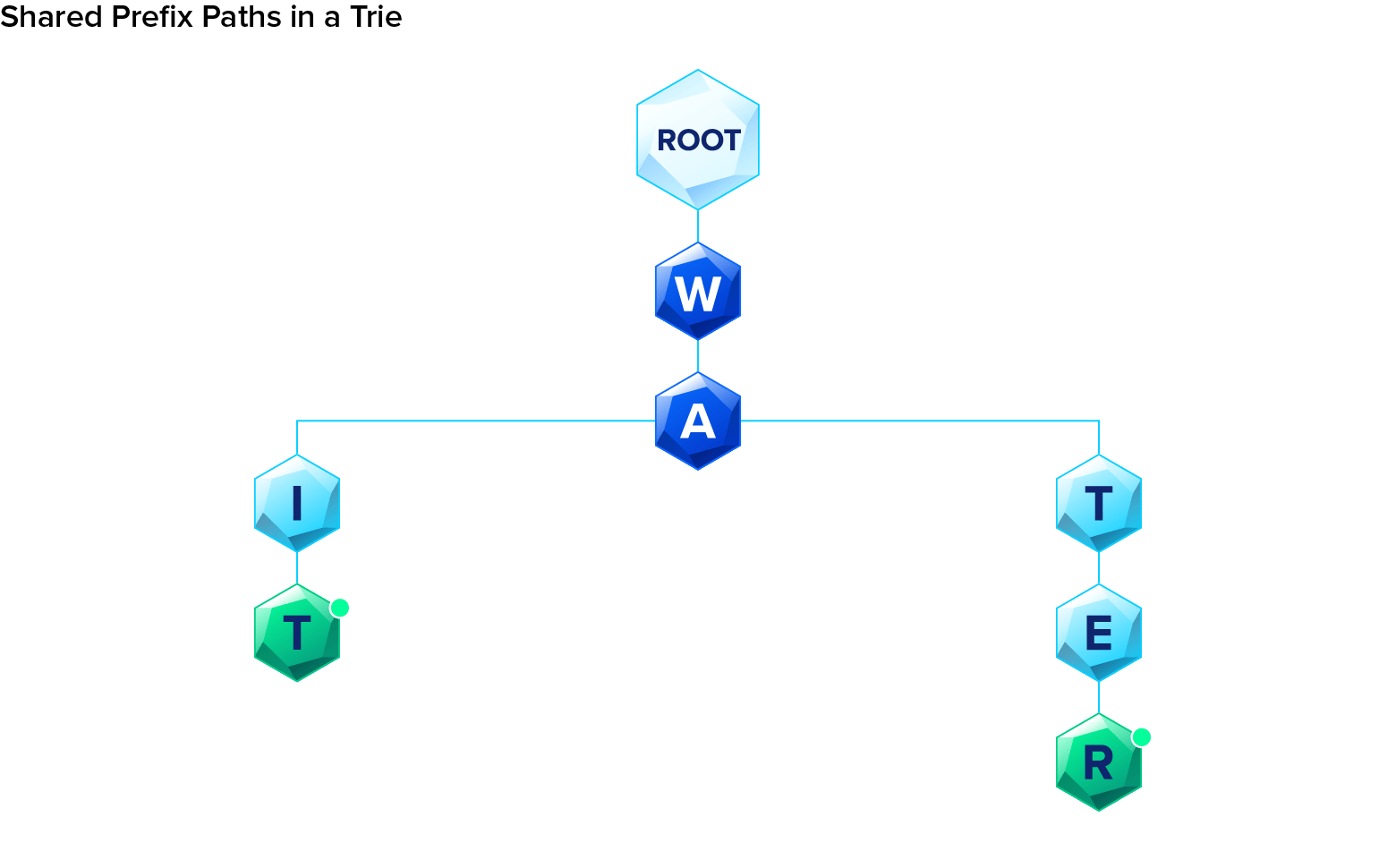
The illustration above shows a path for “wa,” but “wa” isn’t stored as a complete word. To make that distinction, the trie adds a terminal marker wherever a stored word ends. In code, each node typically includes a Boolean field such as isEndOfWord. The field is set to true on the final “t” in “wait” and the “r” in “water,” while it remains false on the “a” node because “wa” is only a prefix.
Core Characteristics of Tries
The character-by-character organization of a trie gives it a different performance profile from structures where each key is a single value. Finding a word or prefix requires the trie to follow one node for each character in the input. The number of stored keys doesn’t directly lengthen that path, so a successful search for a five-character word involves the same number of traversal steps whether the trie contains a few hundred entries or several million.
With each character, the search moves further down one branch and leaves more unrelated keys behind, allowing a prefix query to bypass every branch that can’t contain a match. That progressive narrowing gives tries several defining characteristics:
- Shared prefixes reuse the same path. In a dataset containing many words with a common beginning, the words follow the same nodes until their characters diverge, limiting the number of separate paths the trie must create.
- A complete key can also serve as a prefix. A terminal marker can identify “app” as a stored word while the same path continues through additional nodes for “apple.”
- Ordered traversal can return keys lexicographically. Visiting child nodes in character order produces results in lexicographic order without requiring a separate sorting step.
Case Study: Using Shared Prefixes in an EV Charging System
I used this form of prefix-based organization while working on software for EV charging stations. The system connected software running on each charger to a cloud platform through an intermediary device, which needed to store requests persistently so that processing could resume from the same point after an unexpected interruption.
Every request ID began with the identifier of the device from which it originated. We organized those IDs in a trie according to their shared prefixes, allowing the system to retrieve the requests associated with a particular device using only its ID. The traversal could follow that prefix directly to the relevant group without searching through requests generated by every other device. Each request ID ended with a sequence number that placed it in arrival order when the device’s branch was traversed. After a restart, the intermediary could therefore resume with the next unprocessed request without reconstructing that order.
The requests were held in a small document database because the intermediary device didn’t require the capacity of a large relational system. We separated the persistence layer from the business logic so that we could test four or five database technologies without rewriting the rest of the application. The option we selected required little storage and returned reads within milliseconds under our test conditions. Because requests from the same charger shared its device ID as a prefix, the trie represented that portion of the identifier once and extended the path only for each individual request. After successfully processing a request, we deleted it from the trie and pruned any nodes that were not needed to reach another stored request. This prevented completed work from accumulating on the resource-constrained intermediary device.
Key Trie Operations and Traversal Logic
Trie operations all build on the same character-by-character traversal, with each input character directing the search to the next node. What changes is how the trie interprets or modifies that path, depending on the result the operation needs to produce.
Search Operations
When a system needs to confirm that a complete key is already stored, it performs a search operation. A spell checker, for example, might search a dictionary trie to determine whether an entered word is valid.
To check the candidate word against the stored keys, the trie follows this sequence:
- Begin at the root: The search uses the first character in the input to select the corresponding child node.
- Follow the character path: Each subsequent character determines which child node the traversal visits next.
- Stop when a required node is missing: A broken path confirms that the key is not stored, so the remaining characters don’t need to be processed.
- Check the terminal marker: If a full path exists, the search returns true only when the final node is marked as a complete key. A trie containing “water,” for example, has a valid path for “wat” but an exact search for “wat” returns false unless that prefix was also stored as a word.
Insert Operations
An insert operation occurs when a new key needs to be added to the stored dataset, like updating a dictionary. Because some of the opening characters are likely already stored as part of another key, the operation must preserve the existing path while adding whatever the new entry requires.
The process follows this sequence:
- Begin at the root: The first character determines which child path the insertion should follow.
- Reuse the shared prefix: The insertion follows existing nodes for as long as they match the incoming characters, allowing keys with the same beginning to use a common path.
- Create the missing nodes: When no child corresponds to the next character, the trie adds one and continues extending the path until every character has been represented.
- Complete the new entry: The last node receives a terminal marker so the trie recognizes the path as a stored key.
Delete Operations
A delete operation removes a key when the underlying dataset no longer includes it. If a retailer discontinues a product, for example, its name may need to be removed from the autocomplete trie so it no longer appears in search suggestions. Because several keys rely on the same nodes, the operation must remove the target without breaking the paths used by the remaining entries.
To do this safely, the trie follows this sequence:
- Locate the complete key: The trie follows the character path and checks the terminal marker at the final node. If the path is incomplete or the marker is absent, the key isn’t stored and nothing is deleted.
- Clear the terminal marker: Removing the marker means the path no longer represents the deleted key, although its nodes initially remain in place.
- Remove unused nodes: Starting from the end of the key, the trie works backward and removes nodes that have no children and don’t mark another complete key.
- Preserve shared paths: Cleanup stops when the trie reaches a node that still has children or represents another stored key. This prevents deletion from affecting words that share part of the same path.
Prefix Matching and Traversal Strategies
Prefix matching is used when a system receives part of a key and needs to find the stored entries that begin with it. An autocomplete system, for example, might receive “wat” and return “water.”
To locate possible matches, the trie follows the characters in the prefix until it reaches the corresponding node. If any required node is missing, no stored key begins with that sequence and the search ends.
Many trie implementations provide a method called startsWith for this initial check. It returns true when the complete prefix path exists and false when traversal fails. Autocomplete retrieval continues beyond that point, exploring the descendants of the prefix node and collecting the paths that end at terminal markers.
Sometimes, a system needs to show how many matches exist or place the most frequently selected suggestions first. Developers can support these capabilities through:
- Prefix counters: These record how many stored keys share the path to each node. When the traversal reaches the end of a prefix, the system can read the counter at that node to return the number of matches without exploring every descendant. The counters are adjusted whenever a key is added or removed.
- Selection scores: Each complete key can carry a score based on factors such as how often users select it. Autocomplete systems will compare scores and place the most frequently selected suggestions first.
Time Complexity of Trie Operations
Developers use time complexity to estimate whether a data structure will remain responsive as its inputs grow and to compare it with other ways of organizing the same data. Locating a prefix and returning all of its completions require different amounts of work: An autocomplete system may reach the node for “wat” quickly, but still need to explore a large branch to collect every matching word. Big O notation describes how that work grows without assigning an exact running time, as actual performance also depends on the implementation and the hardware on which it runs.
The table below compares the time complexity of the trie operations covered in this section. It uses “L” for the length of a complete key and “P” for the length of a prefix. For completion retrieval, C represents the number of descendant nodes visited while collecting the results.
Operation | Time Complexity |
|---|---|
Exact Search | O(L) |
Insertion | O(L) |
Deletion | O(L) |
Prefix Check | O(P) |
Retrieve All Completions | O(P+C) |
Implementing a Trie in Java
Implementing a trie in Java begins with deciding how each node will store and retrieve the child that corresponds to the next character in a key. Java implementations commonly manage these connections with arrays or maps, depending on the characters the keys may contain and the amount of memory available.
Starting with the node design, we’ll build a runnable Trie class that uses a HashMap<Character, TrieNode> and supports insertion, exact search, prefix checks, and deletion.
Designing a TrieNode Structure
Every operation in the trie moves through TrieNode objects, so the node design determines how the code finds the next character and recognizes a complete key. Each node needs a collection of child references and a boolean flag indicating whether the path ends at that point.
Java developers generally choose between two ways of storing the child references:
-
Fixed array: An array such as
new TrieNode[26]reserves one position for every lowercase English letter. The code can find a child directly from the character’s position in the alphabet, but every node allocates all 26 references even when it uses only one or two. -
Map: A
Map<Character, TrieNode>creates entries only for child characters that exist. This makes it suitable for sparse nodes, which use only a small proportion of the characters they could potentially contain. A map can accommodate uppercase letters, spaces, and punctuation without assigning each character a fixed position, although that flexibility carries some additional overhead.
Child nodes can also be held in a linked list. This avoids allocating a fixed array, but finding a particular character may require checking the children one at a time. Maps generally provide a more practical option when nodes may have several children.
import java.util.HashMap;
import java.util.Map;

private static final class TrieNode {
    private final Map<Character, TrieNode> children = new HashMap<>();
    private boolean endOfWord;
}
The children map associates each possible next character with the node that continues its path. Java collections require object types as generic arguments, so the map uses the Character wrapper for the primitive char type. The node doesn’t need to store its own character because the parent map already holds that information. The endOfWord field remains false until an inserted key ends at the node, at which point the insert operation changes it to true.
An ordinary class works better than a Java record for TrieNode because insertion and deletion must change its endOfWord field. Records are designed primarily as concise data carriers whose component fields can’t be reassigned, making them more suitable for values such as an autocomplete result containing a word and its score:
private record Suggestion(String word, int score) {}Implementing Insert, Search, and startsWith
The Trie class owns a root node that anchors every stored path. Its insert method adds or extends those paths, while a private findNode method handles the traversal shared by exact searches and prefix checks. Centralizing that logic keeps search and startsWith consistent and allows them to apply different conditions to the final node.
The following runnable example builds a Trie class with insertion and lookup methods. Save it as Trie.java:
import java.util.HashMap;
import java.util.Map;
import java.util.Objects;

public class Trie {
    private static final class TrieNode {
        private final Map<Character, TrieNode> children = new HashMap<>();
        private boolean endOfWord;
    }

    private final TrieNode root = new TrieNode();

    public void insert(String word) {
        Objects.requireNonNull(word, "word");

        TrieNode current = root;

        for (char character : word.toCharArray()) {
            current = current.children.computeIfAbsent(
                    character,
                    key -> new TrieNode()
            );
        }

        current.endOfWord = true;
    }

    public boolean search(String word) {
        TrieNode node = findNode(word);
        return node != null && node.endOfWord;
    }

    public boolean startsWith(String prefix) {
        return findNode(prefix) != null;
    }

    private TrieNode findNode(String input) {
        Objects.requireNonNull(input, "input");

        TrieNode current = root;

        for (char character : input.toCharArray()) {
            current = current.children.get(character);

            if (current == null) {
                return null;
            }
        }

        return current;
    }

    public static void main(String[] args) {
        Trie trie = new Trie();

        trie.insert("water");
        trie.insert("watch");

        System.out.println(trie.search("water"));    // true
        System.out.println(trie.search("wat"));      // false
        System.out.println(trie.startsWith("wat"));  // true
        System.out.println(trie.startsWith("wax"));  // false
    }
}
Compile and run it with:
javac Trie.java
java Trie
The program should print:
true
false
true
false
The implementation works like this:
-
rootanchors the trie: It contains no character of its own and provides the starting point for every operation. -
insertbuilds the required path:computeIfAbsentreturns the child node if it already exists or creates one when it’s missing. Keys with the same prefix therefore reuse the nodes already present. -
findNodehandles read-only traversal: It follows the supplied characters and returns the final node. If a required child is missing, it returnsnull. -
searchandstartsWithinterpret that node differently:searchalso checksendOfWordbecause it needs an exact key, whilestartsWithonly checks that the complete prefix path exists.
Each method processes the input once, so its running time depends on the number of characters supplied. The example also treats keys as case-sensitive and rejects null inputs. A production implementation should decide whether to normalize capitalization or apply other input rules before storing and searching keys.
Implementing Delete Logic
Deletion needs to determine whether the key exists and which parts of its path can be removed safely. The public delete method first checks for an exact match, then passes the confirmed key to a recursive helper that works through the path and removes any nodes no longer in use.
Add the following methods to the runnable Trie class from the preceding section:
public boolean delete(String word) {
    Objects.requireNonNull(word, "word");

    if (!search(word)) {
        return false;
    }

    deleteNode(root, word, 0);
    return true;
}

private boolean deleteNode(TrieNode current, String word, int index) {
    if (index == word.length()) {
        current.endOfWord = false;
        return current.children.isEmpty();
    }

    char character = word.charAt(index);
    TrieNode child = current.children.get(character);

    boolean removeChild = deleteNode(child, word, index + 1);

    if (removeChild) {
        current.children.remove(character);
    }

    return current.children.isEmpty() && !current.endOfWord;
}
The helper moves forward through the key until it reaches the terminal node, where it clears endOfWord. As each recursive call finishes, the code works backward through the path and checks whether the node it has just left is still needed. A child can be removed only when it has no children of its own and does not mark another complete key.
This condition preserves overlapping entries. If the trie stores both “water” and “watch,” deleting “water” removes only the nodes that belong exclusively to that word; the shared path and the branch leading to “watch” remain intact.
End-of-word markers also protect keys that form prefixes of longer entries. If the trie stores both “app” and “apple,” deleting “apple” stops cleanup when it reaches the node marking “app” as a complete key. Deleting “app” clears its terminal marker but preserves the remaining path because “apple” still depends on it.
Add these lines to the end of main to test the method:
System.out.println(trie.delete("water")); // true
System.out.println(trie.search("water")); // false
System.out.println(trie.search("watch")); // true
System.out.println(trie.delete("wat"));   // false
The additional output should be:
true
false
true
false
Implementing Tries Across Programming Languages
Insertion, search, and deletion follow the same traversal logic across programming languages, although the data structures used to store child nodes vary. The representation of those child nodes influences how easy the code is to read and adapt. It also determines the memory required at each node and the work involved in finding the next character.
The comparison below shows the representation commonly used in each language and the practical trade-offs it introduces.
Language | Typical Child Representation | Practical Trade-off |
|---|---|---|
Java | Map<Character, TrieNode> or TrieNode[]
| A map produces adaptable code that can accept varied characters, but HashMap entries and boxed Character keys add memory overhead. An array avoids hashing and provides direct access, although it limits the implementation to a predefined alphabet. |
Python | dict[str, TrieNode] | Dictionaries make the trie concise and easy to modify, but each node and dictionary entry consumes substantial memory. Dynamic dictionary lookups can also add traversal overhead in a large trie. |
JavaScript | Map or an object | A Map provides a clear interface for adding and retrieving child nodes, while objects offer familiar property access. Both rely on dynamically managed structures, and the implementation must handle character iteration carefully when keys contain Unicode characters. |
C++ | std::unordered_map<char, std::unique_ptr<TrieNode>> or std::array | Arrays and explicit memory management can reduce traversal and allocation overhead, but the code becomes more detailed because node ownership must be defined. An unordered map supports sparse branches at the cost of hashing and additional storage per entry. |
Trie Memory Usage and Performance Trade-offs
Theoretical lookup time doesn’t indicate whether a trie will perform well once implemented. Every character traversed corresponds to a node that occupies memory and must be accessed during the search; when a large dataset produces millions of sparsely connected nodes, the resulting structure can consume substantial space and make each traversal step more expensive. The benefit of a short search path ultimately depends on whether the implementation can represent and access those nodes efficiently.
Why Tries Can Become Memory Intensive
A trie’s memory use is distributed across its nodes, which can make the total easy to underestimate. A single node may appear lightweight, yet a large dictionary creates another whenever a key introduces a character path that isn’t already present. Memory use is, therefore, influenced by the number of nodes the dataset requires and the amount of space attached to each one.
Several features of the structure can increase the memory needed:
- Fixed child arrays reserve capacity that most nodes never use. An array with 26 positions provides one for every lowercase English letter, but a node with a single child leaves the other 25 references empty. Repeating that allocation throughout the trie creates substantial unused capacity.
- Larger alphabets increase the size of fixed arrays. Supporting uppercase letters or punctuation requires more positions at every node. Character sets with far more possible values make a fixed position for each one impractical.
- Each node carries its own storage overhead. Alongside its child references, a node may contain a terminal marker and the structure used to manage its children. Languages and runtimes can add further memory for object bookkeeping or alignment, and those small costs accumulate across the trie.
- Limited prefix sharing produces more independent paths. Datasets whose keys diverge near the beginning require more branches than collections with long common prefixes. Under those conditions, a trie may consume more memory than a hash table or binary search tree storing the same keys.
I pay particular attention to structures that remain in memory for the application’s entire runtime. Temporary working data can be released once an operation finishes, but a trie may continue occupying memory so that its keys remain immediately searchable. As the trie grows, it leaves less memory available for the application’s other operations.
Memory Optimization Techniques for Tries
Trie optimization can reduce the space attached to each node or reduce the number of nodes required to represent the keys. A sparsely branching trie wastes memory inside oversized child structures, while long paths without branches create intermediate nodes that contribute little information of their own. The following optimization techniques allocate child storage more selectively and reduce the number of nodes needed to represent the same keys.
Use Maps for Sparse Child Storage
Maps are most effective when most nodes have few children. As branching becomes denser, the overhead attached to each map entry can outweigh the space saved, making a fixed array more efficient.
Combine a Bitmap With a Compact Child Array
The bitmap records which characters have children, while the array contains only the corresponding node references. When a character is requested, the implementation checks its bit and uses the preceding bits to locate the correct array position. This preserves compact storage without creating a separate map entry for every child.
Limit the Supported Alphabet Where the Application Permits It
A trie built exclusively for lowercase English words can map characters to 26 positions without reserving space for uppercase letters or other symbols. Input should only be normalized when distinctions such as capitalization carry no meaning for the application.
Compress Paths That Contain No Branching Decisions
A sequence of single-child nodes can be represented as one path segment containing several characters. Radix trees and compressed tries apply this technique to reduce node count and shorten traversal.
Share Identical Subtrees in Static Dictionaries
When separate paths lead to exactly the same remaining character sequences, they can reference one stored subtree. This produces a directed acyclic structure rather than a strict tree and makes updates more complicated, so it is best suited to collections that change infrequently.
Change the Child Representation as a Node Becomes Denser
A node may begin with a small list or compact map and switch to an array after it develops enough children for direct indexing to justify the reserved space. This hybrid approach adapts the storage cost to the branching pattern of each node.
Practical Performance Considerations
The time required for a trie query depends on what the system must return and how the relevant branch is structured. The main performance factors include:
- Type of query: An exact search follows one path and checks its terminal marker. Autocomplete involves exploring the nodes below the prefix, so locating the prefix may take far less time than collecting and ranking its competitors.
- Length of input: Every additional character adds another traversal step. A four-character product code therefore requires fewer steps than a twenty-character identifier.
- Distribution of the keys: Shared opening characters allow the trie to reuse one path, but a prefix with thousands of completions can create a large branch to search. Setting a result limit allows the traversal to stop once it’s collected enough suggestions.
- Storage and testing conditions: Nodes stored close together in memory are generally faster to access than nodes scattered across separate locations. Time-complexity analysis can’t account for every implementation and hardware difference, so it’s important to test performance using the kinds of keys and queries the application will handle in reality.
Comparing Tries to Other Data Structures
Tries are designed around prefix traversal, which gives them an advantage when searches begin with incomplete keys. That advantage is not so significant when an application only needs exact matches or must maintain keys in sorted order.
Comparing tries with hash tables and binary search trees shows how the expected searches, the relationships between stored keys, and the available memory should guide the choice of data structure.
Advantages and Disadvantages of Trie Structures
The advantages of using a trie are most apparent with autocomplete, where each new character narrows the search to one branch of stored keys. That organization is less economical when the keys have few prefixes in common, since the trie creates more separate nodes without gaining as much path reuse.
The following table weighs these retrieval benefits against the corresponding memory and implementation costs.
Area | Advantage | Disadvantage |
|---|---|---|
Prefix Retrieval | The trie follows the supplied characters directly to the branch containing possible matches. | Returning every match may require exploring a large number of nodes beneath that prefix. |
Shared Prefixes | Related keys reuse the same opening path, reducing the number of times those characters must be represented. | Keys that diverge near the root create more separate paths and receive less benefit from this reuse. |
Traversal Length | The steps required to locate a key or prefix depend primarily on its length, not the total number of stored keys. | Every character requires a separate node access, and the chosen child representation affects the speed of that access. |
Ordered Retrieval | Visiting child nodes in character order returns the stored keys lexicographically. | Implementations that use unordered maps must sort the child characters before producing ordered results. |
Memory Use | Shared paths can reduce duplication when many keys have prefixes in common. | Node objects, child references, and unused array positions can make a trie larger than a hash table or binary search tree containing the same keys. |
Implementation | Insertion, exact search, and prefix checks use the same basic traversal pattern. | Deletion, ranked autocomplete, and memory optimization require additional logic and testing. |
Trie vs. Hash Table
A hash table uses the complete key to calculate where its value should be stored. This makes it well-suited to exact-match searches, since the lookup can move directly to the expected location after processing the key. A partial key doesn’t provide the same route: The hash calculated for “wat” bears no useful relationship to those calculated for “watch” or “water.” Finding every key with that prefix therefore requires scanning the table or maintaining a separate prefix index.
Hash tables also tend to use less memory when strings have little in common, since they store each key as a complete value instead of creating a node for every character path. This makes a hash table generally preferable when searches use complete keys, while a trie is better suited to workloads driven by prefix retrieval.
Trie vs. Binary Search Tree
A binary search tree stores complete keys according to their relative order. Each comparison sends the search to the left or right branch until it finds the requested key or reaches an empty path. A balanced tree limits the number of comparisons required, but prefix retrieval still needs additional logic to locate the first matching key and continue through the ordered entries until the prefix changes.
That ordering makes binary search trees useful for range queries, such as retrieving all product codes from A100 through A500, and sorted traversal, like listing customer names alphabetically. They may also use less memory than a trie when the stored keys have few opening characters in common. To keep searches efficient, a balanced tree may need to rearrange its nodes after an insertion or deletion so that paths don’t get disproportionately long. Trie updates, on the other hand, follow the characters in the key without reorganizing unrelated branches. A trie is better suited to direct prefix retrieval; a binary search tree is more appropriate when the application needs broader forms of ordered access.
Variants and Optimized Trie Structures
As a standard trie assigns a separate node to every character, long paths with little branching are expensive to store. It’s also designed around complete character strings, so binary keys and substring searches call for different traversal patterns.
Optimized trie variants alter how paths or branches are represented to reduce memory use and support these more specialized forms of retrieval.
Radix Trees and Compressed Tries
A radix tree, also called a compressed trie, replaces a chain of nodes with a single path segment when no branching occurs along that route. If a trie stores “compact,” “compute,” and “computer,” for example, the standard structure creates separate nodes for “c,” “o,” “m,” and “p” before branching to “a” and “u.” A radix tree can store “comp” as one segment and branch only where the words differ.
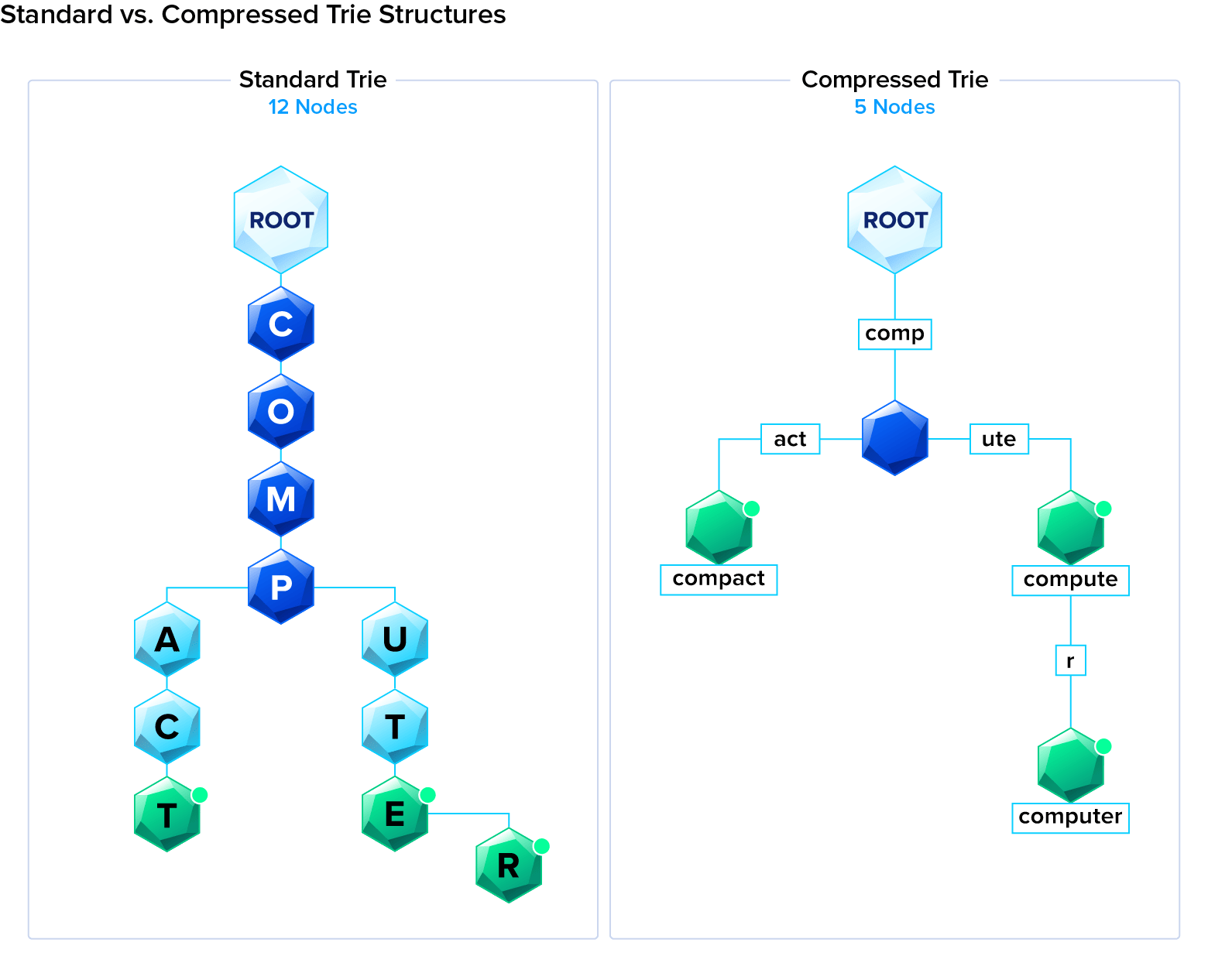
Removing the intermediate nodes reduces memory use and the number of node-to-node movements during traversal. The search must still compare every character in the segment, while insertion and deletion may need to split or combine segments as keys change.
Bitwise Tries and Binary Prefix Trees
A bitwise trie uses the binary digits 0 and 1 as its traversal keys. The values 1010 and 1011, for example, follow the same path through 101 before branching at the final bit. Since every node can have only two children, the structure is well-suited to fixed-length binary values such as IP addresses.
Network routers use this structure to find the most specific routing entry that matches a destination address. If an address matches entries for both 10 and 101, the longer prefix 101 provides the more precise route. This process is known as longest-prefix matching.
Suffix Trees and Specialized Trie Variants
A suffix tree is useful when a system repeatedly searches the same body of text for sequences that may begin anywhere within it. A genomic analysis program can use one to locate many short DNA patterns across a long sequence.
A standard trie can only follow a string from its beginning, whereas a suffix tree stores a compressed representation of the suffix that runs from each position to the end. For “banana,” those portions are “banana,” “anana,” “nana,” “ana,” “na,” and “a.” A search for “ana” follows one path in the tree, which can record that the sequence begins at the second and fourth characters of “banana.” Applied to genomic data, the same structure allows software to index a long DNA sequence once and then locate every occurrence of a shorter pattern without scanning the complete sequence again.
Storing a path from every starting position can require substantial memory, so implementations usually compress sections that contain no branches. The construction and storage costs make suffix trees excessive for ordinary autocomplete or exact-match lookup.
Real-world Applications of Trie Data Structures
The ability to avoid repeated scans of the complete dataset has made tries valuable in systems where retrieval must remain responsive as the number of entries grows. The following examples illustrate some of the most common real-world applications of the trie data structure and examine how each system uses it.
Autocomplete and Predictive Text Systems
Autocomplete and predictive text both use tries to produce suggestions from incomplete input. Autocomplete suggests possible endings for the current word or query, while predictive text may also consider the words that came before it. A trie supports these systems through several related operations:
- Candidate retrieval: The system follows the entered prefix and collects complete keys from the branch below it.
- Suggestion ranking: Stored scores allow the system to prioritize candidates based on factors such as selection frequency or relevance.
- Result caching: Frequently accessed prefix nodes can retain a short list of their highest-ranked suggestions, avoiding a search of the complete branch after every keystroke.
- Ongoing updates: Rankings and cached results must be refreshed as stored entries or user selection patterns change.
Spell Checkers and Dictionary Systems
Spell checking combines exact lookup with a search for plausible alternatives. A dictionary trie can confirm whether an entered word is stored and, when it isn’t, restrict the correction search to character paths that could still produce a valid word. Common uses include:
- Word validation: The spell checker follows the entered characters and accepts the word only if the final node has a terminal marker.
- Correction generation: The traversal tests possible insertions, deletions, or substitutions and abandons a path once it can no longer produce a valid dictionary word.
- Candidate ranking: Frequency values help place common words ahead of less likely corrections.
- Dictionary retrieval: A terminal node can reference information associated with the word, such as its definition or grammatical category.
IP Routing and Network Prefix Matching
Network traffic travels in packets, which are small units of data containing a destination IP address. A router reads that address to determine where each packet should be sent next. Routing tables describe groups of addresses as binary prefixes, and more than one entry may match the same destination. A bitwise trie supports this routing process through the following features:
- Prefix storage: Each marked node represents a network prefix and holds the instruction for forwarding packets that match it.
- Address traversal: The router follows the destination address one bit at a time, moving through the corresponding binary path.
- Route selection: The traversal retains the deepest matching entry it encounters because the longest prefix describes the smallest and most specific address range.
- Path compression: Sections without branches can be stored as longer segments, reducing the number of nodes required for a large routing table.
Choosing When to Use a Trie
The common thread across trie applications is progressive elimination. Each character rules out branches that can’t contain a match, turning partial input into a route through stored data. The same principle supports dictionary searches, network routing, and specialized structures that locate patterns.
Actual performance, though, still depends on how the trie is built. Sparse branches, oversized child arrays, and widely scattered nodes can make an efficient traversal expensive to store and execute. The node representation should therefore reflect how the stored keys branch, reducing unused capacity without making child nodes difficult to locate. Where searches repeatedly depend on prefixes, a trie data structure keeps the work directed toward the relevant part of the dataset from the first traversal step.
Further Reading on the Toptal Blog:
Understanding the basics
A trie data structure is a type of tree that stores keys as sequences of characters or other units. As keys with the same prefix follow a shared path, searches can be narrowed to possible matches with each traversal step.
Use a trie when searches regularly begin with a prefix and the system must retrieve the keys that continue from it. The structure is most effective when many stored keys share opening sequences and available memory can support the required nodes. A hash table is generally simpler when the application searches only for complete keys.
A trie can consume substantial memory because each node carries child references and other storage overhead. When the stored keys share few prefixes, they reuse fewer nodes and create more independent paths, increasing the cost. It may also demand more implementation work than a simpler structure once the application needs to manage deletion or ranked results.

Vancouver, BC, Canada
Member since March 8, 2022
About the author
Menderes is a software developer with nearly three decades of experience. A Java specialist, he’s held senior engineering roles at global enterprises including Amazon and Yahoo, where he built and optimized key features and platform services. Menderes earned a PhD in cognitive science from Middle East Technical University.
Expertise
Previous Role
Senior Software DeveloperPREVIOUSLY AT