
NLP Models for Text Classification: How to Choose and Implement the Right Approach
Text classification can be tackled with a range of approaches, from traditional machine learning techniques to LLMs. Choose an approach that fits the demands of your resources and business case with this guide.

Text classification can be tackled with a range of approaches, from traditional machine learning techniques to LLMs. Choose an approach that fits the demands of your resources and business case with this guide.

Sean is an experienced software developer specializing in natural language processing (NLP) and data science. He has helped companies build complex systems spanning risk optimization, market intelligence, and weather prediction. Sean is also an AI/ML instructor at John Hopkins University and MIT Professional Education.
Expertise
Previous Role
AI/ML InstructorPreviously At


When a customer submits a support request, text classification determines what the message is about and routes it to the right team without waiting for someone to read it first. The same technology processes enormous volumes of unstructured text every day, identifying patterns that allow documents, messages, and other written content to be categorized automatically. The ability to impose structure on language has made text classification valuable across a broad range of natural language processing (NLP) systems.
The arrival of large language models (LLMs) has made text classification much easier to achieve. Tasks that once required a specialized NLP model can often be handled by calling an LLM through an API and providing instructions for analysis or classification. As a result, a dedicated text classification model is now necessary for a narrower range of tasks.
This article examines the main approaches to NLP text classification, the problems traditional classifiers still solve well, and when their advantages justify a machine learning engineer building a dedicated text classification model instead of reaching for an LLM.
What Is Text Classification in NLP?
Text classification is an NLP task that assigns predefined categories to written language based on its meaning or content. In sentiment analysis, for example, those categories might simply be positive and negative, with each review assigned a label according to the sentiment it expresses.
Traditional classifiers learn to make distinctions from previous labeled reviews, identifying patterns in the language associated with each category. With an LLM, task-specific training may not be necessary; the categories and instructions for applying them can be provided to the model directly.
The task can be applied to anything from a single sentence to an entire document, depending on what needs to be classified. Each piece of text might be assigned a single label or multiple labels when categories overlap.
Applications of Text Classification in NLP
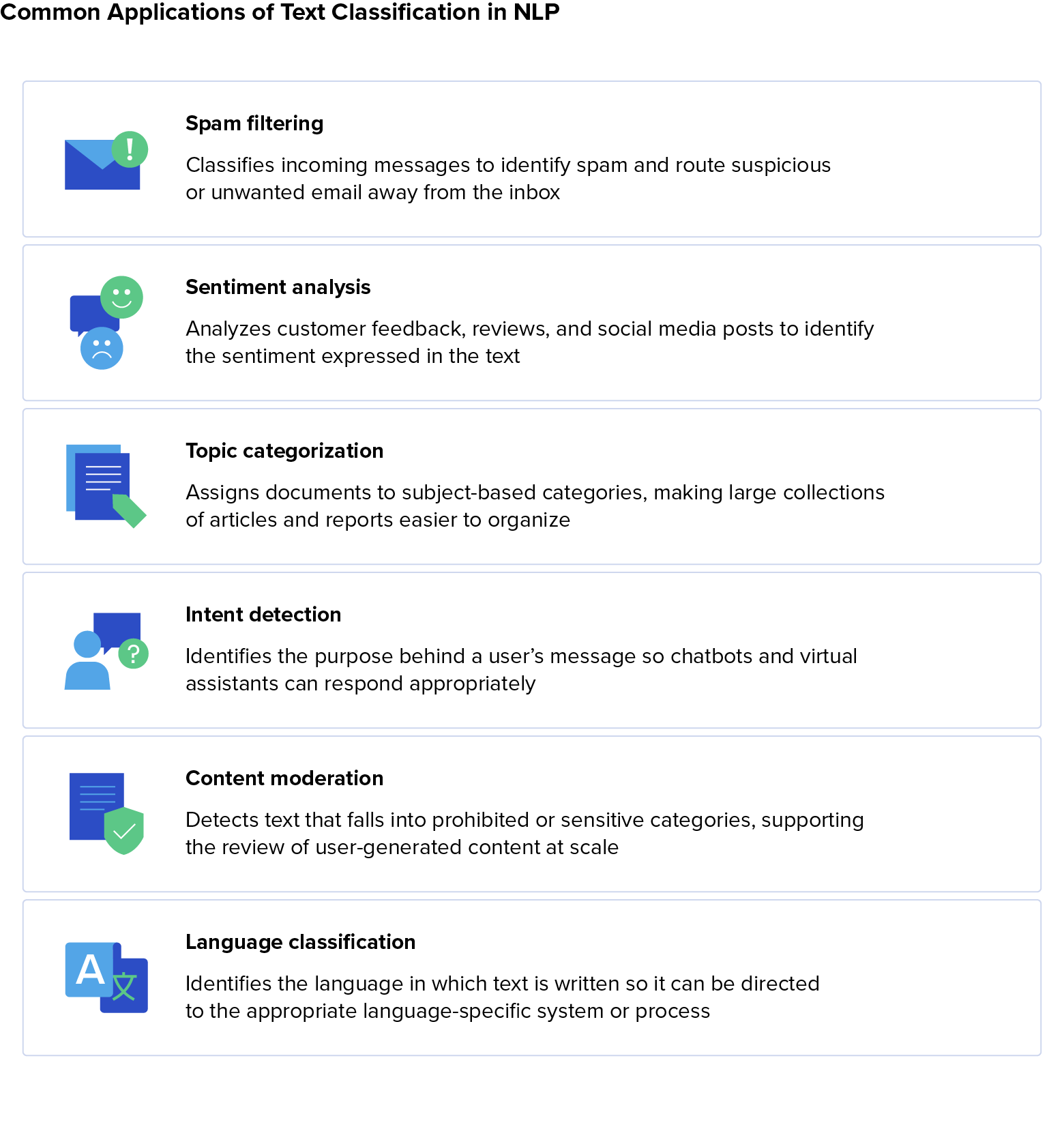
Any application that needs to sort large volumes of language into consistent categories is a potential use case for text classification. It allows organizations to handle text consistently at a scale that would make manual analysis impractical, particularly when new content arrives continuously, as with customer support messages or social media posts.
The categories themselves depend on the application, and the level of detail can vary considerably. Some systems make straightforward distinctions between a small number of labels, such as classifying reviews as negative or positive, whereas others classify text into hundreds of subject categories or assign multiple labels to the same document.
The following examples detail the most common applications.
Text Representation and Feature Extraction
Machine learning models require text to be represented numerically before they can process it. This process, known as feature extraction, converts characteristics of the text, such as the words it contains or how frequently they appear, into numerical values called features. Different representations capture different information about the original text, ranging from the presence of individual words to their order and context. The representation chosen affects what patterns a model can detect, as well as the amount of data and computation involved.
Here’s an overview of the most common approaches, their limitations, and uses.
Technique | How it Works | Limitations | Common Use |
|---|---|---|---|
Bag of Words (BoW) | Represents a document by counting how often each word appears | Discards word order and doesn’t capture meaning or context | Tasks such as spam detection, where the presence or frequency of particular words can distinguish categories |
Term Frequency-Inverse Document Frequency (TF-IDF) | Weights words according to their frequency in a document and their rarity across the wider dataset, giving greater weight to more distinctive terms | Doesn’t capture word order or semantic relationships | Tasks like document categorization, where distinctive terms can help separate one topic from another |
Word Embeddings | Represents words as groups of numbers, with words used in similar contexts assigned similar numerical representations | Assigns the same representation to a word regardless of context when using static embeddings | Tasks where relationships between words carry useful information, such as sentiment analysis |
Traditional NLP Classification Models
Traditional machine learning models still perform well on many text classification tasks and typically require fewer computational resources than deep learning approaches. These models learn from examples of text that have already been assigned categories. They’re particularly useful when a project needs to determine which words influence a prediction, as well as for tasks where LLMs can’t reliably distinguish the categories involved.
The following sections examine three commonly used models and the practical considerations involved.
Naive Bayes
Naive Bayes uses patterns in previously labeled text to estimate which category a new piece of text is most likely to fit. Consider a classifier that sorts news articles by topic such as business, sport, and entertainment. If terms such as “shares,” “investors,” or “earnings” occur frequently in articles labeled as business news, their presence in a new article makes a business classification more likely. The model combines evidence across the text, calculates the probability of each possible category, and assigns the one with the highest probability.
The main considerations when using Naive Bayes for text classification are:
- Performance: Naive Bayes performs well when individual words are strong clues to a category, as they often do in spam detection or topic classification. It can also produce useful results from small training sets because it learns from straightforward patterns.
- Efficiency: Training mainly involves counting how often words appear in each category and using those counts to calculate probabilities. This doesn’t require much computing power so predictions are quick to produce.
- Interpretability: Developers can examine which words the model associates most strongly with each category.
- Limitations: Naive Bayes evaluates words largely independently, so it can struggle when the distinction between categories depends on word order or broader context.
Support Vector Machines
Support vector machines (SVMs) look for the clearest separation between examples from different categories. In a spam classifier, most emails might be easy to identify as spam or legitimate, but some will share features from both groups. These harder-to-classify examples, known as support vectors, help determine where to place the boundary between the categories.
Several practical considerations affect when an SVM is a good fit:
- Performance: SVMs have a long track record of performing well on text classification tasks and can achieve high accuracy without requiring the large training datasets associated with many deep learning models.
- Efficiency: Once trained, SVMs can classify new text quickly. As the dataset grows, training takes longer and requires more memory, which can make SVMs less practical when large volumes of training data are involved.
- Interpretability: With a linear SVM, developers can inspect which words have the greatest influence on a prediction. More complex SVMs are, however, harder to interpret.
- Limitations: SVMs don’t produce probability estimates by default, which can be a drawback when an application needs to recognize how confident the model is in a prediction. They can also require more configuration and tuning than other models.
Logistic Regression
Logistic regression calculates how strongly different text features are associated with a category and uses that information to make predictions. With a classifier that identifies whether a customer support message is urgent, for instance, words such as “outage” or “immediately” might increase the likelihood of an urgent classification. The model learns how much weight to give each word from previously labeled messages.
When using logistic regression, the main considerations include:
- Performance: Logistic regression is often used as a starting point for comparing models, allowing developers to assess whether more complex approaches produce better results. It can also achieve competitive accuracy when the categories have clear differences, without the data and computational demands of deep learning models.
- Efficiency: Training and prediction are relatively inexpensive, even with large collections of text. The model can also be retrained relatively quickly when new labeled data becomes available.
- Interpretability: The model assigns a weight to each feature, indicating how strongly that feature pushes the prediction toward a particular category. Developers can inspect these weights to understand which parts of the text are contributing most to the model’s decisions.
- Limitations: Logistic regression learns simple relationships between features and categories, so it can struggle when a classification depends heavily on word order or context.
Comparing Traditional Machine Learning Models
When a traditional classifier suits the task, the choice between Naive Bayes, SVMs, and logistic regression depends on requirements such as the amount of labeled data available and the complexity of the categories.
The following table shows where each option is likely to make the most sense:
What the Task Involves | Best Option | Why |
|---|---|---|
Limited labeled training data | Naive Bayes | It can learn useful signals without needing a large training dataset. |
Categories with subtle differences between them | SVM | It is designed to find a precise separation between categories. |
Understanding how individual features affect a prediction | Logistic regression | Its learned weights show which words push a prediction toward or away from a category. |
Frequent retraining as new data arrives | Naive Bayes or logistic regression | Both are generally quick and inexpensive to train. |
Very large training datasets | Logistic regression | It handles growing amounts of training data efficiently. |
Predictions that need probability estimates | Naive Bayes or logistic regression | Both provide probability estimates directly. |
Pretrained Language Models for Text Classification
The classifiers discussed above learn to identify categories using features extracted from labeled training data. Pretrained language models build on broader patterns learned from large amounts of text, allowing them to account for context, including differences in meaning that depend on the words surrounding a term. For example, a model classifying customer support messages can distinguish between “I can’t access my account” and “I no longer need access to my account,” even though both messages contain similar words. These types of models are suited to tasks where the meaning of a sentence as a whole is more important than the presence of particular words.
Developers can take an existing pretrained model and fine-tune it for their own categories, which reduces the amount of training needed to build a sophisticated classifier from scratch and can produce good results with less labeled data.
BERT and Pretrained Transformer Models
Many pretrained language models are built on the transformer architecture. Transformers use attention mechanisms, which weigh the importance of different words, to determine which parts of a text are relevant to one another, helping the model interpret a word according to the context in which it appears.
BERT, or bidirectional encoder representations from transformers, considers the context on both sides of a word when identifying its meaning. During pretraining, some words are masked and the model learns to predict them from the surrounding language. It also provided the foundation for later models, such as RoBERTa, which retains the underlying architecture but revises its pretraining process. It was trained for longer on more text and uses a different approach to masking words during training, changes that improved its performance across several NLP benchmarks. ALBERT was developed to reduce the number of parameters, or values learned during training, needed as BERT models grow larger. It reuses these parameters across multiple layers of the model, substantially reducing its memory requirements.
Using Large Language Models for Text Classification
For many text classification tasks, particularly those that involve interpreting meaning, a purpose-built model is no longer necessary. An LLM can interpret text and assign predefined categories from instructions supplied in a prompt, which removes much of the task-specific development needed to build a classifier from scratch.
For example, if a company wants to classify customer reviews according to the product features they discuss, a classifier built around manually designed text features would require developers to account for all the different words and phrases customers might use to describe the same feature. An LLM, however, can recognize those variations without developers defining them in advance. Reducing the amount of upfront specialist development work involved can make an LLM the cheaper option, although it would depend on API pricing and how heavily the system will be used.
When an LLM May Not Be the Right Choice
The first consideration is whether the LLM can classify the text accurately enough for the intended application. Some tasks depend on distinctions that LLMs may struggle to apply consistently. A 2025 study comparing fine-tuned BERT-like models with LLM-based approaches found that BERT-like models performed particularly well when the information needed for classification was contained in the text itself, whereas LLMs had an advantage when deeper semantic understanding or world knowledge was required.
A dedicated model may also be more useful when classification is intended to reveal patterns in the data. For example, a team might need to measure which words are most strongly associated with a category in order to uncover the key drivers of customer dissatisfaction. A technique like TF-IDF can reveal which words are particularly distinctive in a collection of documents, and models such as logistic regression can show how strongly individual features influence a classification, whereas an LLM doesn’t typically provide these kinds of statistics directly.
Efficiency may be another consideration when models need to be trained or adapted for a classification task. In one 2025 study, LLMs achieved higher classification performance overall but took 590 times longer to fine-tune than traditional machine learning classifiers on average.
Implementing Text Classification Models
Before a model can classify text, the training data needs to be prepared in a form it can process. What happens at this stage depends on the model: A custom model requires its own preprocessing setup, whereas a pretrained model such as BERT comes with preprocessing designed for that model. The examples below show how these approaches work in practice.
Preprocessing Text With Keras TextVectorization
Raw text needs to be converted into numbers before a machine learning model can process it. Tokenization starts this process by splitting text into smaller units, such as words or subwords. Depending on the model and task, preprocessing might also include stop-word removal, which removes common words, such as “the” and “and,” or lemmatization, which reduces different forms of a word to a common base, such as “running” and “ran” to “run.”
Keras 3 provides a TextVectorization layer that can tokenize text and convert it into numerical sequences:
import keras

vectorizer = keras.layers.TextVectorization(
    max_tokens=20_000,
    output_mode="int",
    output_sequence_length=200,
)

vectorizer.adapt(training_text)
x_train = vectorizer(training_text)
Here, max_tokens limits the vocabulary to 20,000 terms, while output_sequence_length gives each example a consistent length of 200 tokens. Both values can be adjusted to suit the dataset and model.
Fine-tuning BERT for Text Classification
Fine-tuning adapts a pretrained model to a specific classification task using labeled examples. Because BERT has already learned general patterns in language during pretraining, the model can build on that knowledge when learning the categories required for a new task.
KerasHub provides pretrained BERT models with the preprocessing needed to prepare raw text for the model. The following example loads BERT and adds a classification layer for two categories:
import keras_hub

classifier = keras_hub.models.BertTextClassifier.from_preset(
    "bert_base_en",
    num_classes=2,
)
import keras

early_stopping = keras.callbacks.EarlyStopping(
    monitor="val_loss",
    patience=2,
    restore_best_weights=True,
)

classifier.fit(
    train_data,
    validation_data=validation_data,
    epochs=5,
    callbacks=[early_stopping],
)
The example trains the model for up to five passes through the training data, known as epochs. It also checks performance against a separate set of examples to see how well the model handles text it hasn’t trained on. If performance stops improving, training ends early to reduce the risk of overfitting, where a model learns the training examples too closely and struggles with new text.
Evaluating Model Performance
A model’s overall accuracy measures the proportion of classifications it gets right, but the number can be misleading when categories are unevenly represented. If 90 out of 100 customer messages are routine requests, a model that classifies every message as routine would still achieve 90% accuracy, even though it failed to identify any of the 10 urgent requests.
Other evaluation metrics may offer more insight:
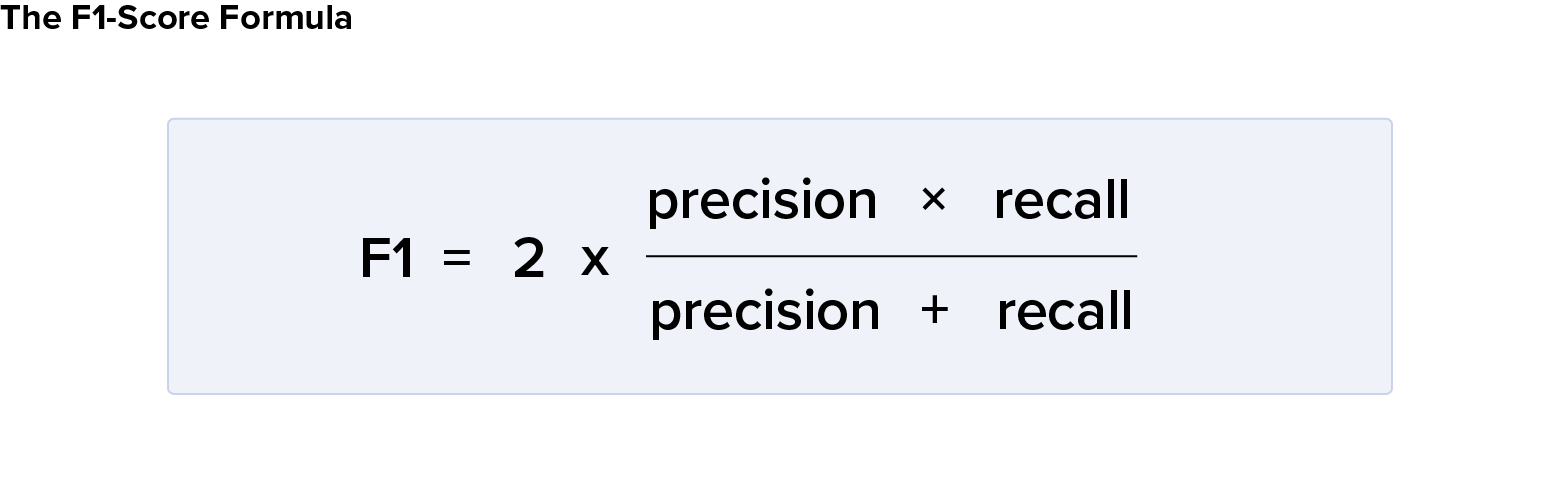
- Precision measures how many texts assigned to a category actually belong there. For an urgent-request classifier, low precision would mean that many routine messages are incorrectly being flagged as urgent.
- Recall measures how many of the texts that should be assigned a category are successfully identified. Low recall would mean that many genuinely urgent requests are being missed altogether.
- F1 score combines precision and recall into a single measure, which is useful when both false positives and missed classifications are important.
Scikit-learn’s classification_report can calculate these metrics by comparing the model’s predicted categories with the correct labels:
from sklearn.metrics import classification_report

print(classification_report(y_test, y_pred))
The report provides precision, recall, and F1 score for each category, making it easier to identify classes where the model performs poorly even when its overall accuracy is high.
Computational Considerations
Computational requirements dictate the infrastructure needed to run a text classification model and its operating costs.
Traditional classifiers such as Naive Bayes and logistic regression can generally be trained and run on central processing units (CPUs), the general-purpose processors found in computers and servers, even with relatively large datasets.
Pretrained transformer models demand considerably more memory and processing power, particularly during fine-tuning. This work is often performed on graphics processing units, which can carry out many calculations simultaneously and therefore process the computations involved in model training much faster than a CPU. The resources a transformer model consumes also depend on the size of the model and the amount of text it processes at once, with larger models requiring more memory and longer inputs increasing the amount of computation needed. These demands can affect both the speed and cost of classification.
With an LLM API, the provider supplies the infrastructure required to run the model. Costs are typically based on the amount of text the model processes and generates, so they rise with usage. For applications processing large volumes of text, running a dedicated model on owned or rented infrastructure may result in lower operating costs.
Choosing the Right Model for the Classification Task
For many NLP text classification projects, an LLM is now a practical place to begin. If it produces sufficiently accurate classifications at an acceptable operating cost, building a separate model adds development work that needs to deliver a tangible benefit.
Traditional classifiers and pretrained models still earn that investment in applications where their particular properties are important. Statistical techniques can expose relationships between language and predictions that an LLM won’t quantify, and a dedicated model gives developers more control over how classification is performed. At sufficient scale, it could also be cheaper to run. Use this simple decision framework as a quick reference to the main questions to consider.
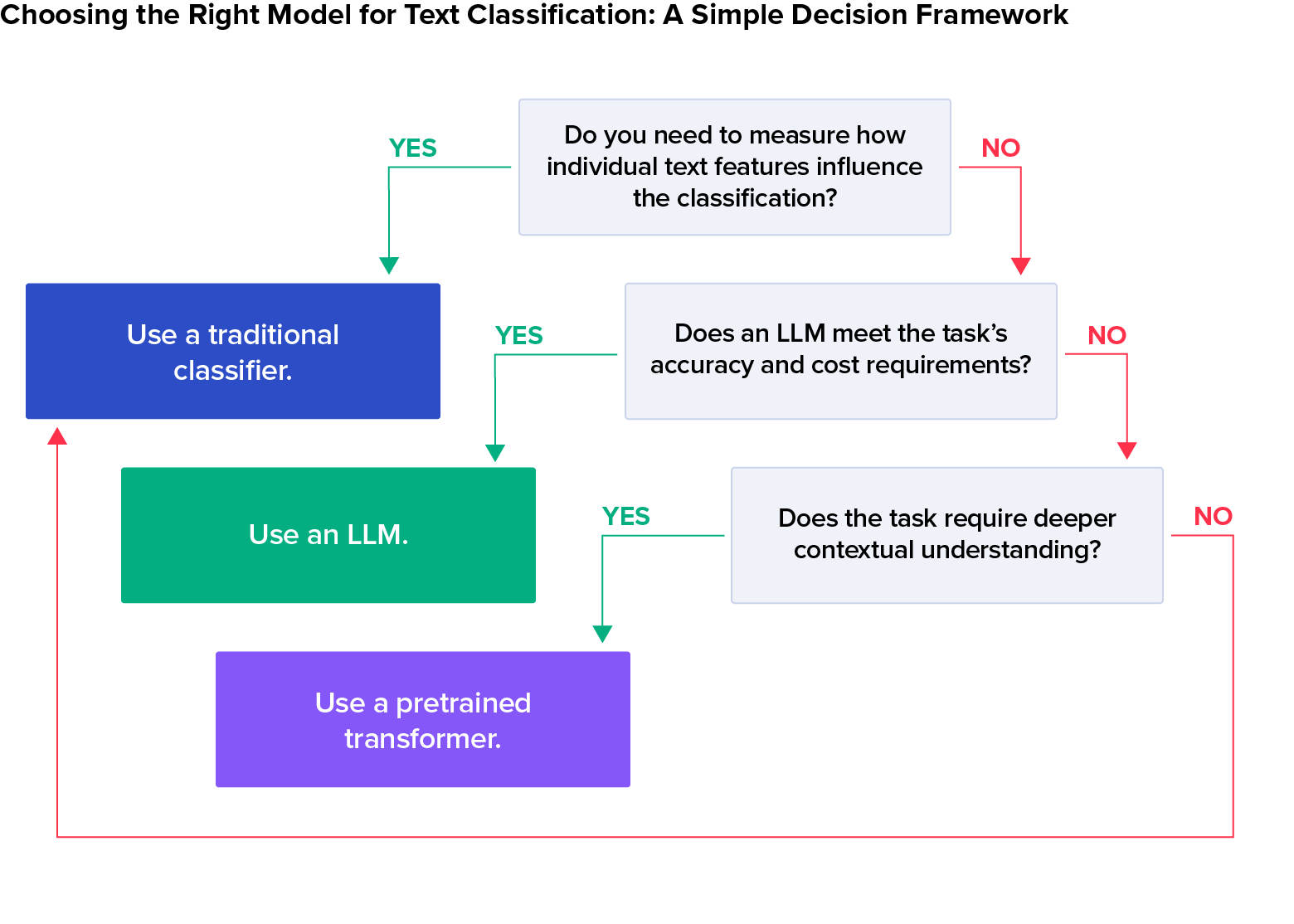
As text classification technology continues to develop, the available options may change, but the requirements of the application will still be the most useful guide for choosing the right model for the task. Starting there keeps the technology aligned with the problem it’s meant to solve.
Further Reading on the Toptal Blog:
Understanding the basics
Text classification involves preparing text for a model, training or configuring the model to recognize predefined categories, and evaluating its predictions. Approaches range from traditional classifiers such as Naive Bayes and Support Vector Machines to pretrained transformers and LLMs.
Yes, BERT can be fine-tuned for text classification using labeled examples from the target task. Because it has already learned patterns in language during pretraining, it can account for context and meaning when distinguishing between categories.
There is no single best LLM for text classification. The right choice depends on how accurately a model handles the specific categories involved, along with its cost and processing requirements. Testing candidate models against representative labeled examples provides the most useful comparison.

New York, NY, United States
Member since December 16, 2016
About the author
Sean is an experienced software developer specializing in natural language processing (NLP) and data science. He has helped companies build complex systems spanning risk optimization, market intelligence, and weather prediction. Sean is also an AI/ML instructor at John Hopkins University and MIT Professional Education.
Expertise
Previous Role
AI/ML InstructorPREVIOUSLY AT