
NLP for Sentiment Analysis: How It Works and Why It Matters for Business
Discover why sentiment analysis is becoming a core enterprise capability, with modern NLP techniques providing a deeper understanding of the customer experience than ever before.

Discover why sentiment analysis is becoming a core enterprise capability, with modern NLP techniques providing a deeper understanding of the customer experience than ever before.

Originally a medical doctor, Bruno is now an experienced data scientist and machine learning (ML) engineer delivering advanced models for enterprise clients including PepsiCo and Microsoft. Most recently, Bruno worked as a senior ML engineer at Google. He is currently pursuing a PhD in computer science.
Expertise
Previous Role
Senior Data ScientistPreviously At



Understanding how customers feel is a competitive requirement. Companies that interpret feedback from real usage can ship targeted improvements faster, directly increasing product quality and user retention. But, as digital channels multiply, businesses are under pressure to interpret vast volumes of unstructured language, such as social media conversations, survey responses, and support interactions, and respond in near real time.
Sentiment analysis powered by natural language processing (NLP) has emerged as a strategic capability that helps organizations quantify attitudes toward their products, surface brand credibility risks, and identify opportunities to improve the customer experience.
How Sentiment Analysis Strengthens Net Promoter Score (NPS) Programs
By analyzing customer reviews, social media conversations, survey responses, and support interactions at scale, companies gain visibility into how their products and brand decisions are actually perceived. In other words, sentiment analysis turns experiences and opinions into machine-readable data, like confidence scores and polarity labels, that teams can act on. When integrated with established customer experience metrics such as net promoter score (NPS), sentiment insights add critical context to numeric ratings and help explain why scores fluctuate over time. I’ve worked with several data-driven organizations already moving from anecdotal feedback to NLP-based analytics. They’re using their findings to inform product roadmaps, marketing strategy, and customer experience design. At a global health insurance company with 1.5 million clients, this facilitated an NPS increase of two points within eight months of implementation.
Why Sentiment Analysis Matters for Business in 2026
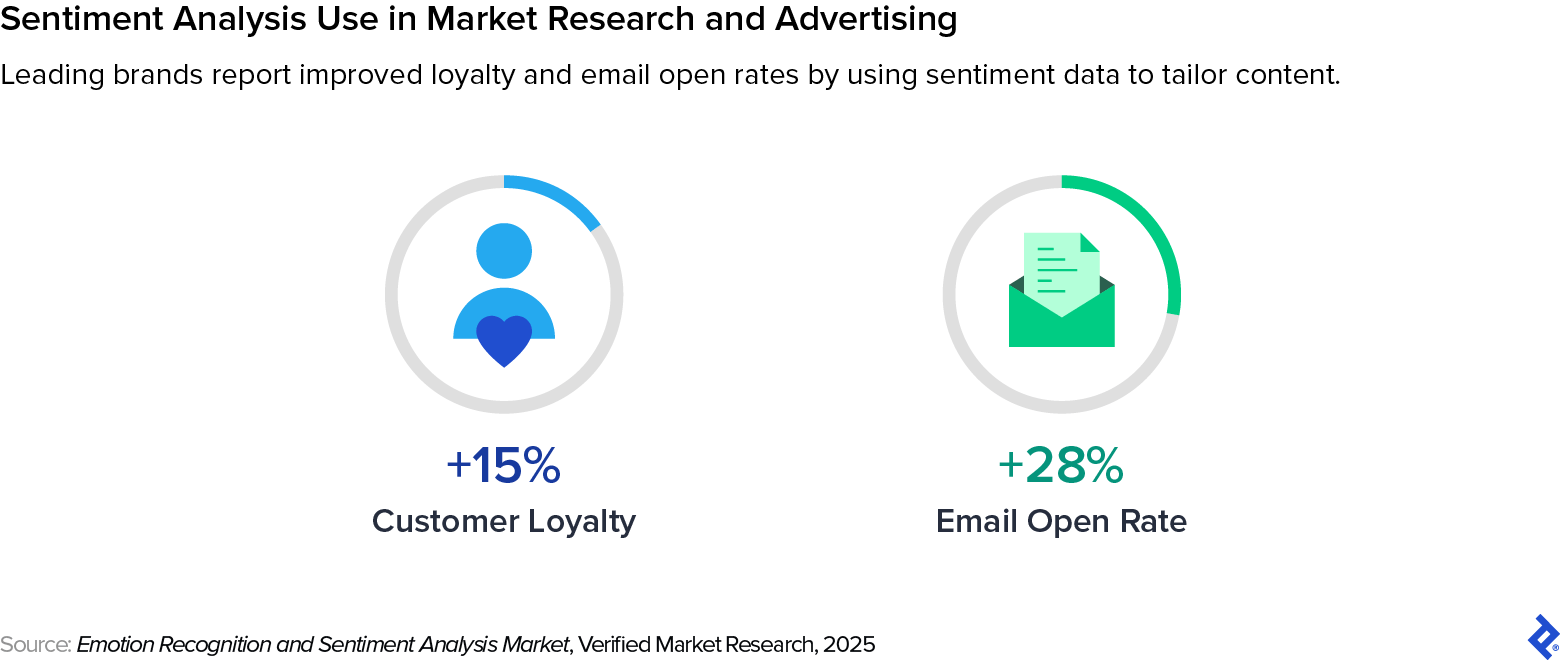
The ROI of using NLP for sentiment analysis is increasingly concrete: It enables marketing teams to better tailor messaging by giving them a deeper understanding of what resonates with customers. The same signals allow product teams to detect points of frustration early and address issues before customers disengage. According to a 2025 report by Verified Market Research, leading brands have seen “a 15% increase in customer loyalty and a 28% boost in email open rates by tailoring content based on sentiment data.”
Engineering teams can rely on sentiment data to prioritize fixes and reduce guesswork around what needs attention. In a wider business context, sentiment monitoring also supports risk mitigation, flagging reputational issues or compliance concerns before they escalate. These outcomes have driven strong adoption in industries where trust is critical, such as financial services and healthcare.
The growth in business impact stems from improvements in how artificial intelligence (AI) systems can interpret language. Recent advances in machine learning (ML) and large language models (LLMs) now support more accurate detection of tone, emotion, and intent in real text than earlier, keyword-driven approaches. Sentiment analysis was cited by 61% of respondents as the most valuable application of generative AI in The 2024 IT Outlook Report, ahead of both code and product development.
Behind these gains is a growing body of engineering work, from data preparation and model selection to monitoring and retraining. For the teams responsible for these systems, a clear view of how sentiment analysis functions at a technical level is essential. It helps to start with the fundamentals: what sentiment analysis is and how modern NLP techniques have expanded its capabilities.
What Is Sentiment Analysis in NLP?
Also known as opinion mining, sentiment analysis refers to the process of identifying and interpreting opinions expressed in text. It helps organizations learn how people feel about a product or service by analyzing the language they use. By applying NLP techniques, the process turns written responses into structured signals that reveal patterns in attitude, satisfaction, and concern, meaning companies no longer have to rely on manual review or isolated customer feedback to gain these insights. The result is reduced bias and reliable trend detection across large datasets.
Analysis methods draw on a wide range of language-rich data sources that capture both spontaneous and solicited feedback, including:
- Social media posts and comments
- Product reviews and ratings
- Customer surveys and feedback forms
- Support tickets, chat logs, and call transcripts
In applying ML-based language models, NLP enables systems to recognize context, intent, and emotional cues embedded in everyday communication. The result is a shift from simple keyword matching toward a more nuanced understanding of tone and meaning. This analysis can operate at different levels of depth; here’s an overview of the most common types and their functions:
Sentiment analysis type | What it detects | Primary function |
|---|---|---|
Polarity detection | Classifies text as positive, negative, or neutral | Monitoring overall customer sentiment and flagging broad shifts in brand perception |
Emotion detection | Identifies specific feelings, such as frustration, anger, or joy | Prioritizing emotion-heavy interactions and guiding escalation in customer support or risk scenarios |
Aspect-based analysis | Links sentiment to specific features or moments in an experience, such as pricing, usability, or support | Diagnosing root causes of satisfaction or dissatisfaction to inform product, UX, and service improvements |
The techniques themselves have evolved alongside advances in NLP. Early systems relied on rule-based logic and sentiment lexicons, which struggled with context and ambiguity. ML models improved adaptability by learning from labeled examples, while transformer-based architectures now model relationships across entire sequences of text, allowing them to understand how words influence each other based on position and context rather than in isolation. This enables sentiment analysis to handle greater complexity and subtle variation in meaning with far more precision.
How Sentiment Analysis Works: From Text to Insight
While the underlying models can be complex, the analysis process itself typically follows a simple series of steps, which, together, progressively refine unstructured text into measurable signals. In my experience working with production systems, sentiment analysis typically moves through these five stages:
1. Data Collection
The process begins with gathering text from relevant channels, such as social media platforms, product reviews, and customer surveys. Pulling from multiple sources provides broader context and reduces the risk of drawing inaccurate conclusions.
2. Preprocessing
Raw text is rarely ready for analysis. Preprocessing prepares the data by cleaning and normalizing it, removing noise like formatting artifacts and internal inconsistencies and standardizing human language so models can interpret it reliably.
3. Model Training
Once the data is prepared, teams either train sentiment models using labeled examples or fine-tune pretrained models for their specific domain. The choice of model directly impacts accuracy, especially when language varies by industry, audience, or channel.
4. Classification
The trained model then evaluates incoming text and assigns sentiment labels. Depending on the approach, this may involve simple sentiment polarity categories or more granular emotional and aspect-level classifications.
5. Visualization
Finally, sentiment outputs are aggregated and surfaced through dashboards or reports. Visualization transforms individual classifications into trends that decision-makers can monitor over time and act on with confidence.
Each step in this process builds on the last, which means small decisions early on can have outsized effects downstream. Across multiple deployments, I’ve seen how inconsistent data cleaning, misaligned labels, or training data that fails to reflect real user language can introduce bias or noise before modeling even begins. Reliable sentiment insights depend as much on thoughtful setup and validation as they do on advanced NLP techniques.
Data Preparation: The Foundation of Reliable Insights
How text is prepared is a key factor in model performance, often determining whether insights are reliable or misleading. But data preparation is often a difficult and time-consuming task. Before classification begins, raw language must be transformed into a consistent, machine-readable form.
Core text preprocessing steps vary by model type. In ML-based pipelines, steps typically include:
- Tokenization: Breaking text into words or subwords so models can analyze them individually.
- Stop-word removal: Filtering out common terms that add grammatical structure but little semantic value.
- Stemming or lemmatization: Reducing words to their base form so variations are treated consistently.
In deep learning and transformer-based models, data preparation looks like:
- Subword tokenization: Models such as BERT and RoBERTa use WordPiece or BPE tokenization, which breaks words into smaller units. This allows models to recognize word structure and to interpret unfamiliar or newly coined terms more reliably by relating them to known components.
- Retention of stop words and modifiers: Words like “not,” “very,” and “but” are kept because they materially affect sentiment and sentence structure.
- Minimal normalization: Stemming is usually avoided, as transformers explicitly model grammatical relationships and contextual nuance.
Even with careful preprocessing, natural language introduces challenges. Sarcasm, idioms, and informal speech can obscure sentiment, and emoji and abbreviations add ambiguity, particularly in conversational or social media data. Models adapted to specific domains tend to perform better, as fine-tuning helps them learn industry vocabulary and conventions.
Approaches and Models Used in NLP for Sentiment Analysis
There are several ways to approach implementing sentiment analysis techniques, each offering different trade-offs around simplicity, accuracy, and flexibility. The most common methods fall into three categories:
- Lexicon-based approaches: These use predefined dictionaries of words with assigned sentiment scores, and text is analyzed by aggregating the polarity of the words it contains. Lexicon-based methods are easy to implement and transparent, but struggle with context, sarcasm, and domain-specific language. In my experience, negation or idiomatic phrasing can drastically skew results.
- Machine learning-based approaches: Traditional ML models, such as logistic regression or support vector machines, learn sentiment patterns from labeled training data. These approaches are more adaptable than lexicon methods and can capture contextual signals, but their performance depends heavily on data quality and feature engineering.
- Deep learning-based approaches: Neural networks, particularly transformer-based models, represent the current state of the art. These models learn complex linguistic relationships that allow them to handle subtle sentiment cues and long-range dependencies, though their higher accuracy requires more computational resources and higher infrastructure and operational costs. Performance also depends on access to representative domain data for fine-tuning.
I’ve seen organizations successfully deploy hybrid systems that combine these approaches. For example, rule-based models or lexicon methods may be used for fast filtering or compliance checks, while ML or transformer models handle more nuanced interpretation.
Modern systems often build on pretrained language transformers like BERT, RoBERTa, and DistilBERT, which are fine-tuned for sentiment tasks using domain-specific data. Some teams also use GPT-based APIs to accelerate deployment when customization needs are limited. Fine-tuning is important in ML and deep learning approaches, helping models align with the language and tone patterns of specific industries or use cases.
Code Example: Training a Simple Sentiment Model
The example below illustrates a minimal sentiment analysis workflow, showing how text moves from raw input to sentiment classification. It uses common Python libraries to keep the focus on the overall process rather than production-level optimization.
import pandas as pd
from sklearn.model_selection import train_test_split
from sklearn.feature_extraction.text import TfidfVectorizer
from sklearn.linear_model import LogisticRegression
# Sample input data
data = {
    "text": [
        "The service was fast and friendly",
        "I’m frustrated with the delayed delivery",
        "Great product quality",
        "Customer support was unhelpful"
    ],
    "label": [1, 0, 1, 0]  # 1 = positive, 0 = negative
}
df = pd.DataFrame(data)
# Preprocessing and feature extraction
vectorizer = TfidfVectorizer(stop_words="english")
X = vectorizer.fit_transform(df["text"])
y = df["label"]
# Train/test split
X_train, X_test, y_train, y_test = train_test_split(X, y, test_size=0.25)
# Train a simple classifier
model = LogisticRegression()
model.fit(X_train, y_train)
# Classify new text
sample_text = ["The app is easy to use but crashes often"]
sample_vector = vectorizer.transform(sample_text)
prediction = model.predict(sample_vector)
print("Predicted sentiment:", "Positive" if prediction[0] == 1 else "Negative")
This sample demonstrates the core stages of sentiment analysis: ingesting text data, preprocessing it into numerical features, training a classifier, and generating a sentiment prediction. In real-world applications, workflows are typically more complex and use larger datasets.
Applying NLP for Sentiment Analysis in Business
In practice, sentiment analysis has the greatest impact when it’s woven into daily decision-making instead of treated as a static report. This might mean using data to trigger alerts when issues arise, or translating signals into prioritized tickets. NLP enables organizations to interpret customer language along three complementary dimensions: how sentiment shifts in real time, the specific elements driving those reactions, and which emotions signal urgency or opportunity. Together, these perspectives help teams respond with greater precision and confidence. Here’s a breakdown:
Real-time Sentiment Tracking
Real-time sentiment tracking allows companies to monitor live streams of text, such as social posts and support chats, and detect shifts in perception as they occur. This is particularly valuable during moments of heightened attention. However, detecting sentiment changes and acting on them are separate challenges. While models can surface signals quickly, effective intervention often requires human judgment and operational readiness that many organizations are still building.
Example: During a network outage, a telecom provider tracks the sentiment of incoming customer messages to identify emerging issues. These signals help teams adjust communications, prioritize responses, and intervene before dissatisfaction spreads.
Aspect-based Insight
Aspect-based opinion mining adds precision by linking opinions to specific elements of a product or service.
Example: An e-commerce platform analyzes online reviews to separate sentiment about product quality from feedback on shipping, pricing, and returns. This clarity lets the team implement targeted improvements to their online sales strategies.
Emotion Detection for Deeper Context
Emotion detection extends sentiment analysis by identifying signals such as joy, anger, or frustration. These emotional cues provide context and highlight opportunities in ways that simple polarity can’t.
Example: A financial services company may use emotion detection in its customer support to reveal anxiety around account security. That insight prompts proactive reassurance and targeted communication, rather than standard support workflows.
Real-world Sentiment Analysis: A Case Study
My experience implementing a sentiment analysis initiative at a large healthcare company illustrates the strategic benefit of this capability. The organization had an NPS program in place, which was already collecting ratings and open-text feedback at scale, but it wanted more actionable insights into client experiences.
The business was serving more than a million clients, generating a substantial volume of comments alongside the NPS. We applied sentiment analysis to batches of feedback using cloud-based compute infrastructure, with results surfaced in a centralized dashboard. The dashboard revealed how sentiment aligned (or failed to align) with NPS. Sankey-style visualization showed the flow of positive and negative sentiment across the three categories: detractors, passives, and promoters.
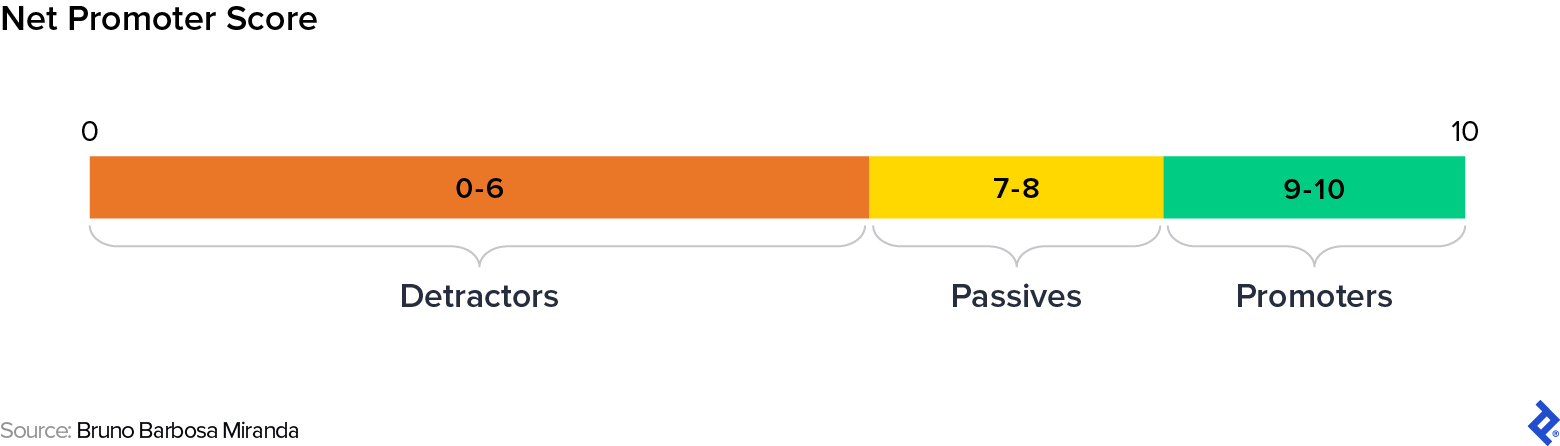
The system highlighted the most common positive and negative words and expressions appearing in each group. One of the most valuable findings was the disconnect between numeric scores and written feedback. Promoters frequently expressed negative sentiment in their comments, while some detractors used surprisingly positive language. Sentiment analysis exposed nuances that NPS alone could not capture, which helped teams avoid false assumptions based solely on ratings.
In identifying recurring themes and language patterns within each NPS bucket, the company uncovered specific opportunities to improve its services. In this case, sentiment analysis acted as a critical interpretive layer, deepening the value and context of an established customer experience metric.
Strategic Considerations for Implementation
When organizations adopt NLP sentiment analysis, the most consequential decision is whether to build capabilities in-house or rely on third-party APIs. The right choice depends on priorities around control, speed, and operational complexity.
Building internally gives teams greater ownership over data and workflows. This approach is often favored by organizations with mature data science functions or strict compliance requirements. The trade-off is a longer development timeline and greater investment.
API-based solutions, by contrast, offer a faster path to value. Cloud services such as AWS Comprehend, Azure Cognitive Services, and Hugging Face provide pretrained sentiment models that can be deployed with minimal setup. Usage-based pricing can be cost-effective in early stages by reducing infrastructure and maintenance overhead, though costs may increase at scale and typically mean sacrificing customization and control over data.
Here’s how the two options compare:
Criteria | In-house development | Third-party APIs |
|---|---|---|
Cost | Higher upfront and ongoing investment | Lower initial cost, usage-based pricing |
Accuracy | Optimized for specific domains when trained on sufficient proprietary data | Exhibits strong general performance, but limited specialization |
Scalability | Requires infrastructure planning | Has built-in scalability |
Customization | Offers full control over models and workflows | Has limited model and feature flexibility |
Compliance | Offers greater control over data handling | Depends on provider policies and certifications |
Measuring Success and Recognizing Limitations
Once sentiment analysis is in production, evaluating its effectiveness requires a combination of technical performance and business-level indicators.
Tracking the following technical metrics can help teams understand how well the model interprets sentiment at a classification level.
- Accuracy: The percentage of sentiment classifications the model assigns correctly across all categories
- Precision: How often the model’s sentiment classifications are correct when it assigns a specific label (This is particularly important for negative sentiment, where incorrect classifications can trigger unnecessary escalations or misdirect resources.)
- Recall: The model’s ability to capture all relevant instances of a given sentiment, such as identifying the full range of dissatisfied customer feedback
- F1-score: A balanced measure that combines precision and recall, useful when sentiment categories are unevenly represented
The following business metrics can reveal whether sentiment insights are driving meaningful outcomes:
- Customer satisfaction: Changes in satisfaction scores following interventions informed by sentiment trends
- Churn rate: Reductions in customer attrition after identifying and addressing negative sentiment signals
- NPS: Improved alignment between customer sentiment and NPS categories, and stronger overall scores over time
- Campaign or service performance: Uplifts in engagement or conversion linked to sentiment-driven decisions
While sentiment analysis can surface valuable insights, it also has limitations that demand deliberate management. Cultural and language bias can affect accuracy, typically when models are trained on datasets that don’t adequately represent regional expressions or dialects. In many cases, short or ambiguous comments lack sufficient context, which increases the likelihood of misclassification. Data quality is crucial, as inconsistent labeling can distort signals and lead to unreliable conclusions.
To sustain performance, sentiment models need ongoing oversight, which includes:
- Continuous monitoring to detect drops in accuracy.
- Regular retraining using updated, representative data to reflect new vocabulary and patterns.
- Human review loops to validate edge cases and feed corrections back into the model.
From Pilot to Production: Implementation Roadmap
To make sentiment analysis viable for day-to-day use, organizations need a structured deployment path that aligns technical decisions with business outcomes and operational realities. The following roadmap outlines key steps to turn experimentation into a production-ready capability.
1. Define Goals and KPIs
Anchor sentiment analysis to a single, clearly defined business problem, such as identifying drivers of NPS decline or detecting early churn signals. Translate that objective into a small set of measurable KPIs, so success can be evaluated beyond model accuracy alone.
2. Collect and Label Data
Start by selecting one or two high-value data sources tied directly to the use case, such as NPS comments or customer support tickets. Focus on recent, representative samples rather than large but unfocused datasets. Standardize the text by removing duplicates and irrelevant metadata, then label a statistically meaningful subset of comments using clear sentiment definitions. Where possible, combine human labeling with spot checks to validate consistency before scaling.
3. Build or Select Models
Choose models based on use-case complexity and risk. Pretrained or vendor models may be sufficient for high-level sentiment trends, whereas domain-specific language usually requires fine-tuning or custom training. Evaluate language coverage, explainability, latency, and integration requirements before committing to a production approach.
4. Validate and Benchmark Results
Test models against labeled data and examine performance by sentiment class, channel, and customer segment, not just for overall averages. Benchmark results against existing methods such as rule-based tagging or manual review to confirm that sentiment analysis delivers a meaningful improvement.
5. Integrate With Systems
Embed sentiment outputs where teams already operate, such as customer relationship management platforms, customer experience dashboards, or analytics tools. Present results in ways that support action, highlighting trends and shifts.
6. Monitor and Retrain Continuously
Establish regular performance reviews to detect drift as customer language and products change. Refresh training data periodically and incorporate feedback from human reviewers to correct recurring errors, helping maintain trust and relevance as the system scales.
Emerging Trends in Sentiment Analysis
The next wave of sentiment analysis will move away from word classification and toward more context-aware interpretations of emotion. New AI capabilities are expanding how sentiment is detected and applied across business workflows. Here’s an overview of the key trends shaping this evolution:
- Multimodal sentiment analysis: Organizations are beginning to combine text with voice signals, facial cues, and body language to better interpret intent, particularly in industries with in-person or video interactions and during usability testing.
- LLM-based sentiment analysis: LLMs such as GPT- and Claude-based systems enable more nuanced emotion detection by capturing mixed sentiment and contextual meaning that traditional classifiers often miss.
- Emotion-aware agents and bots: Sentiment detection is increasingly embedded into virtual agents, allowing customer service bots to adapt their responses to user emotion and escalate sensitive interactions when appropriate. Reliability remains a key issue here, as incorrect interpretations can lead to unnecessary escalations. Careful tuning and human-in-the-loop review are currently still essential for production use.
Together, these advances signal a shift from static scoring to adaptive sentiment intelligence that responds to context in near real time.
Turning Language Into Business Intelligence
Every day, customers explain what’s working, what’s broken, and what they expect. Sentiment analysis gives organizations a way to systematically listen and make more informed decisions across marketing, product, and customer experience.
The strongest results come from combining advanced NLP models for sentiment analysis with human decision-making. Automated systems surface patterns and emotional signals, and teams validate edge cases and translate findings into prioritized actions in line with business goals.
Analyzing customer emotions at scale gives companies crucial decision-making context. As the capabilities of NLP and sentiment analysis continue to expand, this intelligence will become even more valuable for organizations competing in a crowded marketplace.
Further Reading on the Toptal Blog:
- Strategies for Structuring and Scaling High-performance Data Labeling Teams
- Architecting Effective Data Labeling Systems for Machine Learning Pipelines
- Fine-tuning LLMs for Your Industry: Optimal Data Labeling Strategies
- Advanced Data Labeling Methods: From Hybrid Approaches to LLMs
- Strategic Listening: A Guide to Python Social Media Analysis
Understanding the basics
ChatGPT can perform sentiment analysis by interpreting emotional tone, intent, and context within raw text like social media reviews. It supports sentiment classification models and is often used via APIs rather than as a stand-alone analytics system.
Sentiment analysis is one of the most widely adopted NLP applications, particularly in marketing, customer experience, and reputation management. It enables organizations to gain insights into customer preferences and opinions, by evaluating large volumes of unstructured text and quantifying emotions at scale.
NLP sentiment analysis broadly includes rule-based methods, traditional classification models, and neural approaches. LLM-based sentiment analysis uses deep neural networks trained on large datasets, facilitating more nuanced interpretation of emotional tone, context, and intent than earlier NLP techniques.
Sentiment analysis commonly uses machine learning models such as logistic regression, neural networks, and transformer-based architectures. Popular implementations include BERT-derived models, GPT-based APIs, and cloud services from providers like AWS and Microsoft Azure.
Large language models are an evolution within NLP, not a replacement. They extend NLP capabilities by modeling language at greater scale and context, whereas traditional NLP techniques remain valuable for use cases requiring efficiency or strict control over data and model behavior.
Sentiment analysis is particularly effective for emotion-heavy interactions, such as customer support emails and chat transcript data. These sources capture real-time frustration or satisfaction, making them valuable for identifying service gaps and emerging issues. Online review sites and social media platforms are also useful sources supporting brand reputation management.

Belo Horizonte - State of Minas Gerais, Brazil
Member since September 30, 2021
About the author
Originally a medical doctor, Bruno is now an experienced data scientist and machine learning (ML) engineer delivering advanced models for enterprise clients including PepsiCo and Microsoft. Most recently, Bruno worked as a senior ML engineer at Google. He is currently pursuing a PhD in computer science.
Expertise
Previous Role
Senior Data ScientistPREVIOUSLY AT