
How Capital Budgeting Guides Smarter Investment Decisions
Major capital investments are often difficult to reverse, so organizations need a disciplined process for getting them right. This guide introduces a five-step framework for evaluating opportunities and making more informed investment decisions.

Major capital investments are often difficult to reverse, so organizations need a disciplined process for getting them right. This guide introduces a five-step framework for evaluating opportunities and making more informed investment decisions.

Animesh is a corporate finance and investment consultant focused on helping organizations make sound financial decisions and deploy capital effectively. With experience spanning private equity investing and fractional CFO leadership, he has advised companies and investors across the US, UK, Middle East, and Asia on acquisitions and long-term growth strategies.
Previous Role
Fractional CFOPreviously At


When I explain capital budgeting to someone outside of finance, I often compare it to buying a house. Most of us manage a monthly budget: We earn income, pay expenses, and set aside savings. But purchasing a home is a different kind of decision altogether. It requires us to think beyond the year ahead and consider the long-term value, risks, and trade-offs involved in committing significant resources. In many ways, that’s exactly what capital budgeting is for businesses.
The challenge is that most organizations have more opportunities than available capital. Every dollar invested in one capital project is a dollar that cannot go elsewhere. That reality demands a structured and disciplined way of evaluating which capital investments are most likely to create lasting value and which are better left unpursued.
Throughout my career, I’ve worked with organizations evaluating a remarkably diverse range of investments, including technology modernization projects, facility expansions, and even the purchase of a professional sports team. In this article, I’ll draw on these experiences to explain the capital budgeting process and share many of the best practices budgeting consultants use to evaluate opportunities and allocate capital effectively.
What Is Capital Budgeting?
Capital budgeting is the process organizations use to analyze the investment potential of facilities, equipment, technology platforms, acquisitions, and other long-term assets that require significant upfront capital and are expected to generate value over multiple years. Unlike operating budgets, which are revisited annually and can be adjusted relatively easily as conditions change, capital budgeting involves large financial commitments that are often difficult to unwind.
Capital Budgeting vs. Operational Budgeting | |
Capital Budgeting | Operational Budgeting |
Focuses on long-term investments | Focuses on day-to-day operating expenses |
Supports strategic planning and growth initiatives | Supports efficiency and cost control |
Evaluates projects over multiple years | Typically covers a one-year budget cycle |
Uses methods and metrics such as DCF analysis, NPV, and IRR | Uses revenue, expense, and cash flow forecasts |
Guides strategic investment decisions | Supports ongoing business operations |
A defining feature of capital budgeting is its emphasis on projected cash flows rather than accounting profits. Organizations estimate the future cash inflows and outflows associated with a capital project and evaluate whether the projected returns justify the investment required today. This approach also incorporates the time value of money, recognizing that money received in the future is worth less than money available today because it cannot be invested to generate returns in the meantime.
These principles are formalized through discounted cash flow (DCF) analysis, which forms the basis for several metrics organizations commonly use to evaluate capital projects, including net present value (NPV), internal rate of return (IRR), and profitability index (PI). We’ll explore how DCF works and how these metrics are applied in greater detail later in this article.
Why Is Capital Budgeting Important?
Capital budgeting helps organizations make smarter decisions about where to invest limited capital resources. Most businesses have more opportunities than they can realistically pursue at any given time, and capital budgeting provides a structure for comparing opportunities and prioritizing which to pursue. As a result, it serves as a critical bridge between strategic planning and capital allocation, helping organizations translate long-term objectives into investment decisions.
Capital budgeting also provides an important layer of financial discipline. In many organizations, a compelling investment idea can quickly gather steam, especially when it comes from a senior leader with a persuasive vision. But enthusiasm alone is not an investment strategy. Unlike many business decisions that can be reversed or course-corrected, capital commitments are largely irreversible. A poor acquisition or a misplaced store location can affect an organization’s cost structure and competitive position for years.
That’s precisely why the strongest capital budgeting processes are designed to challenge investment opportunities rather than justify them. A rigorous, well-governed process creates the conditions for honest evaluation, ensuring that decisions about major capital projects are driven by evidence rather than momentum and that limited resources are directed where they can have the greatest impact over time.
How the Capital Budgeting Process Works
The most effective capital budgeting processes often resemble the way private equity firms evaluate investments. This isn’t a superficial comparison. Private equity firms are useful models because their entire business depends on getting investment decisions right, which is why the industry has developed rigorous evaluation and governance practices.
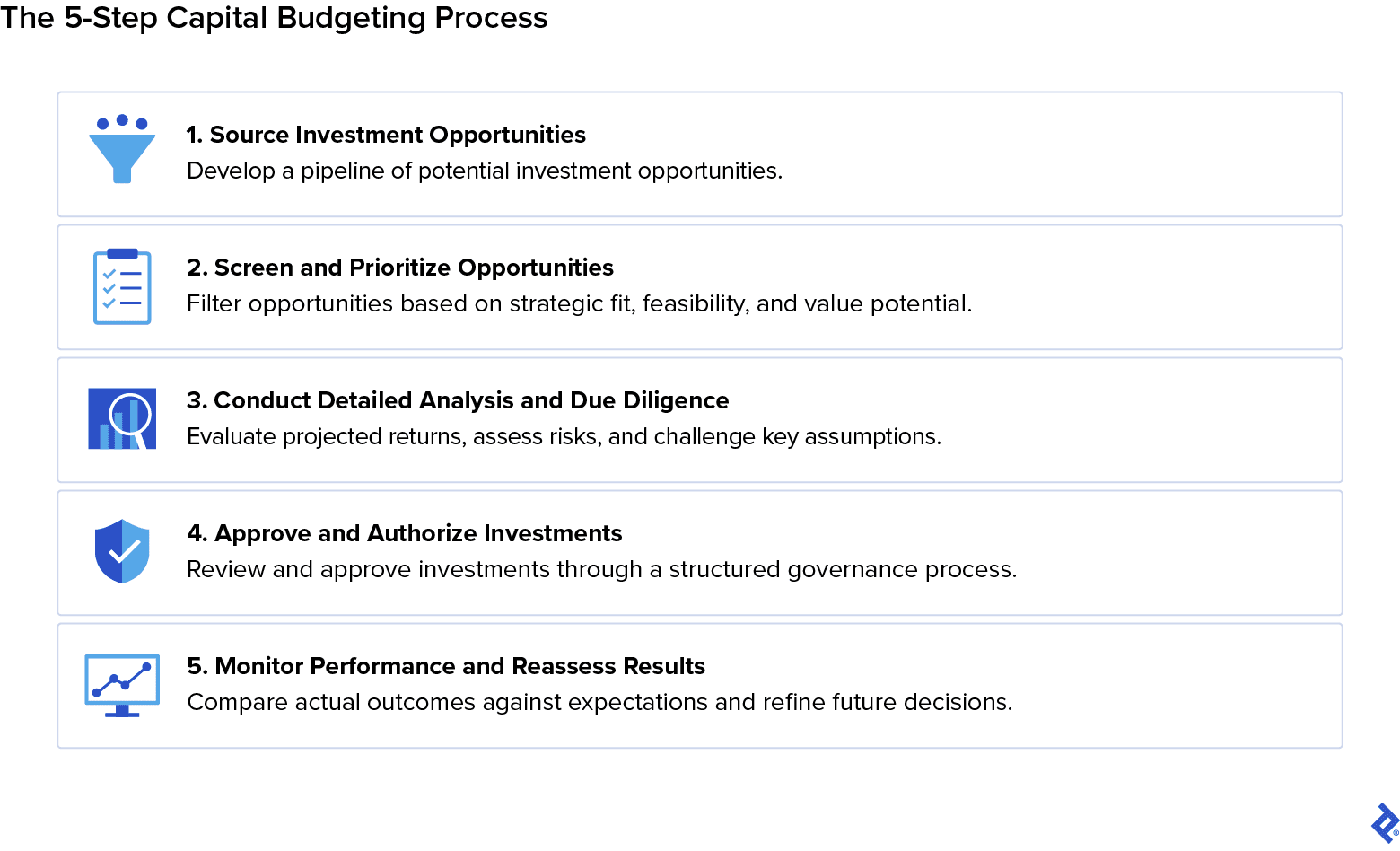
The following five-step framework draws on those practices, tracing how organizations source, screen, authorize, and monitor major capital commitments.
1. Source Investment Opportunities
Every capital budgeting process begins with identifying opportunities that have the potential to create durable value. These opportunities can take many forms, including expanding into new markets, acquiring another business, or investing in new technology. This stage doesn’t require a detailed evaluation for every opportunity. The goal is to build a pipeline of potential capital investments that are reasonably aligned with the organization’s strategic objectives.
One of the biggest misconceptions about capital budgeting is that it begins when a specific project is proposed. The strongest organizations continuously look for opportunities to deploy capital more effectively, much like private equity firms source potential investments. Sourcing should be a repeatable discipline, not something that happens when a compelling idea lands on the CEO’s desk.
Larger organizations often formalize this process through corporate development or strategy teams. Smaller organizations may rely on executives and business-unit leaders to identify opportunities. In my experience, midsized organizations are most at risk of treating sourcing as an afterthought, as they are large enough to face meaningful capital decisions but not yet structured enough to have a formal process around them. By establishing clear ownership, whether through a dedicated team or defined leadership responsibility, organizations can ensure that investment decisions are driven by strategy and opportunity rather than organizational politics.
Best practice: Treat investment sourcing as an ongoing capability rather than an ad hoc exercise. Organizations that continuously generate and assess new opportunities are less likely to make decisions based on whichever project happens to be proposed first.
2. Screen and Prioritize Opportunities
Once potential investments have been identified, the next step is determining which opportunities warrant deeper evaluation. Not every project requires a full financial model or a detailed due diligence process. Instead, organizations establish screening criteria to assess whether an opportunity aligns with strategic objectives, offers meaningful value creation potential, and is operationally feasible. By filtering out weaker opportunities early, leaders can focus their time and resources on a manageable shortlist of high-priority capital projects.
This is also where many capital budgeting processes begin to break down. Screening should be an objective exercise, but it can become a means of validating a project that leadership already wants to pursue. As I often put it, the problem is not the horse but the jockey. Even a sound process can be undermined when a key decision-maker’s preference is already known, making the political cost of saying no feel greater than the financial cost of saying yes.
Capital constraints and opportunity cost also play an important role during screening. Because the capital budget is finite, organizations must compare opportunities across their project portfolio rather than evaluating them in isolation. The objective is to identify which projects deserve the time and resources of a full evaluation and which are better left behind.
Best practice: Build screening criteria before a specific opportunity is on the table, and apply them consistently, especially when a project has strong internal backing. That consistency is your best defense against confirmation bias.
3. Conduct Detailed Analysis and Due Diligence
After the screening stage, organizations move from a high-level view of an opportunity to a detailed evaluation of its financial viability and risks. This is where DCF analysis is put into practice, producing financial metrics like NPV and IRR that anchor the rest of the evaluation. Regardless of the metric used, the quality of the analysis depends heavily on the precision of its inputs.
Two of the most common failure points are terminal value assumptions and the weighted average cost of capital (WACC). Terminal values, which estimate a project’s worth beyond the explicit forecast period, are often calculated using rule-of-thumb approaches that can be easily manipulated, consciously or not, to make a project look more or less attractive than it really is. WACC is the blended rate a company pays to finance its capital through both debt and equity. Like a flawed terminal value, an incorrectly specified WACC can significantly overstate or understate a project’s value.
The consequences of these miscalculations are not abstract. A useful framework for thinking about them is the classic distinction between two types of errors. A type one error means investing in the wrong project (committing capital to something that destroys rather than creates value). A type two error means passing on a good opportunity. While both have costs, the irreversible nature of most capital commitments means that type one errors tend to be more damaging. A careful evaluation process is ultimately about managing that asymmetry and being willing to miss a good opportunity to avoid a bad investment.
Most organizations also rely on quantitative methods such as scenario analysis and sensitivity analysis to assess how changes in key assumptions could affect projected returns. This rigor is often reinforced when capital projects are also being presented to external parties. Banks evaluating debt financing, for example, require detailed sensitivity tables linked to coverage ratios, which forces a more thorough analysis than internal approval processes alone might demand.
Best practice: Stress-test your terminal value and discount rate assumptions as rigorously as your headline projections. A model is only as trustworthy as its weakest input.
4. Approve and Authorize Investments
Once the analysis is complete, organizations must decide whether a capital investment should move forward. In private equity, this stage is highly formalized: Due diligence findings are compiled into an investment committee memo, presented to a partner panel, and approved through a structured governance process designed to ensure that decisions are made collectively rather than by any single individual.
Organizations that make strong capital allocation decisions tend to build similar structures. Major investments are supported by formal documentation, such as a board pack or investment memo that summarizes the financial analysis, strategic rationale, key risks, and due diligence findings. Critically, the approval process should involve people who are independent of whoever is championing the investment. When authorization runs entirely through the CEO or a single senior leader, the screening and analysis stages that precede it risk being shaped by that person’s preferences.
This is why governance structure matters as much as analytical rigor. A dedicated strategy team or investment committee, ideally with some nonexecutive membership, creates the conditions for an honest final decision that reflects the evidence rather than the momentum behind a particular project.
Financial metrics like NPV and IRR, discussed below, are essential considerations at this stage, but they are rarely the whole story. In my experience, perhaps 40% of what drives the final decision is financial, while the remaining 60% involves strategic fit, operational synergies, customer funnel impact, or advantages that ripple into other parts of the business. A well-constructed investment memo reflects that reality, presenting the numbers alongside a broader business justification.
Best practice: Separate investment sponsorship from investment approval whenever possible. Governance, not just analysis, is what protects the integrity of the decision.
5. Monitor Performance and Reassess Results
Capital budgeting does not end when a project is approved. In fact, ongoing assessment and reporting is arguably the most important but most consistently neglected stage of the entire process. Once a project is authorized, the business case that justified it is often filed away and rarely revisited or held up against what actually happened.
Private equity firms don’t operate that way. They routinely measure portfolio performance against the assumptions outlined in their original investment theses, on a quarter-on-quarter basis, and they hold investments accountable to the projections that justified them. The same discipline applies to businesses that take capital budgeting seriously. Monitoring means tracking key financial and operational metrics (e.g., cash flow performance, revenue growth, cost savings, and utilization rates), and revisiting the specific assumptions and projections in the original investment memo to honestly assess whether they held up.
This kind of post-investment discipline serves two purposes. First, it helps organizations determine whether a project is delivering the value that justified the investment in the first place. Second, it improves the quality of future capital budgeting decisions by identifying where assumptions tend to be optimistic, where costs are consistently underestimated, and where projections fall short of reality. Skipping this stage has a compounding cost, as underperforming investments go undetected, and the assumptions that led to poor decisions may get recycled into the next one.
Best practice: Revisit the original investment memo on a regular cadence. Comparing actual results to the original assumptions is what makes future capital budgeting decisions better.
How AI Is Changing Capital Budgeting
These five capital budgeting steps hold up consistently across industries and investment types, but in recent years, artificial intelligence has dramatically streamlined the process. When I began my career, an investment review or diligence process commonly took months and required teams of people to work through reams of documentation. Today, a financial analyst can upload a 200-page diligence report to an AI tool and surface the key economic considerations in minutes.
These capabilities are accelerating the sourcing, screening, and analysis stages of capital budgeting, making it easier to analyze large volumes of information and identify potential opportunities or risks more quickly than ever before. The shift reminds me of what happened when spreadsheets replaced manual financial calculations. Just as Excel dramatically improved the speed and efficiency of financial analysis, AI is making capital budgeting faster, more agile, and less costly.
That said, AI does not replace judgment. It can accelerate analysis and widen access to information, but the harder calls about where capital should ultimately go still rest with the leaders making the decision.
Capital Budgeting Methods and Techniques
Capital budgeting relies on a range of analytical methods, each offering different metrics and perspectives for evaluating an investment. Because no single method or metric provides a complete picture, organizations typically consider multiple measures when assessing major investments.
Discounted Cash Flow (DCF) Analysis and Its Core Metrics
At the foundation of most capital budgeting work is DCF analysis, which estimates what a project’s future cash flows are worth today. For instance, receiving $1 million five years from now is worth less than receiving $1 million today, since that money could be earning a return in the meantime. DCF accounts for this by discounting future cash flows back to their present value.
Because most projects generate value well beyond the years explicitly forecasted, DCF models also estimate a terminal value: a single figure representing everything the project is expected to generate after that point. For example, a project might have a terminal value of $3 million at the end of a five-year forecast period. That figure represents the value of all future cash flows beyond year five and is discounted back to present value just like any other projected cash flow.
Several of the most widely used capital budgeting metrics are derived from DCF analysis.
4 Essential Capital Budgeting Metrics | |
Metrics | Description |
NPV measures the difference between the present value of future cash inflows and the initial investment required to generate them. A positive NPV of $500,000 on a $2 million investment indicates that a project is expected to create $500,000 of value beyond the organization's cost of capital. | |
IRR estimates the rate of return a project is expected to generate over its lifetime, expressed as a percentage. Organizations often compare IRR against a hurdle rate or weighted average cost of capital (WACC). For instance, if a project's IRR is 18% and the hurdle rate is 12%, it clears the bar. | |
PI compares discounted cash inflows to discounted cash outflows to measure value creation relative to investment size. A PI of 1.2, for example, means a project generates $1.20 in present value for every $1 invested, which is useful when organizations must prioritize projects under capital constraints. | |
MIRR refines traditional IRR calculations by using more realistic assumptions about how interim cash flows are reinvested. Because it does not assume that cash flows can be reinvested at the project's own IRR, MIRR often provides a more conservative and realistic estimate of expected returns. | |
Of these DCF-derived metrics, NPV and IRR are the most widely used across industries. IRR is particularly useful during screening, as most organizations have a hurdle rate in mind, and IRR quickly indicates whether an opportunity clears it. NPV becomes the more important measure at the authorization stage, where it provides a standardized basis for comparing competing projects.
Additional Capital Budgeting Tools
Beyond DCF analysis and its associated metrics, organizations use additional tools to address specific liquidity or operational considerations.
Analyzing the payback period helps organizations determine how long it takes for a project to recover its initial investment through cash flows. A $1 million investment generating $250,000 per year, for example, has a payback period of four years. Some organizations also calculate the discounted payback period, which uses DCF to account for the time value of money.
While the payback period is commonly assessed during the capital budgeting process, its usefulness varies considerably by industry. In pharmaceuticals, for example, where drug development involves long validation timelines, payback analysis offers limited insight, but it can be an important filter in capital-constrained environments or industries exposed to rapid technological change.
Throughput analysis takes an entirely different approach, evaluating investments based on their impact on operational throughput and system constraints rather than discounted cash flows. A factory considering a new machine, for instance, might use throughput analysis to determine whether it removes a bottleneck that’s currently limiting overall output, even if the machine’s standalone IRR looks unremarkable. It’s most commonly used in manufacturing and operations-focused environments where removing bottlenecks can create significant value.
A note on capital budgeting metrics: These metrics provide important financial benchmarks for evaluating an investment, but they don’t tell the whole story. Strategic considerations can carry equal if not greater weight in many capital investments.
Real-world Examples of Capital Budgeting Decisions
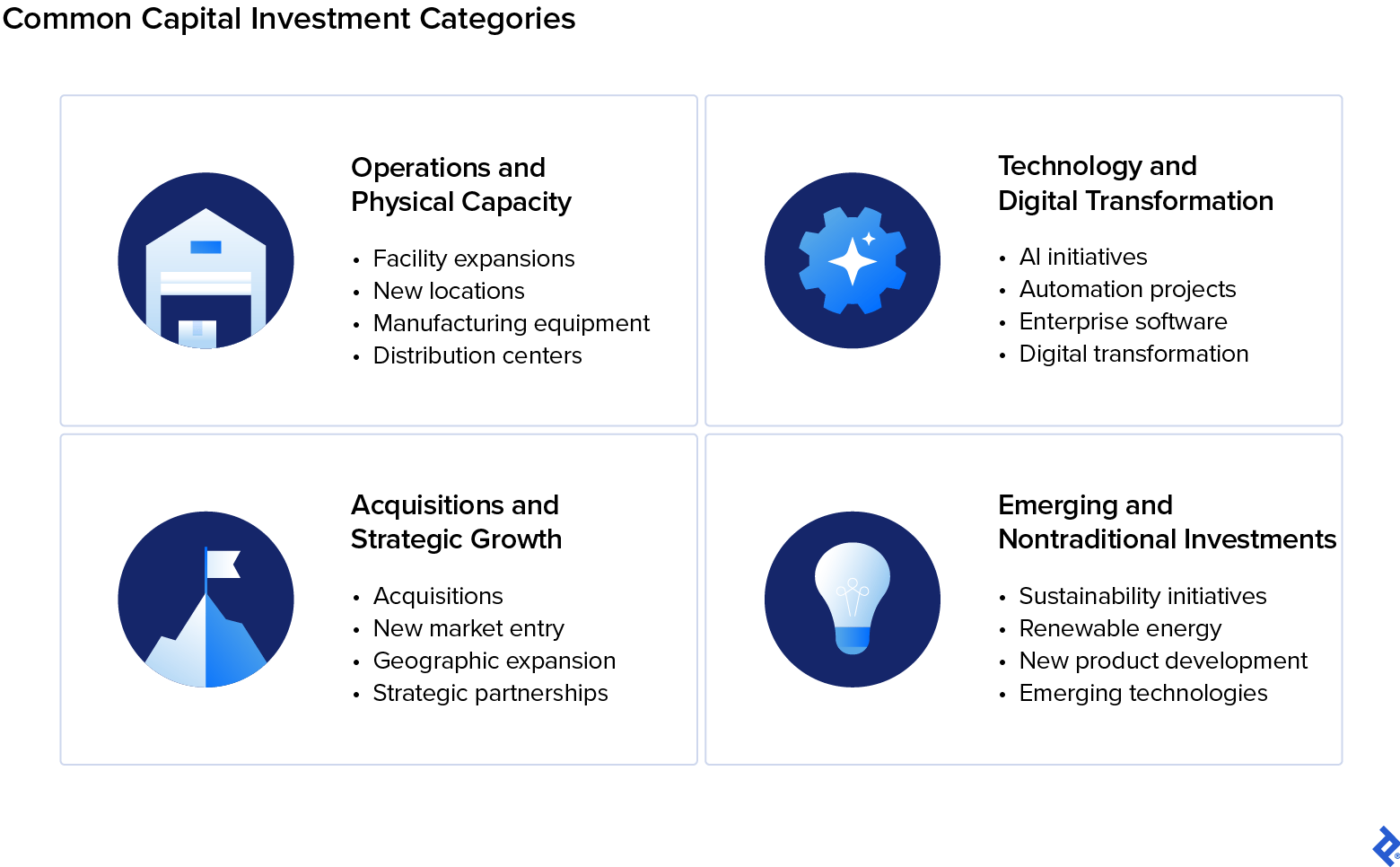
Capital budgeting principles apply across a wide range of investments, but the specific risks and assumptions leaders need to evaluate vary considerably depending on the type of opportunity.
Operations and Physical Capacity
Many capital budgeting decisions involve increasing an organization’s capacity to support future growth through facility expansions, equipment upgrades, and other capital improvements.
As is often the case in capital budgeting, expansion opportunities aren’t evaluated solely against one another. For instance, I recently worked with a franchise operator considering a significant expansion of its restaurant footprint. During the evaluation process, an acquisition opportunity emerged, forcing the team to choose between two competing growth paths: expanding existing locations organically or accelerating growth through acquisition.
At its core, this type of investment is a bet on future demand. Leaders must determine whether anticipated growth is likely to materialize and whether the organization has the operational capabilities to support it without creating new risks or inefficiencies.
Technology and Digital Transformation
Investments in technology, including AI, present a different challenge because many of their most important benefits are difficult to quantify in advance. For example, an automated workflow that reduces processing time in a CRM or back-office system produces clear, measurable labor savings. While those savings can be modeled, more consequential benefits, such as sharper decision-making or a stronger competitive position, do not lend themselves to the same level of precision.
As a result, technology investments often require leaders to weigh measurable financial returns against improvements in organizational capability whose value is real but difficult to estimate with confidence.
Acquisitions and Strategic Growth
Capital budgeting plays a central role in mergers and acquisitions, along with other strategic growth initiatives. Private equity and venture capital firms face the same challenge every day: looking beyond a target’s current performance to assess the opportunities, risks, and assumptions that will determine future value.
One dimension that financial models often underweight is the indirect value an acquisition can generate elsewhere in the business. A new market entry might enable an organization to route sourcing through an existing trading entity, generating an additional margin stream that never appears in the project’s standalone IRR. Procurement synergies and shared infrastructure work similarly. These ripple effects are part of why the nonfinancial dimensions of an acquisition memo often carry as much weight as the numbers themselves in acquisition decisions.
Emerging and Nontraditional Investments
Some capital investments require organizations to make decisions despite significant uncertainty about how and when value will be created. A sustainability investment, such as a shift to renewable energy inputs, may take a decade to pay back and may depend on regulatory or carbon-pricing changes that cannot be reliably forecast. Emerging technology investments pose a similar challenge because the underlying use case may still be evolving, and the market that would ultimately validate the investment may not yet exist.
In these situations, decisions often hinge less on precise forecasts and more on whether the investment strengthens the organization’s long-term strategic position. Leaders must also decide whether the organization is willing to accept a wider range of outcomes in exchange for moving early.
Common Challenges and Mistakes in Capital Budgeting
Even organizations with sophisticated financial models can make poor capital allocation decisions. I’ve found that the biggest challenges in capital budgeting rarely stem from the math itself. More often, the culprit involves how assumptions get made and how governance is structured.
- Relying on unrealistic assumptions: The most common technical pitfall is overconfidence in a model’s inputs. Revenue forecasts, cost estimates, discount rates, and terminal value assumptions all require judgment, and even small changes can dramatically alter a project’s NPV or IRR. Sensitivity analysis and stress testing help organizations understand how changes in key assumptions affect projected returns and avoid anchoring decisions to a single forecast.
- Allowing governance gaps to undermine the process: Capital investment decisions are sometimes shaped by whoever holds the most influence in the room rather than by the evidence in front of them. Independent review and a clear separation between those who propose investments and those who approve them are the primary defenses against this tendency.
- Ignoring strategic and execution risks: Some of the most significant capital budgeting failures stem from issues that never appear in a financial model. Projects that look attractive on paper can struggle because they lack strategic alignment or exceed the organization’s execution capabilities.
- Failing to measure results after approval: The effort devoted to evaluating and approving investments rarely extends to measuring whether those investments actually delivered. Without that discipline, the same flawed assumptions often carry forward into future decisions, and the capital budgeting process never improves.
Capital Budgeting as a Driver of Long-term Growth
Capital budgeting provides organizations with a structured framework for making informed decisions about the future. In practice, however, it is not about finding a perfect answer. Financial models help quantify expected returns, assess risks, and test assumptions, but they cannot eliminate uncertainty or replace judgment.
Early in my career, I worked on the acquisition of a professional sports franchise as a junior analyst. Our team produced a clear recommendation, and we were confident in the numbers. The chairman bid twice our advised price. I went to the CFO and asked, directly, what the purpose of our analysis had been. It was one of those moments that stays with you. The investment ultimately proved transformative, because the chairman had seen something the model hadn’t: The league itself was about to take off, reshaping the sport’s popularity in ways no historical data could have predicted.
That experience shaped how I think about capital budgeting. The process exists to give leaders the clearest possible view of the terrain, but they still have to decide which route to take, sometimes based on things the analysis can’t capture. The strongest organizations build that process with care, not because it guarantees the right answer but because it gives leaders the confidence to act on their own judgment when it matters most.
Further Reading on the Toptal Blog:
Understanding the basics
Capital budgeting is the process of evaluating long-term business investments, such as facilities, equipment, acquisitions, and technology initiatives. It helps leaders determine which projects are most likely to create value and support strategic objectives.
Seven commonly used capital budgeting methods and metrics are DCF analysis, net present value (NPV), internal rate of return (IRR), profitability index (PI), modified internal rate of return (MIRR), payback period, and throughput analysis.
A capital budgeting method is an analytical approach used to evaluate a potential investment. For example, DCF analysis estimates the present value of projected future cash flows and produces metrics such as NPV and IRR that help organizations assess an investment’s financial viability.
Three common capital budgeting methods are DCF analysis, payback period analysis, and throughput analysis. DCF assesses the present value of an investment’s projected future cash flows, while payback period analysis focuses on how quickly an investment recovers its cost and throughput analysis considers its effect on operational capacity.

London, United Kingdom
Member since December 29, 2021
About the author
Animesh is a corporate finance and investment consultant focused on helping organizations make sound financial decisions and deploy capital effectively. With experience spanning private equity investing and fractional CFO leadership, he has advised companies and investors across the US, UK, Middle East, and Asia on acquisitions and long-term growth strategies.
Previous Role
Fractional CFOPREVIOUSLY AT