
PyTorch vs. TensorFlow: Differences, Performance, and How to Choose
This comprehensive guide explores how PyTorch and TensorFlow shape deep-learning work in 2026, from experimentation and model design to production workflows, ecosystem tooling, and infrastructure considerations.

This comprehensive guide explores how PyTorch and TensorFlow shape deep-learning work in 2026, from experimentation and model design to production workflows, ecosystem tooling, and infrastructure considerations.

Nicolas Piro is a data scientist and AI engineer with more than 15 years of experience across e-commerce, healthcare, and industrial applications. He specializes in deep learning, large-scale model deployment, and applied research, with extensive hands-on work using PyTorch, TensorFlow, and modern compiler-based optimization tools.
Previous Role
Lead Data ScientistPreviously At


When I began working with deep learning nearly a decade ago, TensorFlow was the default choice. At Expedia, where I built machine learning models to optimize business workflows, it provided a reliable path from experimentation to production, even if the process was cumbersome. TensorFlow required defining computation graphs before execution, and its syntax often felt far removed from standard Python development.
PyTorch changed that. Its define-by-run approach made modeling far more intuitive for anyone familiar with Python and NumPy, allowing immediate feedback and simpler debugging. That accessibility transformed how quickly teams could experiment and iterate, which explains why PyTorch became the framework of choice for research and early-stage innovation.
Over the past 14 years working in data science and AI development across academia, e-commerce, healthcare, and industrial environments, I’ve seen both frameworks mature. TensorFlow has evolved toward ease of use with eager execution and Keras integration, while PyTorch has expanded its production capabilities through ONNX Runtime, TorchInductor, and Triton Inference Server. This guide compares the two as they stand in 2026, focusing on their real-world performance, usability, deployment readiness, and how to decide which framework best fits your team’s goals. If you’re looking for a quick way to choose a framework for your specific scenario, we’ve also included a downloadable decision matrix that maps PyTorch and TensorFlow to common project needs.
Table of Contents:
- Essential Context: What Is PyTorch?
- Foundational Overview: What Is TensorFlow?
- Core Differences You’ll Notice in Real Projects
- Framework Fit Across Common ML Workflows
- Lessons From Real-world Deployments
- Future Trends in PyTorch and TensorFlow
- Choosing the Right Framework for Your Project
- Final Thoughts
Essential Context: What Is PyTorch?
PyTorch is an open-source deep learning framework developed by Meta AI’s Research lab. It’s built around a simple idea: Models should behave like standard Python code. That design makes PyTorch intuitive for anyone familiar with scientific computing libraries such as NumPy and allows developers to construct and test models dynamically, one operation at a time.
At its heart, PyTorch gives you three things that feel completely native to Python: tensors (NumPy-style arrays that can run on GPUs), autograd (records every tensor operation and automatically computes the gradients you need for training), and ‘nn.Module’ (the standard way to build neural networks as Python classes). You write model logic with normal Python control flow and execute it instantly, making debugging as simple as using print or pdb. For teams accustomed to iterative, hands-on development, this approach reduces friction and shortens the path from idea to prototype.
Since its release in 2016, PyTorch has grown into a complete ecosystem. Libraries like torchvision, torchaudio, torchcodec, and TorchData extend its capabilities across computer vision, speech, and data preprocessing. For natural language processing, teams now rely on community-driven tools like Hugging Face Transformers and Datasets, which integrate seamlessly with PyTorch. At the training level, frameworks such as PyTorch Lightning abstract away much of the boilerplate around training and evaluation, standardizing training and testing loops while preserving PyTorch’s flexibility.
Foundational Overview: What Is TensorFlow?
Developed by Google, TensorFlow is an open-source framework built to support large-scale machine learning across diverse environments, from research notebooks to production systems. It introduced the concept of defining computation graphs in advance, allowing developers to optimize performance and reuse models efficiently across hardware and platforms.
In its early versions, that architecture came with trade-offs. Building and managing static graphs made TensorFlow powerful but also difficult to learn and debug, particularly compared to Python-native workflows. The release of TensorFlow 2.0 in 2019 addressed much of this complexity by adding eager execution as the default mode, integrating Keras as a unified API, and providing tf.function for compiling code into optimized graphs when needed.
TensorFlow’s strength lies in its ecosystem. Components such as TensorFlow Extended (TFX), TensorFlow Serving, and TensorFlow Lite support every stage of the machine learning life cycle: from data preprocessing and model training to mobile and edge deployment. Integrated compatibility with Google Cloud Vertex AI and Tensor Processing Unit (TPU) acceleration reinforces its position as the framework of choice for enterprise-scale, production-oriented environments.
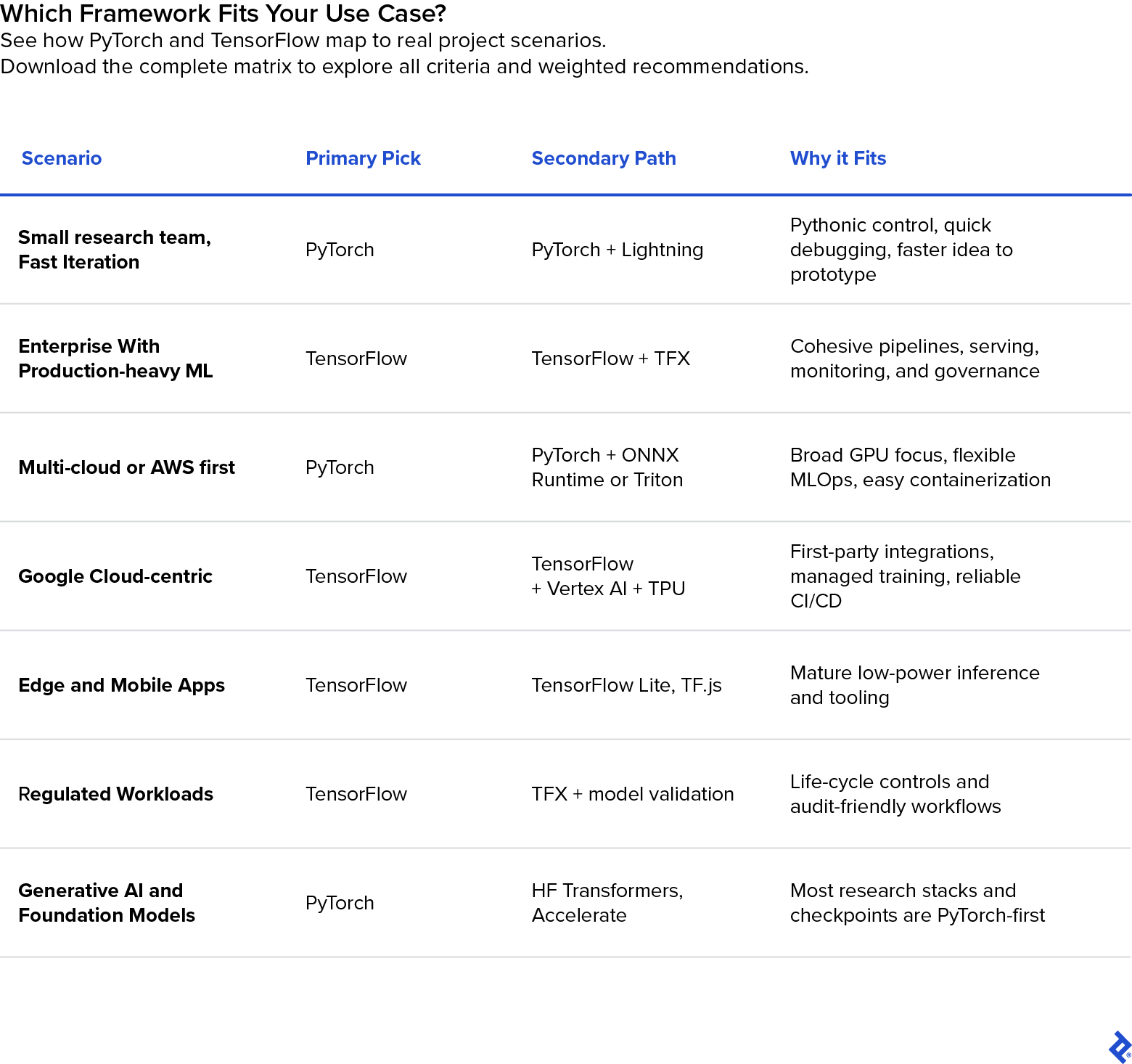
Download the PyTorch vs. TensorFlow Matrix
Core Differences You’ll Notice in Real Projects
With both frameworks established as mature, production-ready tools, their distinctions are more about experience. Each reflects a different philosophy of development that influences how teams design, test, and scale models. Now we will examine these contrasts in practice, including how they differ in usability, scalability, and ecosystem integration, and what those differences mean for real-world machine learning work.
Ease of Use and Syntax
PyTorch remains closer to native Python, letting engineers write and run training logic directly with minimal abstraction. Its syntax feels straightforward and transparent, which makes debugging and experimentation fast. Many developers describe it as “code first, framework second.”
TensorFlow, by contrast, encourages structure from the start. Through the Keras API, it provides ready-made methods for model definition, compilation, and training, reducing boilerplate and enforcing consistency across projects. This makes TensorFlow ideal for teams that want standardized workflows and built-in guardrails, especially in production contexts where reproducibility matters more than fine-grained control.
PyTorch still favors explicit, step-by-step training logic, while TensorFlow abstracts much of the process into higher-level functions such as ‘compile()’ and ‘fit()’. Both now prioritize usability, but in different ways: PyTorch offers flexibility and direct control; TensorFlow accelerates development with structure and prebuilt utilities.
In my experience, the choice depends less on syntax itself and more on whether your team values raw experimentation speed or consistency and guardrails.
Framework Design and Execution
In late 2025 the original philosophical split still influences daily work more than people admit.
PyTorch defaults to a dynamic, Python-like execution model and only shifts to an optimized static mode when explicitly needed. That keeps the path from notebook prototype to production remarkably smooth, especially for models with complex control flow, variable shapes, or heavy experimentation.
TensorFlow takes the opposite default: You can write eager code, but production workloads almost always go through graph-level optimization for peak performance and export. The payoff is excellent reproducibility and deployment options; the cost is extra ceremony when your model isn’t fully predictable ahead of time.
For standard CNNs and transformers, the practical difference between Pytorch and Tensorflow is tiny. For research, dynamic structures, or rapid iteration, PyTorch still feels noticeably faster and more forgiving.
Model Building and APIs
After years of execution-mode convergence, this is still where PyTorch and TensorFlow feel fundamentally different, and where most teams make their final framework choice.
PyTorch: Control Through Code
In PyTorch you build every model by extending a simple base class and defining how data moves through it with regular Python code. That single pattern gives you unlimited flexibility: Conditional layers, loops that depend on the input data, or last-minute architecture hacks are all just regular Python. It’s why research labs and anyone pushing architecture boundaries still overwhelmingly choose PyTorch; you never fight the framework when the model gets weird.
Key characteristics:
- Transparency: The full model definition is visible in standard Python syntax.
- Flexibility: Developers can modify behavior on the fly, add conditional logic, or combine modules dynamically.
- Customizability: Developers can rapidly adapt and extend model architectures as requirements change, supporting frequent experimentation and iteration.
Frameworks like PyTorch Lightning and Hugging Face Transformers extend this foundation, offering optional structure without hiding the underlying logic. Many engineers adopt them to reduce boilerplate while preserving PyTorch’s transparency.
TensorFlow and Keras: Structure and Reuse
Keras (TensorFlow’s primary API in 2025) is deliberately more opinionated. You choose one of Keras’s model-building styles, connect ready-made components, and the framework handles the rest. The model definition is shorter, more uniform, and integrates out-of-the-box with TensorFlow’s training, serving, and mobile/edge stack. When I’ve worked on larger applied teams, this built-in standardization has been the deciding factor: Code reviews are faster, junior engineers produce working models on day two, and the path to TF Serving or TFLite is essentially automatic.
Key characteristics:
- Consistency: Built-in methods standardize model definition, training, and evaluation across projects.
- Reusability: Components and layers integrate cleanly within the TensorFlow ecosystem (e.g., TensorFlow Extended or TensorFlow Lite).
- Speed of development: Teams can build, test, and deploy models faster by relying on high-level abstractions and tight ecosystem integration.
For production systems, Keras layers translate seamlessly into TensorFlow’s serving and deployment stack, reinforcing the Keras-TensorFlow stack’s role as an enterprise-ready framework.
If your work involves frequent architectural experimentation or nonstandard control flow, PyTorch remains the clearer winner. If you prioritize consistency, rapid onboarding, and tight integration with a mature deployment ecosystem, Keras/TensorFlow is still the more pragmatic choice.
Ecosystem and Libraries
If the frameworks themselves have grown closer, their ecosystems remain distinctly shaped by the communities that built them. PyTorch thrives in open research and rapid innovation, while TensorFlow continues to dominate production environments that demand structure, tooling, and long-term support.
PyTorch: Research and Open Innovation
PyTorch’s ecosystem has expanded organically around its research community and independent developers. Its modular design has encouraged an explosion of domain-specific libraries, many of which now drive state-of-the-art work across disciplines.
Key components include:
- Libraries like torchvision, torchcodec, and TorchData for computer vision, audio, and data preprocessing workflows, including convolutional neural networks, vision transformers, and object detection.
- PyTorch Lightning, PyTorch Hub, and Hugging Face Datasets for pretrained models, large language models, and natural language processing.
- Hugging Face Transformers for pretrained models and large language model development. Additional libraries extend PyTorch into specialized domains such as reinforcement learning and scientific computing.
- Captum for model explainability and interpretability.
This environment rewards experimentation. New methods are often first published in PyTorch, and the open-source community quickly implements and refines them. For researchers and applied AI teams, that pace translates into faster iteration, transparent experimentation, and an ecosystem that continues to evolve alongside the latest breakthroughs.
TensorFlow: Production and Integration
TensorFlow’s ecosystem reflects its origins inside Google and its alignment with enterprise infrastructure. It offers end-to-end life-cycle support through a tightly integrated stack.
Key components include:
- TensorFlow Extended (TFX) for data pipelines and model life-cycle management.
- TensorFlow Serving for deployment at scale.
- TensorFlow Lite and TensorFlow.js for mobile and web inference.
- TensorFlow Hub provides access to pretrained models that accelerate experimentation and deployment.
- Specialized libraries such as TensorFlow Recommenders and TensorFlow Decision Forests for solving common applied ML problems with domain-specific abstractions.
Integration with Google Cloud Vertex AI and native TPU support further strengthens TensorFlow’s appeal for organizations operating in large, distributed environments. The ecosystem’s consistency and enterprise backing make it particularly attractive for long-term production systems and teams managing multiple ML products.
Community and Adoption
Over the years, both frameworks have achieved massive industry adoption alongside vibrant open-source communities, but they attract distinct audiences and work in different ways. PyTorch grew from an open, research-first mindset; TensorFlow from an enterprise-driven effort to make large-scale machine learning reliable and repeatable.
When I first started using TensorFlow, it was the default framework almost everywhere. Google’s backing gave it credibility, and companies needed the kind of stability it promised. Even today, TensorFlow powers around 39% of production ML systems worldwide. It’s deeply embedded in enterprise environments and still the go-to choice for organizations that prioritize long-term support, compatibility with cloud infrastructure, and robust deployment tooling.
PyTorch, on the other hand, experienced a surge in popularity once researchers realized how much faster they could prototype with it. Within a few years, it became the framework of record in academic conferences and open-source projects. That shift has had ripple effects: Most tutorials, pretrained models, and open benchmarks now appear first in PyTorch, making it feel like the natural entry point for anyone learning modern deep learning. In 2024, around 70% of AI research implementations used PyTorch, according to the Linux Foundation.
The contrast also shows up in how the communities operate. PyTorch feels collaborative and bottom-up, with independent contributors quickly translating new ideas from papers into working code. TensorFlow’s community tends to be more structured, anchored around Google’s roadmap and a strong focus on production standards. Both approaches have value. I’ve found PyTorch communities to be faster at sharing experimental techniques, while TensorFlow communities excel at scaling and maintaining proven workflows across large organizations.
Deployment and Production Readiness
In production, the strengths and weaknesses of each framework become fully visible. Model deployment, scaling, and life-cycle management test the quality of the code and how well the ecosystem supports real-world constraints. Here, TensorFlow maintains a clear advantage in structure and tooling, while PyTorch has grown rapidly through lighter, modular solutions.
Aspect | PyTorch | TensorFlow |
Serving and Inference | Most production teams deploy PyTorch models using Triton Inference Server, ONNX Runtime, or custom REST/gRPC endpoints. These tools provide scalable serving and cross-framework interoperability. |
TensorFlow Serving offers a mature, stable system for versioned model deployment with gRPC and REST APIs; integrates seamlessly with TFX. |
Edge and Mobile Deployment |
ExecuTorch and PyTorch Mobile support lightweight inference on Android, iOS, and embedded systems. ExecuTorch is now the main initiative for on-device and edge inference across platforms. |
TensorFlow Lite, TensorFlow.js, and Edge TPU provide robust, production-tested options for mobile, embedded, and browser environments. |
Cloud Integration | Fully compatible with AWS SageMaker, Azure ML, and Google Cloud Vertex AI through ONNX or native runtimes. PyTorch is widely supported across multicloud MLOps environments. | Deep integration with Google Cloud Vertex AI and managed pipelines through TFX; strong first-party cloud support. |
Pipeline and Life-cycle Management | PyTorch does not include a built-in life-cycle framework; teams typically use external tools such as Kubeflow, MLflow, or Metaflow for orchestration, model tracking, and monitoring. | Comprehensive support via TensorFlow Extended (TFX), including model validation, monitoring, and retraining pipelines. |
Optimization and Performance |
TorchInductor and torch.compile for optimized inference; growing support for quantization and compilation. |
XLA compiler and TensorRT integration for high-performance inference across CPUs, GPUs, and TPUs. |
TensorFlow still offers the most cohesive path from experimentation to deployment. Its ecosystem forms a closed loop that manages everything from data ingestion to model monitoring, which appeals to enterprises that value standardization and governance. PyTorch, on the other hand, favors adaptability. Its reliance on modular, third-party tools makes it easy to integrate into diverse infrastructures without committing to a single stack.
In my experience, the choice often reflects an organization’s maturity. Teams that already run structured ML pipelines tend to benefit from TensorFlow’s completeness, while smaller or cloud-native teams often prefer PyTorch for its simplicity and flexibility. Both can deliver production-grade systems, but they serve different operational philosophies: TensorFlow optimizes for scale, PyTorch for agility.
Visualization and Debugging
Good visualization and debugging tools can make the difference between an experiment that converges and one that burns through hours of GPU time with no clear insight. Both PyTorch and TensorFlow now provide mature ecosystems for inspecting models, tracking metrics, and understanding performance bottlenecks, though they do so in different ways.
Tooling Aspect | PyTorch | TensorFlow |
Primary Visualization Tool | Integrates with TensorBoard through 'torch.utils.tensorboard'; many teams now rely on external platforms like Weights & Biases, Comet, and Neptune for experiment tracking and visualization. |
TensorBoard (native) with dashboards for metrics, graph structure, embeddings, and profiling. |
Debugging Style | Mirrors standard Python debugging workflows: Developers can use 'print()', 'pdb', or IDE breakpoints in real time, thanks to dynamic execution. | Eager execution allows real-time debugging similar to standard Python, while advanced users can still employ TensorBoard Debugger V2 and custom logging for graph-based workflows. |
Performance Profiling |
PyTorch Profiler with Chrome Trace and TensorBoard integration provides detailed views of GPU usage, memory allocation, and kernel performance. |
TensorFlow Profiler and XLA Analyzer deliver in-depth GPU and TPU profiling with timeline views, memory summaries, and performance bottleneck analysis. |
Explainability and Visualization | Libraries such as Captum and TorchCAM support model interpretability. Teams typically use Hugging Face Transformers and Datasets, which integrate seamlessly with PyTorch. |
TensorBoard Projector, TF Explain, and native model interpretability APIs remain the main tools for exploring embeddings and visualizing internal model behavior. |
In my experience, PyTorch provides a lighter and more flexible debugging experience, as it behaves like ordinary Python code, making it easy to inspect tensors, variables, and errors on the fly. TensorFlow’s tools, on the other hand, are more structured and comprehensive. TensorBoard feels like a control room for your model, visualizing metrics, graphs, and hardware usage in real time. It takes a bit longer to set up, but once it’s running, it’s hard to match its depth and polish.
For day-to-day work, PyTorch’s simplicity makes quick iteration easier, while TensorFlow and third-party platforms provide more systematic tools for detailed performance tracking. PyTorch tends to reveal issues as you work, whereas TensorFlow invites you to monitor and instrument your models more deliberately.
Performance and Scalability
At scale, performance depends as much on infrastructure as on the framework itself. What matters is how efficiently each environment can distribute workloads, compile operations for target hardware, and maintain stability under heavy training demands. In this area, PyTorch and TensorFlow both achieve impressive GPU acceleration and optimization through compiler-level improvements, but they approach it through different design choices.
Aspect | PyTorch | TensorFlow |
Hardware Acceleration | Broad GPU support through CUDA and ROCm; optimized for modern GPU architectures, including NVIDIA H100. | Deep TPU and GPU integration, enhanced by XLA for ahead-of-time compilation. |
Distributed Training | PyTorch Distributed, DeepSpeed, and FSDP for large models and parallel training. | tf.distribute.Strategy enables mirrored, parameter-server, and multiworker setups with strong TPU support. |
Compiler and Optimization Tools
| TorchInductor and TorchCompile improve runtime efficiency and inference speed. | XLA compiler and Graph Optimization Toolkit streamline both training and inference. |
Scalability | Performs strongly in multi-GPU clusters and containerized environments like Ray or Kubernetes. Suited for hybrid and on-premises GPU infrastructures. | Excels on managed cloud environments, particularly on Google Cloud and TPU pods, with tightly integrated orchestration and monitoring. |
Recent Benchmarks (2025) | Up to 250 TFLOPS per GPU on H100 hardware, with nearly 4x faster training in compile mode compared to legacy eager execution. | Achieves 275-460 TFLOPS throughput on TPU v4/v5 workloads, maintaining a performance edge in large-scale distributed training. |
Performance differences now tend to show up less in benchmark scores and more in operational context. TensorFlow still leads in large, tightly managed environments where TPU access and reproducibility are priorities. PyTorch often proves faster to tune and scale across general-purpose GPU clusters, especially in research or hybrid setups. In practical terms, both frameworks are fast enough; the real differentiator is which one fits your infrastructure, team expertise, and deployment strategy.
Integration With Other Tools and Platforms
In most real projects, frameworks don’t work in isolation. They operate within broader systems that manage data pipelines, model tracking, and deployment. The quality of those integrations often determines how smoothly teams can move from experimentation to production.
Integration Area | PyTorch | TensorFlow |
Cloud Platform Integration | Broad multicloud support, especially on AWS SageMaker and Azure ML; integrates well with custom or hybrid infrastructure. | Native integration with Google Cloud Vertex AI, BigQuery ML, and other GCP services for end-to-end pipeline management. |
Orchestration and Workflow Tools | Commonly paired with MLflow, Airflow, Ray Serve, or BentoML for modular, script-based workflows. | Works seamlessly with Kubeflow Pipelines and TFX, enabling automated data validation, training, and deployment. |
Experiment Tracking and Observability | Integrates with Weights & Biases, Neptune.ai, and Comet for tracking and reproducibility; flexible but relies on third-party tools. | Ships with TensorBoard for native visualization and tracking; also supports external tools for extended observability. |
CI/CD and DevOps Workflows | Easily scripted in GitHub Actions, GitLab CI, or other automation pipelines; supports containerized workflows for training and deployment. | Integrates with AWS CodePipeline, GCP-native CI/CD, and TFX components for fully managed life-cycle automation. |
Teams working in Google Cloud environments tend to prefer TensorFlow because of its deep service integration, which minimizes the need for additional orchestration layers. PyTorch remains the more adaptable choice in AWS- or Azure-based ecosystems, where modularity and custom MLOps setups are common. In my experience, the smoother framework is usually the one that best matches your existing infrastructure, not necessarily the one with the longest feature list.
Cost and Resource Considerations
Every framework choice carries hidden costs. Beyond licenses and cloud bills, teams have to account for hardware efficiency, training duration, and the effort needed to keep models running. In practice, PyTorch tends to minimize early experimentation costs, while TensorFlow is often more economical once models reach full production scale.
Category | PyTorch | TensorFlow |
Training Costs | Highly efficient on GPUs; supports mixed-precision training to reduce compute and memory usage. Well suited for rapid experimentation and midscale workloads. | Optimized for TPUs, which can significantly reduce cost per training run at scale but require Google Cloud infrastructure. |
Inference Costs | Uses ONNX Runtime and ExecuTorch for optimized inference on servers; mobile and edge support is improving but less mature than TensorFlow Lite in some use cases. | TensorFlow Lite and TensorFlow.js provide production-ready, low-power inference for mobile and embedded environments. |
Resource Utilization | Excellent for quick iteration, though sometimes less resource-efficient in continuous large-scale production. | Structured pipelines through TFX and TensorFlow Serving help minimize idle resources in large deployments, though they require setup and operational investment. |
Operational Overhead | Often relies on external MLOps tools (MLflow, Metaflow, etc.); this offers flexibility but can increase integration and maintenance effort unless standardized. | Offers integrated enterprise support, though its complexity and setup requirements can raise onboarding costs. |
In most organizations, the balance comes down to scale and duration. I’ve seen teams overspend not because they chose the wrong framework, but because they underestimated the operational side of machine learning. PyTorch makes that side visible earlier; TensorFlow hides it until you scale. Either way, the costs eventually surface.
Framework Fit Across Common ML Workflows
Choosing between PyTorch and TensorFlow makes the most sense when tied to specific project goals. Both frameworks are powerful and production-ready, but their strengths become clearer once you consider the type of work, team composition, and deployment environment.
When PyTorch Fits Best
- Research and prototyping: PyTorch’s flexible, Pythonic syntax allows rapid experimentation and debugging. Most new architectures in computer vision, NLP, and generative AI are first published in PyTorch, making it the natural choice for research groups.
- Startups and applied AI teams: Smaller teams often favor PyTorch for its simplicity and minimal setup overhead. It’s easier to iterate, test, and ship models without committing to a large tooling ecosystem.
- Custom architectures: Projects involving nonstandard training loops, multitask learning, or complex data flows benefit from PyTorch’s explicit control over computation.
- Cross-framework deployment: PyTorch models export easily through ONNX, making integration with other runtimes or serving systems straightforward.
When TensorFlow Fits Best
- Enterprise and production systems: TensorFlow’s stability, governance features, and integration with Google Cloud make it well-suited for organizations managing multiple ML pipelines.
- Edge and mobile deployment: TensorFlow Lite and TensorFlow.js provide mature solutions for inference beyond the cloud.
- Structured ML pipelines: With TFX, TensorFlow supports automated data validation, model tracking, and retraining at scale, reducing operational overhead.
- TPU-heavy workloads: TensorFlow’s native XLA compiler and TPU optimization still deliver best-in-class performance for very large training jobs.
Shared and Hybrid Scenarios
- Education and onboarding: Both frameworks are now beginner-friendly, with rich documentation and strong community support.
- Multiframework ecosystems: Large organizations sometimes maintain both stacks (PyTorch for research, TensorFlow for deployment) though this remains the exception rather than the rule.
- Third-party MLOps tools: Framework-agnostic platforms like MLflow, Weights & Biases, and Ray have made it easier to standardize workflows across frameworks.
Ultimately, the most effective choice depends less on benchmarks than on workflow maturity. PyTorch rewards agility and creative iteration. TensorFlow rewards scale, process, and predictability. Knowing which of those strengths matters more to your team is what makes the decision clear.
Lessons From Real-world Deployments
I’ve spent much of my career moving between environments that demand very different things from machine learning. Some projects required scale and repeatability above all else, while others needed room to experiment, fail, and adjust quickly. Those shifts have shaped how I use PyTorch and TensorFlow, as well as what I expect from each.
TensorFlow at Expedia: Reliability in Production
At Expedia, we built models to detect anomalies in server logs, an early use case for machine learning in large-scale infrastructure monitoring. TensorFlow’s structured workflow made it the natural fit. Its static graph model at the time felt rigid, but it delivered stability, reproducibility, and performance in a demanding production environment. Integrating TensorFlow with the company’s existing data pipelines and deployment systems required effort, yet it ensured consistent results once the model went live. That reliability outweighed the slower iteration speed.
PyTorch in Healthcare: Flexibility for Complex Data
In healthcare projects involving computer vision, I turned to PyTorch for its flexibility. Medical imaging models require extensive experimentation with architectures and preprocessing methods, and PyTorch allowed for that level of control. The dynamic execution model made it easy to test new ideas, trace errors in real time, and quickly adapt the pipeline. Combined with tools like PyTorch Lightning and Captum, it supported both explainability and efficient scaling during experimentation.
Industrial Sensing and Applied Research: Choosing by Context
In industrial sensing and physics research, the framework choice often came down to the surrounding infrastructure. Teams with established TensorFlow expertise and stable pipelines benefited from the integration of TensorFlow with TFX and Serving. Others, especially in early-stage R&D, preferred PyTorch for faster iteration and tighter feedback loops.
Those contrasts made it clear that no single framework fits every phase of development. TensorFlow’s discipline enforces scalability and control, while PyTorch’s design encourages experimentation and agility. The key is not choosing one forever, but one that fits where your project is now.
Future Trends in PyTorch and TensorFlow
After a decade of parallel growth, PyTorch and TensorFlow are entering a new phase defined less by design philosophy and more by infrastructure. The competition now centers on compilers, interoperability, and the quest to support increasingly larger generative models. Both ecosystems are evolving rapidly, but the directions they’re taking reveal different bets on what the next generation of machine learning will demand.
Compiler Stacks and Performance Optimization
Compiler development is reshaping both frameworks.
- PyTorch continues advancing with TorchInductor and TorchDynamo, tools that automatically convert dynamic graphs into optimized code paths. These improvements are bringing PyTorch’s runtime efficiency closer to that of static frameworks while preserving its interactive workflow.
- TensorFlow is deepening its investment in XLA and TPU integration, targeting large-scale distributed workloads. These optimizations aim to maintain TensorFlow’s role as the default choice for managed, cloud-based training.
Together, these advances are making compiler stacks the real differentiator in deep learning performance, more than framework syntax or APIs.
Interoperability and Standards
Cross-framework interoperability is becoming the next layer of abstraction.
- ONNX has emerged as a common export format for model sharing and deployment across runtimes.
- Keras 3.0 introduced cross-framework compatibility, allowing models to move between TensorFlow, JAX, and PyTorch.
This push toward openness suggests that the future of frameworks may be less about competition and more about compatibility.
Ecosystem Direction
The two frameworks are evolving to capitalize on their respective strengths.
- PyTorch is consolidating its dominance in research while expanding into production with stronger support for mobile and edge inference.
- TensorFlow is doubling down on its enterprise positioning, building tighter integration with Google Cloud and other managed AI services.
Both are adapting to a landscape where models are no longer confined to a single environment but must operate across multiple devices, platforms, and organizations.
Generative AI Landscape
The rise of generative models has tilted momentum toward PyTorch. Most leading large language models and diffusion systems are built on it, supported by a highly active open-source ecosystem. TensorFlow, however, remains influential in applied AI, particularly where integration with GCP services or custom TPU infrastructure matters. Compiler-level optimization and cloud-backed model hosting could help TensorFlow reenter competitive ground in this space.
PyTorch vs. TensorFlow: Choosing the Right Framework for Your Project
Teams choose frameworks for concrete reasons: Existing infrastructure, team skills, deployment targets, and time to value. PyTorch and TensorFlow now overlap across most capabilities, so the useful question is not which is better, but which fits your project goals and constraints.
If your organization optimizes for rapid iteration and hands-on control, PyTorch aligns well with that workflow. It reads like Python, lowers the cost of experimentation, and maps cleanly to research-heavy roadmaps. If your priority is predictable scaling and managed pipelines, TensorFlow offers a cohesive path through Keras, TFX, TensorFlow Serving, and cloud integrations, particularly in Google Cloud environments.
For teams that need to make this decision systematically, we’ve prepared a downloadable PyTorch vs. TensorFlow Decision Matrix. It outlines how each framework performs across common scenarios, from research and prototyping to enterprise-scale production, so you can match your priorities, score them, and identify the best fit for your environment.
Final Thoughts
PyTorch and TensorFlow have matured into capable, production-ready ecosystems. The differences that once separated them, such as static versus dynamic graphs or research versus production, have largely narrowed. What remains are distinct strengths shaped by their histories and communities.
PyTorch continues to lead in flexibility and experimentation speed. Its intuitive design, strong research adoption, and rapidly expanding tooling make it ideal for teams that iterate fast and value hands-on control.
TensorFlow excels in structured scalability. Its enterprise integrations, deployment maturity, and reach across cloud, mobile, and edge environments make it the natural choice for organizations that prioritize stability and life-cycle management.
Ultimately, the right framework depends on context: team expertise, deployment goals, and the infrastructure surrounding your models. For many teams, the decision isn’t permanent but iterative: Projects evolve, and frameworks can coexist through shared standards like ONNX.
Before committing, review both frameworks’ latest documentation, run small prototypes, and test how each integrates with your existing pipelines. The best tool will be the one that lets your team learn quickly, deliver reliably, and adapt as machine learning evolves.
Further Reading on the Toptal Blog:
Understanding the basics
Neither is universally better. PyTorch excels at flexibility and rapid experimentation, while TensorFlow offers stronger production tooling and ecosystem integration. The right choice depends on your team’s workflow, infrastructure, and deployment needs.
ChatGPT is trained using PyTorch. Most large language models (including those developed by OpenAI) use PyTorch because its dynamic execution model and tooling make research, experimentation, and large-scale model development more efficient.
If you’re focused on research or prototyping, PyTorch is usually the easier and more intuitive place to start. If you plan to work in enterprise environments with structured ML pipelines, TensorFlow and Keras may be more useful. Many engineers eventually learn both.

Zürich, Switzerland
Member since January 21, 2022
About the author
Nicolas Piro is a data scientist and AI engineer with more than 15 years of experience across e-commerce, healthcare, and industrial applications. He specializes in deep learning, large-scale model deployment, and applied research, with extensive hands-on work using PyTorch, TensorFlow, and modern compiler-based optimization tools.
Previous Role
Lead Data ScientistPREVIOUSLY AT