
Symfony vs. Laravel: Choosing the Right PHP Framework
The best PHP framework is rarely determined by technology alone. Compare Laravel and Symfony through the lens of architecture, scalability, team dynamics, and long-term business needs.

The best PHP framework is rarely determined by technology alone. Compare Laravel and Symfony through the lens of architecture, scalability, team dynamics, and long-term business needs.

Radoslav is a full-stack developer specializing in Symfony and Laravel. He has helped startups and enterprise organizations, including Orange and Century 21, develop scalable web, mobile, and SaaS platforms. His work spans application architecture and cloud infrastructure, with an emphasis on clean, maintainable solutions that translate complex business requirements into scalable software.
Previous Role
Senior Full-stack DeveloperPreviously At


I started working with PHP nearly 20 years ago, teaching myself PHP 5 from a book as a teenager. At the time, there were no mature frameworks like Symfony or Laravel, and far fewer libraries to rely on. Building applications meant doing almost everything from scratch, including the foundational architectural design.
Today, frameworks like Symfony and Laravel are robust and capable of supporting modern applications. However, choosing between them isn’t always straightforward. If you based the decision on popularity alone, Laravel would win. According to the JetBrains 2025 State of PHP report, Laravel is the most widely used PHP framework, with 64% of PHP developers reporting usage. Symfony ranks as the second-most used framework at 23%.
Yet those numbers only tell part of the story. While Symfony may be less popular, I’ve come to appreciate its structure and architectural control, particularly in larger or more complex systems. It’s harder to learn but worth it in those contexts. Meanwhile, Laravel is widely adopted for a reason. It offers a streamlined developer experience and excels in scenarios that demand rapid development. Neither framework is inherently better; the right choice depends on the architectural demands of your project and your team’s workflow.
This guide takes a practical, side-by-side approach to evaluating Symfony and Laravel across both technical and business dimensions. My goal is to help you choose the framework that aligns with your use case.
Table of Contents
- Quick Decision Guide
- Head-to-Head Technical Comparison
- Team and Talent Considerations
- Business and Financial Impact
- Typical Use Cases
- Future Outlook
- Making Your Decision
Quick Decision Guide: Symfony vs. Laravel
When choosing between Symfony and Laravel, I always start by considering how quickly the team needs to move and how much control the system will demand as it grows.
Symfony vs. Laravel: Quick Decision Guide | |
|---|---|
If Your Priority Is… | Choose |
Launching and Iterating Quickly | Laravel |
Developer Productivity and Easy Onboarding | Laravel |
Long-term Architectural Control | Symfony |
Enterprise Governance and Maintainability | Symfony |
Building Distributed or Highly Customized Systems | Symfony |
Rapid Development of Real-time Features | Laravel |
Infrastructure Flexibility and Scalability | Symfony |
When to choose Symfony: If you’re building a system that needs to scale predictably over time (e.g., one that will grow in complexity or involve multiple teams), Symfony is usually the better fit. In my experience, Symfony’s modular design and explicit structure make it easier to manage complexity as back-end-heavy systems evolve.
When to choose Laravel: If your priority is speed (e.g., launching an MVP, iterating quickly, or onboarding developers efficiently), Laravel is hard to beat. I’ve seen teams go from idea to working product significantly faster with Laravel, especially when strong conventions and built-in tooling reduce the need for upfront architectural decisions. That accessibility is a big part of why it remains so widely adopted today.
Head-to-Head Technical Comparison: Symfony vs. Laravel
The big-picture trade-offs between Symfony and Laravel become clearer when we examine how each framework actually works. The table below provides a high-level snapshot across key technical dimensions. We’ll expand on each area in detail throughout the rest of this section.
Symfony vs. Laravel Technical Overview | |||
|---|---|---|---|
Symfony | Laravel | Takeaway | |
Architecture and Modularity | Component-based, highly decoupled architecture | Opinionated, integrated framework | Symfony offers architectural control; Laravel offers an all-in-one approach. |
Performance and Scalability | Flexible infrastructure and scaling patterns | Strong out-of-the-box performance for midscale apps | Both scale well, but Symfony is more predictable in complex, distributed systems. |
ORM and Data Layer | Doctrine ORM (Data Mapper) | Eloquent ORM (Active Record) | Doctrine favors separation of concerns; Eloquent favors development speed. |
Security and Compliance | Fine-grained security controls and long-term support | Secure defaults and streamlined authentication | Symfony suits compliance-heavy environments; Laravel simplifies secure development. |
Testing and Quality Assurance | Emphasis on isolated services and contracts | Emphasis on features and user workflows | Symfony favors service-level testing; Laravel favors behavioral testing. |
Developer Experience and Tooling | Explicit configuration and architectural transparency | Streamlined workflows and integrated tooling | Laravel maximizes developer velocity; Symfony prioritizes control and consistency. |
Deployment and Infrastructure | Flexible infrastructure and custom deployment strategies | Integrated deployment and operations tooling | Laravel reduces DevOps overhead; Symfony enables deeper infrastructure control. |
Ecosystem and Community | Reusable components with broad ecosystem influence | Large, active community with extensive learning resources | Laravel's community is larger; Symfony's influence extends across the PHP ecosystem. |
Architecture and Modularity
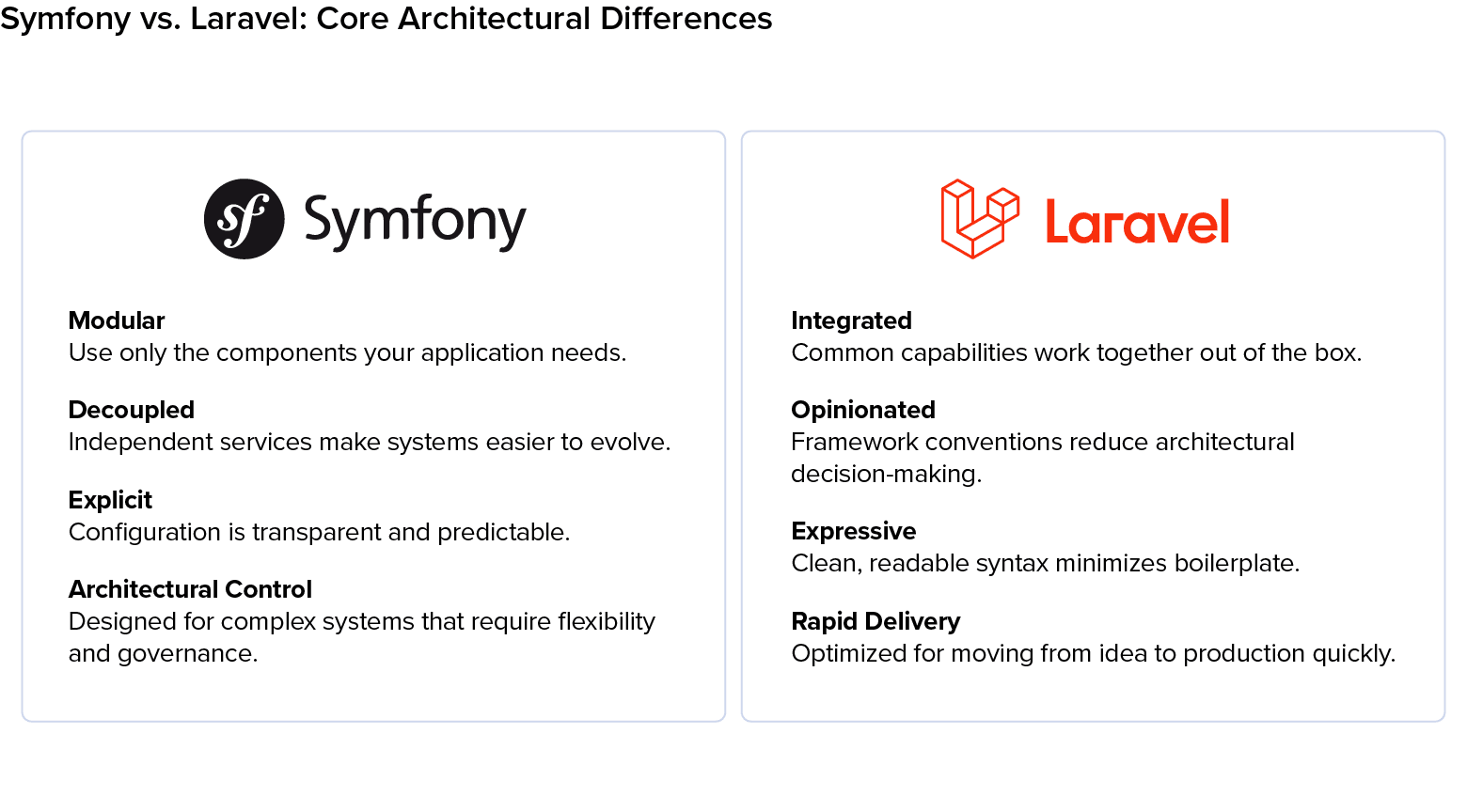
Both Symfony and Laravel follow the model-view-controller (MVC) pattern, which separates application logic, data handling, and user interface rendering into distinct layers. However, they take fundamentally different approaches to application structure, with Symfony emphasizing modularity and architectural control, while Laravel provides an integrated, opinionated framework experience.
Symfony Architecture
Symfony is built on a collection of decoupled, reusable PHP components (more than 50), which gives you fine-grained control over how your application is structured. Rather than prescribing a single way of building applications, it encourages explicit architectural decisions. That extends to how services and dependencies are managed: Dependency injection is commonly handled through constructors or service configuration, making the application structure more straightforward to test and maintain as your systems become more complex.
I’ve found Symfony’s more explicit approach considerably more natural to reason about in large systems because there’s generally less magic happening behind the scenes. Services and dependencies tend to be declared more transparently, which provides greater visibility into how the application behaves as the codebase grows. This architecture also makes it more practical to extract logic into custom packages or migrate components toward microservices over time.
That said, Symfony’s structure guides rather than guarantees good architecture. I’ve inherited Symfony codebases where the previous developer had pushed excessive business logic into the wrong layers and created tightly coupled services despite the framework’s modularity, leaving the application in a state that took weeks to untangle. The framework creates conditions for good architecture, but it doesn’t enforce them.
Laravel Architecture
Laravel, on the other hand, follows the same underlying MVC pattern but implements it through an integrated, opinionated architecture that helps developers move quickly without needing to make as many upfront decisions. Many common concerns (e.g., routing, authentication, and database access) are preconfigured and ready to use.
Laravel achieves much of this through framework conventions and runtime abstractions that provide a clean and expressive development experience with minimal setup. This lowers the barrier to entry considerably for smaller teams and products under active development. The tradeoff is that application behavior can become more implicit as the service graph grows, which may complicate static analysis or debugging in very large systems compared to Symfony’s more explicit architectural style.
This makes Laravel ideal for projects where speed and simplicity matter most. For MVPs, SaaS products, and smaller applications, the framework’s defaults allow teams to focus on shipping features rather than designing infrastructure from scratch.
Takeaway: Symfony provides the architectural control and modularity needed for large, evolving systems, with cleaner paths to a microservices architecture. Laravel prioritizes rapid development and developer productivity through a cohesive framework experience.
Performance and Scalability
Performance issues in PHP applications are rarely caused by the framework itself. In my experience, Symfony and Laravel applications with identical functionality can easily trade places in benchmarks depending on how they’re configured. Factors such as bytecode caching (OPcache), application caching and queues (Redis), and the underlying execution model (traditional PHP-FPM versus persistent-worker solutions like Laravel Octane or FrankenPHP) often have a greater impact on performance than the framework alone.
That said, Symfony and Laravel encourage different approaches to scaling. Symfony’s architecture naturally accommodates highly customized caching, messaging, and deployment strategies, while Laravel focuses on providing accessible tools and conventions that help teams achieve strong performance without extensive infrastructure planning upfront.
Symfony Performance
Symfony performs especially well in complex or high-traffic environments where infrastructure-level optimization becomes important. Its component-based architecture makes it easier to introduce performance-oriented infrastructure patterns (e.g., HTTP caching, message queues, and event-driven workflows) without tightly coupling those decisions to the framework itself. For example, teams can swap out queue back ends or evolve caching strategies without rewriting core application logic.
Symfony’s Messenger component provides a consistent abstraction for asynchronous processing across different transports, while its caching system supports a wide range of back ends and caching strategies. Together, these tools give teams fine-grained control over how performance concerns are implemented as application requirements evolve.
Laravel Performance
Laravel performs best in scenarios where strong defaults and fast setup drive results. For many applications, especially APIs and midsized systems, it delivers solid performance out of the box without requiring significant infrastructure planning upfront.
When higher throughput is needed, Laravel provides tools like Octane (via Swoole or RoadRunner) to improve concurrency, along with built-in support for queues and real-time broadcasting through integrations like Pusher and Ably. These features allow teams to introduce performance optimizations quickly, though scaling more complex systems often requires additional architectural planning around queues, database access patterns, and service boundaries.
Takeaway: Performance differences between Symfony and Laravel are usually less important than the architectural decisions that surround them. Symfony offers more flexibility for teams evolving complex infrastructure over time, while Laravel reduces the overhead required to achieve strong performance early in a project’s life cycle.
ORM and Database Management
Symfony and Laravel diverge most clearly in how they model and organize data. Each framework approaches this through a distinct object-relational mapping (ORM) strategy, which is the layer responsible for translating between application objects and database tables.
Symfony’s Doctrine ORM encourages a stronger separation between business logic and database persistence, while Laravel’s Eloquent ORM integrates database interactions more directly into application models.
Symfony (Doctrine ORM)
Doctrine implements the Data Mapper pattern, which separates business logic from database persistence. Rather than embedding database behavior directly into models, entities remain closer to plain domain objects, giving developers more flexibility in how business rules are structured and maintained. The separation also provides a natural barrier that helps prevent malformed data from reaching core business logic.
This approach provides fine-grained control over complex schemas, entity relationships, and query behavior, making Doctrine well-suited for large applications with evolving domain models or compliance-heavy data requirements. It also supports multiple databases and advanced query customization without tightly coupling application logic to the persistence layer.
Initially, I disliked Doctrine for the amount of boilerplate it introduced through entity mapping, getters, and setters, especially coming from Laravel, which takes a more integrated approach. Today, however, modern integrated development environments (IDEs), code generation, and AI-assisted workflows have automated much of that repetitive work. Tasks that once felt tedious are now largely handled for you, meaning Doctrine’s architectural advantages no longer come with the same development overhead they once did.
Laravel (Eloquent ORM)
Eloquent follows the Active Record pattern, where database behavior is embedded directly into models. This approach feels more immediately approachable to me, offering an intuitive syntax that abstracts SQL command generation behind clean, readable method chains.
Laravel’s ORM emphasizes readability and ease of implementation through its syntax and tightly integrated framework conventions. Together, these design choices dramatically reduce boilerplate and make common database interactions easy to reason about. Modern static analysis tools and IDE integrations have also made Eloquent’s more dynamic behavior easier to validate and debug than in earlier Laravel ecosystems.
That convenience comes with tradeoffs worth being aware of. Because business logic and persistence are more tightly connected in Eloquent, teams that aren’t deliberate about the separation of concerns can gradually create God Objects, in which Active Record classes take on too many responsibilities and become difficult to maintain. While I’ve seen the same pattern emerge in poorly structured Doctrine implementations, it’s less common.
Takeaway: Doctrine and Eloquent encourage different architectural styles, but modern tooling has narrowed many of their historical tradeoffs. In the long run, your team’s engineering discipline matters more than your ORM choice.
Security and Compliance
Both Symfony and Laravel provide mature security foundations, including protections against common vulnerabilities such as SQL injection and cross-site scripting (XSS). They also support modern authentication workflows. The more meaningful distinction is how much control and customization teams need around security architecture as systems grow.
Symfony Security
Symfony provides a highly configurable security architecture with granular control over authentication flows, authorization policies, encryption behavior, and firewall configuration. Its role-based access control (RBAC) capabilities support fine-grained permissions and multiple authentication strategies, helping organizations define exactly what registered users can access. Long-term support (LTS) releases also provide extended security patch coverage that many regulated industries require.
As an added benefit, Symfony’s explicit configuration model can simplify security reviews and auditing because authentication flows, firewall behavior, and access policies are defined more transparently throughout the application.
Laravel Security
Laravel takes a more integrated approach by shipping with many protections enabled by default. Features like cross-site request forgery (CSRF) protection and password hashing are built directly into the framework, helping defend against common online attacks without requiring manual configuration.
Laravel also streamlines authentication and session management through built-in tooling and scaffolding that make it easy to implement secure login flows. For smaller engineering teams, this convenience significantly lowers the barrier to building secure applications without dedicated security specialists.
As systems become more specialized, however, teams may eventually need security solutions that extend beyond Laravel’s default abstractions. Still, for most modern web applications, Laravel’s default security tools provide a strong baseline.
Takeaway: Symfony gives organizations more explicit control over security architecture and policy enforcement, while Laravel’s integrated protections and streamlined workflows make it faster to reach a secure baseline without extensive configuration.
Testing and Quality Assurance
The biggest testing difference between Symfony and Laravel isn’t their testing capabilities but the development habits they encourage over time. Symfony encourages testing around isolated services and explicit boundaries, while Laravel prioritizes behavioral testing focused on end-to-end feature validation and user outcomes.
Symfony Testing
Symfony integrates cleanly with PHPUnit and provides strong support for unit, functional, and integration testing across complex application environments. Because services and dependencies are typically defined more explicitly, application behavior can be readily mocked and verified independently during testing. This aligns with a more contract-oriented testing approach, where teams verify isolated services independently and ensure behavior remains predictable as systems evolve.
This makes Symfony particularly effective for systems where teams need confidence that individual services can evolve independently without introducing regressions elsewhere in the application. When Symfony’s dependency injection patterns are used consistently, testing isolated pieces of business logic remains manageable as the codebase grows.
Of course, this level of isolated test coverage can come with significant overhead, particularly in larger Symfony applications, but AI-assisted tooling is changing that equation by making repetitive unit tests, mocks, and scaffolding far less burdensome to generate and maintain. AI doesn’t eliminate the need for review, but it can significantly reduce the effort required to sustain broader test coverage over time.
Laravel Testing
Laravel ships with built-in helpers, factories, and tools like Pest that make common testing workflows easy to implement quickly. Its testing ecosystem supports a behavioral testing style and is especially effective for validating complete user flows and end-to-end feature behavior.
I’ve found Laravel particularly productive for Agile teams iterating rapidly on product features because many framework conventions are already wired together in ways that simplify realistic application testing. This allows teams to validate new functionality quickly without building an extensive testing infrastructure upfront.
While Laravel makes it easy to test things quickly, that speed comes with tradeoffs. When budgets and schedules are constrained, I’ve seen teams prioritize rapid feature delivery and end-to-end validation over comprehensive unit coverage. That decision often makes sense early in a product’s life cycle, but once products mature, the cost of not having reliable regression coverage becomes much higher, making broader automated testing increasingly important over time.
Takeaway: Symfony’s explicit architecture naturally supports isolated, highly structured testing, while Laravel excels at fast, feature-oriented testing workflows that help teams iterate quickly.
Developer Experience and Tooling
Developer experience is where the philosophical differences between Symfony and Laravel become especially noticeable in day-to-day work, although developers who are comfortable with one framework will usually find the other reasonably accessible.
Symfony Developer Experience
Symfony provides a highly configurable environment supported by tools like the Symfony CLI, Profiler, and Web Debug Toolbar. Its ecosystem encourages explicit configuration and standardized architectural patterns, giving experienced developers fine-grained control over services, dependencies, and application structure.
What I appreciate most about this approach is that application behavior is typically declared rather than inferred. When dependencies are injected explicitly, there’s less guesswork involved in understanding how a system works or where a particular behavior originates. You’re not left hoping that a given call will always return what you expect. That predictability also pays off during debugging and static analysis, where implicit behavior can quietly compound into hard-to-trace problems.
Symfony’s learning curve is real, but it’s more front-loaded than people often assume. I’ve seen developers with no prior Symfony experience contribute meaningfully within a few months, but the key ingredient wasn’t documentation or tutorials. It was having experienced Symfony developers around them to ask questions, review their work, and help them develop good instincts at the outset.
Laravel Developer Experience
Laravel takes a more integrated and developer-centric approach. Tools like Artisan, Horizon, Telescope, and Valet are designed to streamline the entire development life cycle, from local setup to deployment and monitoring.
Laravel’s tightly integrated conventions minimize boilerplate and make it easy to move quickly without spending significant time on infrastructure decisions upfront. Building a fully functional RESTful API, for example, often requires relatively little setup thanks to Laravel’s integrated tooling and conventions.
Its workflows feel natural during day-to-day development, especially for teams focused on rapid product iteration rather than infrastructure design. That convenience can introduce more implicit behavior as systems grow, but for many applications, the productivity gains outweigh the tradeoff.
Takeaway: Symfony prioritizes consistency and architectural control, while Laravel is designed to streamline development through integrated workflows and an approachable developer experience. However, the underlying engineering fundamentals transfer well between both ecosystems.
Deployment and Infrastructure
The architectural principles behind Symfony and Laravel also shape how teams deploy and operate applications. Symfony is designed to accommodate highly customized deployment environments and evolving infrastructure strategies, while Laravel focuses on simplifying deployment and infrastructure management through tightly integrated tooling and managed services.
Symfony Deployment
Symfony’s development environment can feel heavier than it actually is in production. Cache rebuilding and debug tooling can create the impression that the framework isn’t optimized for deployment, but in my experience, that perception rarely survives contact with a properly profiled setup. I’ve seen teams delay infrastructure investments based on development-mode overhead that simply didn’t reflect how Symfony behaves at scale.
In reality, Symfony integrates naturally with containerized and enterprise-oriented deployment environments, including Docker and Kubernetes, and works well with managed platforms like Upsun (formerly Platform.sh). Its environment-based configuration model works especially well for teams managing multiple staging, production, and compliance-sensitive environments across larger systems.
This gives teams more flexibility to evolve infrastructure gradually as operational requirements change. As your systems grow, infrastructure decisions can be revisited independently rather than forcing changes throughout the application.
Symfony also fits naturally into infrastructure-as-code workflows and custom CI/CD pipelines. Its observability ecosystem integrates well with enterprise observability tooling (such as Datadog or Sentry), supporting the level of operational visibility that becomes increasingly important as systems grow more distributed and complex.
Laravel Deployment
Laravel aims to reduce much of the complexity traditionally associated with deployment and operations. Tools like Forge, Envoyer, and Laravel Vapor simplify common infrastructure tasks such as provisioning, zero-downtime deployments, and serverless hosting, reducing the operational overhead required to get applications into production.
This is especially effective for smaller teams and fast-moving products where reducing infrastructure complexity is often more valuable than optimizing for deployment flexibility from the start. As systems scale, however, teams may eventually need to make more deliberate architectural and operational decisions beyond Laravel’s default workflows.
Takeaway: Symfony fits organizations that prefer to shape infrastructure around long-term operational requirements and evolving deployment strategies, while Laravel simplifies deploying and managing applications through a tightly integrated ecosystem.
Ecosystem and Community
The surrounding ecosystems for Symfony and Laravel shape the broader experience of working within each platform. This influences everything from initial onboarding to the sustainable health of the systems built on them.
Symfony vs. Laravel Community and Ecosystem Metrics | ||
|---|---|---|
Symfony | Laravel | |
Used regularly by 23% of PHP developers | Used regularly by 64% of PHP developers | |
Admired by 50.0% of respondents (used by 3.1% of developers) | Admired by 47.8% of respondents (used by 6.5% of developers) | |
GitHub Stars* | Approx. 31,100
| Approx. 84,300
|
Packagist Installs* | Approx. 252 million
| Approx. 544 million
|
*Approximate figures as of July 2026
Symfony Ecosystem and Community
Symfony’s ecosystem is known for its focus on reusable infrastructure and architectural longevity. Many major PHP platforms and open-source projects (including Drupal, Magento, and phpBB) either depend directly on Symfony components or integrate significant portions of its architecture.
Although Symfony has a smaller overall user base than Laravel, developer sentiment around the framework remains exceptionally strong. The 2025 Stack Overflow Developer Survey showed Symfony was admired by roughly half of respondents, slightly outperforming Laravel despite Laravel’s broader footprint.
One of the underrated benefits of learning Symfony is that its concepts and components transfer naturally across much of the modern PHP ecosystem. Even developers who never work directly with Symfony often encounter its architectural patterns and reusable components indirectly through other frameworks and platforms. Symfony’s influence also extends into tools that have grown beyond the framework itself. API Platform, for example, was originally built for Symfony but has since expanded to support Laravel as well. As a result, Symfony experience tends to compound over time.
Symfony’s governance model and predictable release cycle also make it especially appealing to organizations managing long-lived systems. Its LTS releases provide extended security patch coverage, giving teams a reliable foundation for applications expected to remain in production for many years.
Laravel Ecosystem and Community
Laravel has built one of the largest communities in the PHP ecosystem, with adoption metrics that consistently outpace Symfony across developer surveys, package downloads, and GitHub activity. Its extensive documentation and educational platforms like Laracasts lower the barrier to entry for new developers while helping experienced teams move quickly.
The ecosystem is also remarkably cohesive. Many first-party tools and community packages are designed to work together out of the box, reinforcing Laravel’s broader focus on developer productivity and rapid application development. The consistency allows teams to adopt additional capabilities without constantly rethinking framework conventions or infrastructure patterns.
Laravel has also played a major role in sustaining PHP’s overall reputation. As of July 2026, PHP continues to power 70.8% of websites (including a large share built on WordPress and other CMS platforms), yet many developers have gravitated toward JavaScript for full-stack and back-end projects. Laravel’s modern, expressive development experience has done more than most frameworks to keep PHP relevant and attractive to developers who might otherwise have moved on entirely.
Takeaway: Symfony’s ecosystem rewards developers who value reusable infrastructure and architectural consistency, while Laravel’s larger community excels at making modern PHP development approachable and easy to adopt.
Team and Talent Considerations for Symfony vs. Laravel
The choice between Symfony and Laravel affects far more than application architecture. It influences hiring decisions and how teams approach software development over the long term.
Laravel remains the most widely used PHP framework according to recent developer surveys and therefore benefits from a substantial developer community. As a result, organizations often find it easier to hire an experienced Laravel developer or assemble a larger Laravel team as projects scale. Its approachable workflows and widely adopted conventions help new team members to become productive quickly, making Laravel especially useful for startups and fast-moving product teams. The framework’s popularity also creates a large global market of freelancers and contractors already familiar with Laravel conventions and tooling.
Symfony tends to attract developers with deeper experience in large-scale systems and architectural planning. Its learning curve is steeper, and organizations may face more competition when hiring an experienced Symfony developer. That tradeoff often makes sense for organizations where consistency and maintainability are priorities, though it’s worth factoring into hiring timelines and budget planning from the start.
One approach I’ve seen work well regardless of framework choice is bringing in a senior architect or consultant to establish structure and oversee key decisions, while letting midlevel developers handle day-to-day implementation. This can reduce costs without sacrificing architectural quality, and it’s especially effective with Laravel, where strong conventions and integrated tooling make it easier for less experienced developers to work productively within a well-defined structure.
Business and Financial Impact: Laravel vs. Symfony
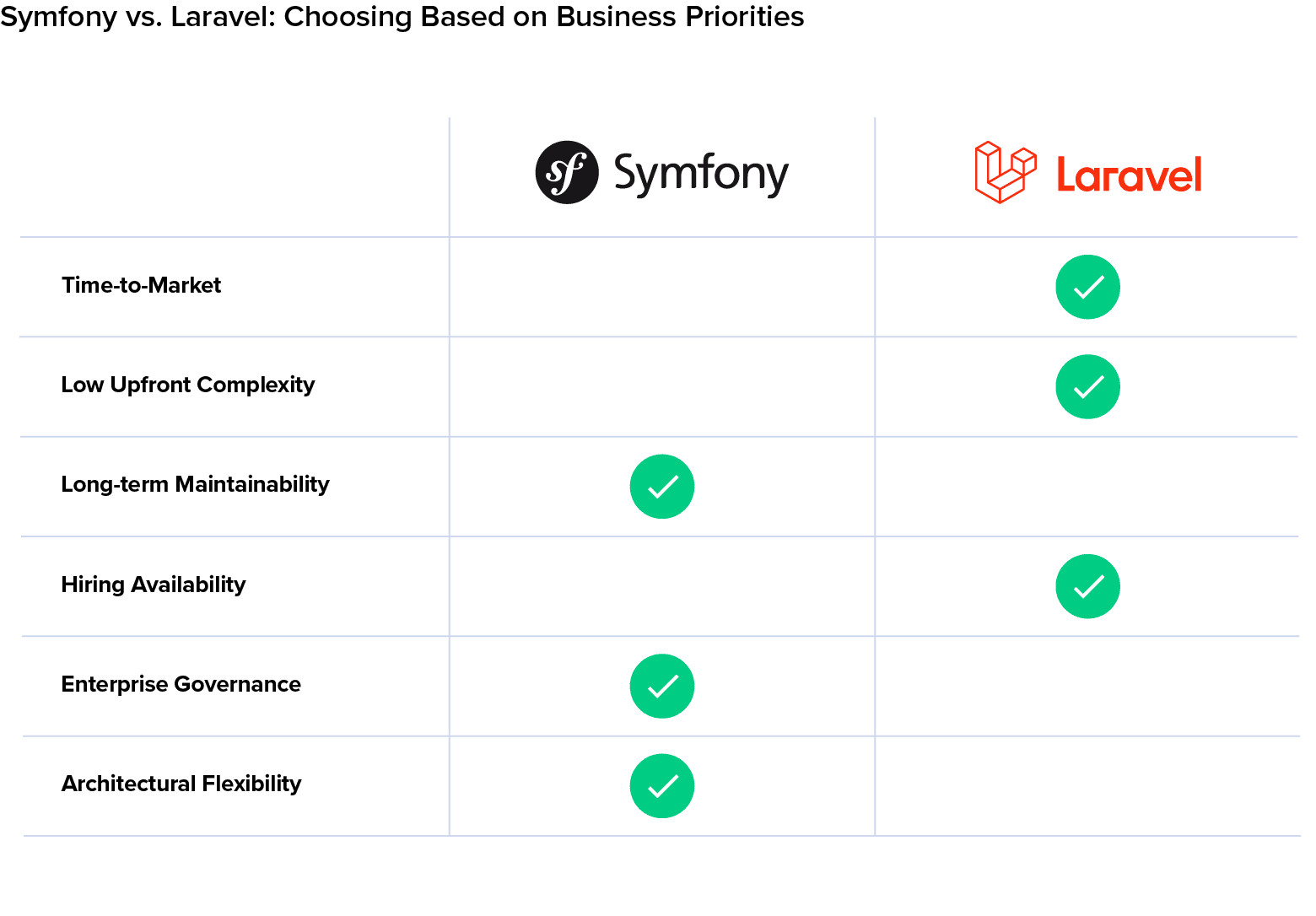
Neither Symfony nor Laravel is inherently better from a business or cost perspective. The financial tradeoff is less about raw framework performance and more about where complexity emerges during a product’s life cycle. Laravel tends to deliver greater efficiency during early development, while Symfony often reduces ongoing maintenance and refactoring costs in larger or more operationally demanding systems.
One dynamic that often surprises business stakeholders is how invisible back-end quality can be until it becomes expensive. Poor front-end design is immediately apparent. Users notice it, and so do stakeholders. Poor back-end architecture, by contrast, tends to be a black box until the costs materialize as slow feature delivery, mounting bugs, or painful refactoring cycles. By that point, the decisions that caused the problem are often years old.
Delivery Velocity vs. Long-term Operational Cost
Laravel is often the more cost-effective choice during early product development. Strong conventions and extensive tooling reduce upfront engineering overhead and allow teams to move from concept to production quickly.
Its regular release cadence also encourages continuous iteration and rapid adoption of new ecosystem features. For teams that maintain upgrades consistently, this can help applications stay modern and aligned with the broader Laravel ecosystem. However, organizations that defer upgrades for long periods often accumulate technical debt more quickly, making future migrations increasingly disruptive as systems grow.
Symfony typically requires more upfront architectural planning and a steeper onboarding investment, but that structure can produce meaningful operational advantages over longer product life cycles. The framework is designed to support gradual system evolution, allowing teams to introduce change without accumulating the same level of organizational and technical debt.
Symfony’s structured deprecation policies and predictable upgrade paths are especially valuable for organizations planning around multiyear maintenance horizons or compliance-sensitive environments where governance and operational stability become organizational requirements rather than engineering preferences alone.
Takeaway: Laravel minimizes early development friction and accelerates product delivery, while Symfony shifts more investment upfront in exchange for greater maintenance predictability over time. Regardless of framework, however, sustainable systems depend on consistent engineering discipline, proactive maintenance, and some senior architectural oversight.
Laravel vs. Symfony: Typical Use Cases
You generally can’t tell from the outside whether an application was built with Symfony or Laravel, and I’m sometimes surprised to learn which products have been built with each. Still, the organizations and platforms associated with each ecosystem help illustrate the kinds of problems they are most commonly used to solve.
Examples of Symfony Products
Symfony is frequently associated with large-scale platforms where long-term maintainability, extensibility, and operational stability are primary concerns. Major open-source projects such as Drupal, Adobe Commerce (formerly Magento), and phpBB rely heavily on Symfony components, reflecting the framework’s influence across content management, e-commerce, and community platforms. Symfony’s reach extends even further through component adoption in projects like Wikimedia that leverage Symfony packages without using the full framework.
Symfony’s influence across these projects reflects something broader than framework adoption. Its modular architecture and reusable components have made it a foundational building block across the PHP ecosystem, often powering systems that don’t advertise their use of Symfony at all.
Examples of Laravel Products
Laravel is commonly found in customer-facing web applications, SaaS platforms, and enterprise digital products where delivery speed and developer productivity are priorities. Organizations across industries have publicly documented Laravel-powered applications, including projects from media organizations such as NPR, the New York Times, and Der Spiegel. Among its enterprise adopters, DHL has publicly documented the use of Laravel to build an internal event platform.
What these examples illustrate is less about industry or scale and more about development priorities. Organizations often adopt Laravel when reducing development friction is more important than maximizing architectural flexibility from the outset.
Takeaway: Both frameworks have proven capable of supporting large-scale applications. Symfony is often chosen for systems that prioritize extensibility and operational longevity, while Laravel is frequently adopted by teams optimizing for product delivery and rapid iteration.
Future Outlook: PHP Framework Evolution and Trends
The future of PHP development looks increasingly less like a competition between frameworks and more like an ecosystem of interoperable tools. Over the past decade, both Symfony and Laravel have matured well beyond their original identities, and many of the historical tradeoffs between them have narrowed through improved tooling, stronger standards, and a growing emphasis on composability.
One of the more telling indicators of this convergence is API Platform. As discussed earlier, it began as a Symfony-specific tool and has since expanded to support Laravel as well. That evolution reflects a broader trend: The most useful infrastructure tools are increasingly designed to work across framework boundaries rather than within them. As more teams move toward service-oriented architectures, individual components matter more than strict framework allegiances.
PHP itself is also evolving in ways that affect both frameworks equally. The traditional “boot, run, die” execution model, where PHP scripts would initialize, handle a request, and terminate, is giving way to persistent runtime approaches like FrankenPHP and Swoole. These tools allow PHP applications to maintain ongoing processes rather than reinitializing on every request, moving PHP closer to the persistent runtime model that has long characterized platforms like Node.js. Both Symfony and Laravel are adapting to this shift, and it has the potential to meaningfully change how PHP applications are architected and deployed over the next several years.
It’s also worth noting that PHP’s broader approach to web development has proven more durable than its reputation sometimes suggests. Patterns like server-side rendering, which JavaScript frameworks are now widely adopting as modern innovations, have been central to PHP development for decades.
Modern tooling is accelerating this trend toward greater interoperability. The growing role of AI in everyday development has narrowed the gap between Symfony and Laravel in ways that would have seemed unlikely even five years ago. As these tools continue to mature, the practical differences between frameworks will increasingly come down to architecture and philosophy rather than day-to-day implementation overhead.
Making Your Decision: The Right PHP Framework for Your Project
By this point, the technical differences between Symfony and Laravel should be clear, but in my experience, framework decisions are rarely driven by technology alone. The decision is ultimately about the people on your team: their seniority, their working style, and how much architectural guidance the framework needs to provide.
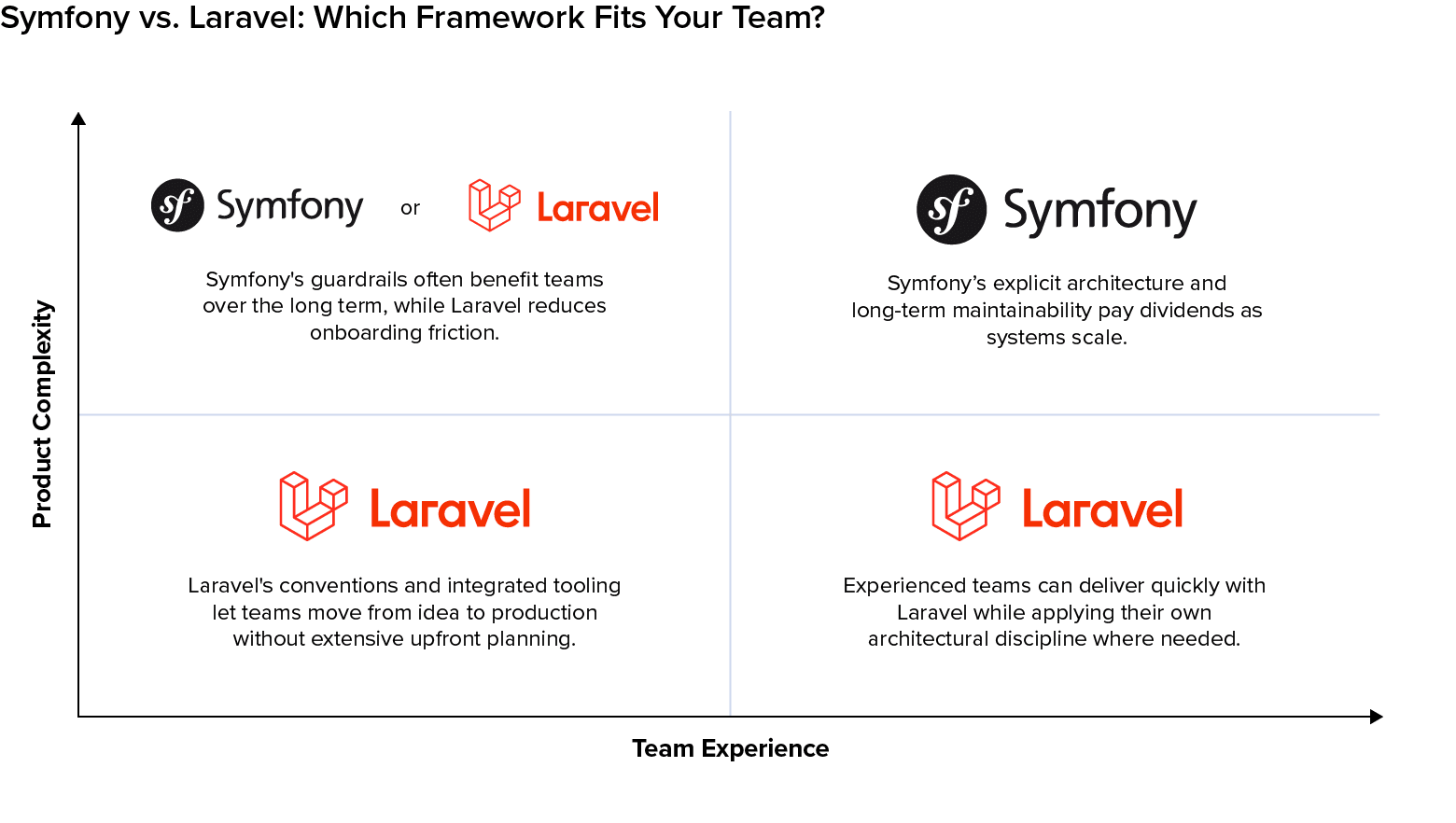
Laravel tends to make more sense for teams that need to move quickly from idea to production, especially smaller organizations or those earlier in their journey with large-scale system design. In those environments, the framework’s conventions do a lot of the architectural heavy lifting, so your team doesn’t have to.
Symfony becomes increasingly attractive when architectural consistency and maintainability carry more weight, particularly when multiple teams are working within the same codebase or when the application needs to evolve incrementally over several years. The investment is higher upfront, but the returns compound over time.
It’s also worth remembering that the Symfony versus Laravel framework debate is less of a war than it sometimes appears. Both Symfony and Laravel are serious tools with serious communities behind them, and both will be here for a long time. Choose the one that fits your team and the system you’re actually building, not the one that’s winning the latest popularity contest.
Further Reading on the Toptal Blog:
Understanding the basics
Symfony is an open-source PHP framework designed for building web applications and APIs. It is known for its modular architecture and reusable components, making it a popular choice for enterprise applications and complex systems.
Laravel is an open-source PHP framework focused on developer productivity and rapid application development. It provides integrated tools for routing, authentication, database access, and deployment. It is a popular choice for applications that need to launch or evolve quickly.
Yes, Symfony remains one of the most widely used PHP frameworks, particularly for enterprise applications and long-lived platforms that require strong architectural control. Its reusable components also power major projects such as Drupal, Magento, and phpBB, extending its influence well beyond the framework itself.
Laravel is not based on Symfony, but it uses several Symfony components under the hood for functionality such as console commands, HTTP handling, and dependency injection. Laravel builds its own framework experience on top of many of these reusable Symfony packages.

Košice, Košice Region, Slovakia
Member since September 30, 2021
About the author
Radoslav is a full-stack developer specializing in Symfony and Laravel. He has helped startups and enterprise organizations, including Orange and Century 21, develop scalable web, mobile, and SaaS platforms. His work spans application architecture and cloud infrastructure, with an emphasis on clean, maintainable solutions that translate complex business requirements into scalable software.
Previous Role
Senior Full-stack DeveloperPREVIOUSLY AT