
The Adaptive Talent Imperative: How CPG and Retail Companies Can Transform With Cross-functional Experts
The biggest obstacle consumer packaged goods (CPG) and retail companies face isn’t technology or capital. It’s finding talent that can bridge the gap between business strategy and technical execution in real time.

The biggest obstacle consumer packaged goods (CPG) and retail companies face isn’t technology or capital. It’s finding talent that can bridge the gap between business strategy and technical execution in real time.

Chris is the GM of Consumer Products and Services at Toptal. A seasoned executive at the intersection of retail, consumer, and technology, he has held leadership roles in technology startups, global consultancies like EY, Nielsen, and Capgemini, and built innovative partnerships with industry leaders like Google Cloud, AWS, and Microsoft Azure. Chris has a BS in engineering and math from the University of Illinois Urbana-Champaign and a BS in physics from Illinois State University.
Previously At


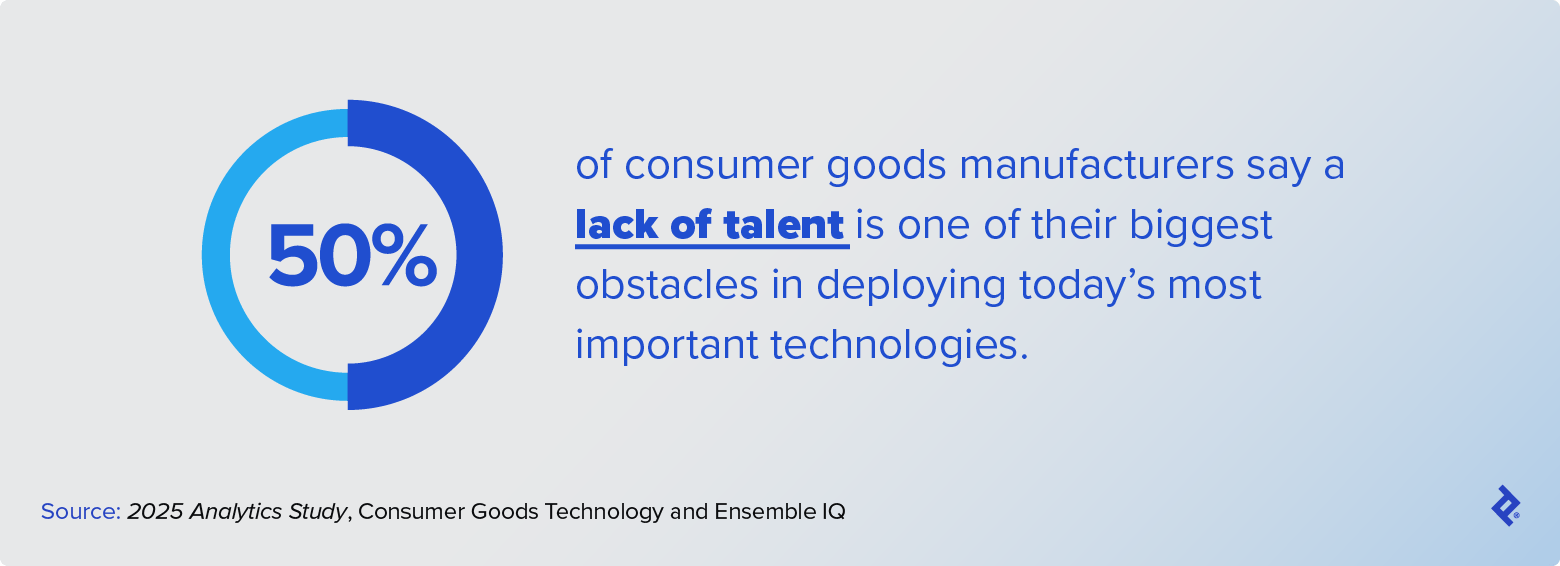
More than 40% of consumer packaged goods (CPG) and retail executives say their analytics and decision-making capabilities are lagging, according to a 2025 study by Consumer Goods Technology and Ensemble IQ. Not due to head count, but because they lack the right mix of skills. The same survey also found that 50% of manufacturing executives believe a lack of talent is one of their biggest obstacles to leveraging GenAI.
We had the opportunity to attend the Analytics Unite conference in Chicago in early 2025 and participated in a panel discussing the results of this study. What stood out most—and what loudly resonated with the audience—was that the conversation wasn’t focused on platforms, tools, or even architecture. It was squarely focused on talent: how hard it is to find, and how urgent it is to get right.
Toptal was also invited to speak on this topic at an industry share group in California in May 2025, where we explained how we help consumer goods companies and retailers operationalize what we call the adaptive talent model. The concept of adaptive talent—or talent with a flexible, multidisciplinary skill set—resonated with CPG leaders across the board, particularly the ability to embed analytics professionals who understand both data and business context. Multiple attendees said their No. 1 pain point was that their teams don’t understand the business well enough to drive action. Leaders also cited an inability to find the right talent locally.
The Industry Problem No One Is Talking About
Many CPG and retail companies are still working within rigid organizational models that favor linear planning, siloed functions, and static job descriptions. The result? A systemic delay in accessing the capabilities required to keep up with market demands. Our industry faces other obstacles to progress, as well.
CPG and Retail Tend To Follow, Not Lead
Due in part to a historic reliance on structured R&D practices, there is often hesitancy across the CPG industry to be the first to try something new. Talent strategy is no exception. Job descriptions for roles like AI translator, product analytics lead, or customer insights strategist are either unclear or completely absent in many CPG and retail organizational structures.
Even when there’s interest in these roles, rigid human resources processes and legacy structures delay progress. This slow-to-move dynamic means companies often wait until roles become widely adopted before testing them out—at which point, they’ve already lost the first-mover advantage.
Geography Requirements Constrain the Ability To Source Top Talent
One of the biggest obstacles to accessing the right talent? Geographic bias.
Thanks to legacy hiring practices rooted in the need for in-person involvement in the manufacture of tangible products, too many CPG and retail companies default to hiring locally or requiring in-person work, even when the best-qualified talent lives elsewhere. We’re seeing this play out in high-stakes adaptive work.
When a large alcoholic beverage company approached us for support ahead of a strategic CEO-to-CEO meeting with one of their key global retail partners to codesign a promotional strategy for an upcoming global event, we provided adaptive talent capable of delivering both the campaign strategy and creative execution. The core client team sat in a corporate headquarters in North America. The Toptal talent worked US hours, but was located in Greece. Geography didn’t matter. Fit did. The outcome: A compelling pitch that drove alignment and momentum at the highest levels.
Most Teams Can Describe the Past—Not Drive the Future
Whether it’s e-commerce, in-store activation, or pricing and promo strategy, decision-making today happens in real time, on the move, and across channels. Yet many companies are still equipping their teams with static dashboards, outdated business intelligence tools, and disconnected reports—and they lack the strategic business and technical expertise to transform these legacy systems.
One of our clients, a global CPG brand, described their challenge this way: Field sales and category managers—those closest to customers and in-store execution—lack user-friendly sales and data tools to use on the fly. Insights were buried behind complex login systems and drill downs, so they had to email analysts and wait for static reports. Momentum lost. Opportunity missed.
Compare that with what Tractor Supply Company, a Fortune 500 rural lifestyle retailer, implemented with Gura—a voice-first, AI-enabled assistant initially deployed to store associates through headsets. It quickly evolved into a voice-enabled mobile platform with how-to videos, visuals, and generative AI support for everything from customer service to HR and internal comms. Insight was embedded in the workflow—right where it belonged.
There is still the legacy mindset of building platforms and solutions to the specification and not to the real business challenges. Typical technologists are good at technology selection and implementation. But the CPG industry needs talent that understands the technology and the business challenges so that they can architect, design, build, and deliver capabilities that enable what’s next and provide ready-to-activate solutions.
Adaptive Talent Is Rare, But Essential
At Toptal, we define adaptive talent as cross-functional catalysts who enable capability and quick action. For example:
- A category strategist who can build a demand model.
- A marketing leader who can run experiments and interpret results.
- A digital product owner who understands merchandising, user interfaces, and margin math.
These professionals (sometimes referred to as hybrid talent) don’t just bridge gaps between business and tech—they operate at the seams, where actual decisions are made. Many CPG companies were architected for a different era—one where business leads defined strategy and data just confirmed or explained it afterward. Today, the most effective organizations bring analytics talent to the strategy table early, helping to define the problem, not just validate the solution.
How To Implement the Adaptive Talent Model
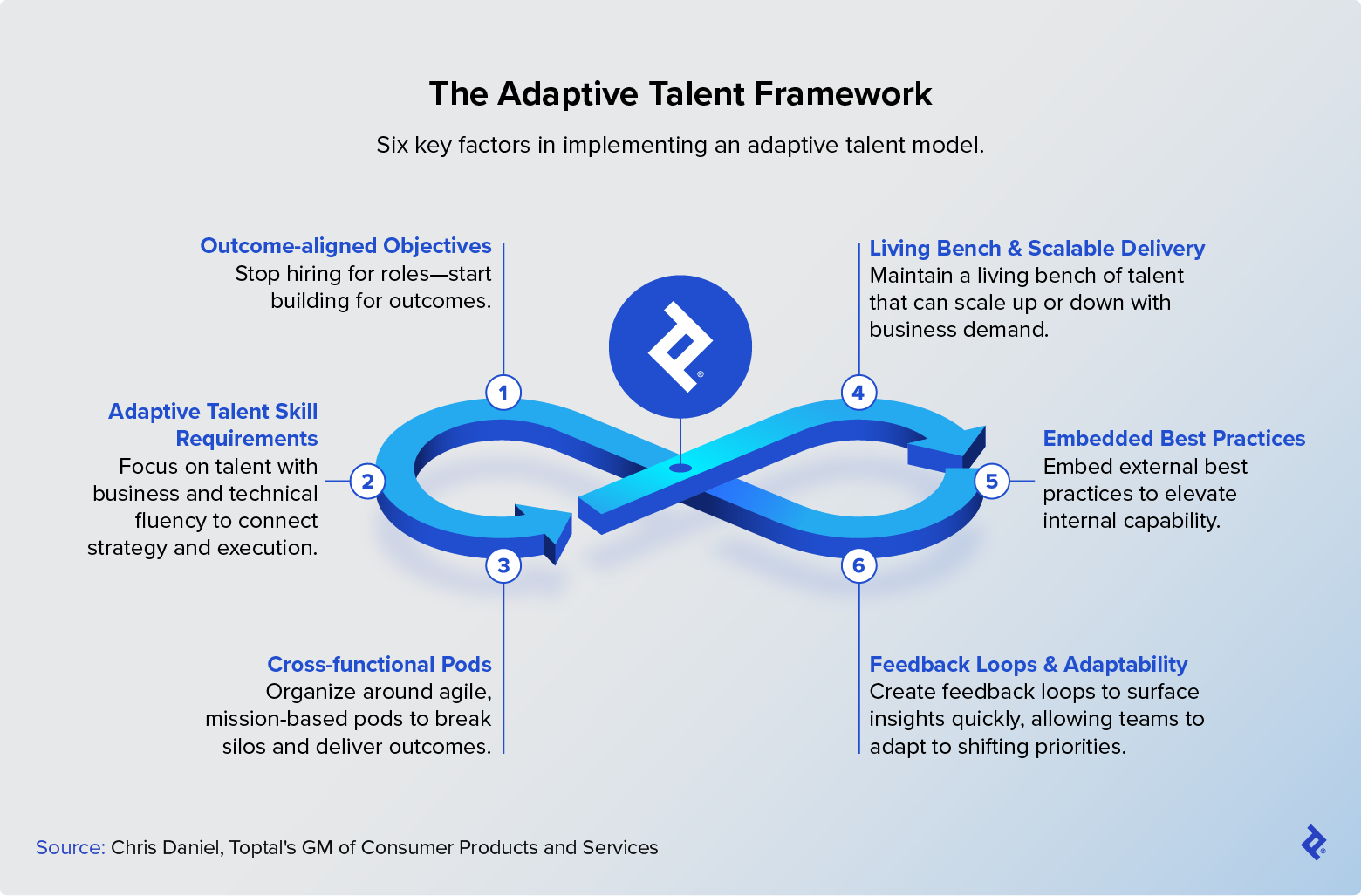
Although the specific details and implementation steps vary depending on the business, the two most important principles of the adaptive talent model are hiring for outcomes instead of roles and creating a living bench of talent that can scale up or down as your needs evolve.
Adaptive talent often doesn’t fit within traditional role silos. If your only approach to procurement is legacy methods, you’re not going to maximize the value of each person you add to your team. The best organizations are moving from head count-based staffing to capability- and skill-based resourcing. That means defining the outcome you need to hire for, not the role(s).
The next step—often the more difficult one—is sourcing the right adaptive talent to deliver on those identified outcomes. That’s where the help of a strategic partner like Toptal comes in. You define what success looks like, and your partner sources and delivers talent that knows how to execute it. Because Toptal operates outside traditional HR systems, we can move faster, iterate flexibly, and deliver talent that wouldn’t even surface in a conventional recruiting model.
Consider the example of a large, private equity-backed US retailer that needed to move quickly on the acquisition of a distressed brand. They didn’t need full-time staff. They needed the right staff, right now. So instead of building traditional mergers and acquisitions teams of finance specialists, business analysts, and engineers, the retailer came to Toptal.
Their challenge wasn’t just hiring: It was scaling capability fast, and then scaling back down once the dust settled. We staffed a flexible bench of cross-functional experts to drive operations during the transition, support the turnaround plan, and embed the latest retail best practices. We didn’t just fill roles—we helped the company build a living, breathing capability engine that could flex with the business.
A Unified and Flexible Approach: Strategy, Technology, and Execution
Adaptive talent thrives when backed by a structure that enables them to deliver. The industry needs a system that doesn’t just deliver individuals, but packages top talent into the most flexible engagement models in the market—from targeted placements to project-based work to fully managed services.
CPG and retail leaders should demand a better system that not only addresses the talent challenge but enables the business through a combination of both business-facing capabilities and the technology and marketing expertise needed to activate cross-functional performance at scale.
Remember, the shift to adaptive talent isn’t about job titles—it’s about outcomes. The organizations that figure out how to identify, deploy, and scale this resource will be the ones that move faster, make smarter decisions, and ultimately outperform their competition.
Have a question for Chris or his Consumer Products and Services team? Get in touch.

About the author
Chris is the GM of Consumer Products and Services at Toptal. A seasoned executive at the intersection of retail, consumer, and technology, he has held leadership roles in technology startups, global consultancies like EY, Nielsen, and Capgemini, and built innovative partnerships with industry leaders like Google Cloud, AWS, and Microsoft Azure. Chris has a BS in engineering and math from the University of Illinois Urbana-Champaign and a BS in physics from Illinois State University.
PREVIOUSLY AT