
How a Fractional CMO Can Accelerate Growth for Your B2B SaaS Company
Business-to-business SaaS companies are turning to part-time CMOs to boost growth while cutting costs. This advice from successful founders and CMOs will help your organization do the same.

Business-to-business SaaS companies are turning to part-time CMOs to boost growth while cutting costs. This advice from successful founders and CMOs will help your organization do the same.

Jeff is the Growth and Digital Marketing Practice Lead at Toptal. He holds a bachelor’s degree from Middlebury College and an MBA from Cornell University with an emphasis in leadership and innovation. Jeff has spent the past 15 years building demand generation, content marketing, and digital programs that drive meaningful transformation and growth for both internal teams and external clients. Before joining Toptal, he held senior management roles at Accenture Song, Material, and Telus International.
Previously At


An increasing number of B2B SaaS companies are turning to experienced fractional CMOs for strategic clarity and measurable growth, without the costs and long-term obligations of a full-time hire. It’s a trend we’re seeing at Toptal’s Marketing Agency, and one that’s backed up by external data, too: One 2024 survey of 340 startup and SMB executives found that 9% were working with a fractional CMO, or planning to work with one in the next 12 months, an increase of 80% from the year before.
The survey also found that CEOs and founders in the SaaS and professional services industries are especially likely to lean on fractional marketing executives compared to other leaders in other sectors. Given today’s challenging marketing landscape and the intense competition in SaaS in particular, these companies can benefit from agile leaders with cutting-edge digital marketing skills built through repeated, high-pressure fractional engagements. Yet, in my experience, too many fractional CMO hires are made without a clear strategy beyond “more, faster, and cheaper.” Such an ad hoc approach can lead to misaligned priorities, wasted spend, and short-term tactics that fail to build lasting growth.
This guide is designed to help B2B SaaS companies understand when fractional CMO arrangements make sense and how to get the most out of this model. First, we cover some basics to level set on this surprisingly complex topic, then I’ll share deeper insights from veteran fractional marketing leaders about how to structure a successful engagement and get the most out of the fractional CMO model.
What Is a Fractional CMO, and Why Do SaaS Companies Hire Them?
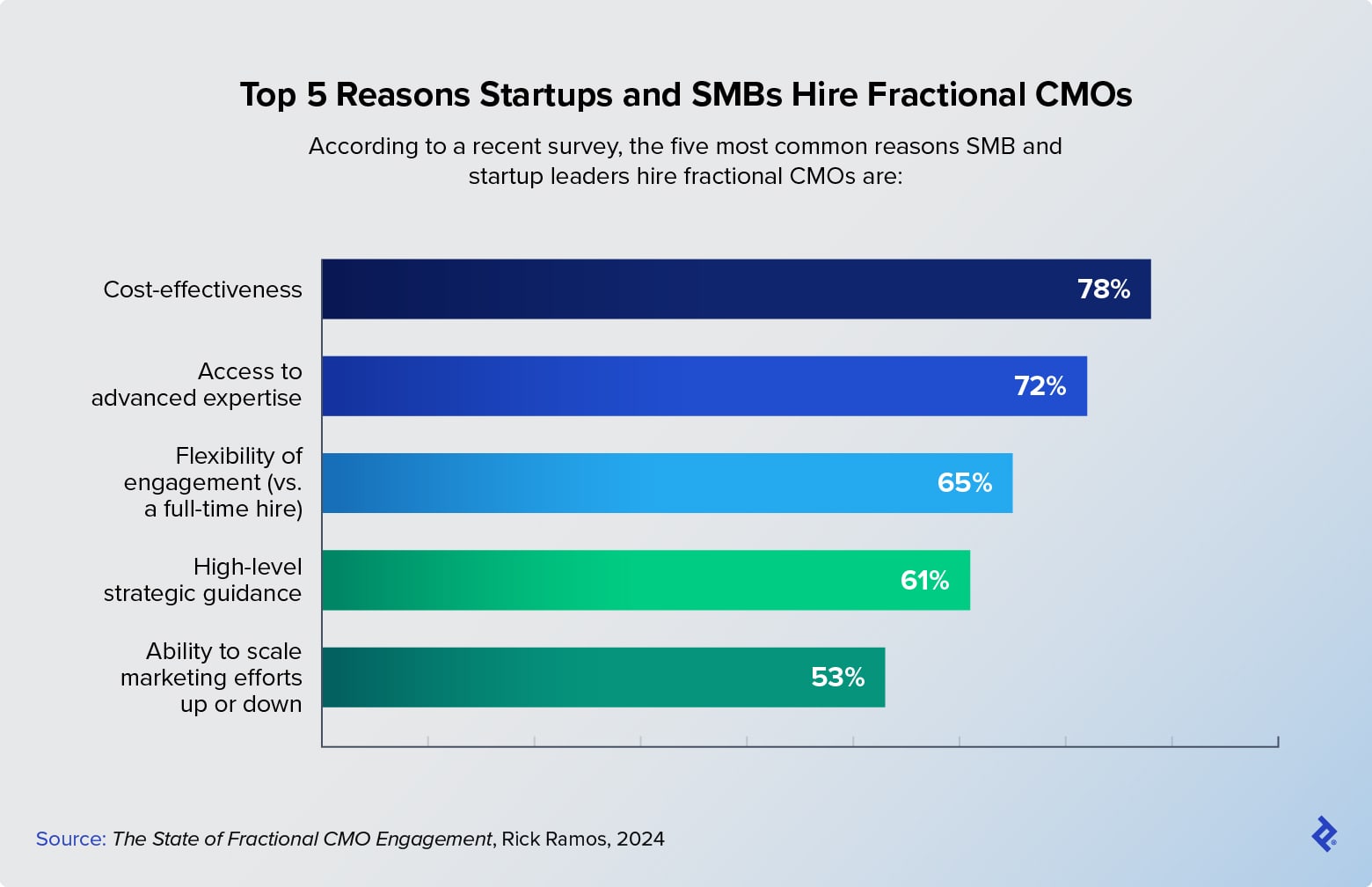
A fractional chief marketing officer, or fractional CMO, is a part-time executive who provides senior-level marketing leadership without the expense of a full-time, in-house hire. Instead of committing to a large salary and benefits package, businesses can bring in a fractional CMO on an hourly or retainer basis to guide marketing strategy, oversee execution, and align marketing with long-term growth goals.
In their nascent stage, many B2B SaaS startups rely on their founders or sales leaders for marketing strategy, but that can only take a company so far. Under intense pressure to grow, most founders and CEOs eventually realize that bringing in an experienced marketing expert is crucial.
Take Alina Vandenberghe, co-founder and co-CEO of the B2B SaaS marketing company Chili Piper. She realized her own marketing function was broken when her board of directors pushed her to reimagine her relatively large team and chart a new course. The company was at a critical growth stage, and Alina was determined to lower customer acquisition costs (CaC) and understand what her marketing customers go through on a daily basis. At first, she took on the role of chief marketing officer (CMO) herself. “It was the most painful job of my life,” she told me, “but we did hit our numbers.”
Once she succeeded in lowering CaC and stabilizing the marketing team, it was time to find her successor. But instead of recruiting a full-time CMO, Alina brought on a short-term fractional marketing executive to test her hypotheses about the skill sets and attributes she needed in a permanent leader.
Beyond cost savings, companies may opt for a fractional arrangement to test the cultural fit and leadership style of a potential hire, provide temporary leadership between funding rounds, or try out marketing strategies before investing in a full-time function leader.
What Does a Fractional CMO Do at a B2B SaaS Company?
There’s no standard playbook for the responsibilities of a fractional CMO—they can vary with a company’s life-cycle stage and other factors. That said, part-time marketing executives often lead the following initiatives:
- Setting an overarching marketing strategy and creating a marketing plan
- Defining the company’s core ideal customer profile (ICP)
- Defining or honing brand identity, branding strategy, and key messaging pillars
- Establishing product-market fit
- Defining a channel strategy
- Establishing credibility with the C-suite, board, and sales leadership teams
- Building the marketing function (e.g., hiring full-time employees)
- Developing and owning the customer pipeline
- Creating or refining brand messaging
- Defining a go-to-market (GTM) strategy
- Collaborating with and supporting the sales team
The last four bullets in the list above—focusing on pipeline, messaging, GTM strategy, and sales alignment—are often the most important things to ask of a part-time marketing executive. Here’s why.
Pipeline Development
In most B2B SaaS organizations, the CMO owns pipeline and revenue, usually in partnership with the chief revenue officer (CRO) or other sales leadership. But for smaller or earlier-stage companies, actively developing that pipeline is critical. In my experience, firms that hire fractional leadership are usually below $50 million in annual recurring revenue (ARR). That means fractional CMOs must be experts at growth, with the ability to develop differentiated messaging, define clear positioning, and create a whole host of processes that drive adoption and customer retention.
Brand Messaging
Branding tends to carry less weight for B2B CMOs than their B2C counterparts, since broad consumer awareness is typically less important than market positioning and measurable lead generation. That said, a B2B CMO will nearly always be asked to build differentiated messaging and positioning. In the context of SaaS, where product features can be developed rapidly, having product marketing chops is especially important for creating clear, unique messaging that stands out. This is particularly true in the era of AI, when every tech company faces pressure to play up its AI integrations and capabilities.
Go-to-Market Strategy
Whatever their other responsibilities, CMOs need to be strategy experts. A fractional CMO is meant to help their client company develop a thoughtful and clear GTM strategy, along with an implementation plan. They may also establish the foundation of a marketing engine—hiring or organizing the team, putting the right martech and automation tools in place, and creating processes to manage leads from first touch to conversion.
Sales Enablement
Successful fractional CMOs also work directly with sales on enablement content, tactics, handoff processes, and detailed life-cycle marketing programs. Retention, cross-selling, and upselling are all important components of the job that must be designed in collaboration with the CRO and other leadership to ensure minimal revenue leakage and maximum growth.
3 Benefits of Hiring a Fractional CMO
Hiring a fractional CMO offers meaningful advantages for SaaS companies, including cost savings, the benefit of executive-level experience, and better stakeholder and investor communication. This section explores these key advantages and how fractional leadership can help accelerate growth and sharpen strategy for B2B SaaS companies.
Cost Savings Versus a Full-time CMO
Reduced cost is often the main benefit for companies that hire a fractional CMO, as this model offers significant savings compared with hiring a full-time marketing executive. Total salaries and compensation for full-time CMOs in the US in 2025 range from $228,000 to more than $400,000, according to Glassdoor. While cost structures and monthly or hourly rates vary widely for fractional CMOs based on location, experience, and other factors, the arrangement tends to be shorter in duration, with flexible terms (including equity, bonuses, and other compensation), and a lower overall price tag.
Corporate boards, often including venture capitalists, are among the most vocal proponents of bringing on fractional CMOs and other leaders, as the arrangement effectively balances short- and longer-term uses of cash. In conversations with Toptal clients, I see B2B SaaS boards increasingly choosing a period of fractional marketing leadership as a transitional step while refining product-market fit and demonstrating traction.
Extensive Experience in Your Sector
Another major benefit of choosing a fractional CMO, particularly for young companies, is the ability to leverage the expertise of a seasoned leader. Taking a chance on an unproven marketing hire who hasn’t truly led the function before is too big a risk for a startup. While anyone can experiment, test, and learn, experienced leaders have taken companies through comparable growth stages and won’t waste unnecessary resources on unproven bets and hunches. That’s why I believe it’s absolutely essential for a fractional marketing leader to have direct, applicable experience.
Manny Ataebi, the former fractional CMO for Series B startup Demostack (now chief revenue officer of Bettermode), is an excellent example of how repeatable expertise can accelerate results. He was specifically hired to take Demostack upmarket, from $30,000 average contract value (ACV) to an enterprise-level $100,000 ACV—an ambitious and difficult task. With a track record as a seven-time SaaS CMO and more than a decade of experience leading startups into the enterprise market, he understood how to make the pivot happen—and achieved it. (After a successful 12 months, Demostack extended his contract.)
In short, fractional marketing leaders like Ataebi come in specific “flavors.” Some are product people, while others focus on brand or building demand generation teams. So it’s important to carefully consider how a candidate’s background complements your company’s growth stage and immediate business objectives. Because you’re not looking for a long-term candidate, you can focus on finding the skills that most serve what your organization needs right now. PartnerStack CMO Tyler Calder, who started with the SaaS company as a fractional marketing VP, told me that the right fit truly depends on the skill gaps and most urgent goals of a particular company. “The expectation of marketing is quite broad; I’ve never met a CMO who’s good at all of it. Some are great at pieces of it, and they’re great at recognizing where the gap is and supplementing it [with other experts].”
Improved Stakeholder Alignment
An experienced fractional CMO’s playbook almost always involves strong stakeholder engagement and communication skills. As “outsiders” at the company, these leaders have the objectivity to challenge the status quo, educate fellow senior leaders on the latest best practices, and set realistic expectations.
Calder, the PartnerStack CMO, notes that in many of his fractional engagements, one of the greatest challenges is ensuring that stakeholders clearly understand marketing’s impact. Strong communication and reporting are essential to demonstrate results and keep everyone moving toward the same growth objectives. In some cases, marketing may be delivering great value, but the sales or product teams may not understand or fully appreciate it. A strong fractional leader can come in with fresh eyes to reposition successes through better reporting and communication, while strengthening weak areas, building cross-functional alignment, and minimizing waste.
Michael Fertman, a Toptal fractional CMO who has led marketing at several SaaS companies, agrees that a core benefit of employing a part-time CMO is their ability to communicate impact and strategy. Companies often need a translator between the CEO’s vision and the way marketing executes, he says. Because marketing concepts are often open to interpretation, a fractional executive can clarify expectations and set a realistic course of action.
The Challenges of Engaging a Fractional CMO and How to Solve Them
As with any executive hire, there are risks when engaging a fractional CMO. Without careful planning, issues like divided attention, compressed timelines, and scope creep can limit results. Fortunately, these risks are neither inevitable nor insurmountable.
Split Focus and Context Switching
Some critics of the fractional CMO model say that months-long contracts create short-term pressure that impacts a leader’s ability to identify strategic growth opportunities. While it’s true that it can be difficult to balance all the strategic elements of their job with day-to-day team leadership, successful fractional CMOs address this by establishing credibility early—through strong and transparent communication, quick wins, and alignment with business priorities. This credibility buys them the leeway to balance near-term execution with long-term strategy.
Logistics matter, too. Rather than working a set number of hours for a client, for example, Ataebi, the former Demostack CMO, always prefers to work a certain number of full days per week. This approach limits the amount of context-switching he has to do on a daily basis and simplifies scheduling internal meetings. After all, as the company’s marketing leader, he needs to meet with his team and other leaders on a regular basis, despite his part-time schedule.
Working set days allows for consistent one-on-ones with the team and better week-to-week consistency. Still, some aspects of the fractional CMO commitment, such as board or executive meetings, may not be flexible, and your CMO will need to adapt. “The board meeting is when the board meeting is,” Ataebi says. “They’re not going to change that for me.”
Short Timeframes
There is no set-in-stone timeframe for a fractional CMO contract, but in my experience, they typically range from three to 12 months. Some critics say any fractional contract is too short, because marketing delivers its true value across years, not a few quarters. While it’s true that the ultimate success of a firm’s differentiated approach does not manifest in a matter of months, I’ve seen a lot of engagements where a properly scoped fractional leadership role can turn a company around.
Fractional leaders themselves take different approaches to timing, depending on company needs and the scope of work. Ataebi favors the 12-month engagement, like the one he started with at Demostack. Calder, however, often works on shorter, 90-day fractional assignments with the option to extend if the partnership is working.
Misaligned Expectations
Many founders and executives hire fractional leaders because of cost savings, but as the engagement proceeds, expectations for performance, workload, and deliverables can easily expand beyond the original scope. I’ve also seen founders who expect their fractional CMO to be a one-person show with the ability to take on everything from strategy to operations to execution singlehandedly.
But even if the part-time CMO you engage is happy to pitch in with execution on a lean team, their greatest value lies in their marketing strategy experience. Given their limited hours, a company’s fractional CMO must be allowed to focus much (if not all) of their effort on strategy and higher-level priorities. Clearly articulating the strategic mandate and ensuring organizational alignment at the outset empowers the CMO to deliver the results that make the model so effective.
Negotiating all the specifics of an engagement in advance, including day-to-day responsibilities, expected days and times of service, standing meetings, and exit terms, allows both parties to reap the rewards of a successful partnership.
Strategy vs. Execution: What Kind of Marketing Leadership Do You Need?
Not every company needs a CMO—sometimes hiring a part-time VP or other, execution-focused fractional marketing leader may be a better choice, depending on the organization’s industry, life-cycle stage, revenue, and existing team.
Marketing leaders may not care whether you call them a VP or a CMO, but there are practical differences in what you can expect from each role. A VP-level leader is often tasked with getting their hands dirty, executing and shipping work early in their tenure without first putting together a well-considered strategy. Calder says that in a typical fractional VP role, he may be expected to deliver a basic paid search or social media marketing campaign, a landing page, or a customer case study within the first week of the engagement.
If your company is quite young and doesn’t yet have foundational systems (such as CRM, analytics, automation), established marketing channels, or content strategy, then an execution-focused fractional marketing VP could be more useful than a strategy-focused CMO. This type of leader can dig in to build programs, processes, and campaigns from the ground up. However, if your company has systems in place and a team of specialists running channels and creating content, a part-time CMO would likely be a better fit to guide high-level strategy and align marketing efforts with business goals. For more details on when to hire a VP versus a CMO, see the chart below.
When to Hire a Fractional CMO: by Team Size and Maturity | ||
Team | Signals | Hiring Recommendation |
Lean (1-3 generalists) | No senior marketing leadership or specialized roles; CEO or founder drives go-to-market |
Fractional VP of Marketing: Hire a player-coach to set up systems and execute quickly. |
Growing (4-8 generalists and specialists) | Specialists cover domains like demand generation, content, and product marketing; no unifying strategy |
Fractional VP of Marketing: If execution is underperforming, hire a hands-on leader to manage campaigns and ensure delivery.
Fractional CMO: If execution is on track, hire a strategic leader to provide alignment and vision.
|
Established (>8 generalists, specialists, and managers) | Solid, well-functioning team; needs strategic direction and executive influence |
Fractional CMO: Hire an executive-level leader to elevate the function and build credibility with the rest of the C-suite, board, investors, and other senior stakeholders |
Transitioning From Fractional Leadership to a Full-time Chief Marketing Officer
Once your company is scaling rapidly, with established product-market fit and consistent new-customer acquisition, you likely need full-time marketing leadership to ensure sustainable growth. When that day comes, the right fractional leader will happily hand over the reins to an execution-focused leader who can carry out the strategy. With a clear transition plan baked into the fractional contract, handoff becomes much easier. In fact, your fractional CMO may even be able to help you recruit and onboard a permanent hire—something Ataebi often does as his engagements come to an end.
At Chili Piper, transitioning from founder-led marketing to a fractional marketing leader helped Vandenberghe test her hypotheses about what characteristics her permanent hire needed to have. She ultimately decided that the best fit was a full-time VP of marketing, and she found one who, she says, has the fearlessness required to help lead an innovative company. This phased approach gave Chili Piper the time required to validate and refine strategy and chart a clear path to growth. Fractional leadership may not be forever—but it could be the strategic catalyst your business needs right now.
Have a question for Jeff or his Growth and Digital Marketing team? Get in touch.

About the author
Jeff is the Growth and Digital Marketing Practice Lead at Toptal. He holds a bachelor’s degree from Middlebury College and an MBA from Cornell University with an emphasis in leadership and innovation. Jeff has spent the past 15 years building demand generation, content marketing, and digital programs that drive meaningful transformation and growth for both internal teams and external clients. Before joining Toptal, he held senior management roles at Accenture Song, Material, and Telus International.
PREVIOUSLY AT